SBI, Axis Bank, Bank of Baroda, and Power Finance Corporation are lining up over $2 billion in overseas bond sales next week, becoming the latest borrowers to tap RBI’s concessional swap window aimed at shoring up the rupee.
Key Takeaways
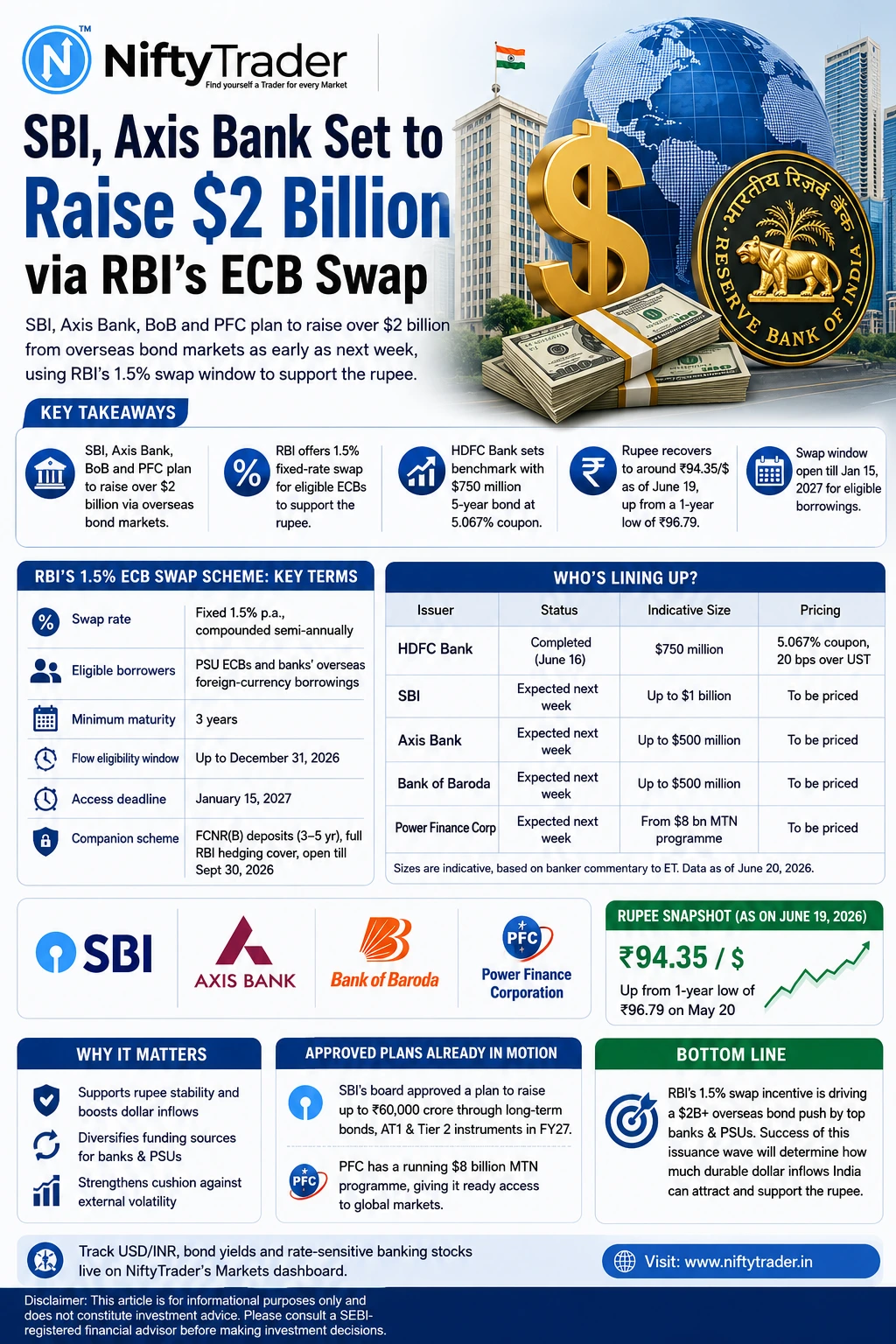
- SBI, Axis Bank, Bank of Baroda and PFC are set to raise over $2 billion combined from overseas bond markets, possibly as early as next week, bankers told Economic Times.
- The fundraising follows RBI’s 1.5% fixed-rate swap incentive for external commercial borrowings, announced at the June 5 monetary policy and operationalised through June 8 circulars.
- HDFC Bank opened the window on June 16 with a $750 million, five-year bond at a 5.067% coupon, a record-tight 90 bps spread over US Treasuries.
- The rupee has recovered to around ₹94.35/$ as of June 19, up sharply from a one-year low of ₹96.79 hit on May 20.
- RBI’s swap covers eligible ECB and overseas bank borrowings received until December 31, 2026, with access open till January 15, 2027.
SBI, Axis Bank, BoB Line Up for Overseas Bonds
State Bank of India, Axis Bank, Bank of Baroda, and government-owned Power Finance Corporation are preparing to tap international bond markets, potentially as early as next week, to collectively raise more than $2 billion, multiple bankers involved in the deals told Economic Times.
These lenders are moving to use RBI’s concessional fixed-rate swap on external commercial borrowings before pricing conditions shift.
Institutions with existing medium-term note (MTN) programmes, SBI and PFC among them, have an edge, since their offering documents are already in place and issues can be launched at short notice.
Smaller banks are expected to keep individual issues closer to $500 million to avoid overextending on a first outing.
Why Now: RBI’s 1.5% Swap Incentive, Explained
The trigger is a package of currency-support measures RBI Governor Sanjay Malhotra unveiled at the June 5 policy statement.
Under the scheme, eligible ECBs by PSUs and overseas foreign-currency borrowings by banks can be swapped with the RBI at a fixed cost of 1.5% a year, compounded semi-annually, well below prevailing market hedging costs.
The facility covers eligible flows received up to December 31, 2026, with access open until January 15, 2027.
A parallel window lets banks raise fresh three-to-five-year FCNR(B) deposits with RBI absorbing the full hedging cost, echoing the 2013 “Rajan swap” that pulled in roughly $34 billion the last time the rupee came under similar pressure.
Also Read: Banks Ask RBI to Let NRIs Break and Rebook FCNR Deposits at the New 7.1% Rates
HDFC Bank Set the Benchmark
HDFC Bank fired the starting gun on June 16, raising $750 million through five-year senior unsecured bonds via its GIFT City IFSC unit.
The bonds priced at a 5.067% annual coupon, with the final spread tightening to 90 basis points over US Treasuries from initial guidance of 120 bps, reflecting strong international demand.
The notes are rated Baa3 by Moody’s and BBB by S&P, in line with the bank’s existing ratings, and mature on June 24, 2031.
Bankers say this tight pricing has encouraged peers to move quickly before the window potentially narrows.
Also Read: HDFC Bank Eyes $500 Million Dollar Bond via RBI Swap Window
Who’s Lining Up
| Issuer | Status | Indicative Size | Pricing |
|---|---|---|---|
| HDFC Bank | Completed (June 16) | $750 million | 5.067% coupon, 90 bps over UST |
| SBI | Expected next week | Up to $1 billion | To be priced |
| Axis Bank | Expected next week | Up to $500 million | To be priced |
| Bank of Baroda | Expected next week | Up to $500 million | To be priced |
| Power Finance Corp | Expected next week | Drawn from $8 bn MTN programme | To be priced |
Sizes are indicative, based on banker commentary to ET. Data as of June 20, 2026.
RBI’s Swap Window: Key Terms
| Feature | Detail |
|---|---|
| Swap rate | Fixed 1.5% p.a., compounded semi-annually |
| Eligible borrowers | PSU ECBs and banks’ overseas foreign-currency borrowings |
| Minimum maturity | 3 years |
| Flow eligibility window | Up to December 31, 2026 |
| Access deadline | January 15, 2027 |
| Companion scheme | FCNR(B) deposits (3–5 yr), full RBI hedging cover, open till Sept 30, 2026 |
Data as of June 20, 2026; based on RBI’s June 5 statement and June 8 circulars.
Why This Matters for the Rupee
The rupee closed at 94.35/$ on June 19, having strengthened 2.28% over the past month, though it remains down nearly 9% over the last year.
It had slid to roughly ₹96.79 on May 20 before recovering on improving capital flows and softer crude prices.
RBI’s swap package, alongside FPI investment-limit relaxations announced the same day, is designed to widen dollar-inflow channels ahead of any fresh bout of volatility.
For traders, the pace of ECB issuance is also a live signal of corporate funding confidence and how much cushion the rupee has against external shocks.
Track live USD/INR levels and rate-sensitive banking stocks on NiftyTrader’s Markets dashboard as this fundraising wave unfolds.
Approved Plans Already in Motion
SBI’s board separately approved on June 18 a plan to raise up to ₹60,000 crore through long-term bonds, AT1 and Tier 2 instruments in FY27, with flexibility to raise funds in rupees or other convertible currencies from domestic and overseas investors.
PFC, meanwhile, operates a running $8 billion MTN programme that gives it ready market access without fresh approvals. None of the four institutions had responded to ET’s queries on the proposed issues at the time of the original report.
Bottom Line
RBI’s 1.5% swap incentive is turning into a real-time test of how much dollar liquidity Indian banks and PSUs can pull in before the window narrows.
HDFC Bank’s record-tight pricing has set the benchmark, and SBI, Axis Bank, Bank of Baroda, and PFC now look set to follow with a combined $2 billion-plus push as early as next week.
For the rupee, clawing back from a one-year low, the success of this issuance wave will signal whether the June 5 currency-support measures are driving durable dollar inflows or just a short-term fix.
Disclaimer: This article is for informational purposes only and does not constitute investment advice. Readers should consult a SEBI-registered financial advisor before making investment decisions.