8th Pay Commission Enters Crucial Phase After Memorandum Deadline Ends
The 8th Pay Commission has entered a critical stage as the deadline for memorandum submissions ended on June 15, 2026. With consultations progressing and state visits underway, attention is now shifting to the next major development—a likely Dearness Allowance (DA) hike announcement expected in September.
The commission, which was formally assigned its mandate in October 2025, has less than a year left to submit recommendations that could impact nearly 55 lakh central government employees and around 69 lakh pensioners.
For lakhs of employees and retirees, the coming months could determine future salary structures, pension benefits and allowances.
8th Pay Commission : DA Hike Expected in September as Inflation Data Remains Key
Before the 8th Pay Commission submits its final recommendations, central government employees are likely to receive another Dearness Allowance increase.
The government revised DA and Dearness Relief (DR) by 2% in April 2026, taking the rate to 60%.
According to employee representatives, the next DA hike is generally announced in September, although some years have seen announcements shift to October.
“Dearness allowance is typically announced in September, although in some years the announcement may be delayed until October,” said Manjeet Singh Patel, President of the All India NPS Employees Federation.
The final DA rate for July-December 2026 will depend on the All India Consumer Price Index for Industrial Workers (AICPI-IW) data for May and June 2026.
The latest AICPI-IW reading for April 2026 increased by 0.8 points to 149.9, indicating continued inflationary pressure that could support another DA increase.
Read More : Sensex Falls 607 Points, Nifty Drops 155 on Friday as IT Selloff Wipes Weekly Gains
Upcoming State Visits Scheduled
The consultation process is still underway through regional meetings.
| Location | Dates |
|---|---|
| Lucknow, Uttar Pradesh | June 22–23, 2026 |
| Bhubaneswar, Odisha | July 6–7, 2026 |
| Kolkata, West Bengal | July 9–10, 2026 |
The commission has already held discussions in Delhi, Hyderabad, Jammu & Kashmir, Ladakh, Maharashtra, and Uttarakhand as part of its nationwide outreach program.
What Employees and Pensioners Demanded From the 8th Pay Commission
With the memorandum submission process now closed, the commission has received recommendations from employee unions, pensioner associations and various stakeholder groups.
Among the most prominent demands are:
- Higher fitment factor
- Increase in minimum basic pay
- Better pension benefits
- Review of the National Pension System (NPS)
- Restoration of the Old Pension Scheme (OPS)
- Improvements in HRA and other allowances
- Enhanced retirement benefits
- Better risk pay and bonus structures
Employee associations have argued that rising living costs and changing economic conditions require a meaningful revision in salary and pension structures.
State Visits Continue as 8th Pay Commission Expands Consultations
The commission is also continuing stakeholder consultations across different states and union territories.
Upcoming visits include:
- Lucknow, Uttar Pradesh: June 22-23
- Bhubaneswar, Odisha: July 6-7
- Kolkata, West Bengal: July 9-10
These meetings are designed to gather region-specific feedback from employees, pensioners and government representatives.
The commission has already held consultations in Delhi, Ladakh, Jammu & Kashmir, Telangana, Maharashtra and Uttarakhand.
Pay Commission Timeline: Last 7 Years Under 7th CPC and Current 8th CPC Status
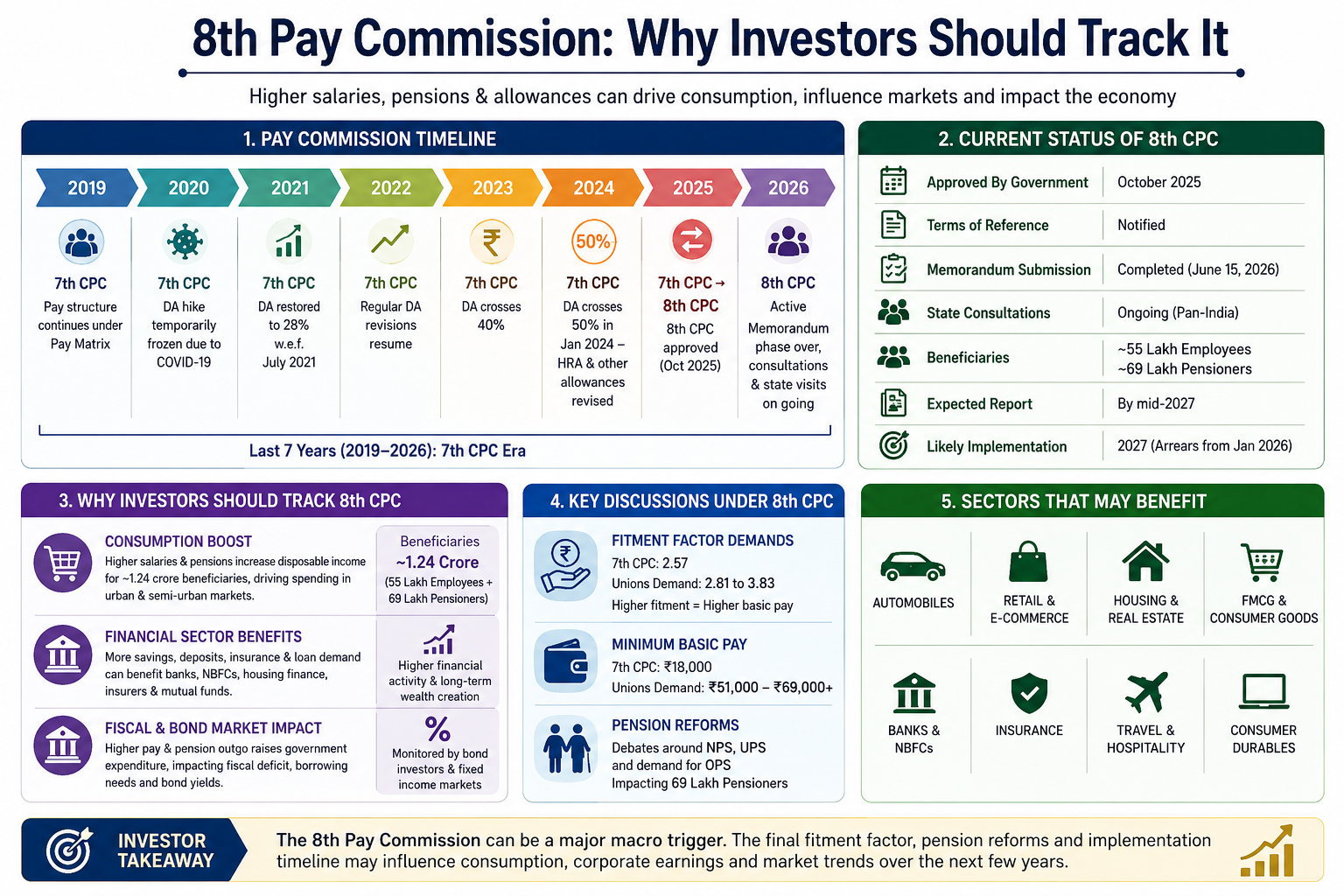
Since India generally constitutes a new Central Pay Commission every 10 years, the period from 2019 to 2026 has been dominated by the 7th Central Pay Commission (7th CPC). The 8th Central Pay Commission (8th CPC) is now active and conducting consultations for the next pay revision cycle.
| Year | Pay Commission Status | Major Developments |
|---|---|---|
| 2019 | 7th CPC | Salary structure continued under the Pay Matrix system introduced by the 7th CPC. |
| 2020 | 7th CPC | DA hikes were temporarily frozen during the COVID-19 pandemic. |
| 2021 | 7th CPC | Frozen DA restored and increased to 28% from July 2021. |
| 2022 | 7th CPC | Regular biannual DA revisions resumed. |
| 2023 | 7th CPC | DA crossed 40%, boosting employee compensation. |
| 2024 | 7th CPC | DA crossed the 50% threshold, triggering revisions in HRA and certain allowances. |
| 2025 | 7th CPC → 8th CPC Transition | Government approved the Terms of Reference and constituted the 8th CPC. |
| 2026 | 8th CPC Active | Memorandum submissions completed, stakeholder consultations and state visits underway. |
7th Pay Commission: Key Highlights
The 7th CPC was implemented in 2016 and remains the current pay structure in force until the 8th CPC recommendations are accepted.
Major Features
- Minimum basic pay increased from ₹7,000 to ₹18,000.
- Uniform fitment factor of 2.57 applied across pay levels.
- Introduction of the Pay Matrix System, replacing Grade Pay and Pay Bands.
- Revision of pensions and allowances.
- Regular DA revisions twice every year.
7th CPC
| Parameter | 7th CPC |
|---|---|
| Implementation | January 2016 |
| Minimum Basic Pay | ₹18,000 |
| Maximum Basic Pay | ₹2.5 lakh (Cabinet Secretary level) |
| Fitment Factor | 2.57 |
| Pay Structure | Pay Matrix |
| Pension Revision | Included |
| Current DA (Jan 2026) | 60% |
Current Status of the 8th Pay Commission
The 8th CPC is currently in the consultation stage and is expected to submit its report by mid-2027. It will review salaries, pensions, allowances, and retirement benefits for approximately 55 lakh employees and 69 lakh pensioners.
Key Milestones
| Item | Status |
|---|---|
| Government Approval | 2025 |
| Terms of Reference | Notified |
| Memorandum Submission | Completed (June 2026) |
| State Consultations | Ongoing |
| Beneficiaries | 55 lakh employees, 69 lakh pensioners |
| Expected Report | Mid-2027 |
| Likely Implementation | 2027 with arrears from Jan 2026 |
What Could Be the Impact on Employees and Pensioners?
Any major recommendation from the 8th Pay Commission could significantly affect take-home salaries, retirement benefits and pension payouts.
A higher fitment factor could result in a substantial increase in minimum basic pay, while changes to allowances may improve overall compensation packages.
Pensioners are also closely watching the commission’s deliberations, as revisions to Dearness Relief and pension formulas could directly impact monthly income.
For now, employees are awaiting two major developments—the September DA announcement and the next round of consultations that may provide hints about future salary revisions.
Why Investors Should Track the 8th Pay Commission
The 8th Pay Commission is not only important for government employees and pensioners, but also for investors. Any significant increase in salaries, pensions, and allowances could boost disposable income for nearly 1.24 crore beneficiaries, including around 55 lakh central government employees and 69 lakh pensioners. A rise in household income often translates into stronger consumer spending, which can benefit several sectors of the economy.
Investors closely track Pay Commission developments because they can influence demand across sectors such as banking, automobiles, housing, consumer durables, FMCG, travel, insurance, and retail. At the same time, a large salary revision could increase government expenditure, potentially affecting fiscal deficit targets, government borrowing, and bond yields.
Track Live : Nifty Change in OI Live
Consumption Boost Could Benefit Multiple Sectors
One of the biggest variables under discussion is the fitment factor, which determines how much salaries increase under the new pay structure. While the 7th Pay Commission adopted a fitment factor of 2.57, employee unions have submitted proposals ranging from 3.0 to 3.83 under the 8th CPC. If a higher fitment factor is accepted, minimum basic pay could see a substantial jump, boosting purchasing power and supporting demand for automobiles, housing, electronics, consumer goods, and discretionary spending.
Banking, Insurance and Financial Stocks May Gain
Higher salaries and pensions generally lead to increased savings, deposits, insurance purchases, mutual fund investments, and loan demand. Banks, housing finance companies, life insurers, and asset management firms could benefit from stronger financial activity among government employees and retirees.
Pension Reforms Could Influence Long-Term Financial Flows
The 8th CPC is also examining pension-related issues. Employee associations have sought a review of the National Pension System (NPS), while some groups have demanded restoration of the Old Pension Scheme (OPS) or changes under the Unified Pension Scheme (UPS). Any major pension reform could affect long-term savings patterns and financial sector flows.
Fiscal Deficit and Bond Yields Remain Key Risks
While higher salaries can stimulate consumption, they also increase the government’s wage and pension bill. Investors in debt markets will closely monitor the final recommendations, as a larger-than-expected fiscal burden could lead to higher government borrowing requirements, potentially putting upward pressure on bond yields and affecting interest-rate-sensitive sectors.
Stocks Investors Should Watch
If the 8th Pay Commission recommends a meaningful salary hike, investors may keep an eye on:
- Automobile companies
- Consumer durable manufacturers
- FMCG stocks
- Retail and e-commerce companies
- Banks and NBFCs
- Housing finance companies
- Life and general insurance firms
- Travel and hospitality businesses