
Wall Street Crashed as Global AI Trade Faces Its Biggest Test Yet
The artificial intelligence-driven rally that fueled global stock markets throughout 2026 is suddenly facing a reality check.
Wall Street futures plunged on Tuesday after a dramatic sell-off in South Korea’s technology sector sparked fresh concerns about AI-related valuations. The sharp decline in chip stocks quickly spread across global markets, raising questions about whether the AI boom can continue supporting record-high equity valuations.
For investors, the latest sell-off could be one of the most important market developments of the year.
Track Live : GIFT Nifty Live – Today Price, Chart, Timings and Nifty Opening Signal
Americas Markets
| Index | Change % |
|---|---|
| IBOVESPA (Brazil) | +1.21% |
| S&P/TSX Composite (Canada) | +0.42% |
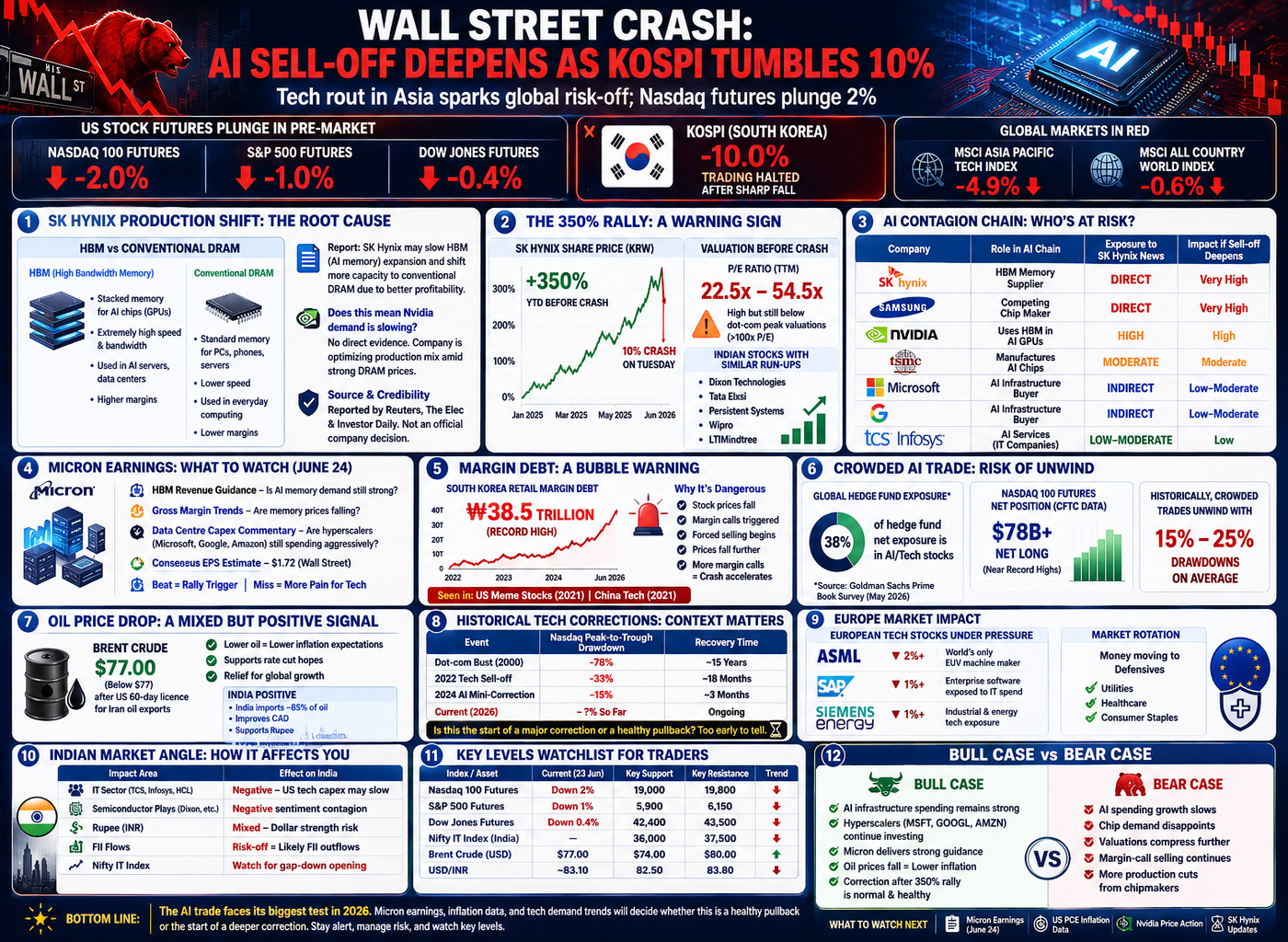
Wall Street Futures Signal Weak Start for US Markets
US stock futures traded sharply lower ahead of the opening bell.
Nasdaq 100 futures dropped more than 2%, leading losses across major indices.
S&P 500 futures fell over 1%, while Dow Jones futures declined around 0.4%.
The weakness follows Monday’s sell-off on Wall Street, when the Nasdaq Composite lost 1.3% and the S&P 500 closed lower as investors reduced exposure to large technology stocks.
The latest decline suggests that concerns surrounding AI-related investments are beginning to weigh heavily on market sentiment.
US Futures Under Heavy Pressure
| Index | Price | Change |
|---|---|---|
| Nasdaq 100 Futures (Sep 2026) | 29,805.00 | -2.77% |
| E-Mini S&P 500 Futures (Sep 2026) | 7,435.00 | -1.41% |
| S&P 500 | 7,472.79 | -0.37% |
| Nasdaq Composite | 26,166.60 | -1.32% |
| Dow Jones Industrial Average | 51,712.71 | +0.29% |
| Russell 2000 | 3,004.40 | +0.83% |
| VIX | 19.74 | +14.24% |
| US Dollar Index | 101.18 | +0.16% |
Read More : Bank Nifty Falls 1% as Profit Booking Hits Banking Stocks After 8% June Rally
KOSPI Crash Triggers Global Market Sell-Off
The immediate trigger for the global rout came from South Korea.
The benchmark KOSPI index plunged nearly 10%, forcing the exchange to temporarily halt trading through a circuit breaker mechanism.
The sell-off was driven by sharp declines in major semiconductor stocks.
Shares of SK Hynix and Samsung Electronics dropped more than 12% after reports suggested that SK Hynix could slow the expansion of AI memory-chip production and focus more on conventional DRAM products.
The development rattled investors who had viewed AI chip demand as one of the strongest growth themes in global markets.
Top Gainers (Americas)
| Symbol | Company | Change % |
|---|---|---|
| DFTX | Definium Therapeutics | +49.80% |
| APGE | Apogee Therapeutics | +46.66% |
| ORKA | Oruka Therapeutics | +18.03% |
| BWIN | Baldwin Insurance Group | +16.21% |
| SMCI | Super Micro Computer | +15.66% |
| KLRA | Kailera Therapeutics | +14.97% |
| BHVN | Biohaven | +14.22% |
Top Losers (Americas)
| Symbol | Company | Change % |
|---|---|---|
| SPCX | Space Exploration Technologies Corp. | -16.45% |
| RGC | Regencell Bioscience | -12.49% |
| AGI | Alamos Gold | -11.83% |
| AVAV | AeroVironment | -10.78% |
| GFI | Gold Fields | -10.29% |
| ASTS | AST SpaceMobile | -9.26% |
| CAVA | CAVA Group | -9.31% |
Europe Markets
| Index | Change % |
|---|---|
| FTSE 100 | -0.26% |
| CAC 40 | -0.62% |
| DAX | -1.02% |
| Euronext 100 | -1.08% |
| EURO STOXX 50 | -1.08% |
| MSCI Europe | -1.27% |
| British Pound Index | +0.35% |
| Euro Index | -0.28% |
Asia Markets
| Index | Change % |
|---|---|
| Nikkei 225 | -3.55% |
| Hang Seng | -1.82% |
| SSE Composite | -1.37% |
| S&P BSE Sensex | -1.16% |
| S&P/ASX 200 | -0.33% |
| Japanese Yen Index | -0.09% |
| Australian Dollar Index | -0.24% |
Key Takeaways for Investors
| Indicator | Market Signal |
|---|---|
| Nasdaq Futures -2.77% | Strong pressure on technology stocks |
| VIX +14.24% | Rising market volatility and risk aversion |
| Nikkei -3.55% | Weakness spreading across Asian equities |
| DAX & Euro Stoxx below 1% | European markets also under pressure |
| Dollar Index higher | Investors shifting toward safe-haven assets |
| Dow Jones positive | Defensive and value stocks showing resilience |
AI Rally Faces Fresh Questions From Investors
The AI trade has been one of the biggest drivers of equity market gains this year.
Massive investments in data centres, AI chips and cloud infrastructure helped technology companies reach record valuations despite geopolitical uncertainty and elevated interest rates.
However, investors are increasingly questioning whether the enormous spending on AI infrastructure will generate returns strong enough to support those valuations.
The latest correction reflects growing concerns that expectations may have run ahead of fundamentals.
The sharp decline in AI-related stocks suggests that investors are becoming more selective about companies benefiting from the AI boom.
Micron Earnings Become the Next Major Market Trigger
Investors are now looking ahead to upcoming quarterly results from Micron Technology.
The earnings report is expected to provide critical insights into AI memory-chip demand and future spending by data-centre operators.
Strong guidance could help restore confidence in the sector.
On the other hand, any signs of slowing demand may intensify concerns about the sustainability of the AI-driven rally.
As a result, Micron’s results are likely to be closely watched by investors across global markets.
Signs of Excessive Optimism Are Emerging
Market participants have also pointed to stretched valuations and speculative positioning.
SK Hynix shares had surged nearly 350% this year before Tuesday’s collapse.
At the same time, margin borrowing by South Korean retail investors recently climbed to record highs, indicating elevated levels of speculative activity.
Such conditions often increase market vulnerability when sentiment changes suddenly.
Tuesday’s sell-off appears to be a reminder that even the strongest market trends can face sharp corrections.
Falling Oil Prices Fail to Lift Market Sentiment
Normally, lower oil prices would provide support to equities.
Brent crude traded below $77 per barrel after reports indicated that the United States issued a 60-day licence allowing Iran to continue selling oil internationally.
The move was viewed as supportive of ongoing US-Iran peace negotiations and helped ease concerns about global energy supplies.
However, the positive impact from lower oil prices was overshadowed by the technology sell-off.
1. HBM vs. Conventional DRAM & Report Credibility
- The Product Difference: High Bandwidth Memory (HBM) stacks DRAM chips vertically to handle high-speed AI data processing; conventional DRAM handles standard everyday computer data processing.
- Nvidia Orders: There is no evidence Nvidia orders are slowing. SK Hynix is reallocating production because standard DRAM prices are soaring, yielding higher profit margins.
- Source Credibility: The production pivot is not a rumor; financial institutions like Morgan Stanley and industry reports confirmed the shift, but it signals profit optimization rather than an AI demand drop.
2. Valuation and Context of the 350% Rally
- P/E Ratio: Prior to the market crash, SK Hynix traded at a steep trailing Price-to-Earnings (P/E) ratio of 22.5x to 54.5x depending on the specific trailing metrics used.
- Dot-Com Peak Comparison: While high, this still trails the dot-com bubble peak where tech giants routinely traded above 100x P/E ratios.
- Indian Exposure: Indian technology and engineering stocks with high AI/chip sector exposure, such as Dixon Technologies, Tata Elxsi, and Wipro, experienced similar massive domestic run-ups before the global pause.
3. Investor Contagion Chain
- Direct Exposure: SK Hynix and its direct memory competitor Samsung Electronics are most vulnerable to immediate price swings.
- High Exposure: Nvidia relies directly on these suppliers for its high-performance AI graphics processing units (GPUs).
- Moderate Exposure: TSMC manufactures the underlying AI processor silicon architectures but does not produce the raw memory components.
- Indirect Exposure: Major infrastructure buyers like Microsoft and Google, alongside Indian IT firms like TCS and Infosys, face lower, indirect valuation risks.
4. What to Watch in Micron Earnings (June 24)
- HBM Revenue Guidance: Watch if Micron’s 2026 HBM capacity remains completely sold out as previously claimed.
- Gross Margin Trends: Analysts are projecting record gross margins near 81.6%; any dip signals pricing pressure.
- Data Centre Capex: Check for management commentary on whether cloud providers are slowing down infrastructure spending.
- Consensus Expectations: The consensus Wall Street expectation is an adjusted EPS of $19.72.
5. Margin Debt Danger
- The Record Leverage: South Korean retail margin debt hit a historic peak of 38.5 trillion won right before the drop.
- The Crash Acceleration: When stock prices fall, brokers initiate automated margin calls. This forces retail traders to sell their shares instantly, triggering a cascading market crash.