India Jobs: Biggest Cities Are Hiring More, But These Sectors Lead the Shift
Where Are India’s New Jobs Coming From? The Answer May Surprise You
India’s biggest cities are creating jobs at a faster pace, but the nature of employment is changing rapidly.
Instead of factories or farms, the country’s urban workforce is increasingly finding opportunities in transport, communication, finance, healthcare, education and other service industries. The latest report from the National Statistics Office (NSO) shows that India’s largest cities are becoming service-driven economies, with formal salaried jobs dominating the employment landscape.
For investors, businesses and job seekers, the report highlights a major structural shift that could shape India’s growth story for years to come.
Track Live : Opening Price Clues – What Pre-Market Data Says Today
Service Sector Is Driving Employment in India’s Largest Cities
The ‘Labour Market Dynamics in Million-plus Cities’ report, based on the Periodic Labour Force Survey (PLFS) 2025, provides city-level labour market estimates for the first time.
The findings show that service sector jobs have become the backbone of employment in India’s 46 million-plus cities.
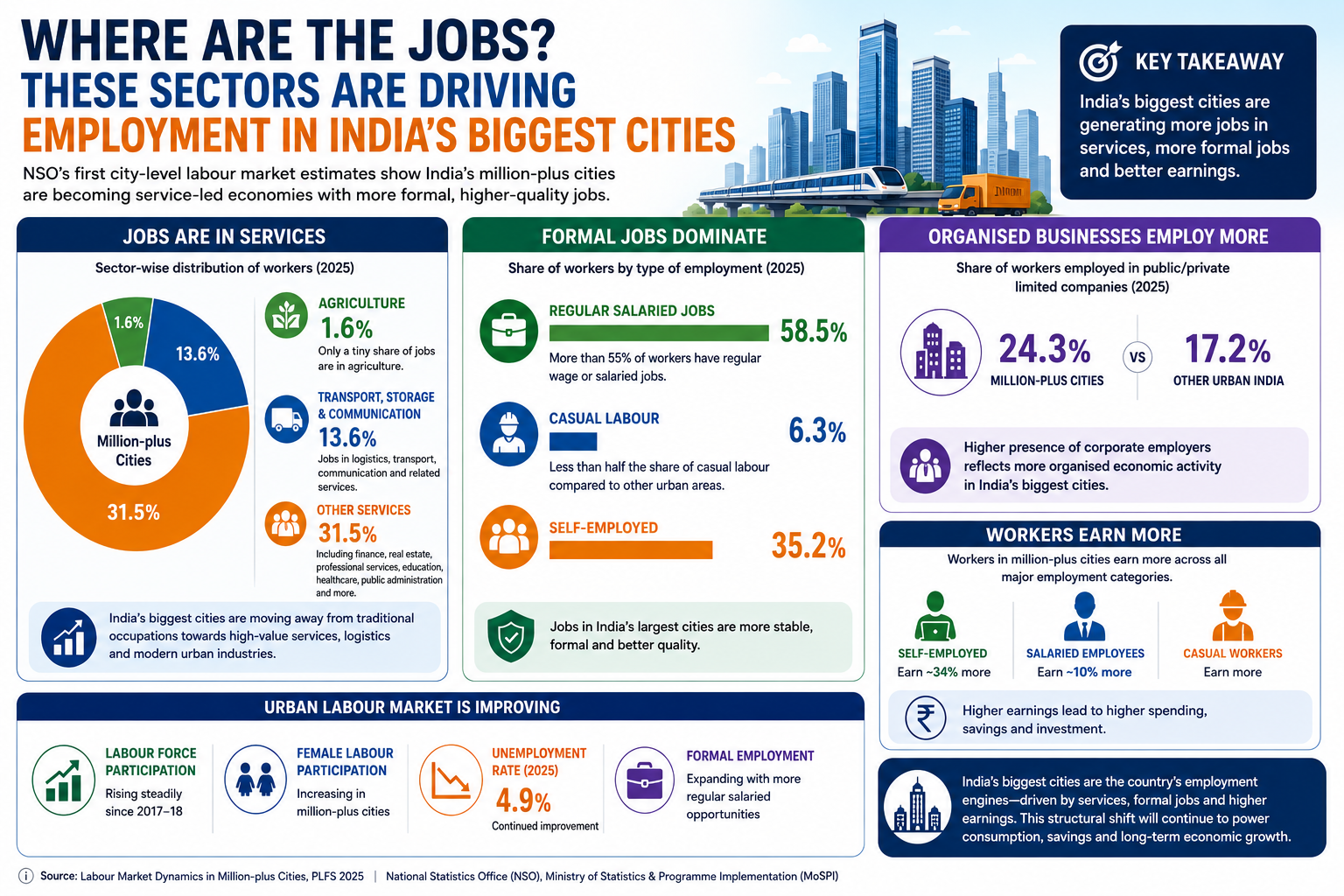
Only 1.6% of workers are employed in agriculture, compared with 10.1% across the rest of urban India.
Meanwhile, transport, storage and communication account for 13.6% of employment, while finance, real estate, professional services, healthcare, education and public administration together employ 31.5% of the workforce.
Sector-wise Employment (PLFS 2025)
| Indicator | Million-plus Cities | Other Urban India |
|---|---|---|
| Agriculture Jobs | 1.6% | 10.1% |
| Transport & Communication | 13.6% | 9.2% |
| Other Services | 31.5% | 24.1% |
| Salaried Jobs | 58.5% | 42.9% |
| Casual Labour | 6.3% | 14.4% |
The data confirms that India’s urban economy is steadily shifting towards logistics, communication and knowledge-based industries.
Read More : Why Global Investors Are Turning to India’s Stock Market as the AI Rally Slows
India vs US Employment-to-Population Ratio (Last 5 Years)
| Year | India (WPR) | United States (EPOP) |
|---|---|---|
| 2021 | 52.6% | 58.4% |
| 2022 | 56.0% | 60.0% |
| 2023 | 57.0% | 60.3% |
| 2024 | 57.3% | 60.1% |
| 2025 | 57.4% | 59.3% |
| Latest (Mid-2026) | 51.4% (May 2026, CWS) | 59.0% (June 2026) |
Key Trends
- India: Employment recovered strongly after the pandemic, with the annual Worker Population Ratio (WPR) reaching 57.4% in 2025. High-frequency monthly data then softened to 51.4% in May 2026, reflecting seasonal and cyclical factors.
- United States: The Employment-to-Population Ratio (EPOP) climbed to 60.3% in 2023 before easing to 59.0% in June 2026 as hiring slowed and labor-force participation declined.
Structural Differences
India
- Uses the Worker Population Ratio (WPR) for people aged 15+.
- Employment gains have been supported by rising female workforce participation and growth in self-employment.
- Monthly data in 2026 indicate some cooling in employment momentum.
United States
- Uses the Employment-to-Population Ratio (EPOP) for the civilian population aged 16+.
- The labor market remained historically strong after the pandemic but has cooled during 2026 as job creation slowed and participation fell.
Where Urban Jobs Are Growing
- Transport, Storage & Communication: 13.6%
- Finance, Real Estate & Professional Services: 31.5%
- Agriculture: Just 1.6%
Message:
Services now dominate employment in India’s largest cities.
Formal Jobs Lead
- Regular Salaried Jobs: 58.5%
- Public & Private Companies: 24.3%
- Casual Labour: 6.3%
Message:
Urban employment is becoming more organised and formal.
Workers Are Earning More
- Higher salaries across self-employed, salaried and casual workers
- Longer average working hours
- Better quality employment than other urban areas
Labour Market Is Improving
- Female labour participation rising
- Unemployment around 4.9%
- Labour force participation increasing steadily
Formal Salaried Jobs Are Becoming the New Normal
One of the biggest takeaways from the report is the rapid growth in formal employment.
Regular salaried jobs account for 58.5% of employment in million-plus cities, compared with 42.9% across other urban centres.
Casual labour makes up only 6.3% of employment in major cities, less than half the 14.4% recorded elsewhere.
According to the Ministry of Statistics and Programme Implementation (MoSPI), this reflects the increasing formalisation of India’s urban labour market.
Private Companies Are Hiring More Workers
Large organised businesses are playing a bigger role in job creation.
The report shows that 24.3% of workers in India’s biggest cities are employed by public or private limited companies.
In comparison, the figure stands at 17.2% across the rest of urban India.
The growing presence of corporate employers indicates that organised businesses continue expanding their workforce as cities develop into economic hubs.
Why Formal Employment Matters for the Stock Market
- Higher tax collection → More government spending on infrastructure.
- Stronger retail consumption → Higher sales for FMCG, auto and retail companies.
- Better credit quality → Lower NPAs and healthier banks.
- Higher home loan demand → Growth for housing finance and real estate.
- More SIP investments → Steady domestic liquidity supports equities.
- Greater insurance penetration → Higher premiums and long-term financial savings.
- Higher retirement savings → More long-term capital flows into financial markets.
Higher-Quality Jobs Are Also Paying Better
The report suggests that better-quality employment is translating into higher incomes.
Self-employed workers in million-plus cities earn around 34% more than the urban average.
Regular salaried employees also earn nearly 10% higher wages than workers in other urban centres.
The report further notes that employees in India’s largest cities work longer average hours, reflecting stronger economic activity.
Here’s What Happened Today and Why Traders Reacted
The latest NSO labour market report highlighted a structural transformation in India’s urban economy.
Investors viewed the data positively because rising formal employment generally supports stronger consumer spending, improved household income and long-term economic growth.
The report also reinforced confidence that India’s service economy continues expanding despite global economic uncertainties.
Urban Consumption Could Be the Next Growth Driver
Higher-paying, formal jobs in India’s largest cities are not just creating employment—they are driving the next wave of consumer spending and corporate earnings. Recent government data show workers in million-plus cities earn higher salaries and are more likely to hold formal jobs, supporting stronger discretionary spending.
- Housing: Higher incomes boost home purchases, mortgages and demand for construction materials.
- Automobiles: Rising salaries support sales of passenger vehicles, SUVs and EVs.
- Consumer Electronics: Spending increases on smartphones, laptops and premium appliances.
- Travel & Restaurants: Urban professionals spend more on holidays, hotels, airlines and dining out.
- Healthcare: Better incomes and insurance drive demand for hospitals and diagnostics.
- Financial Products: Higher savings increase investments in SIPs, insurance, wealth management and banking products.
- Premium Consumer Brands: Consumers upgrade to branded apparel, footwear, beauty and lifestyle products.
The Investment Flywheel
Formal Jobs → Higher Salaries → Higher Urban Consumption → Stronger Corporate Earnings → Long-Term Support for the Stock Market. As urban incomes rise, investors should watch consumption-driven sectors because they are likely to benefit from this structural shift.
What Does This Mean for Investors?
The report highlights one of India’s biggest long-term investment themes—the rapid formalisation of its urban economy.
For long-term investors, sectors linked to urban consumption, logistics, financial services, technology, healthcare and organised retail may continue benefiting from expanding employment opportunities.
For traders, improving employment data could strengthen sentiment towards companies exposed to domestic demand and urban economic activity.
India’s Urban Economy Is Entering a New Growth Phase
The NSO’s first city-level labour market report confirms that India’s largest cities are becoming the country’s primary engines of employment generation.
Agriculture now plays only a marginal role in urban labour markets, while service sector jobs, organised businesses and formal employment continue gaining momentum.
With unemployment falling to 4.9%, labour force participation improving and corporate hiring expanding, the report reinforces a broader structural shift in the Indian economy.
As India’s cities continue to grow, the next wave of employment is expected to come from transport, communication, finance, professional services and other high-value industries—making them key sectors to watch for both businesses and investors.