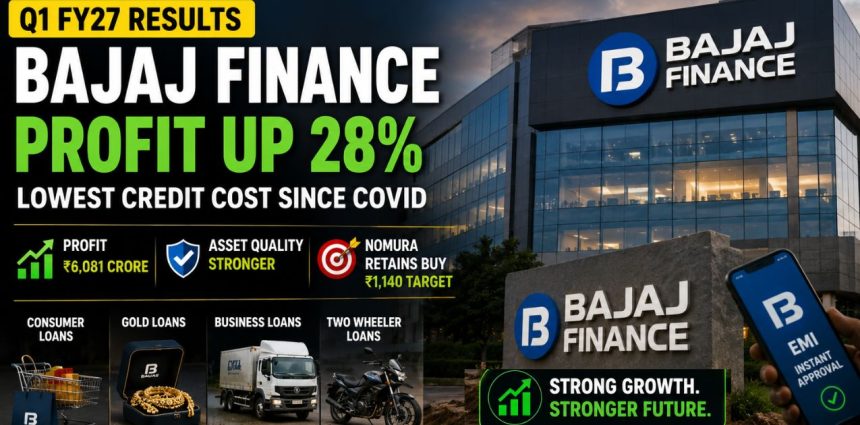
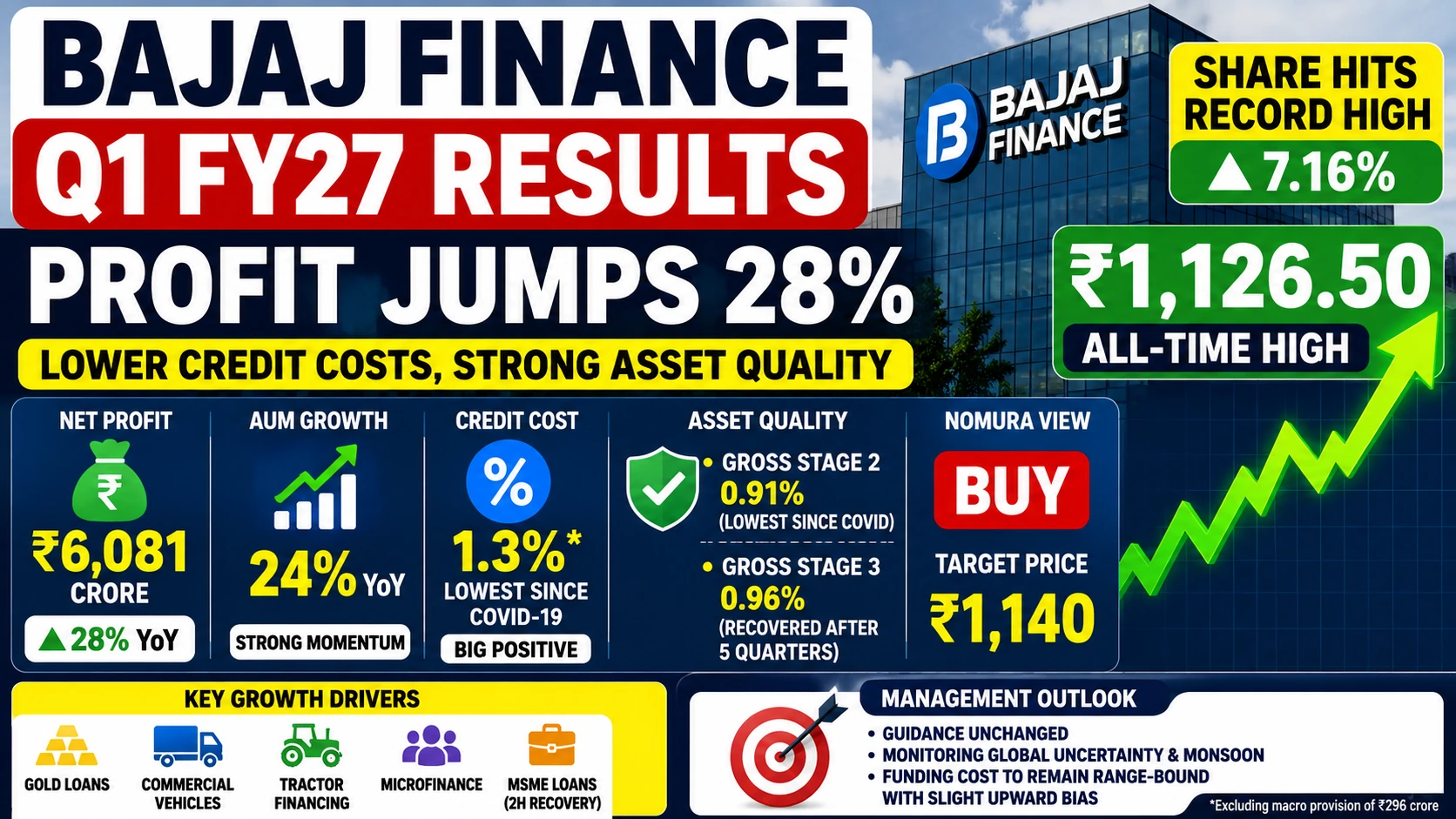
Bajaj Finance’s Q1 FY27 numbers, released 30 July 2026, beat estimates on almost every count. Consolidated profit after tax rose 28% year-on-year to ₹6,081 crore, while AUM rose to a record ₹5.47 lakh crore, up 24% YoY, per the company’s investor presentation. Total revenue from operations came in at ₹23,165.45 crore, up nearly 20% YoY, per the exchange filing.
The results reinforce investor confidence that Bajaj Finance’s core growth engine remains intact, asset quality is improving, customer additions are accelerating, and profitability is at a multi-year high, even as MSME lending stays the one visible soft spot.
Key Takeaways
✔ PAT up 28% YoY to ₹6,081 crore
✔ AUM at a record ₹5.47 lakh crore, up 24%
✔ GNPA improves to 0.96%, Net NPA to 0.39%
✔ Stock hits fresh 52-week high — a day after results, not on results day
✔ Nomura reiterates Buy, target ₹1,140
Check Live: Bajaj Finance Option Chain (BAJFINANCE) — Live OI
Q1 FY27 Results At A Glance
| Metric | Q1 FY27 | Q1 FY26 | YoY Change |
|---|---|---|---|
| AUM | ₹5,46,944 cr | ₹4,41,450 cr | +24% |
| Profit Before Tax | ₹8,149 cr | ₹6,368 cr | +28% |
| Profit After Tax | ₹6,081 cr | ₹4,765 cr | +28% |
| Net Interest Income | ₹12,571 cr | ₹10,228 cr | +23% |
| Credit cost (annualised) | 1.54%; 1.31% ex-provision | 1.87% | Improved |
| New loans booked | 16.13 MM | 13.49 MM | +20% |
| New customers added | 5.10 MM | 4.69 MM | +9% |
| Net NPA | 0.39% | 0.50% | Improved |
| Gross NPA | 0.96% | 1.03% | Improved |
| ROE (annualised) | 20.4% | 19.0% | +140 bps |
Source: Bajaj Finance Q1 FY27 investor presentation, 30 July 2026
Expectations vs Reality: How Bajaj Finance Performed Against Street Estimates
Going into results, Bloomberg consensus pegged Q1 FY27 net profit at ₹5,791 crore, net interest income at ₹12,408 crore, and provisions at ₹2,192 crore, per BusinessToday’s pre-results preview. The stock carried 27 ‘Buy’, 6 ‘Hold’ and 6 ‘Sell’ ratings ahead of the print, with a consensus 12-month target of just ₹1,083.82 — implying only 2.8% upside at the time.
| Metric | Street Estimate (Bloomberg consensus) | Actual Q1 FY27 | Verdict |
|---|---|---|---|
| Net Profit (PAT, attributable to owners) | ₹5,791 cr | ₹5,985.75 cr | ✅ Beat |
| Net Interest Income | ₹12,408 cr | ₹12,571 cr | ✅ Beat |
| Provisions | ₹2,192 cr | ₹1,993 cr (incl. ₹296 cr macro buffer) | ✅ Better than expected |
| Finance Cost | ₹7,906 cr | ₹7,942 cr | ➖ Roughly in line |
| AUM Growth | ~23–24% (implied by guidance corridor) | 24% YoY | ➖ In line |
| Pre-results 12-month target | ₹1,083.82 | Nomura ₹1,140 / Bloomberg (post-results) ₹1,144.59 | ✅ Targets raised |
Source: BusinessToday (pre-results preview, 30 July 2026), Bajaj Finance investor presentation, Business Standard
Individual brokerage previews, for context:
- BNP Paribas forecast PAT of ₹5,968.40 crore (+25.2% YoY) — closest of the named previews to the actual print
- YES Securities was the most bullish, at ₹6,000 crore (+25.9% YoY)
- Antique Stock Broking was the most conservative, at ₹5,733.20 crore (+20.3% YoY)
What Surprised The Street Most?
The real surprise wasn’t the profit print itself, it was provisions. Actual loan losses and provisions of ₹1,993 crore came in ₹199 crore below the Bloomberg consensus estimate of ₹2,192 crore, even after Bajaj Finance set aside a ₹296-crore prudent macro-economic provision.
BNP Paribas had flagged ahead of results that its “material positive surprise” case for the stock rested on what it saw as conservative margin assumptions baked into the Street consensus, that thesis played out.
Where the Street’s caution proved right was on guidance: BNP Paribas had also noted the broader Q1 season was “unlikely to carry major surprises… one way or another” on outlook, and Bajaj Finance leaving its FY27 corridor unchanged (aside from the raised customer-addition target) matched that expectation.
Which Business Segments Drove Growth?
Gold loans led the pack, more than doubling to ₹21,152 crore, up 112% YoY. Commercial vehicle and tractor financing grew 102% to ₹4,355 crore. Urban personal loans, the largest book at ₹1,09,802 crore, grew a comparatively moderate 19%. MSME lending was the one soft spot, up just 2% to ₹51,320 crore — management expects it to recover by the December quarter, per Investing.com’s concall coverage.
Stock Reaction: Why The Rally Came A Day Late
Bajaj Finance shares closed 0.09% lower on results day itself, near ₹1,053.50, even with the earnings beat, investors were awaiting confirmation of sustained momentum before committing further, per Investing.com.
That confirmation came on 31 July: the stock surged as much as 7.66% intraday to a fresh 52-week high of ₹1,129, touching ₹1,134.20 by late morning, per NewsX, as brokerages highlighted the improving credit trends. Market cap touched roughly ₹7.06 lakh crore, among the highest of any Indian financial services company that day.
Also Check: BAJAJ FINANCE Options Chart | Nifty Trader
Asset Quality And Balance Sheet Strength
Gross Stage-2 assets fell to 0.91% of the portfolio, and GNPA improved to 0.96% from 1.03% a year earlier. Combined, Stage-2 and Stage-3 assets reduced to 1.87% of the loan book from 1.94% in Q4 FY26, even though they rose ₹328 crore in absolute terms, per the presentation, the loan book simply grew faster than the stressed pool.
Net NPA came in at 0.39%, with Stage-3 provisioning coverage held at 60%. Excluding the ₹296-crore prudent macro-economic provision, credit cost was 1.31% versus 1.87% a year ago. Capital adequacy stood at 20.90% (Tier-1 at 20.01%), and BFL’s standalone daily average liquidity coverage ratio was 231% against a 100% requirement.
FY27 Guidance
Per Slide 23 of the investor presentation, long-term guidance is unchanged: AUM growth of 23-25%, profit growth of 23-24%, GNPA under 1.4%, NNPA under 0.5%, ROA of 4.3-4.7% and ROE of 19-21%. Management did raise its FY27 customer-addition target to 18-20 million from an earlier 15-17 million, per BusinessToday’s concall report, and signalled it could revisit broader guidance after the September quarter if current trends hold.
What Brokerages Are Saying
| Brokerage | Rating | Target Price | Implied Upside* |
|---|---|---|---|
| Nomura | Buy | ₹1,140 | ~+1% |
| Bernstein | Underperform | ₹840 | ~-26% |
| Bloomberg Consensus | — | ₹1,144.59 | ~+1% |
*Source: BusinessToday, 31 July 2026. *Upside calculated against the ₹1,134.20 level seen on 31 July after the post-results rally. When these targets were first set, against the pre-rally close of ₹1,053.50, implied upside was closer to 8-9%; the rally has already closed most of that gap.
Nomura said better credit trends could lift FY27 profit estimates 2-3% if sustained. Bernstein countered that much of the good news may already be priced in. A wider BusinessToday roundup of CLSA, JPMorgan and Macquarie targets shows a spread from roughly ₹815 to ₹1,300.
The FINAI Push
Bajaj Finance is scaling what it calls its “FINAI” transformation. The company plans to scale agentic AI to 600+ autonomous agents across sales, operations, debt management, HR, IT and risk, and to enable customer discovery through platforms like ChatGPT and Gemini by Q2 FY27, per the presentation. AI-driven voice and text bots already generated ₹2,551 crore of personal-loan disbursement in the quarter. Two new business lines are targeted for launch around January-February 2027, per Investing.com’s concall coverage.
Why Does Bajaj Finance Trade At A Premium?
The stock commands a premium to NBFC peers, P/E of 33.43x and P/B of 5.58x as of 1 July 2026, per ValueResearch, before the latest rally pushed multiples higher. That premium is earned rather than assumed: a 20.4% annualised ROE, GNPA at 0.96%, and 17% YoY growth in the customer franchise are all ahead of most listed NBFC peers, the kind of combination that has historically justified Bajaj Finance’s re-rating.
What Should Investors Watch Next?
- September quarter guidance review — management said it may revisit its AUM/profit corridor after Q2 if trends hold
- MSME recovery — flagged for the December quarter
- Credit cost trajectory — whether the 1.31% ex-provision run-rate sustains without further macro provisioning
- Funding cost — consolidated cost of funds was 7.40% in Q1, down 1bps QoQ; any RBI move could reverse that
- AI execution — the two undisclosed new business lines slated for early 2027
- Valuation — how much further re-rating room exists after this week’s rally
Final Take
The biggest takeaway from Q1 FY27 isn’t just the 28% profit growth, it’s that Bajaj Finance improved asset quality, held industry-leading profitability, and kept investing aggressively in AI-led transformation, all in the same quarter. Whether that combination sustains through the September quarter, when management may revisit guidance, will determine if the stock’s premium valuation holds up.
Read Next: Stocks to Watch July 31: Maruti, Sun Pharma, ITC, Vedanta, RIL in Focus as Q1 Earnings Peak
FAQ
What is Bajaj Finance’s Q1 FY27 profit?
Consolidated PAT was ₹6,081 crore, up 28% YoY, on AUM of ₹5.47 lakh crore.
Why did Bajaj Finance shares rally after Q1 FY27 results?
The stock closed flat-to-lower on results day itself; the rally to a fresh 52-week high came the following session as brokerages flagged improving asset quality and easing credit costs.
What is Bajaj Finance’s target price after Q1 FY27?
Nomura: Buy, ₹1,140. Bernstein: Underperform, ₹840. Bloomberg consensus: ₹1,144.59.
What is Bajaj Finance’s FY27 AUM growth guidance?
23-25%, per the company’s own investor presentation (Slide 23), unchanged after Q1.
What is Bajaj Finance’s GNPA and NNPA in Q1 FY27?
GNPA improved to 0.96% from 1.03%; Net NPA improved to 0.39% from 0.50%.