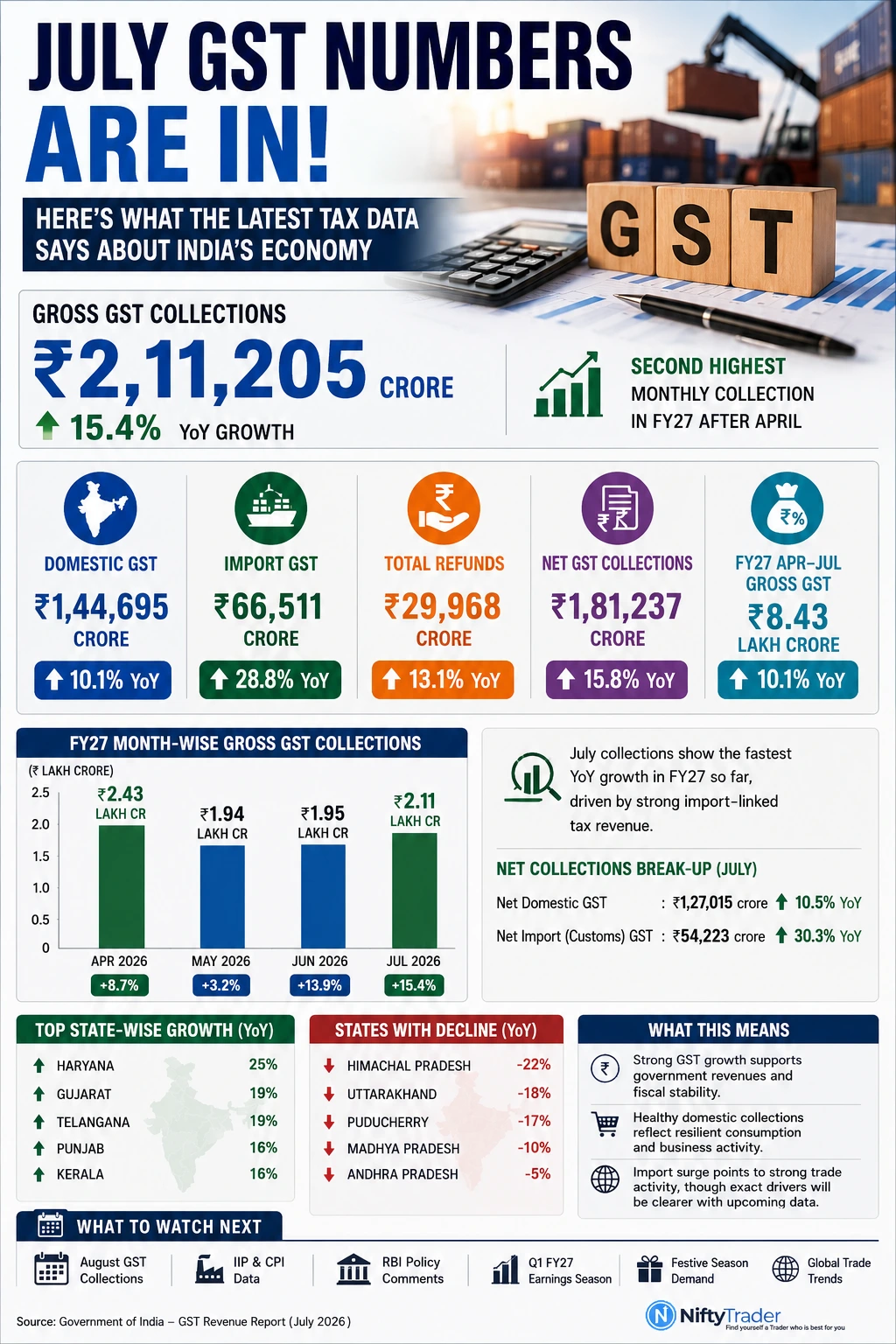
India’s gross GST collections rose 15.4% year-on-year to Rs 2.11 lakh crore in July 2026, the second-highest monthly tally of the current financial year, as a sharp jump in import-linked tax revenue offset steadier domestic growth, according to the government’s monthly GST revenue report released on August 1.
The headline figure, Rs 2,11,205 crore, compares with Rs 1,83,065 crore collected in July 2025 and extends a run of double-digit annual growth in GST collections across the first four months of FY27.
Need to Know
- Gross GST collections: Rs 2.11 lakh crore in July 2026, up 15.4% YoY
- Domestic GST revenue: Rs 1.45 lakh crore, up 10.1%
- Import GST revenue: Rs 66,511 crore, up 28.8% — the single biggest driver of growth
- Net GST revenue after refunds: Rs 1.81 lakh crore, up 15.8%
- Total GST refunds: Rs 29,968 crore, up 13.1%
- FY27 cumulative (April–July) GST collections: Rs 8.43 lakh crore, up 10.1%
- Haryana posted the highest state-level growth at 25%; Himachal Pradesh saw the steepest decline at -22%
Imports, Not Domestic Demand, Powered July’s GST Collections
Gross domestic GST revenue rose 10.1% year-on-year to Rs 1,44,695 crore in July 2026, from Rs 1,31,439 crore in July 2025. That is a healthy pace, but it was overshadowed by tax revenue on imports, which surged 28.8% to Rs 66,511 crore from Rs 51,626 crore a year earlier.
Import-linked GST collections have now grown roughly three times faster than domestic GST collections for a second straight month, a pattern that shows up clearly once refunds are stripped out too. The official data does not break down what is driving the import surge, higher import values, a change in trade mix and stronger customs compliance are all plausible contributors, and clearer trade-volume data over the coming weeks should help separate them.
Net GST Collections Tell the Same Story, Refunds Rise as Well
After adjusting for refunds, net GST collections climbed 15.8% year-on-year to Rs 1,81,237 crore in July 2026, against Rs 1,56,570 crore in July 2025. Net domestic revenue rose 10.5% to Rs 1,27,015 crore, while net customs (import) revenue jumped 30.3% to Rs 54,223 crore, confirming imports as the standout performer of the month.
Total refunds increased 13.1% year-on-year to Rs 29,968 crore. Within this, domestic refunds rose 7.3% to Rs 17,680 crore, while export-linked refunds processed through ICEGATE climbed 22.7% to Rs 12,288 crore, pointing to faster liquidity support for exporters even as overall trade-related revenue rose.
Also Read: GST at 10 How AI Is Transforming India’s Tax System
July’s GST Collections Are FY27’s Second-Best — the Full Trend
At Rs 2.11 lakh crore, July’s GST collections trail only April’s record for the financial year so far, and comfortably outpace the May–June plateau.
| Month | Gross GST Collections | YoY Growth |
|---|---|---|
| April 2026 | Rs 2.43 lakh crore (FY27 record) | +8.7% |
| May 2026 | Rs 1.94 lakh crore | +3.2% |
| June 2026 | Rs 1.95 lakh crore | +13.9% |
| July 2026 | Rs 2.11 lakh crore | +15.4% |
April’s GST collections are seasonally inflated by year-end business settlements, so July’s Rs 2.11 lakh crore, delivering the fastest YoY growth of the four months, is arguably the stronger read on underlying momentum through the first third of FY27.
State-Wise GST Collections Scorecard: Haryana Leads, Five States Decline
Among larger states, Haryana recorded the fastest growth in July at 25%, followed by Gujarat and Telangana at 19% each. Punjab and Kerala grew 16%, Uttar Pradesh rose 15%, and Maharashtra, the largest contributor to national GST revenue, grew a steady 13% to Rs 32,210 crore.
Karnataka added 12% and Delhi rose 8%. Among India’s larger industrial and trade hubs, Gujarat, Karnataka and Telangana all outgrew the national average, a sign that business activity in manufacturing-heavy states stayed resilient through July.
| State | July 2026 GST Growth (YoY) |
|---|---|
| Haryana | +25% |
| Gujarat | +19% |
| Telangana | +19% |
| Punjab | +16% |
| Kerala | +16% |
| Uttar Pradesh | +15% |
| Maharashtra | +13% |
| Karnataka | +12% |
| Delhi | +8% |
Six states and union territories logged declines. Himachal Pradesh fell the most at 22%, followed by Uttarakhand (-18%), Puducherry (-17%), Madhya Pradesh (-10%), Andhra Pradesh (-5%) and Tamil Nadu, which slipped a marginal 1%. The official report does not explain state-specific weakness, so it is worth watching whether these six turn around in August or extend the slide.
Four Months In, FY27’s GST Collections Trend Holds Steady
For April–July, the first four months of FY27, gross GST collections rose 10.1% to Rs 8,42,905 crore, from Rs 7,65,607 crore in the same period last year. Net GST collections for the period increased 9.2% to Rs 7,21,457 crore. Cumulative net customs revenue is up a sharp 32.7% for the year so far, while net domestic revenue growth is a more modest 2.5%, underlining how much of FY27’s buoyancy is being carried by trade and import activity rather than the domestic consumption engine.
The GST 2.0 Backdrop: Revenue Rising Despite Lower Rates
July’s GST collections land against the backdrop of GST 2.0, the rate rationalisation that took effect on September 22, 2025, which scrapped the 12% and 28% slabs in favour of a simpler 5% and 18% structure, with a 40% rate reserved for luxury and sin goods. Individual health and life insurance premiums also moved to nil rate under the reform.
That context matters for how the growth should be read: revenue is rising at double digits even after rates were cut on a wide range of everyday goods, which points to stronger compliance, a wider formal tax base and steady consumption volumes doing the heavy lifting, rather than higher rates.
Sector Impact: Who Benefits From Strong GST Collections
GST data does not move stock prices the way an earnings beat or an RBI rate call does, but a strong, broad-based print like July’s tends to feed into sentiment across a few pockets:
- Banks and NBFCs: Firmer business activity and tax compliance typically support credit demand, a mild positive for lenders if the trend holds into August.
- Consumption and FMCG: Domestic GST growth of 10.1% suggests underlying consumer spending stayed resilient even after GST 2.0 rate cuts took effect.
- Infrastructure and capital goods: Stronger government revenue improves fiscal room for capex, a medium-term positive for construction and engineering names.
- Ports and logistics: The 28.8% jump in import GST points to sustained trade volumes, relevant for logistics, shipping and freight-linked stocks.
What to Track Next
July’s print is one data point, not a trend. The next confirmations to watch: August GST collections (due September 1), the IIP and CPI inflation prints, RBI policy commentary, ongoing Q1 FY27 corporate earnings, merchandise trade data, and early festive-season demand indicators, all of which will show whether the import-led surge broadens into domestic demand or fades as the base effect normalises.
NiftyTrader Desk View
July’s GST collections print is a broadly constructive data point for market watchers tracking India’s consumption and trade cycle, though the composition is worth flagging: the 28.8% import-led surge is doing more work than the 10.1% domestic print, and states like Maharashtra, Gujarat and Karnataka, the traditional industrial and trade hubs, are once again out-growing several smaller states.
For real-time cues on how institutional money is reading macro prints like this one, track NiftyTrader’s FII-DII Dashboard alongside the live option chain tool.
Read Next: NSE IPO Inches Closer as Exchange Completes ₹1,491 Crore SEBI Settlement
FAQs
What was India’s GST collections figure for July 2026?
India’s gross GST collections for July 2026 stood at Rs 2.11 lakh crore (Rs 2,11,205 crore), up 15.4% year-on-year from Rs 1.83 lakh crore in July 2025.
Why did GST collections grow faster in July 2026 than in the previous two months?
Growth was led by a 28.8% jump in revenue from imports, which outpaced the 10.1% rise in domestic GST collections. June and May 2026 had seen slower GST collections growth of 13.9% and 3.2%, respectively.
Which states recorded the highest and lowest GST growth in July 2026?
Haryana recorded the highest growth among larger states at 25%, followed by Gujarat and Telangana at 19% each. Himachal Pradesh recorded the steepest decline at 22%, followed by Uttarakhand at 18%.
What is the cumulative GST collections figure for FY27 so far?
Gross GST collections for April–July FY27 stood at Rs 8.43 lakh crore, up 10.1% year-on-year, while net GST collections for the period rose 9.2% to Rs 7.21 lakh crore.
Is July 2026’s GST collections figure a record?
No. July 2026’s GST collections of Rs 2.11 lakh crore mark the second-highest month of FY27, behind April 2026’s record Rs 2.43 lakh crore, which is typically the year’s strongest month due to year-end settlements.
Why do traders track GST collections at all?
GST data offers a near real-time read on consumption, manufacturing and trade activity, arriving well ahead of quarterly GDP numbers, which is why it is watched as a leading indicator alongside IIP and corporate earnings.