Govt’s New Mobile Manufacturing Scheme Offers Up to 6.5% Incentives, Eyes Indian Brands
India is taking the next big step in its mobile manufacturing push. The government has officially notified the Rs 62,500-crore Mobile Phone Manufacturing Scheme (MPMS), putting greater emphasis not just on producing smartphones in India, but on making more of their components locally.
The five-year scheme could reshape India’s electronics manufacturing ecosystem. With incentives linked to production, domestic sourcing and Indian product design, the government is now looking to move the industry further up the value chain.
Track Live : NSE Option Chain — Live
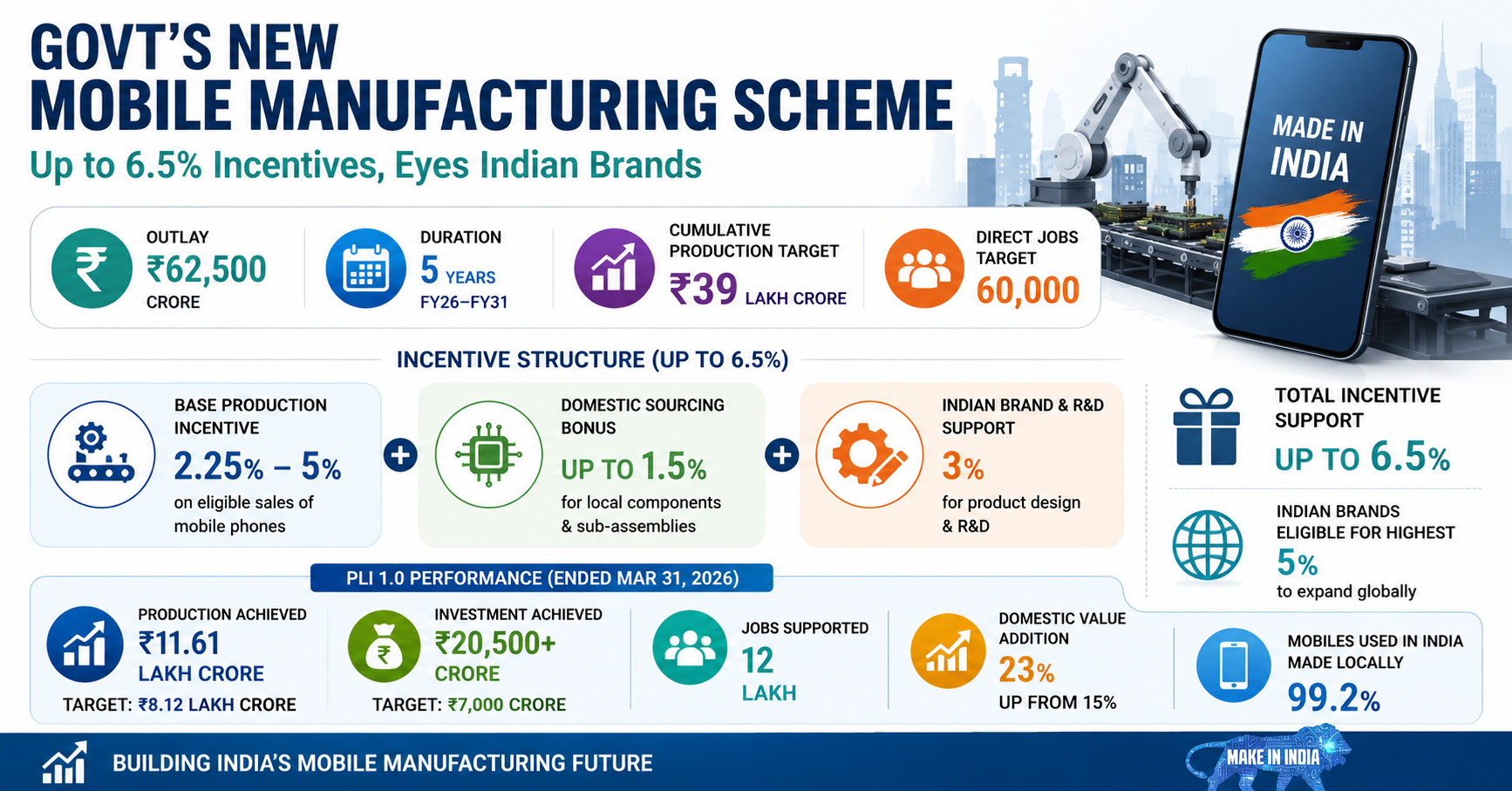
- Budget & Duration: ₹62,500 crore total outlay running for 5 years from FY 2026-27 to FY 2030-31 as a successor to the original PLI scheme.
- Base Production Incentives: Offers 2.25% to 5% incentives on eligible net sales for mobile phones manufactured locally.
- Local Sourcing Bonus: Provides an extra up to 1.5% incentive for sourcing key components and sub-assemblies domestically (bringing total manufacturing/sourcing support higher).
- Indian Brand & R&D Support: Grants an additional 3% incentive specifically dedicated to product design and research and development (R&D) to help build and scale homegrown Indian smartphone brands.
- Targets: Projected cumulative mobile production of roughly ₹39 lakh crore and creation of around 60,000 direct jobs over the 5-year span.
Why the Rs 62,500-crore mobile manufacturing scheme matters now
The Mobile Phone Manufacturing Scheme will operate from April 1, 2026, and continue through FY2030-31.
Under the scheme, manufacturers will receive incentives ranging from 2.25% to 5% on eligible sales of mobile phones made in India.
There is also an additional incentive of up to 1.5% for sourcing specified components and sub-assemblies domestically.
The Cabinet had approved the scheme on July 15 with a total outlay of Rs 62,500 crore. The government expects mobile phone production to reach around Rs 39 lakh crore over the five-year period, while creating approximately 60,000 direct jobs.
Read More : India’s Gold Loan Lenders: IIFL Finance Surges 8% as JPMorgan Turns Bullish
Incentive Structure & Key Benefits
- Base Production Incentive: Offers 2.25% to 5% on eligible incremental sales of mobile phones manufactured in India.
- Domestic Sourcing Bonus: An additional incentive of up to 1.5% for manufacturers that source specified components and sub-assemblies domestically.
- Indian Brand & R&D Boost: An additional 3% incentive on eligible sales for companies focusing on domestic product design and R&D.
- Global Export Push: Indian handset brands are eligible for the highest base tier of 5% to support domestic companies looking to aggressively expand into international markets.
Local sourcing becomes the new focus for mobile manufacturers
The biggest change in the new Mobile Phone Manufacturing Scheme is its focus on localisation.
MeitY Secretary S Krishnan said domestic value addition in mobile phone manufacturing has increased from around 15% to 23%.
The additional sourcing incentive is designed to push manufacturers to deepen domestic supply chains.
This means the next phase of India’s mobile manufacturing story is expected to involve more than assembling handsets. The government wants a larger share of components and sub-assemblies to be made within the country.
Indian brands get extra support for design and research
The scheme also gives greater importance to Indian brands.
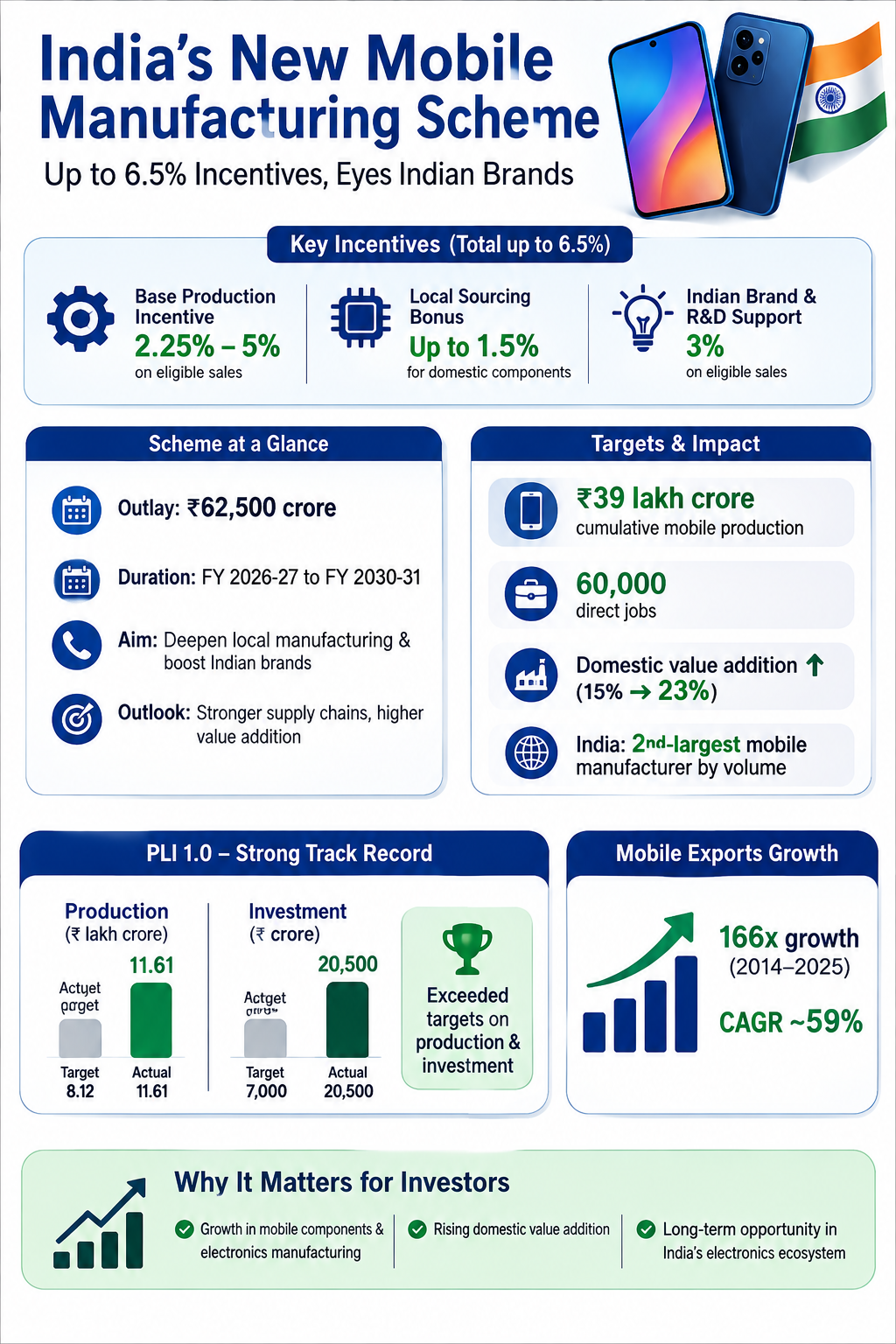
The government will provide an additional 3% incentive on eligible sales for product design and research and development aimed at building Indian brands.
Krishnan said Indian handset brands will be eligible for incentives of up to 5%, as the government seeks to help domestic companies expand into international markets.
This could be important for India’s electronics industry because developing local brands, intellectual property and product design could help companies capture more value from the global smartphone supply chain.
PLI 1.0 exceeded its production and investment targets
The new Mobile Phone Manufacturing Scheme follows the earlier Production Linked Incentive Scheme for Large Scale Electronics Manufacturing, or PLI-LSEM.
That programme ended on March 31, 2026, after exceeding several of its original targets.
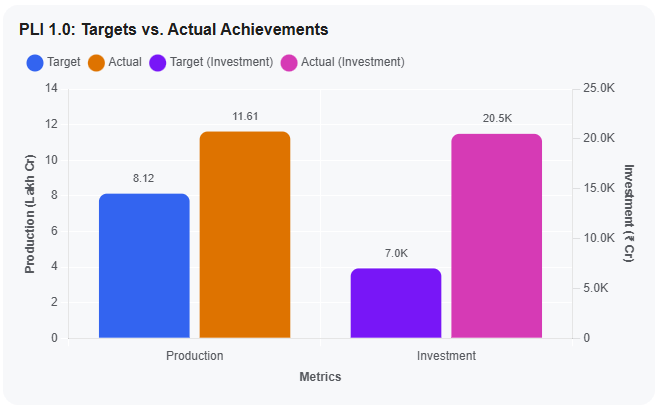
According to figures shared by Krishnan, mobile phone production under PLI 1.0 reached Rs 11.61 lakh crore, compared with the target of Rs 8.12 lakh crore.
Investment crossed Rs 20,500 crore, significantly above the original target of Rs 7,000 crore.
The earlier PLI scheme also attracted major global handset makers and contract manufacturers, including Samsung and companies manufacturing Apple devices in India.
The Legacy of PLI 1.0 (Ended March 31, 2026)
- Production Outperformance: Reached ₹11.61 lakh crore in total mobile phone production, comfortably beating the government’s initial target of ₹8.12 lakh crore.
- Investment Surge: Attracted over ₹20,500 crore in capital investment, nearly tripling the baseline target of ₹7,000 crore.
- Ecosystem Impact: Powered a total of $14 billion in broader electronics investments, making smartphones India’s single-largest exported product category and supporting 12 lakh jobs.
- Value Addition: Raised domestic local value addition from a low of 15% to 23%.
Track Live : BSE Option Chain — Live Sensex & Bankex Options Data Today
India has already become a major mobile manufacturing hub
The government believes the earlier PLI programme helped transform India’s position in the global mobile industry.
Around $14 billion has been invested across India’s electronics ecosystem since PLI 1.0 was launched, while mobile phone manufacturing now supports around 12 lakh jobs, Krishnan said.
India is now the world’s second-largest mobile phone manufacturer by volume.
The government also says 99.2% of mobile phones used in India are manufactured domestically, highlighting the sharp shift away from dependence on imports.
Strategic Goals for the Next 5 Years (FY26–FY31)
- ₹39 Lakh Crore Production: The ultimate target for cumulative mobile manufacturing output over the 5-year tenure.
- Structural Supply Chain Deepening: Pushing domestic value addition well past the current 23% mark by financially penalizing pure import-and-assemble models.
- Employment Generation: Projected to create at least 60,000 direct jobs within the immediate ecosystem.
Mobile phone exports have become a major growth engine
India’s mobile phone exports have also expanded rapidly.
Krishnan said exports grew 166 times between 2014 and 2025, registering a compound annual growth rate of around 59%.
Mobile phones accounted for nearly 61% of India’s overall electronics exports in FY26, according to the figures shared.
Smartphones also became India’s largest individual exported product category in 2025, surpassing categories such as petroleum and gems and jewellery.
Here’s what happened today and why traders reacted
The notification of the Rs 62,500-crore Mobile Phone Manufacturing Scheme strengthens the government’s long-term manufacturing roadmap.
For investors, the biggest opportunity could be across the broader electronics manufacturing ecosystem rather than only handset makers.
Companies involved in mobile assembly, components, electronics manufacturing services, supply chains and domestic sourcing could benefit as localisation increases.
However, the impact on individual stocks will depend on how much companies qualify for incentives, their investment plans and their ability to increase domestic value addition.
What could the scheme mean for investors in the coming years?
The new Mobile Phone Manufacturing Scheme signals that India’s electronics strategy is moving into its next phase.
The first phase was largely about building manufacturing scale. The new phase is more focused on local sourcing, domestic value addition, Indian brands, design and R&D.
For investors, these areas could become important long-term themes.
The government’s target of nearly Rs 39 lakh crore in cumulative mobile production also highlights the scale of the opportunity.
If manufacturers successfully build deeper domestic supply chains, India’s mobile manufacturing sector could become more competitive globally.
That makes the Mobile Phone Manufacturing Scheme an important policy development to watch—not only for the electronics industry, but also for investors tracking India’s next manufacturing growth cycle.