
Amazon, Flipkart Sellers to Pay More — Cancellation Fees Up to 10%, Penalties Up to ₹90
Amazon and Flipkart are making it more expensive for sellers to cancel orders or miss dispatch deadlines just as India’s festive shopping season approaches.
The Amazon and Flipkart seller fee hikes come at a critical time for e-commerce companies. Order volumes are expected to rise during the festival season, but sellers operating on thin margins could feel the impact of higher cancellation fees, closing charges and penalties.
For investors, the changes also highlight a bigger trend: India’s e-commerce platforms are trying to improve fulfilment while increasing revenue per order as competition from quick commerce intensifies.
Track Live : NSE Option Chain — Live
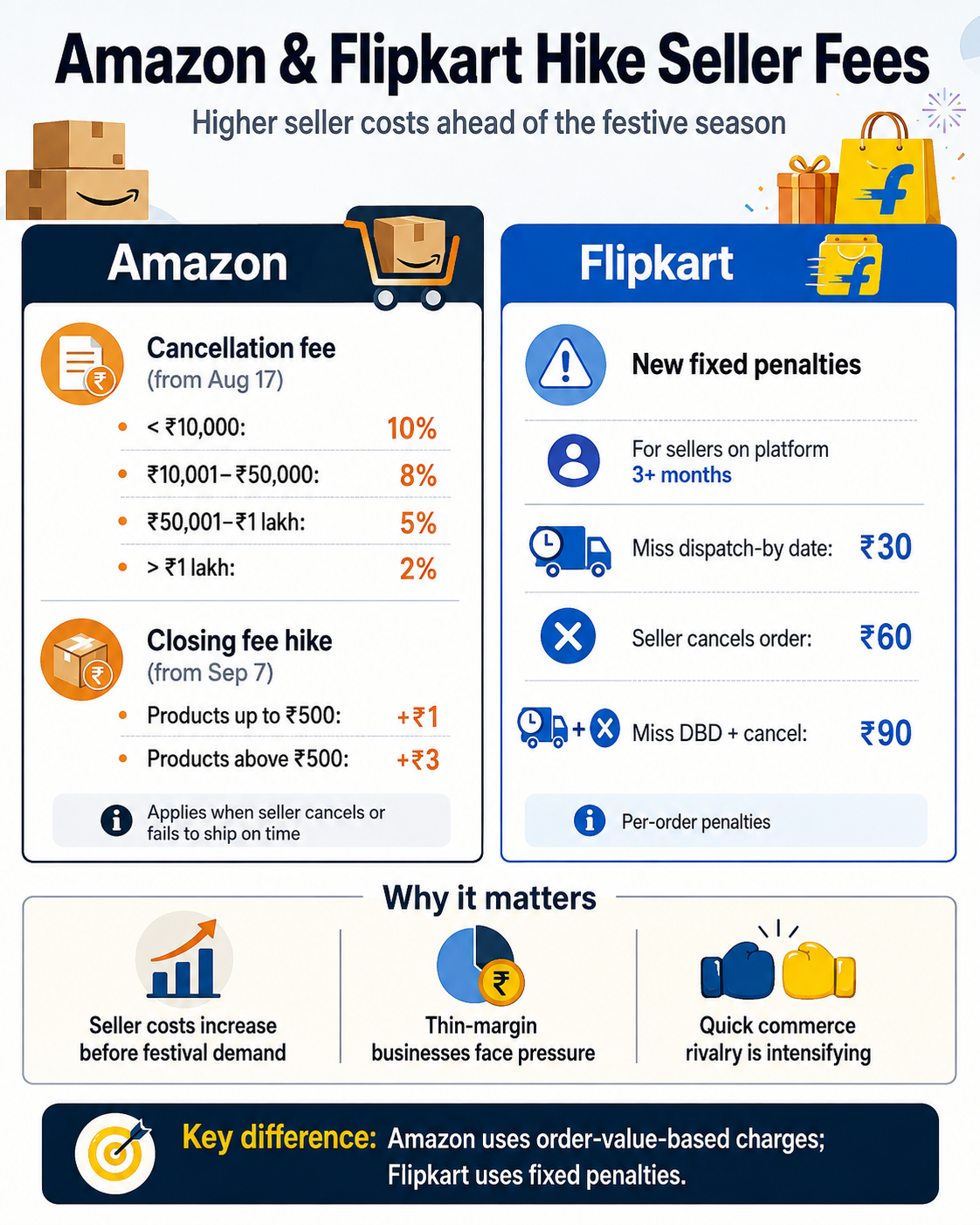
Amazon changes cancellation fees for sellers
Amazon has revised its cancellation charges for sellers using Easy Ship and Self-Ship services.
The new structure, effective August 17, links the cancellation fee directly to the order value instead of the earlier referral-fee-based system.
- Value-Linked Cancellation Fees: Effective August 17, 2026, cancellation charges for Easy Ship and Self-Ship are calculated as a direct percentage of the order value rather than the old referral-fee system:
- 10% fee for orders below ₹10,000.
- 8% fee for orders between ₹10,001 and ₹50,000.
- 5% fee for orders between ₹50,001 and ₹1,00,000.
- 2% fee for orders above ₹1,00,000.
(Applies if a seller cancels an order for non-buyer reasons or fails to ship within 24 hours of the estimated date).
- Hiked Closing Fees: Effective September 7, 2026, closing fees across Fulfilment Centre (FBA), Easy Ship, and Seller Flex will increase:
- Increased by ₹1 for products priced up to ₹500.
- Increased by ₹3 for products priced above ₹500.
The charge applies when sellers cancel orders for reasons other than buyer requests.
Amazon can also charge the fee if an order is cancelled because the seller fails to ship and confirm it within 24 hours of the estimated shipping date.
Read More : SEBI RPT Rules Revamp: Panel Proposes Rs.10 Crore Omnibus Cap, Sharper Promoter Checks
Amazon is also increasing closing fees
Amazon is raising its closing fees from September 7, citing higher fuel and logistics costs.
The closing fee will increase by Re 1 for products priced up to Rs 500 and by Rs 3 for products priced above Rs 500.
The increase applies across Amazon’s Fulfilment Centre, Easy Ship and Seller Flex channels, according to the seller communication.
For sellers, the change adds another cost just before the period when competition for customers and promotional spending typically increases.
A Rs 5,000 cancellation could cost sellers Rs 500
The impact of Amazon’s new cancellation structure becomes clearer when applied to actual order values.
A seller cancelling a Rs 5,000 order could face a Rs 500 cancellation charge under the 10% slab.
For a Rs 20,000 order, the 8% charge would mean a Rs 1,600 fee.
This makes the revised Amazon seller fees particularly important for businesses operating with low margins.
Even when the percentage declines for higher-value orders, the absolute cost can remain substantial.
Flipkart introduces penalties of up to Rs 90
Flipkart is taking a different approach.
The platform has introduced a new fixed penalty structure for sellers who have been active on the platform for at least three months.
The penalties range from Rs 30 to Rs 90 per order, depending on the seller-side failure.
A Rs 30 penalty applies when a seller fails to hand over an order to Flipkart’s logistics partner by the agreed dispatch by date (DBD).
A seller cancelling an order after receiving it from a customer faces a Rs 60 penalty.
If the seller misses the DBD and then cancels the order, the penalty rises to Rs 90.
The new system replaces an earlier approach under which sellers could face account lockouts for order cancellations.
Track Live : BSE Option Chain — Live Sensex & Bankex Options Data Today
Flipkart Penalty Structure
- Delayed Dispatch / Breaches: Sellers will be charged ₹30 to ₹60 per shipment depending on the tier/severity of the dispatch delay.
- Compounded Penalty: If an order is delayed and subsequently cancelled, the penalty maxes out at up to ₹90 per order.
- Impact: Industry executives note that small brands, individual sellers, and regional vendors operating on razor-thin margins will face the heaviest blow from this fixed structure.
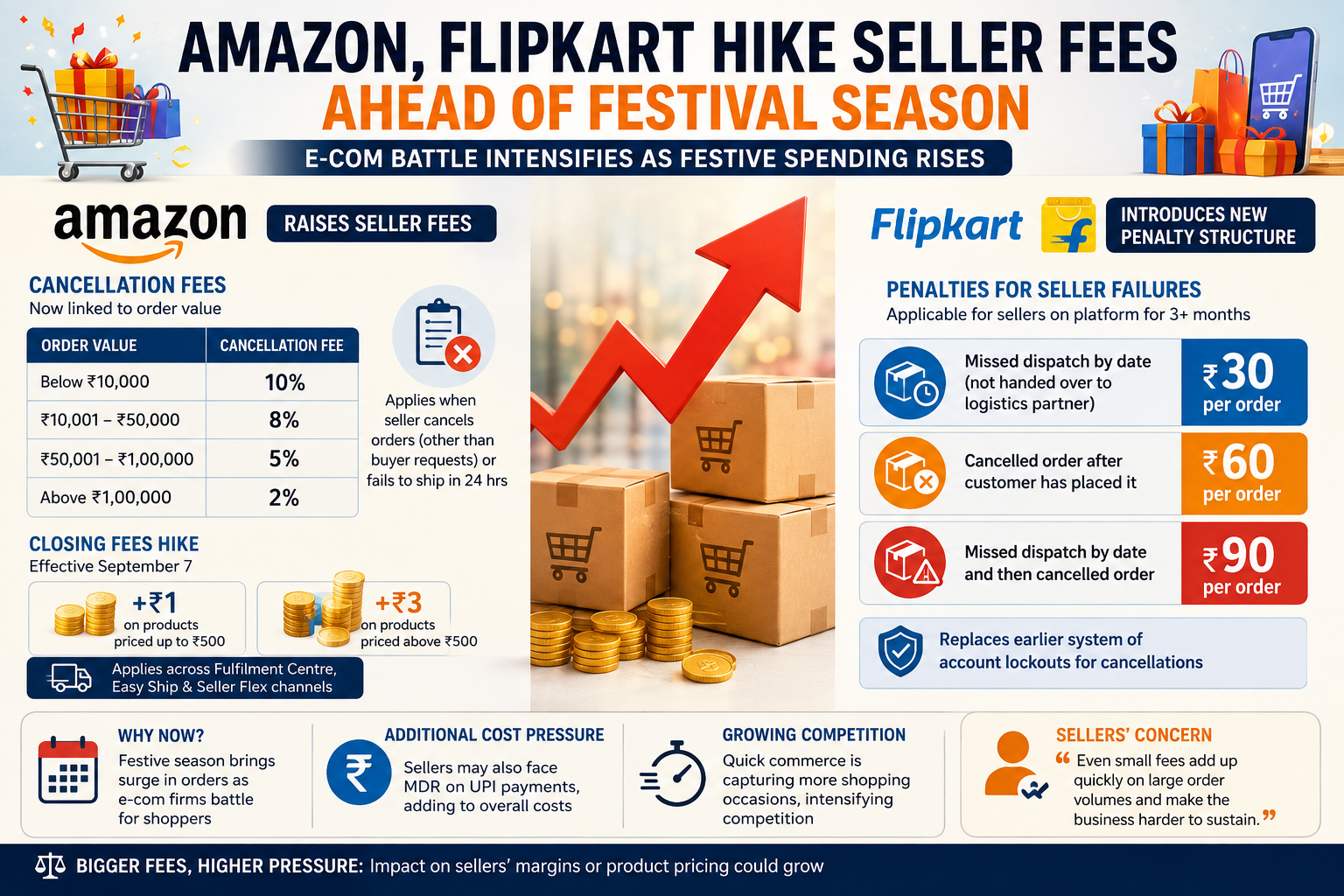
Why are Amazon and Flipkart increasing seller costs now?
The timing is important.
The festive season is one of the most important periods for Indian e-commerce, with platforms preparing for higher order volumes and sellers trying to maximise sales.
But the sector is also facing growing competition from quick commerce, which is expanding beyond groceries and entering more shopping categories.
One seller said e-commerce platforms are under pressure to acquire customers ahead of the festive season, particularly as quick commerce captures more shopping occasions.
The higher fees could therefore serve two purposes: increase platform revenue and discourage seller cancellations or fulfilment delays.
Broader Impact on the Market
- E-Commerce Strategy: These adjustments allow platforms to optimize logistics networks, force sellers to maintain accurate inventory, and offset high promotional and customer-acquisition costs.
- Impact on Consumers: Because these multi-layered fee hikes directly hurt a seller’s contribution margin, many online merchants are expected to raise retail prices or limit festival discounts to protect their bottom line.
Sellers could face more pressure on margins
For sellers, the biggest concern is the cumulative impact of multiple charges.
A seller told Moneycontrol, “Fee hikes before the festive season are common, but for sellers operating on thin margins, the cumulative impact can be significant.”
The seller added that even small fees can quickly add up when order volumes are high.
This could force some merchants to reconsider discounts or adjust product prices to protect margins.
There is also a potential additional cost on the horizon.
Moneycontrol has reported that e-commerce sellers could face a merchant discount rate (MDR) on UPI transactions if such a charge is introduced.
The eventual impact would depend on the rate and how the cost is divided between platforms and merchants.
Amazon and Flipkart are taking different approaches
The two platforms are addressing seller behaviour differently.
Amazon’s revised cancellation fee is linked to order value, meaning the cost rises or falls depending on the value of the cancelled order.
Flipkart has adopted fixed penalties, with the maximum charge capped at Rs 90 per order.
For the platforms, both approaches could encourage sellers to improve dispatch reliability and reduce cancellations.
That becomes particularly important during the festive season, when delays or cancellations can quickly affect customer experience.
What does this mean for e-commerce investors?
For investors, the Amazon and Flipkart seller fee hikes highlight the increasing pressure on India’s e-commerce business model.
Higher seller fees could provide additional revenue for platforms, but excessive cost pressure could create challenges for merchants.
If sellers respond by increasing product prices, consumers could ultimately bear part of the additional cost.
At the same time, stronger fulfilment discipline could improve customer satisfaction and reduce order cancellations, potentially benefiting platforms during the high-volume festive period.
What traders should watch next
The biggest factor to watch is whether higher seller costs translate into better platform economics or weaker seller participation.
Investors should monitor festive-season order growth, seller activity, cancellation rates, fulfilment performance and platform revenue.
The growing threat from quick commerce will also remain important.
For now, Amazon and Flipkart appear to be balancing two objectives: winning more customers during the festive season while making sellers more accountable for fulfilment failures.
For sellers, however, the message is clear. Higher order volumes may bring more sales, but the cost of every cancellation, delay and fulfilment mistake is also becoming more expensive.