Bankex Put Option Jumps 16,500% in Minutes — Traders Blame New Closing Auction
A Bankex put option delivered a stunning move on August 27, leaving traders trying to understand what had happened during the final minutes of trading.
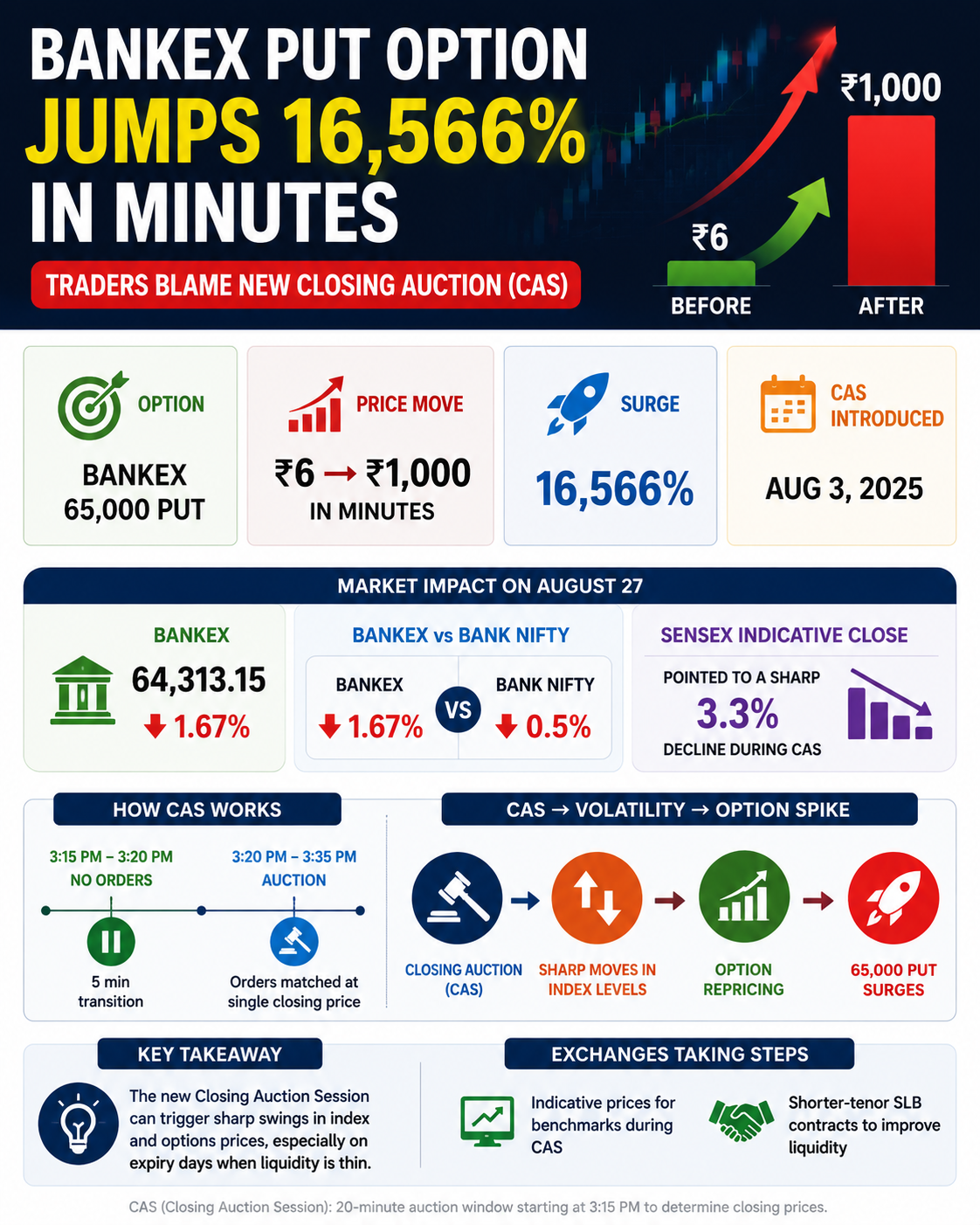
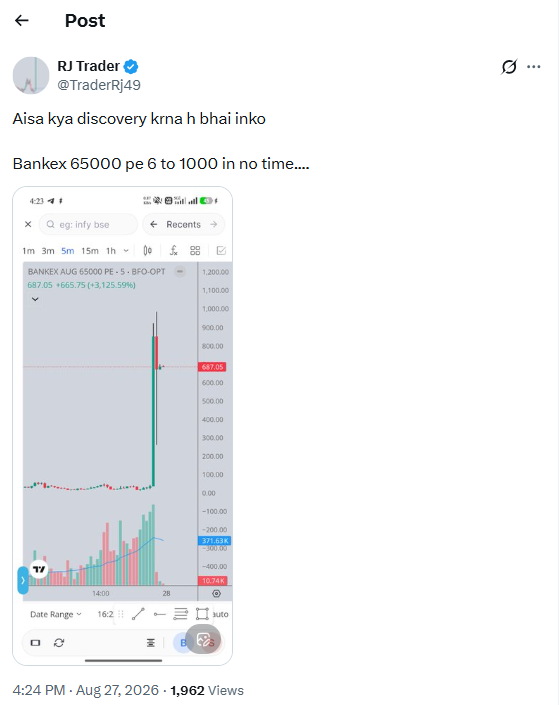
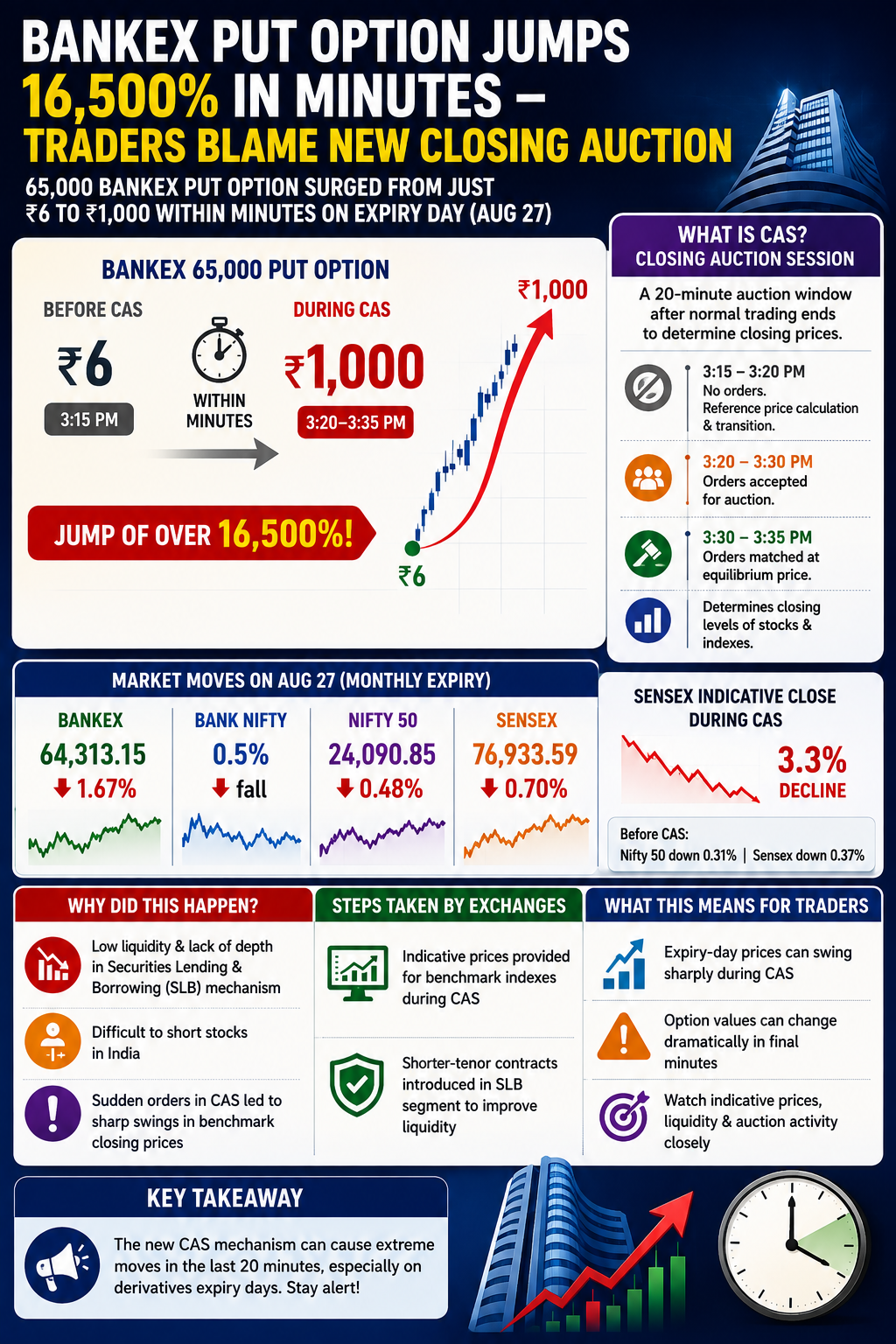
The 65,000 Bankex Put option surged from just Rs 6 to Rs 1,000 within minutes on the monthly derivatives expiry day. The extraordinary move was linked by traders to the newly introduced Closing Auction Session (CAS).
The episode highlights how sharply derivatives prices can move when liquidity is thin and benchmark closing prices change rapidly.
For options traders, the incident is also a reminder that expiry-day positions can behave very differently during the closing auction than during normal continuous trading.
Track Live : Sensex Levels Today
Bankex Put Option Jumps sees an extraordinary price swing
The 65,000 Bankex Put contract was reported to have risen from Rs 6 to Rs 1,000 within minutes.
Such a move can dramatically alter the value of an options position, particularly for traders holding contracts close to expiry.
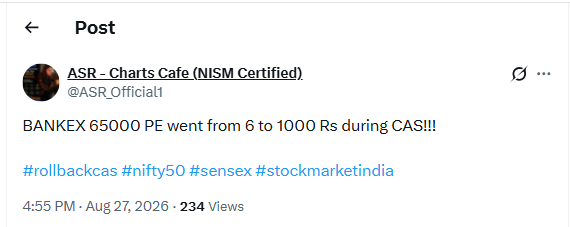
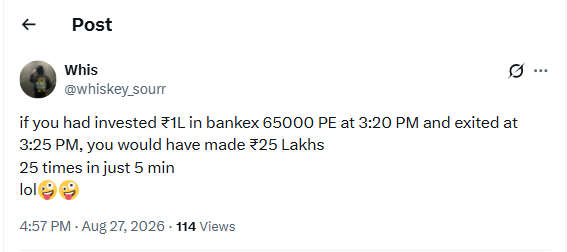
The disparity in Bankex option prices was subsequently highlighted on X by traders and market observers, with many questioning how such an extreme movement could occur in such a short period.
Traders attributed the unusual volatility to the impact of the new closing auction mechanism.
The move also demonstrates why expiry-day traders need to pay close attention to liquidity, order depth and the benchmark price used to determine the final settlement.
What happened on August 27
- The Bankex 65,000 Put reportedly jumped from around ₹6 to ₹1,000 within minutes during the monthly expiry session.
- The new Closing Auction Session (CAS) began on August 3 and runs from 3:15 pm to 3:35 pm for eligible cash-market securities.
- During the initial 3:15–3:20 pm transition period, no orders are accepted, followed by the auction order-entry and matching periods.
- On Thursday’s expiry, the Sensex experienced an extraordinary late-session swing, falling more than 2,000 points in roughly six minutes before recovering part of the move.
- The Sensex’s indicative closing level was pointing to a roughly 3.3% decline during the auction, compared with a much smaller decline immediately before it.
Read More : ITC Infotech Nears Happiest Minds Takeover: Rs 390-400 Deal, Delisting Likely
Why can a ₹6 option become ₹1,000?
The important mechanism is price discovery in the underlying stocks.
CAS changes how closing prices for eligible cash-market stocks are determined. The auction uses orders to establish a single equilibrium closing price, rather than simply relying on continuous-market trading. NSE specifies a ±3% CAS price band from the reference price for eligible stocks.
When several Bankex constituents experience sharp price movements during the auction, the indicative value of the Bankex can move sharply. That can dramatically change the theoretical value of an expiry-day put option.
For a 65,000 PE, even a relatively small change around the strike can have an enormous effect because the option is approaching expiry. If the index suddenly moves below the strike, its intrinsic value can jump rapidly.
So the chain is essentially:
CAS → sharp closing-price discovery in stocks → Bankex indicative value swings → expiry option repricing → extreme move in 65,000 PE
Nifty and Sensex also showed sharp swings
The unusual Bankex movement came against a volatile closing session for India’s benchmark indices.
On August 27, the Bankex fell 1.67% to 64,313.15, compared with a 0.5% decline in Bank Nifty.
The broader benchmarks also ended lower. The Nifty 50 fell 0.48% to 24,090.85, while the BSE Sensex declined 0.7% to 76,933.59.
The key point for traders was what happened during the closing auction.
Before the auction began, the Nifty 50 and Sensex were down around 0.31% and 0.37%, respectively. The Sensex’s indicative closing level subsequently pointed to a much sharper 3.3% decline during the auction session.
That difference created uncertainty for traders holding positions into the final minutes.
Track Live : NSE Option Chain — Live
How the New Closing Auction Session (CAS) Works
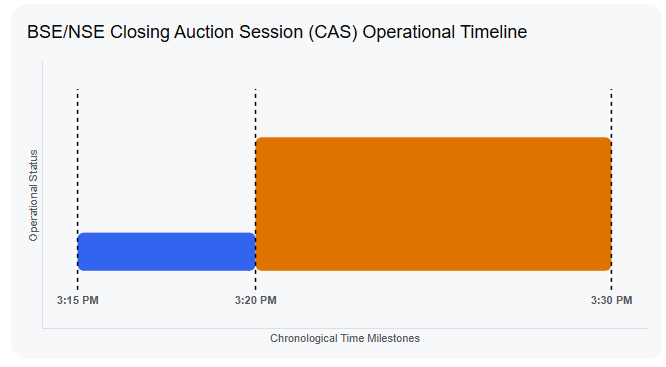
- 3:15 PM – 3:20 PM (The Freeze): Regular continuous trading ends. Order entry is blocked for 5 minutes while the exchange calculates reference prices and prepares the order book for the auction.
- 3:20 PM – 3:30 PM (The Auction): Orders are accumulated and matched at a single equilibrium price to establish the official closing price of the day, rather than using a simple 30-minute volume-weighted average.
X Platform by Traders and Market Observers
Why the new CAS mechanism is creating concern
The Closing Auction Session was introduced on August 3, and the first few sessions saw sharp movements in the Nifty 50 and Sensex.
One factor being discussed by market participants is liquidity.
Analysts have attributed some of the volatility to a lack of liquidity and depth in India’s securities lending and borrowing, or SLB, mechanism. Limited availability in the SLB market can make it more difficult for traders to short stocks efficiently.
When liquidity is thin, relatively small changes in orders can potentially produce much larger price movements.
For options traders, this can become even more significant because index derivatives derive their value from the underlying benchmark.
- Weak Securities Lending & Borrowing (SLB): India’s SLB mechanism lacks depth and liquidity. Because it is highly difficult for market makers to short-sell and borrow shares instantly to counter wild upside moves, price discoveries during chaotic auctions break down.
- Indicative Price Lag: During the closing minutes, the “indicative close” for the BSE Sensex pointed to a massive 3.3% crash before stabilizing. These lagging indicators spark panic among algorithmic trading desks, triggering automated stops that worsen the sell-off.
- Exchanges’ Countermeasures: To address these wild swings, exchanges have begun providing real-time indicative benchmark pricing throughout the CAS window and introducing shorter-tenor SLB contracts to make share borrowing more accessible.
Exchanges have already introduced measures
The sharp volatility has prompted exchanges to take steps aimed at making the closing auction more transparent and improving market functioning.
According to a Reuters report, exchanges have introduced measures including providing indicative prices for benchmark indexes during the closing auction session.
Shorter-tenor contracts have also been introduced in the SLB segment to improve liquidity and make securities borrowing more accessible.
These measures are intended to reduce uncertainty and improve price discovery during the closing process.
However, traders are likely to continue watching the behaviour of index derivatives closely, particularly around monthly and weekly expiries.
What the Bankex option move means for traders
The Rs 6-to-Rs 1,000 move is an extreme example, but the broader lesson is important.
Expiry-day traders should not assume that prices seen during regular trading will behave normally once the market enters the closing auction. A sudden change in the underlying index can produce significant changes in the value of near-expiry options.
For option buyers, extreme movements can create very large gains, but such situations are highly unusual and difficult to predict. For option sellers, sudden volatility can sharply increase risk.
Investors who hold index-linked positions should therefore watch indicative closing prices, liquidity and auction-session developments rather than relying only on the pre-3:15 pm market level.
Here’s what happened today and why traders reacted
The sharp move occurred during the final part of Thursday’s trading session as the market transitioned into the new CAS mechanism.
The CAS is a 20-minute auction window beginning at 3:15 pm, after regular trading ends. It is designed to determine the closing prices of stocks and consequently influence benchmark index levels.
However, the transition does not happen immediately.
Between 3:15 pm and 3:20 pm, orders are not accepted. These five minutes are used to calculate reference prices and shift the market from continuous trading into the closing auction.
That unusual trading structure became particularly important on the monthly Bankex expiry day.
CAS could remain a key market trigger in coming sessions
The Bankex expiry episode puts the spotlight firmly on India’s new Closing Auction Session.
While the mechanism is designed to improve price discovery at the close, the early volatility shows that traders are still adapting to the new process.
For now, the key focus will be whether the extreme swings seen in benchmark indices and derivatives moderate as market participants become more familiar with CAS.
For traders, the message is clear: the final 20 minutes of the trading day now deserve much closer attention, especially on derivatives-expiry sessions.