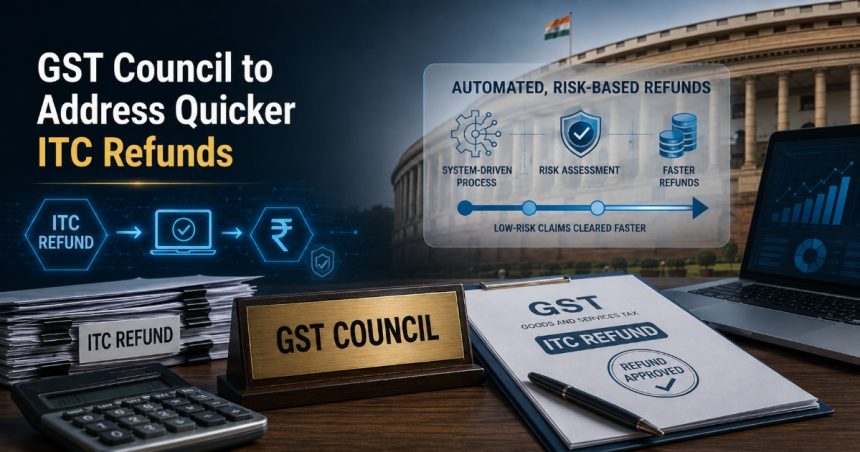
New GST Refund System May Get Major Overhaul: 90% Claims Could Be Automated Within Days
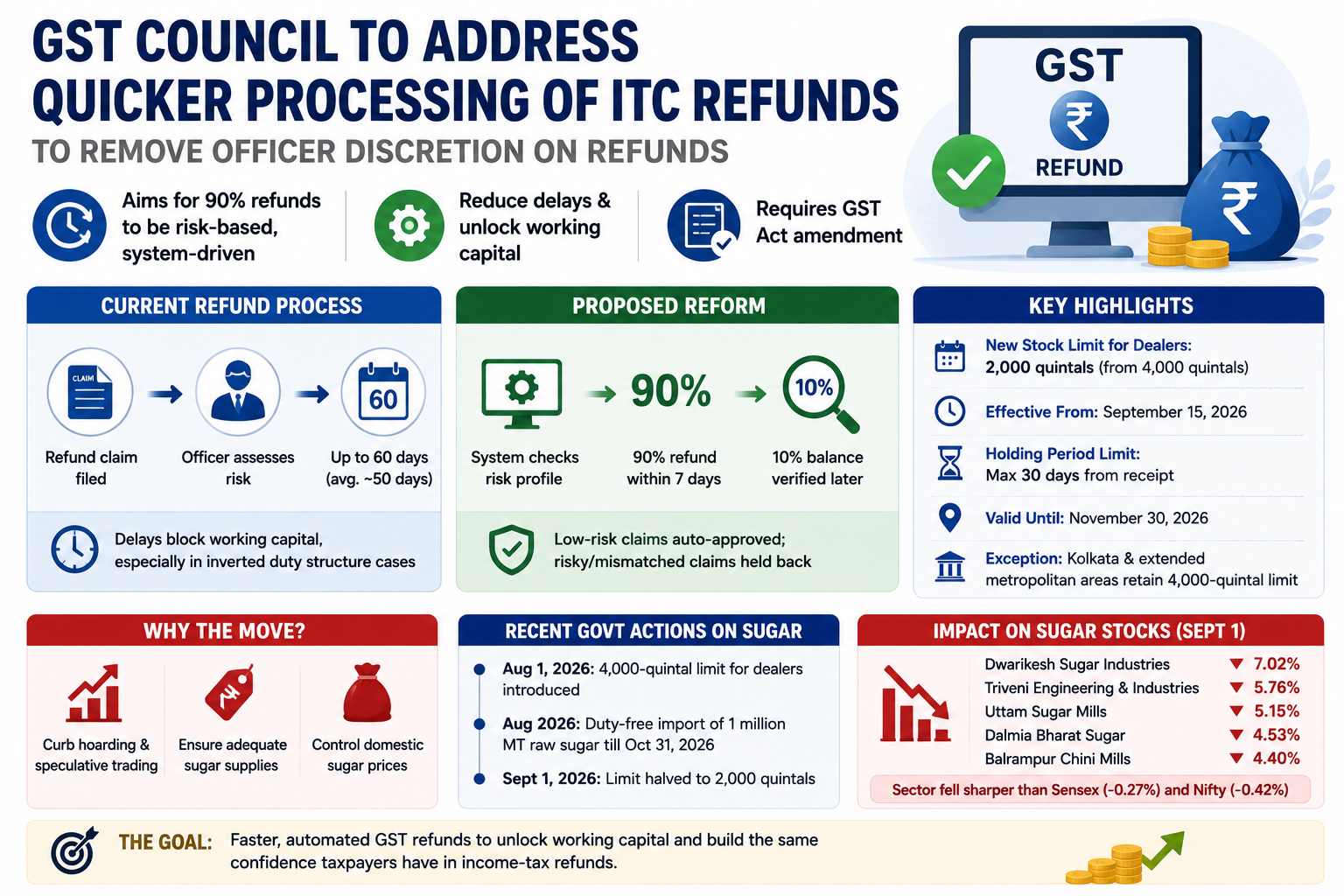
Businesses could soon get faster access to money locked up in GST input tax credit (ITC) refunds, as the GST Council is expected to consider a system-driven mechanism that would reduce officer intervention and speed up low-risk claims.
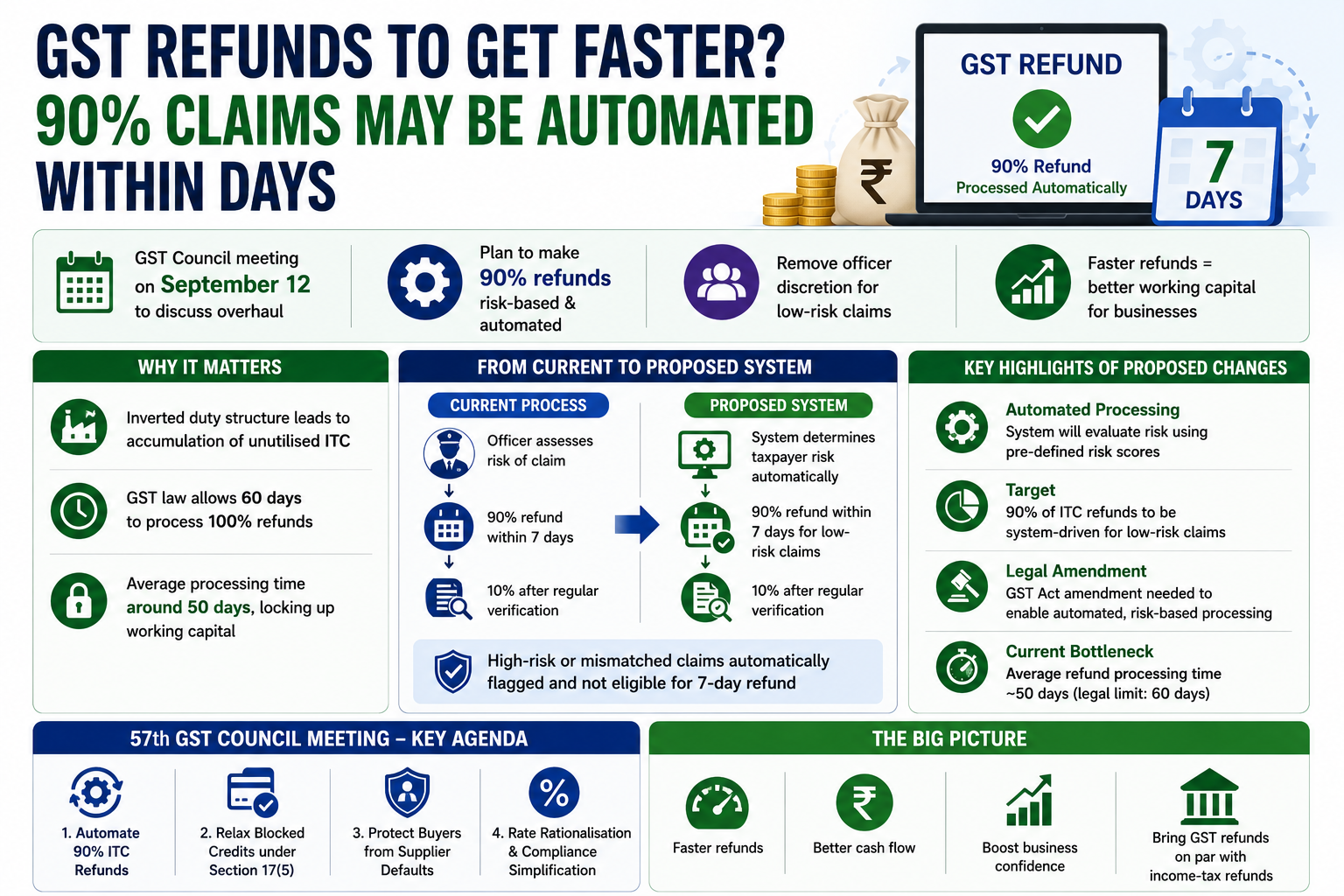
The proposal, likely to come up at the GST Council meeting on September 12, could make 90% of eligible refunds risk-based and automated. For businesses, especially those dealing with an inverted duty structure, the change could provide a meaningful working-capital boost.
The bigger question is whether the proposed system can finally turn GST refunds from a lengthy administrative process into a faster, more predictable one.
Track Live : NSE F&O Lot Size
Why inverted duty structure businesses are particularly affected
The issue is especially relevant for companies facing an inverted duty structure.
This happens when the GST rate paid on inputs is higher than the GST rate charged on the finished product. As a result, businesses accumulate unutilised ITC that they may become eligible to claim as a refund.
While the money is ultimately refundable, businesses can face a significant waiting period before receiving it.
“The difference is not immediately returned to the taxpayer as cash and, therefore, working capital gets stuck,” the government source explained.
For businesses operating with tight cash-flow cycles, even several weeks of delay can increase financing requirements and put pressure on liquidity.
GST refunds can currently take around 50 days
The GST framework provides a 60-day window for processing 100% of a refund claim.
However, government data cited by the source indicates that the average processing time is around 50 days.
“Our system shows that the average time taken is around 50 days… but it means that the taxpayer’s money remains stuck,” the official said.
The proposed automation is aimed at shortening this period, particularly for taxpayers whose claims carry low risk.
That could be beneficial for companies that regularly depend on GST refunds to maintain working capital.
Key Highlights of the Proposed Changes
- Automated Processing: The system will automatically evaluate a taxpayer’s risk profile using pre-determined risk scores, removing the need for physical officer assessments for provisional refunds.
- Targeted Speed: The Council aims to make 90% of ITC refunds entirely system-driven for low-risk claims.
- Legal Amendments: Implementing this shift will require an amendment to the GST Act to legally enable automated, risk-based processing.
- Current Bottlenecks: Right now, businesses (especially those under an inverted duty structure) face an average refund processing wait time of 50 days, against a legal limit of 60 days.
Full Agenda Details for the 57th GST Council Meeting
1. Complete Automation of 90% ITC Refunds
- The Upgrade: During the 56th meeting, a system-generated risk score framework was launched under an amended Rule 91(2). This system provisionally processed 90% refunds for low-risk exporters and inverted duty structure claims. However, final clearance still required physical tax officer validation.
- The Change: The Council is considering a formal amendment to the GST Act to make this process entirely hands-off. The system’s automated risk score will independently trigger the disbursement, completely cutting out manual officer discretion to reduce cash flow delays.
2. Relaxing Blocked Credits under Section 17(5)
- Company Vehicles: Exploring the eligibility of ITC on corporate vehicles used for employees.
- Employee Insurance: Evaluating permissions for ITC on mandatory group health and life insurance policies.
- Construction & Works Contracts: Reviewing the relaxation of credit blockages on immovable properties and works contracts—a highly litigated matter highlighted by courts (Safari Retreats case).
3. Protecting Buyers from Supplier Defaults
- The Current Issue: Under strict compliance rules, if a supplier collects GST from a buyer but fails to deposit it with the government, the innocent buyer’s ITC is frequently blocked or reversed.
- The Proposed Fix: In line with recent judicial benchmarks (Maruti Enterprises and Bhandari Scrap Traders), the Council will evaluate legal and technological patches to protect honest buyers. If the buyer can prove genuine purchases and clear transactions made through authorized banking channels, their credit claims will be legally protected.
4. Additional Cross-State and Corporate Easing
- Interstate ITC Transfers: For multi-state corporate entities, a mechanism for the seamless transfer of unutilised interstate ITC is on the table to prevent money from being trapped in inactive state ledgers.
- Corporate Guarantees: The Council plans to clarify and simplify the complex valuation and tax rules surrounding corporate guarantees provided by parent companies for their subsidiaries.
- Multi-State Registration: Small businesses and online sellers may receive provisions allowing easier multi-state GST registration to expand their trade footprint with minimal compliance friction.
The government already introduced 90% provisional refunds
The proposed reform builds on an earlier GST Council decision.
In September 2025, the Council approved a mechanism allowing 90% of eligible refunds to be sanctioned provisionally within seven days, initially for zero-rated exports and later extended to inverted duty structure claims from November 1, 2025.
The remaining 10% is subject to regular verification and processing.
The intention was to give businesses access to most of their money quickly while allowing tax authorities additional time to examine the balance.
“The proposal that was approved earlier provides for 90 percent of the refund to be given within seven days, with the remaining 10 percent to be processed subsequently within the prescribed time,” the source said.
However, the existing mechanism still involves officer intervention.
Track Live : Option Backtesting India (Build Right Strategy)
The new proposal could remove officer discretion
The major difference under the proposed system would be the removal of the initial officer-led risk assessment.
Currently, officers assess whether a taxpayer should qualify for provisional release of 90% of the eligible refund.
That manual step can potentially create delays.
“CBIC has already issued instructions in its jurisdiction for 90 percent of eligible refunds to be released within seven days,” the official said.
“The difference now is that we want to move away from the officer-led assessment towards a system-based process.”
Under the proposed model, automation would not mean every refund gets cleared automatically.
Instead, the system would identify risky claims, including cases where a taxpayer claims more credit than is available or admissible. Such claims would be held back for further scrutiny.
GST Act amendment will be required for automation
The proposed change would require an amendment to the GST Act, meaning the GST Council would need to approve the legislative change before the system can be implemented on a wider basis.
The government source described the proposal as a fast-tracking measure rather than a change that would create a revenue loss.
“For making the process fully system-driven, an amendment to the GST law will be required,” the source said.
The proposed amendment therefore becomes an important agenda item ahead of the September 12 GST Council meeting.
Faster ITC refunds could improve business cash flows
For businesses, the potential benefit is straightforward: faster GST refunds could release working capital earlier.
Companies currently waiting weeks for eligible ITC refunds could potentially deploy that money toward inventory, salaries, suppliers, expansion or debt reduction.
The impact could be particularly relevant for sectors where input taxes regularly exceed output taxes.
However, the success of the proposal will depend on the accuracy of the government’s risk-based system. A system that correctly separates low-risk claims from suspicious or mismatched claims could significantly reduce delays without compromising tax compliance.
Read More : Sugar Stock Drops 7% as Government Cuts Dealer Stock Limit; Dwarikesh, Uttam Slide
What investors should watch after the GST Council meeting
The September 12 GST Council meeting will be the key near-term event.
Investors should watch whether the Council approves the proposed GST Act amendment, how quickly the automated risk-based mechanism could be implemented and whether the seven-day provisional refund process becomes more predictable.
The reform could be positive for corporate cash flows and working capital if implemented effectively.
The broader objective is to give taxpayers the same confidence they increasingly associate with income-tax refunds.
“The broader thinking is similar to the confidence taxpayers now have about income-tax refunds,” the source said. The aim is to ensure taxpayers are not worried about their money remaining stuck for long periods.
For businesses and investors, that could make faster GST ITC refunds more than an administrative reform — it could become a meaningful improvement in cash-flow efficiency across the economy.