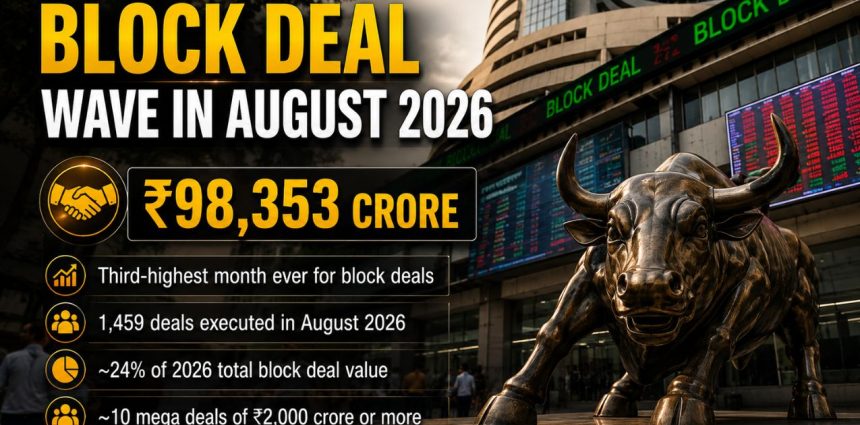
Synopsis: India’s block-deal activity surged to ₹98,353 crore in August 2026, making it the third-highest monthly total on record. But with the Nifty still under pressure, the bigger question is whether this was an exit wave or a large rotation of ownership as institutional buyers absorbed the supply.
Mumbai | September 2, 2026
India’s stock market saw an unusual contradiction in August: shareholders put nearly ₹1 lakh crore of stock through block deals, yet institutions continued to show up on the other side even as the benchmark Nifty remained under pressure.
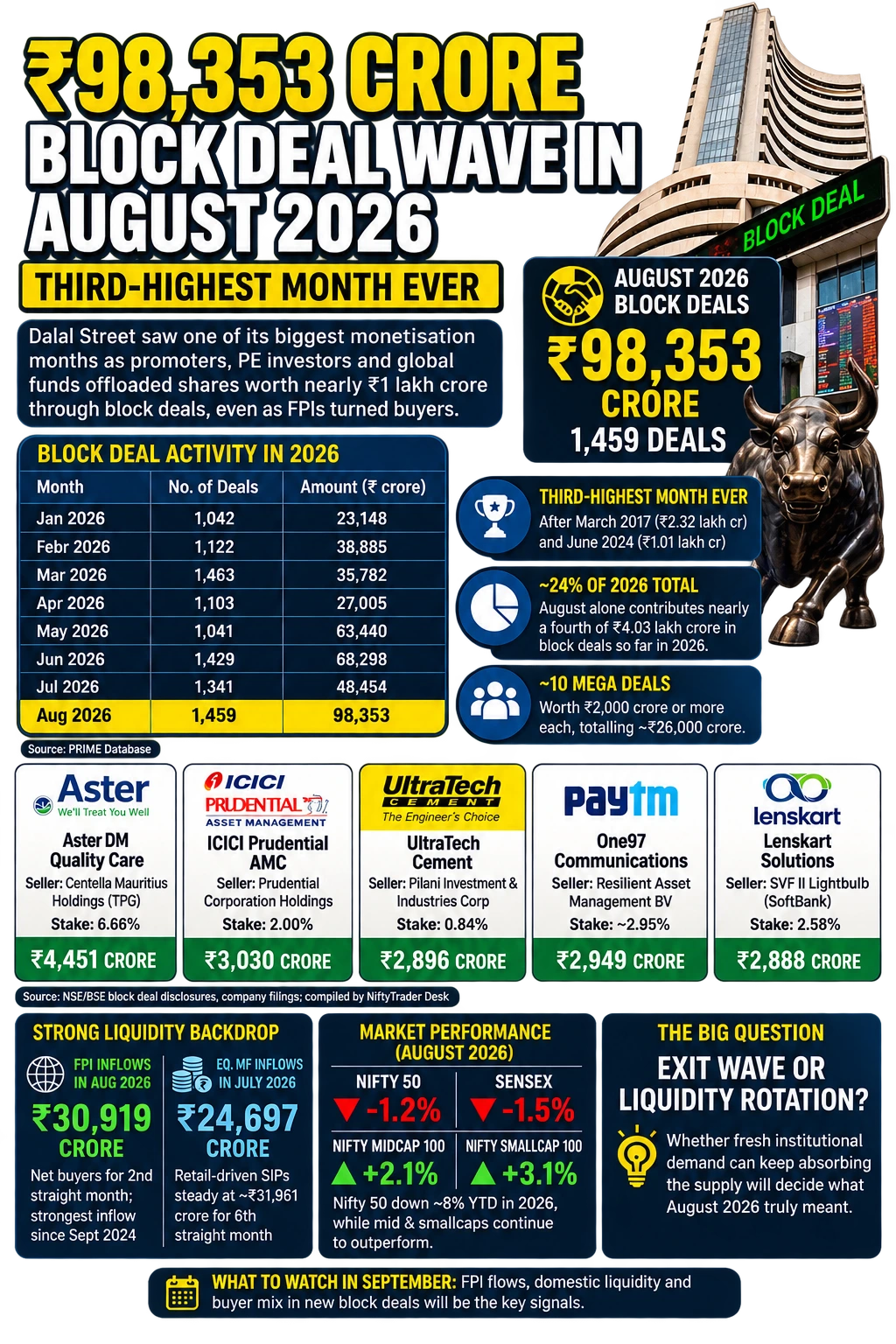
According to PRIME Database data, 1,459 block deals worth ₹98,353 crore were executed across the BSE and NSE during August. That was more than double July’s ₹48,454 crore and well above June’s ₹68,298 crore.
The August figure was the third-highest monthly block-deal value on record, behind March 2017 at ₹2.32 lakh crore and June 2024 at about ₹1.01 lakh crore.
But the headline number alone does not tell the full story.
The more important market question is, who is absorbing this supply?
That matters because August also saw foreign investors return to Indian equities, while domestic institutions continued to provide liquidity. If sellers are simply finding fresh buyers, the activity could represent a major transfer of ownership rather than broad-based capitulation.
Key Takeaways
- August block deals reached ₹98,353 crore, the third-highest monthly value on record.
- About 10 deals of ₹2,000 crore or more accounted for roughly ₹26,000 crore.
- TPG, Prudential, and SoftBank-linked entities were among the prominent sellers.
- Foreign portfolio investors (FPIs) returned to buying in August, while domestic institutional liquidity remained important.
- The key September signal will be whether institutional demand continues to absorb large shareholder exits.
August Block Deals More Than Doubled From July
The scale of August’s activity stands out sharply against the previous two months.
| Month | Block Deal Value |
|---|---|
| June 2026 | ₹68,298 crore |
| July 2026 | ₹48,454 crore |
| August 2026 | ₹98,353 crore |
August’s total was more than 2x July’s level and around 44% higher than June.
The activity was not limited to a handful of transactions. Around 10 block deals of ₹2,000 crore or more together accounted for approximately ₹26,000 crore.
Even more striking, a single trading session on August 26 saw block-deal activity of more than ₹10,300 crore, involving companies including Avenue Supermarts, Groww parent Billionbrains Garage Ventures, PhysicsWallah, Rubicon Research, Welspun Corp and Viyash Scientific.
That points to a broader revival in large-ticket institutional transactions rather than an isolated one-off deal.
Five Big Deals That Defined August
Several transactions illustrate how ownership was changing hands across Indian equities.
Aster DM Quality Care: TPG Books ₹4,451 Crore
A TPG-affiliated entity, Centella Mauritius Holdings, sold about 5.81 crore Aster DM Quality Care shares, representing roughly 6.66% of the company, at ₹766.17 per share.
The transaction was worth approximately ₹4,451 crore.
The deal is significant because it represents a substantial monetisation by a large financial investor after a period of ownership and value creation.
ICICI Prudential AMC: Prudential Sells 2% Stake
Prudential Corporation Holdings sold approximately 98.85 lakh shares, equivalent to a 2% stake in ICICI Prudential AMC, for about ₹3,030 crore.
The shares changed hands at roughly ₹3,065.47 apiece.
The transaction was linked to Prudential meeting minimum public-shareholding requirements, making it more of a regulatory and ownership-structure transaction than a simple bearish call on the stock.
UltraTech Cement: ₹2,896 Crore Stake Sale
Pilani Investment and Industries Corporation sold around 25 lakh UltraTech Cement shares, representing approximately 0.84%–0.85% of the company, at ₹11,585 per share.
The transaction was worth about ₹2,896 crore.
On the buying side, HDFC Mutual Fund acquired around ₹1,500 crore worth of shares, while ICICI Prudential Mutual Fund bought roughly ₹400 crore.
That buyer mix is important: a large portion of the supply was absorbed by domestic institutional investors.
Paytm: ₹2,950 Crore Changes Hands
Around 1.92 crore shares of One97 Communications, the parent of Paytm, changed hands in an approximately ₹2,950-crore transaction on August 18.
The trade represented roughly 3% of the company.
The transaction involved Resilient Asset Management BV and was connected to the broader ownership structure involving Antfin.
Importantly, the transaction should not be interpreted as a direct reduction in Vijay Shekhar Sharma’s own holding.
Lenskart: SoftBank-Linked Entity Sells 2.58%
A SoftBank-linked entity, SVF II Lightbulb, sold approximately 4.5 crore Lenskart shares, or about 2.58% of the company, for roughly ₹2,888 crore.
The shares were sold at around ₹641.75 apiece.
The buyer base included a wide range of institutional investors, including Societe Generale, Goldman Sachs, Motilal Oswal Mutual Fund, Vanguard, Morgan Stanley, SBI Mutual Fund and HDFC Mutual Fund.
Again, the transaction highlights the same pattern: a large shareholder monetises while institutional capital takes the other side.
Foreign Investors Returned—but the 2026 Picture Is Still Weak
The block-deal surge also came at a time when foreign investors began returning to Indian equities.
FPIs recorded around ₹30,919 crore of net equity inflows in August, following approximately ₹20,200 crore of buying in July. This marked two consecutive months of FPI buying after four months of heavy selling.
But the broader 2026 picture remains considerably weaker.
Depository-based data showed foreign investors had still recorded a net equity outflow of roughly ₹2.23 lakh crore for 2026 through August.
The two figures should not be treated as contradictory. Exchange-based FII cash-market data and broader depository FPI data can differ because they cover different investment routes and transaction categories.
The important takeaway is simpler: August brought a meaningful improvement in foreign investor appetite, but it has not yet erased the year’s heavy withdrawals.
Domestic Institutions May Be the Other Half of the Story
Foreign investors were not the only source of liquidity.
The UltraTech transaction provides a clear example of domestic mutual funds absorbing substantial supply. Similar institutional participation has appeared across several large block transactions.
This matters because the ability of domestic institutions to absorb promoter, PE and strategic-investor exits can prevent large transactions from automatically translating into sustained open-market selling pressure.
In other words, a ₹3,000-crore stake sale does not necessarily mean ₹3,000 crore of fresh bearish positioning.
It can simply mean that one category of investor is exiting while another category is taking ownership.
Nifty Weak, But Mid- and Small-Caps Held Up Better
The block-deal surge also happened against a mixed market backdrop.
The Nifty 50 fell around 1.2% in August, while the Sensex declined about 1.5%.
But the broader market behaved differently.
The Nifty Midcap 100 gained around 2.1%, while the Nifty Smallcap 100 rose about 3.1%, extending its winning streak to five consecutive months.
That divergence is important.
If August’s large block transactions were being driven purely by broad-based risk aversion, weakness would be expected to spread more uniformly across market segments.
Instead, large-cap benchmarks remained under pressure while parts of the broader market continued to attract money.
This strengthens the possibility that capital was rotating between investors and segments rather than simply leaving Indian equities altogether.
Check Live: NIFTY50, SENSEX, FII DII DATA | NIFTYTRADER
IPOs and Secondary Sales Add Another Supply Layer
Block deals were not operating in isolation.
India’s primary market also remained active, with 21 mainboard IPOs raising around ₹21,000 crore in August, according to market data.
Across January-August 2026, PRIME Database data showed 60 IPOs had raised approximately ₹72,165 crore, with July and August accounting for a particularly large share of the activity.
This creates an important backdrop for listed stocks.
Investors are simultaneously dealing with:
- Large shareholder stake sales
- IPO supply
- Offers for sale
- QIPs and other equity fundraising
- Portfolio rebalancing by institutional investors
The key issue is therefore not simply how much stock is coming to market.
It is whether there is enough fresh capital willing to absorb it.
Also Check: Latest IPO GMP Today (Live IPO Grey Market Premium)
The ₹98,353-Crore Question: Exit Wave or Liquidity Rotation?
This is where August’s block-deal numbers become more interesting.
There are two possible interpretations.
Scenario 1: Liquidity Rotation
Large shareholders, including private-equity investors and strategic holders—are monetising positions after years of ownership.
Institutional investors, meanwhile, are willing to buy those shares at negotiated prices.
Under this scenario, the block-deal surge represents a transfer of ownership rather than a broad exit from Indian equities.
The buyer mix in transactions such as UltraTech and Lenskart supports this possibility.
Scenario 2: Exit Overhang
The alternative is that large investors are using strong liquidity windows to reduce exposure.
If FPI buying fades, domestic liquidity slows or valuations become less attractive, the market could struggle to absorb the next wave of large transactions.
That could create an exit overhang, particularly in stocks where multiple large shareholders are looking to monetise positions.
The difference between these two scenarios will not be visible in the ₹98,353-crore headline number.
It will be visible in who keeps showing up on the buy side.
September Could Decide What August Really Meant
For traders, three signals could matter more than the August block-deal record itself.
1. FPI flows
If foreign investors extend their July-August buying streak, institutional demand could continue providing an important liquidity cushion.
2. Domestic mutual-fund flows
Continued domestic institutional participation would make it easier for the market to absorb large shareholder exits without creating widespread price pressure.
3. Buyer mix in new block deals
This may be the most useful signal.
If upcoming transactions continue to attract mutual funds, global institutions, and long-only investors, August will increasingly look like a rotation of ownership.
If buyers become more concentrated among short-term or opportunistic investors while sellers keep increasing, the risk of an exit overhang rises.
What Traders Should Watch Next
The ₹98,353-crore August figure is therefore less useful as a standalone bullish or bearish signal.
Instead, traders should watch whether the supply-demand balance behind these transactions remains healthy.
A large block sale is not automatically bearish.
A large block purchase is not automatically bullish.
The market reaction depends on the quality of the seller, the identity and conviction of the buyer, the discount to the prevailing price, and what happens to the stock after the transaction.
For September, the crucial question is straightforward:
Can fresh institutional demand continue absorbing the shares being put up for sale?
If yes, August may ultimately be remembered as a month of ownership rotation and deep institutional liquidity.
If that demand starts weakening, the same ₹98,353-crore number could look very different in hindsight—as evidence of a much larger exit wave.
Methodology Note
The block-deal figures used in this article refer specifically to PRIME Database’s BSE/NSE block-deal series. Block-plus-bulk deal trackers can show different totals because definitions and coverage vary across datasets.
Read Next: Stocks to Watch Sept 2: TBZ, HDFC Bank, RIL as Oil Tops $95