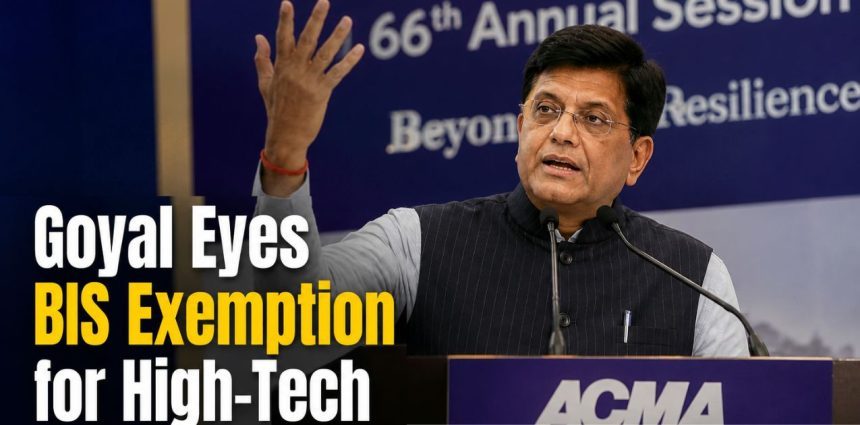
Synopsis: Commerce and Industry Minister Piyush Goyal said on September 2 that the government is preparing a regulation to ease BIS certification requirements for high-tech manufacturers, including semiconductor companies.
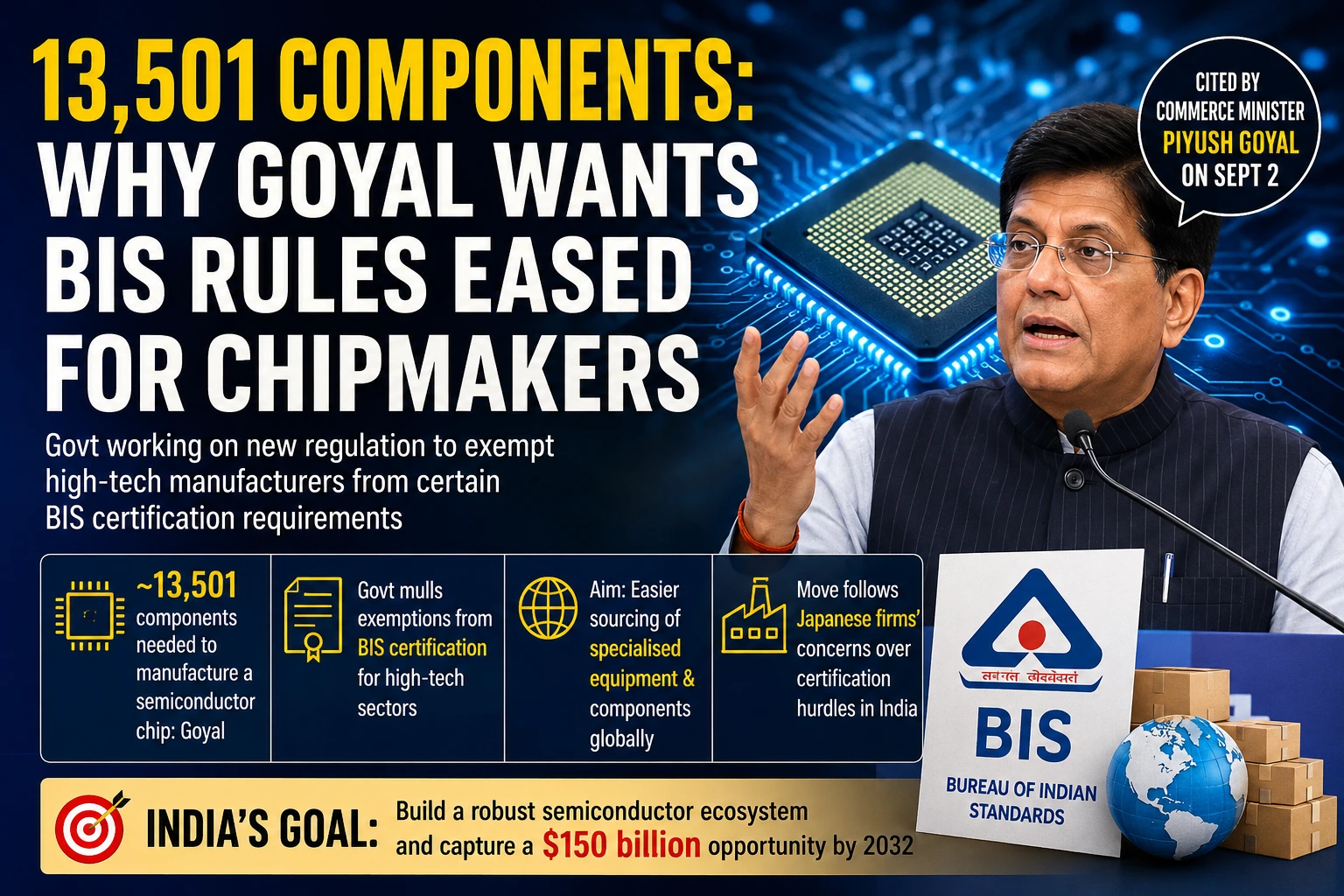
Goyal cited around 13,501 components that may be required to manufacture a semiconductor chip, highlighting the regulatory friction involved in setting up advanced plants. The proposal follows concerns raised by Japanese semiconductor companies during Goyal’s August Tokyo visit. The final scope and implementation of the exemption remain undecided.
Key Takeaways
- Commerce Minister Piyush Goyal said the government is preparing a new BIS exemption framework for high-tech sectors.
- Goyal cited roughly 13,501 components as an illustration of the scale of semiconductor manufacturing requirements.
- The figure comes from Goyal’s remarks and has been reported by multiple outlets; it should not be treated as an independently verified universal requirement for every chip plant.
- The proposal follows concerns raised by Japanese semiconductor companies over BIS certification requirements during Goyal’s August 25 Tokyo visit.
- The government has not yet published the final regulation, meaning the sectors, products, companies, and projects eligible for relief remain unclear.
- Any impact on auto-component and other technology-intensive industries will depend on how broadly the eventual framework is written.
13,501 Components Put India’s BIS Problem in Focus
India wants to build a larger domestic semiconductor industry. But before a chip can be manufactured, companies must establish facilities containing highly specialised machinery, tools, materials, and components sourced from global suppliers.
Goyal’s reference to around 13,501 components puts that complexity into a single number.
The minister said a semiconductor company requires roughly that number of components and argued that requiring BIS certification across such a large pool of specialised inputs could make the process unnecessarily difficult.
The number should be read as Goyal’s illustration of the sourcing challenge, rather than as an official technical standard. Multiple reports have carried the figure, but no public government document establishes 13,501 as a fixed requirement for semiconductor manufacturing.
That distinction matters because the government is still working on the regulatory framework.
Check Live: NiftyTrader: Live Options Analytics & F&O Trading Tools
What Goyal Said About BIS Relief
Speaking at the Automotive Component Manufacturers Association of India’s 66th Annual Session in New Delhi on September 2, Goyal said the government is coming up with a new regulation for high-tech sectors.
The proposed approach would allow eligible companies to source specialised equipment and components globally without facing the same certification burden applicable to products covered by India’s mandatory BIS requirements.
However, the exemption is not yet a blanket waiver.
The final rules will determine which sectors qualify, what types of equipment or components are covered, and whether exemptions are granted at the company, product, or project level.
That means companies cannot yet treat the proposal as an operational change in India’s import or certification rules.
Why BIS Requirements Became a Concern
BIS certification is generally voluntary unless the government makes compliance mandatory for specified products through notified requirements such as Quality Control Orders.
The issue for high-tech manufacturers is different from ordinary consumer-product certification.
Semiconductor plants use highly specialised equipment and components, many of which are sourced from global suppliers. Where applicable certification requirements cover such inputs, companies can face an additional compliance step while establishing facilities.
That creates a potential mismatch.
India wants to attract high-tech manufacturing quickly, but some of the technology needed to build those factories is itself imported.
The government’s proposed exemption is therefore aimed at reducing regulatory friction at the plant-setup stage.
Why Japan Triggered the Discussion
The BIS issue was already on the government’s agenda before Wednesday’s announcement.
During Goyal’s August 25 visit to Tokyo, Japanese semiconductor and AI companies raised concerns about certification requirements affecting specialised equipment and components.
Goyal said the government had directed the Bureau of Indian Standards and the Commerce Ministry to work on a framework that could provide exemptions at the company, industry, product, or project level.
The latest remarks in New Delhi indicate that the government is continuing to develop that framework.
Goyal has also highlighted India’s semiconductor opportunity, with demand projected to reach around $150 billion by 2032.
The Auto-Component Angle Could Be Bigger Than It Looks
The choice of venue for Goyal’s latest announcement is noteworthy.
He made the remarks at the ACMA annual session, putting the BIS issue directly in front of India’s automotive-component industry.
Modern vehicles increasingly depend on semiconductors, sensors, electronic control units, and other technology-intensive components. As automotive manufacturing becomes more electronics-heavy, suppliers are becoming increasingly dependent on specialised global technology and equipment.
If the eventual BIS framework extends beyond semiconductor projects, it could potentially help other advanced manufacturing segments source specialised inputs more efficiently.
But that is not yet government policy.
The final notification will determine whether the relief remains focused on semiconductor and other high-tech projects or reaches wider electronics and auto-component manufacturing.
India’s Semiconductor Bet Raises the Stakes
The BIS proposal comes as India is scaling up its semiconductor ambitions.
The first phase of the Semicon India programme was backed by a ₹76,000 crore government outlay. Under the next phase, Semicon 2.0, the government has approved a further ₹1,27,500 crore outlay covering areas including chip design, semiconductor manufacturing, equipment and materials, packaging, research and development, and talent.
That makes execution the next major test.
India’s semiconductor strategy is moving beyond attracting announcements and approvals. Projects ultimately need to move through construction, equipment installation, testing, and commercial production.
Removing unnecessary certification friction could help at one stage of that process.
It cannot, however, solve every challenge facing the industry.
What Investors Should Watch Next
For investors, this is best viewed as a policy and execution story rather than an immediate earnings trigger.
The most important monitorable is the final BIS framework.
Markets will want to know:
- Which high-tech sectors qualify?
- Will the exemption cover equipment, components, or both?
- Will companies receive automatic relief or require project-level approval?
- How quickly can manufacturers actually use the framework?
There is also a policy trade-off.
Easier access to global components could help companies establish high-tech facilities faster. But it could also reduce the immediate incentive to localise certain specialised inputs.
That leaves India balancing two objectives: accelerating high-tech manufacturing now while building a domestic component ecosystem over time.
The Bigger Question: Can BIS Relief Actually Speed Up Plants?
The proposed exemption solves a very specific problem, but its real value will be measured by what happens after the regulation is notified.
If specialised equipment and components can move into India with fewer certification hurdles, companies could gain more flexibility during the plant construction and commissioning phase.
But the expectation gap is important.
A regulatory exemption does not automatically translate into faster commercial production. Semiconductor projects still require enormous capital, technology partnerships, specialised infrastructure, skilled workers, supplier qualification, and lengthy production ramp-ups.
The forward-looking risk is therefore implementation.
If the final rules are narrow or require additional approvals, the practical benefit could be smaller than the headline announcement suggests. If the framework is broad and easy for qualifying manufacturers to use, it could strengthen India’s pitch to global semiconductor and advanced-manufacturing companies.
Bottom Line
Goyal’s September 2 announcement puts fresh momentum behind India’s plan to ease BIS certification requirements for high-tech manufacturing.
The 13,501-component figure gives the policy debate a striking scale, while concerns from Japanese semiconductor companies show that certification requirements have become part of India’s pitch to international manufacturers.
But this remains a proposal, not a completed exemption.
The next catalyst is the formal regulation. Its scope, eligibility rules, and implementation process will determine whether the move becomes a meaningful boost for semiconductor capacity or simply removes one layer of compliance.
For India’s manufacturing story, the real test is straightforward: can regulatory relief turn into faster plant execution and actual production?
Read Next: RBI Closed FCNR(B) Window as Inflows Surged Beyond Expectations
SEBI Disclaimer: This article is for informational purposes only and does not constitute investment advice. Readers are advised to consult a SEBI-registered financial advisor before making any investment decisions. NiftyTrader.in does not guarantee the accuracy or completeness of third-party data cited herein.