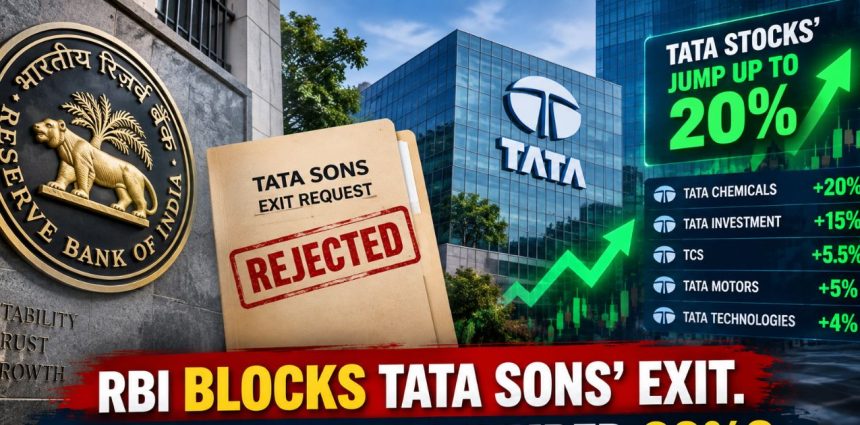
Tata Sons’ attempt to surrender its RBI registration has failed, reviving the mandatory-listing debate. Tata Chemicals hit a 20% upper circuit, and TCS rose 5.5%, while RBI has now filed a Bombay High Court caveat. But the biggest question is whether the market is pricing an IPO before Tata Sons has actually filed one.
Need to Know
- The RBI rejected Tata Sons’ request to surrender its Certificate of Registration (CoR) on September 11, 2026, leaving the company facing the regulatory framework applicable to NBFC-Upper Layer entities.
- Tata Chemicals jumped as much as 20% on September 15, while Tata Investment Corporation and other Tata-linked stocks also rallied; TCS rose as much as 5.5%.
- RBI has filed a caveat in the Bombay High Court, preparing to be heard before any interim order if the Tata Sons dispute reaches the court.
- Market estimates cited by ET put a potential Tata Sons valuation at ₹9–12.5 lakh crore, against an estimated underlying portfolio value of around ₹15–16 lakh crore. These are estimates, not a confirmed IPO valuation.
- Tata Sons’ board is expected to meet on September 17, making that date an important near-term monitorable. The same day, the NSE IPO is scheduled to open for subscription — NSE is not listing that day.
RBI’s Rejection Changes the Tata Sons Equation
Tata Sons has spent more than two years trying to avoid the consequences of its classification as an NBFC-Upper Layer entity.
The company formally applied on March 28, 2024, to surrender its CoR and move outside the registered CIC framework. Tata Sons had also reduced its debt materially as part of its effort to change its regulatory position. Earlier reporting showed the group holding company had repaid more than ₹20,000 crore of debt.
The strategy did not succeed.
The RBI has now rejected the surrender request and advised Tata Sons to take the necessary steps to comply with the rules applicable to NBFC-Upper Layer entities.
That is why the latest decision matters.
It does not mean Tata Sons has already launched an IPO.
It means the preferred regulatory route for avoiding the listing requirement has been rejected.
Also Read: RBI Rejects Tata Sons’ Exit Plan. The Listing Question Is Back
Tata Stocks Jump — But the Rally Is Not Uniform
The market reaction itself gives investors a clue about how traders are interpreting the news.
| Stock | September 15 move | Market relevance |
|---|---|---|
| Tata Chemicals | Up to 20% | One of the clearest Tata Sons value-unlocking proxies |
| Tata Investment Corp | Up to 15% | Strong holding-company exposure |
| TCS | Up to 5.5% | Major listed Tata Sons holding |
| Tata Motors PV | About 5% | Broader Tata listing sentiment |
| Tata Technologies | About 4% | Smaller Tata-linked stock |
The sharpest move came from Tata Chemicals, while TCS, Tata Motors PV and other Tata names also advanced.
The important point is that the market is not treating the Tata Group as one uniform trade.
The strongest moves are appearing in stocks that investors see as having a more direct connection to the Tata Sons valuation story.
Why Tata Chemicals Became the Market’s Favourite Proxy
Tata Chemicals has repeatedly emerged as one of the clearest listed beneficiaries of Tata Sons listing speculation.
During the March 2024 episode, the stock surged to ₹1,349.70 as investors reacted to reports that a Tata Sons listing could unlock value. ET reported a 34.5% three-day rise, while Business Standard reported a 27% gain over two sessions.
That history matters because it shows how quickly the market can price the possibility of a Tata Sons listing into Tata-linked stocks.
And it also shows the risk.
The trade can move faster than the corporate process.
2024 Gives Traders a Warning
The current rally has a precedent.
In 2024, Tata Sons listing speculation drove Tata Chemicals and other Tata-linked stocks sharply higher. But in September that year, Business Standard reported that Tata Sons had ruled out IPO plans while it continued to seek RBI approval to surrender its registration.
The lesson is not that the current rally will reverse.
The lesson is that Tata Sons listing expectations can move shares substantially before there is a completed transaction.
That makes the latest move particularly interesting.
This time, the RBI has actually rejected the deregistration route in writing.
RBI’s Bombay High Court Caveat Adds a New Layer
The latest development is not just the RBI rejection.
The central bank has also filed a caveat petition in the Bombay High Court relating to the Tata Sons listing matter.
A caveat is a precautionary legal step designed to ensure that the party filing it receives notice and an opportunity to be heard before a court considers relief in the matter.
The caveat does not mean Tata Sons has already lost a court case.
It also does not mean Tata Sons has already filed a challenge.
But it does suggest that the RBI is preparing for the possibility of litigation.
That changes the near-term equation from a simple regulatory decision into a potential regulatory-plus-legal process.
Can Tata Sons Still Challenge the RBI?
A judicial challenge remains possible, but the exact route and grounds would depend on Tata Sons’ response.
For investors, the more important point is that a court process could introduce another variable into the listing timeline.
That creates an expectation gap.
The market can price a Tata Sons IPO in minutes.
A regulatory and legal process can take much longer.
Tata Sons IPO Valuation: ₹9 Lakh Crore or ₹12.5 Lakh Crore?
This is where caution is essential.
Economic Times reported that bankers and valuation experts were estimating a potential Tata Sons valuation of ₹9–12.5 lakh crore, against an underlying portfolio value of roughly ₹15–16 lakh crore.
The difference reflects the discounts investors typically apply when valuing a holding company rather than directly owning its underlying businesses.
That means the ₹9–12.5 lakh crore range should be treated as a market estimate, not an announced IPO valuation.
There is currently no confirmation:
| IPO detail | Status |
|---|---|
| IPO announcement | Not formally announced |
| IPO price | Not announced |
| IPO size | Not announced |
| Listing date | Not announced |
| Potential valuation | ₹9–12.5 lakh crore reported estimate |
| Estimated underlying portfolio value | ₹15–16 lakh crore reported estimate |
This distinction could become especially important if Tata-linked stocks continue to rally before any formal filing appears.
What Tata Sons Owns — and Why It Matters
Tata Sons is the principal holding company of the Tata Group and owns major stakes across the conglomerate.
Trendlyne’s June 2026 corporate-shareholding data shows Tata Sons held large stakes in companies including Tata Capital and Tata Motors Commercial Vehicles, among others.
The reverse relationship matters too.
Earlier Tata Sons shareholding disclosures show Tata Steel and Tata Motors at around 3.06% each, and Tata Chemicals at around 2.53%.
That helps explain why Tata Chemicals and other Tata-linked stocks can react disproportionately when Tata Sons valuation expectations change.
Tata Trusts and Shapoorji Pallonji: Why Ownership Matters
Tata Sons has an unusual shareholder structure.
Tata says philanthropic trusts hold 66% of Tata Sons, while reporting has put the Shapoorji Pallonji group’s holding at around 18.37%.
That makes the listing debate bigger than a normal IPO.
A public listing could create a market value for an asset that has historically remained closely held.
For the Shapoorji Pallonji group, that could create greater liquidity and price discovery.
For Tata Trusts, the implications extend into governance, control and the future structure of the group.
That shareholder tension could influence not only whether Tata Sons lists, but also how any eventual transaction is structured.
September 17 Is the Next Date to Watch
Tata Sons’ board is expected to meet on September 17.
The meeting was already expected to address leadership and succession issues, and the RBI’s latest decision now makes the regulatory question an even more important backdrop.
But investors should not assume that September 17 means an IPO announcement.
The more meaningful signals would be any concrete board decision, regulatory-compliance step or disclosure regarding Tata Sons’ response.
The timing is also notable because the NSE IPO opens for subscription on September 17, although NSE is scheduled to list later.
Check Live: NSE IPO
What Could Happen Next?
| Scenario | What it would mean |
|---|---|
| Tata Sons moves towards compliance | Listing expectations could strengthen |
| A legal challenge emerges | The timeline becomes harder to predict |
| No immediate concrete action | Some of the event-driven premium in Tata stocks could cool |
| Formal listing process begins | Market attention could shift from speculation to valuation and issue structure |
The third scenario is the one traders should not ignore.
The current rally reflects expectations.
Expectations can remain elevated for a long time — or disappear quickly when the next corporate step fails to match what the market had priced in.
The Real Risk for Tata Stock Traders
The regulatory story has become more concrete.
But the timing risk has not disappeared.
Tata Chemicals has already gained 20% in one session.
The market therefore faces a familiar tension:
The expectation of value unlocking is immediate. The actual value-unlocking event is not.
If Tata Sons progresses quickly towards a formal listing process, the current rally could gain a stronger fundamental narrative.
If legal, governance or regulatory complications delay that process, some of the speculative premium could unwind.
That is why September 17 matters, not because an IPO is guaranteed that day, but because the next concrete signal could help the market distinguish probability from reality.
What Investors Should Watch
The key Tata Sons monitorables are now:
RBI: Further regulatory communication.
Bombay High Court: Whether a Tata Sons or shareholder challenge is filed.
September 17 board meeting: Any concrete decision or disclosure.
Tata-linked stocks: Whether the rally broadens or remains concentrated in the strongest proxies.
Valuation: Whether investors continue to use the reported ₹9–12.5 lakh crore range or apply a larger holding-company discount.
The Bottom Line
RBI has closed Tata Sons’ preferred route to escape the listing framework.
The market has responded immediately, with Tata Chemicals surging 20% and other Tata stocks moving sharply higher.
But the market is now facing an important expectation gap.
There is regulatory pressure. There is a possible legal battle. There is a huge valuation estimate. There is a board meeting ahead.
What there is not yet is a formal Tata Sons IPO filing.
That distinction could determine what happens next to Tata-linked stocks.
The latest rally may be the start of a genuine Tata Sons value-unlocking cycle.
Or it may once again prove that the market can run far ahead of the corporate event itself.
For now, the next signal matters more than the next rumour.
Read Next: HDFC Bank CEO Race Meets an Oil Shock: 10 Stocks Facing Fresh Triggers
Disclaimer: This article is for informational purposes only and does not constitute investment advice.