Need to Know
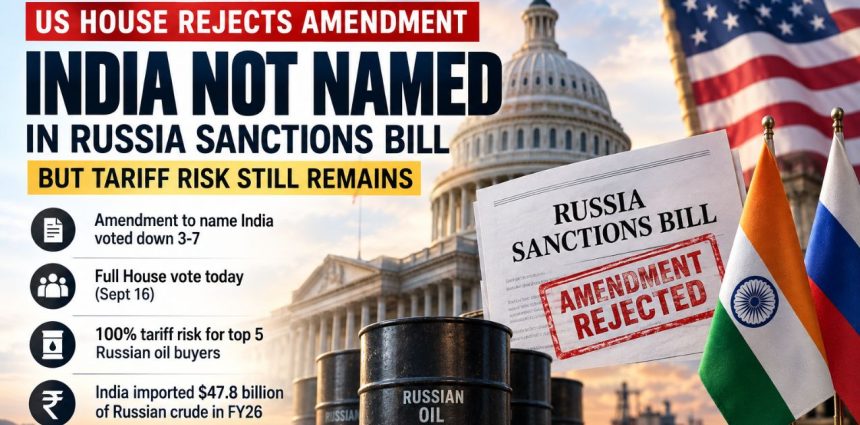
- The US House Rules Committee voted 3-7 to block an amendment naming India, China and eight other countries directly in the Russia sanctions bill
- The bill keeps the Senate’s original wording instead, a 100% tariff risk for whichever countries rank among the five largest importers of Russian oil or gas, with no country named
- The procedural rule for final passage cleared the House by just 214-211 on September 15, after two Democrats crossed over to back Republicans
- The full House votes on final passage today, Wednesday, September 16, under a closed rule that allows no further amendments
- India imported $47.8 billion of Russian crude in FY26, and Russia supplied over a third of India’s oil import bill by value in April alone
- The rupee closed at a record-low 95.92/USD on September 15, with Sensex down 778 points and Nifty down 280 points
Also Read: 100% Tariff Risk: Russia Sanctions Bill Stalls in US House, India Gets Reprieve
What Actually Changed This Week
India will not be named anywhere in the text of the Russia sanctions bill now heading to a final US House vote. A last-ditch attempt by Democratic lawmakers to write India, China and eight other countries directly into the legislation was voted down 3-7 by the House Rules Committee on Monday, clearing the way for the bill to reach the floor exactly as the Senate passed it in August.
That’s a meaningful correction to how this story has circulated in India this week. Coverage built around the amendment’s release tended to frame India as newly “named” in the Russia sanctions bill. In fact, the amendment naming India never survived the committee; what goes to the floor today is the original Senate language, which targets the five largest importers of Russian oil or gas by volume, not by name.
What the Rules Committee Actually Rejected
Two competing Democratic amendments were on the table, and both fell by the same 3-7 margin.
| Amendment | Sponsor(s) | What it proposed | Result |
|---|---|---|---|
| Amendment #1 | Rep. Steny Hoyer, with Rep. Marcy Kaptur | Name ten specific countries as tariff-eligible under Section 113 | Defeated 3-7 |
| Amendment #4 | Rep. Gregory Meeks, with four co-sponsors | Strike Section 113 entirely, removing the tariff authority | Defeated 3-7 |
The panel then cleared, 7-3, a rule sending the bill to the floor without either change. A US House committee rejected attempts to add amendments that would explicitly name India and other countries for potential tariffs under the bill, while also turning aside a rival proposal to remove the tariff powers altogether.
The full House adopted that rule the next day by 214-211, after first agreeing to the “previous question” by a similarly tight 214-208 margin, with the Rules Committee having reported the underlying rule 7-3 on September 14.
The Ten Countries That Nearly Got Named
Congressman Hoyer’s amendment would have written this list directly into the bill’s tariff-eligibility section: China, India, Turkiye, Azerbaijan, Hungary, the Slovak Republic, the UAE, Singapore, Kazakhstan and the Kyrgyz Republic.
| # | Country |
|---|---|
| 1 | China |
| 2 | India |
| 3 | Turkiye |
| 4 | Azerbaijan |
| 5 | Hungary |
| 6 | Slovak Republic |
| 7 | UAE |
| 8 | Singapore |
| 9 | Kazakhstan |
| 10 | Kyrgyz Republic |
None of these ten appear by name in the Russia sanctions bill that goes to the floor today. Tariff exposure is set by a rolling calculation instead of a fixed list.
Why India Stays Exposed Without Being Named
Losing the named-country label doesn’t mean losing the tariff risk. The bill still hands the President power to raise duties by up to 100% on any country that lands among the world’s five biggest buyers of Russian crude or gas, based on the trailing 12 months of trade, a list the US Trade Representative has to redraw every 180 days rather than fix once in the statute.
A country only ducks the trigger if it stops placing new Russian orders within 30 days of enactment; keep buying past that window, and exposure kicks in automatically.
Gas buyers get a narrow escape hatch if they take under 15% of Russia’s gas exports and are actively cutting back, crude, which is what India actually buys, gets none.
India has sat among the world’s top two Russian crude buyers since 2023, alongside China. That volume ranking, not any line of text, is what keeps India inside the bill’s target zone.
A Razor-Thin Vote Exposes a Fractured House
The 214-211 margin on the procedural rule is arguably the bigger story buried inside this week’s committee action.
Speaker Mike Johnson needed close to unanimous Republican support to move the Russia sanctions bill through regular order, and the final tally shows how narrowly that was held, the rule passed only after two Democrats broke ranks to vote with the majority.
Paired with the party-line 7-3 vote blocking both Democratic amendments, the sequence points to a House that largely agrees the bill should pass unchanged, while staying sharply divided over how much unilateral tariff power President Trump should get to enforce it.
Final Vote Today, Then a Seven-Week Recess
The House is expected to take up the final passage of the sanctions package on September 16, after debate on the rule began around noon local time on September 15.
Johnson is racing the calendar: the House breaks for recess on Thursday and, if the bill clears today, doesn’t reconvene until after the November midterms. Passage sends the bill to President Trump, who has publicly backed it, for signature.
India’s Russian Oil Bill: The Numbers That Matter
| Metric | Figure | Period |
|---|---|---|
| Russian crude import value | $47.8 billion | FY2025-26 |
| Russian crude import value | $5.79 billion | April 2026 (single month) |
| Russia’s share of India’s oil import value | 37.7% | April 2026 |
| Russia’s share of India’s oil import volume | 34.3% | April 2026 |
| Russia’s share of India’s total crude imports | ~35% | FY2024-25 |
| Growth in value of Russian crude imports | 96% CAGR | FY2019-20 to FY2024-25 |
| India’s overall crude import dependency | 88.2% | FY2024-25 |
| Russian crude inflow volumes | Fell from ~1.7 mbpd to ~1.0 mbpd before rebounding | 2025 into early-mid 2026 |
Russian oil accounted for about 35% of India’s total crude imports in FY2025, up from just 2% in FY2020, with the value of those imports growing at a 96% compound annual rate over five years, as India’s overall crude import dependency reached 88.2%.
Commerce Ministry data shows India imported Russian crude worth $5.79 billion in April 2026 alone, pushing Russia’s share of India’s oil import bill to 37.7% by value and 34.3% by volume that month.
Kpler tracking shows Russian crude inflows easing from around 1.7 million barrels a day in 2025 to roughly 1.0 million barrels a day in early 2026 amid sanctions pressure, tariffs, payment issues and shipping constraints, a market response to pressure, analysts say, rather than a deliberate pivot away from Russian oil.
Rupee, Sensex Slide as the Vote Nears
Indian markets were already on the back foot the day the procedural rule passed. Brent crude jumped 1.92% to near $107.71 a barrel on September 15 on escalating US-Iran tensions and fears of disruption through the Strait of Hormuz, the dollar index firmed to 99.61, and the Sensex tanked 777.94 points to close at 74,003.82, while the Nifty dropped 279.50 points to 23,118.60, with the rupee slumping 38 paise to a record closing low of 95.92 against the dollar.
Institutional flows split along familiar lines: FIIs were net sellers of ₹2,977.86 crore in the cash market that day, while DIIs stepped in as net buyers of ₹2,686.05 crore, cushioning the fall.
None of that slide can be pinned on the Russia sanctions bill alone; an Iran-linked crude spike and a cautious Fed did most of the work on September 15.
But a bill that extends Iran sanctions and threatens a 100% tariff on India’s largest crude supplier is exactly the kind of headline risk keeping a currency already at record lows from finding a floor.
Check Live: NIFTY50, SENSEX, FII DII DATA
Three Scenarios From Here for India
Today’s vote doesn’t close this story; it opens three fairly distinct paths for how the tariff risk plays out.
- The bill passes unchanged, and the formula does what a named list would have. Once signed, the USTR has 30 days before new Russian purchases start triggering exposure, then resets the top-five list every 180 days. At India’s current ~30-35% Russian share of oil imports, it would take a real, sustained cut in Russian barrels, not a change in law, to drop out of that zone.
- The bill stalls on the floor. A rule that cleared by three votes, and Democratic leadership publicly objecting to the scope of tariff authority, leaves real room for a closer-than-expected outcome. A delay past Thursday’s recess would push final action past the midterms and buy India months.
- The bill passes and becomes a negotiating lever rather than a trigger. The Senate text carries waiver provisions, and precedent backs this reading: an earlier 50% Russian-oil-linked tariff on India was cut to 18% in a February 2026 bilateral deal after India signalled it would scale back purchases. Enforcement, not statute, has repeatedly been where India’s real tariff number gets decided.
For traders, the number to track after today isn’t whether India is named in the bill; it isn’t, but where India sits on the USTR’s rolling five-country list once the bill takes effect.
Frequently Asked Questions
Is India named in the US-Russia sanctions bill?
No. The House Rules Committee rejected, 3-7, an amendment that would have listed India with nine other countries. The version going to the floor uses the Senate’s original language, targeting the top five Russian oil/gas importers by volume, unnamed.
Does that mean India is safe from the 100% tariff?
No. Section 113 still allows a 100% tariff on any country ranking among the top five Russian crude or gas buyers over a trailing 12 months. India has ranked in the top two since 2023, which keeps it exposed regardless of the statute’s wording.
When does the House vote on final passage?
Today, Wednesday, September 16, under a closed rule with no further amendments allowed. The House then recesses from Thursday until after the November midterms.
How much Russian crude does India actually import?
$47.8 billion in FY2025-26. In April 2026 alone, Russia accounted for 37.7% of India’s oil import value and 34.3% of import volume.
What happens after the House votes?
A passed bill goes to President Trump for signature. Implementation then shifts to the US Trade Representative, which must identify the top-five importer list on the bill’s timeline and recalculate it every 180 days.