Trump Threatens 100% Tariffs Over Russian Oil as India-US Trade Talks Move Forward
India’s trade outlook is entering a crucial phase. India-US trade deal talks are moving rapidly even as New Delhi faces fresh pressure from Washington over its purchases of Russian oil. For investors, the combination of strong export growth and uncertainty over US trade policy could influence export-oriented sectors and market sentiment in the coming sessions.
Track Live : NSE-Listed Companies and Indian Stock List
Trump Threatens 100% Tariffs: India-US trade deal talks move in the right direction
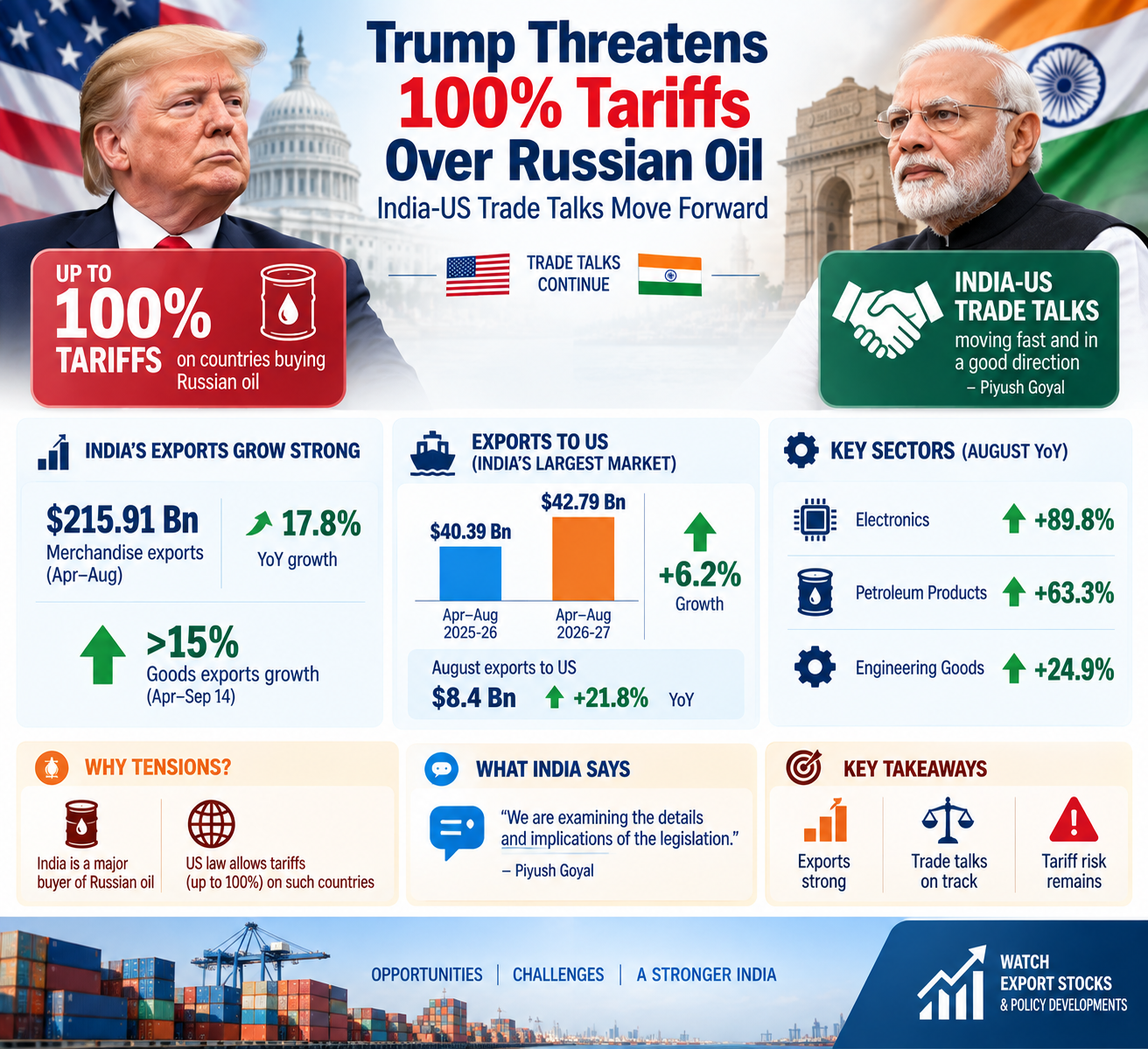
Commerce and Industry Minister Piyush Goyal said on September 22 that India-US trade talks were moving “fast” and in a “good direction”. He did not disclose the remaining areas of disagreement.
India and the US are negotiating a Bilateral Trade Agreement, with the US remaining India’s largest export market. Indian goods exports to the US increased to $42.79 billion during April-August, compared with $40.39 billion a year earlier.
The progress in trade negotiations comes at an important time for Indian exporters, particularly companies that depend heavily on overseas demand.
India’s exports maintain strong momentum
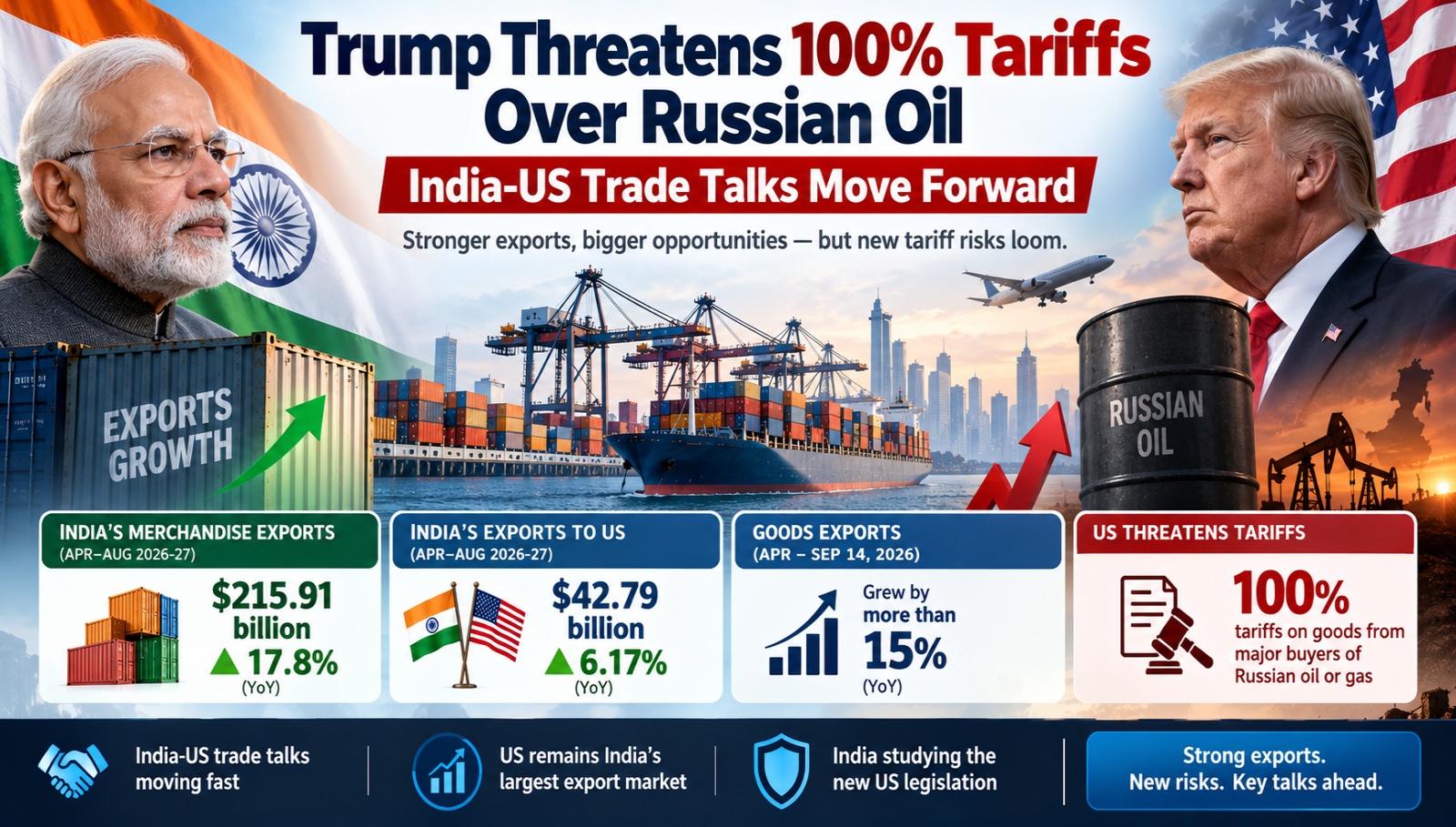
Goyal said Indian goods exports increased by more than 15% between April and September 14, compared with the corresponding period a year earlier. This follows merchandise exports of $215.91 billion during April-August, up 17.8% year-on-year.
The Commerce Ministry data also show that the US remains India’s largest export destination. Indian merchandise exports to the US reached about $42.79 billion during April-August, compared with $40.39 billion in the same period a year earlier.
August was particularly strong: India’s exports to the US rose 21.83% year-on-year to $8.4 billion, according to Commerce Ministry data. For April-August, however, the increase was more moderate at 6.17%, taking exports to roughly $42.8 billion.
Track Live : Intraday Stock Scanner: Live F&O Breakout Booster
- April–August Growth: India’s merchandise exports grew by 17.8% year-on-year, reaching $215.91 billion.
- September Mid-Month Trend: Between April and September 14, cumulative goods exports maintained a strong trajectory, growing by more than 15% compared to the same period last year.
Export-growth context: April–August 2026-27
| Indicator | April–August 2026-27 |
|---|---|
| Merchandise exports | $215.91 billion |
| YoY merchandise export growth | 17.85% |
| Total exports — goods + services | $399.27 billion |
| Total export growth | 15.55% |
| Non-petroleum exports | $180.61 billion |
| US exports | $42.79 billion |
The Commerce Ministry said merchandise exports increased from $183.21 billion in April–August 2025-26 to $215.91 billion in the same period of 2026-27, representing 17.85% growth.
Total exports, including merchandise and services, were estimated at $399.27 billion, compared with $345.55 billion a year earlier, translating into 15.55% growth.
What is happening with the trade agreement?
The two countries are still negotiating the BTA. Earlier this month, Goyal said the first tranche of negotiations had effectively been completed but that India was awaiting a framework from Washington that would provide preferential tariff treatment for Indian exports relative to competitors.
That makes tariff treatment an important issue to watch even as Goyal now describes the talks as moving quickly.
Russian oil has added a new complication
At the same time, Washington has introduced another potential source of uncertainty.
US President Donald Trump signed the Lindsey O. Graham Sanctioning Russia and Iran Act of 2026 on September 18. The legislation gives the US President authority to impose tariffs of up to 100% on goods from countries that are major purchasers of Russian oil or gas. India and China are among the major Russian crude buyers.
Importantly, the legislation does not automatically impose a 100% tariff on Indian goods. It gives the US administration authority to determine whether and how such tariffs would be applied. The law also provides a period before implementation, while the US administration identifies potentially targeted countries and tariff rates.
- The US Tariff Mandate: On September 18, 2026, US President Donald Trump signed new legislation granting the presidency broad executive authority to slap tariffs of up to 100% on goods coming from major buyers of Russian oil and gas.
- India’s Exposure: Because India and China stand as the world’s largest purchasers of Russian crude, India is directly vulnerable to these conditional sanctions.
- New Delhi’s Response: India has firmly communicated to Washington that executing these tariff measures could severely damage bilateral relations. The government reiterated its strict commitment to ensuring affordable energy security for its population.
India is studying the US legislation
Goyal said India is examining the details and potential implications of the new US sanctions legislation and would discuss the matter at an appropriate time.
India has also indicated that measures targeting its Russian oil purchases could affect bilateral relations, while maintaining that it needs affordable and reliable energy supplies from multiple sources. Reuters reported that Indian officials have raised concerns with Washington over the potential implications for trade and energy security.
Non-petroleum exports add important context
Non-petroleum exports stood at $180.61 billion, up 14.39% from $157.89 billion a year earlier. This is useful context because it shows that export growth was not solely dependent on petroleum products.
The August data also showed strong growth in several manufacturing-oriented categories. Electronic goods exports jumped 89.82%, petroleum-product exports rose 63.27%, while engineering-goods exports increased 24.86% year-on-year.
The US remains India’s biggest export market
The United States accounted for $42.79 billion of India’s merchandise exports during April–August, compared with $40.39 billion in the corresponding period a year earlier. That makes the ongoing India-US trade negotiations particularly important for Indian exporters.
Here’s what happened today and why traders reacted
The key market issue is the contrast between improving exports and rising trade uncertainty. Strong exports can support corporate revenue and foreign-exchange inflows, but the US policy on Russian oil purchases has created a fresh risk for India-US trade relations.
US President Donald Trump signed legislation on September 18 giving him authority to impose tariffs of up to 100% on goods from major buyers of Russian oil and gas, including India and China. The measure does not automatically impose a 100% tariff on Indian goods, leaving implementation to the US administration.
Goyal said India was studying the details and implications of the legislation and would discuss the issue “at an appropriate time”.
Read More : September 28 Bank Strike: Customers May Face 5 Days Without Normal Branch Services
What the trade developments mean for investors
For investors, India-US trade talks could remain a major market trigger. Progress toward a bilateral trade agreement could improve visibility for exporters, while any escalation over Russian oil could increase uncertainty for companies with significant US exposure.
Export-focused sectors and companies could therefore remain sensitive to every new development from Washington and New Delhi.
The next focus will be whether the trade negotiations continue to advance while India manages the Russian oil issue. For traders, currency movements, export stocks and sectors with high US revenue exposure may remain particularly important to track.