
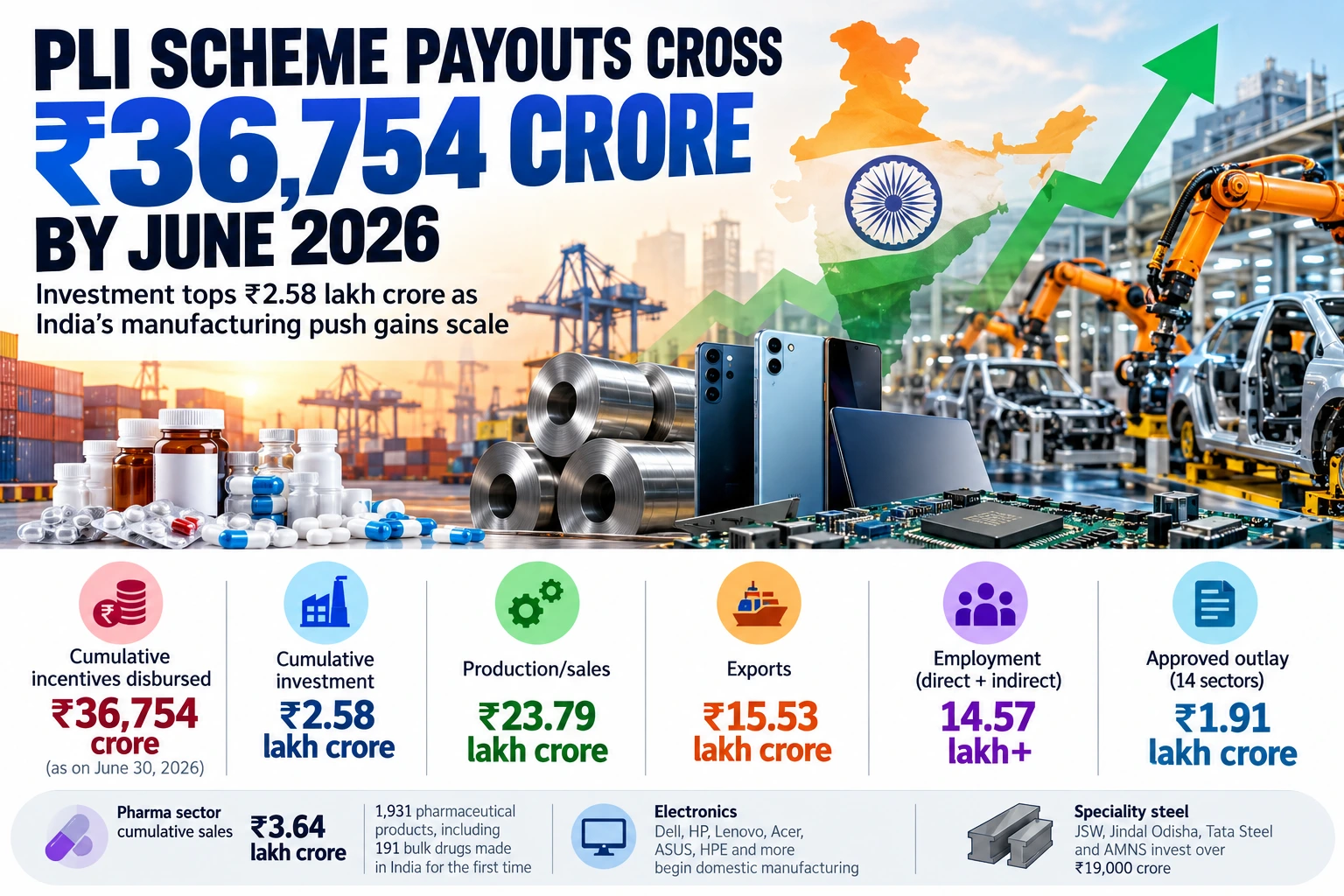
India’s Production Linked Incentive (PLI) scheme has disbursed ₹36,754 crore to beneficiary companies as on June 30, 2026, the Department for Promotion of Industry and Internal Trade (DPIIT) said on September 25.
Cumulative investment under the scheme has crossed ₹2.58 lakh crore, production and sales have touched ₹23.79 lakh crore, and exports stand at ₹15.53 lakh crore, but a comparison with the government’s own December 2025 update shows employment generation nearly flattened in the first half of 2026 even as capital deployment kept climbing.
The PLI scheme was launched in 2020 across 14 sectors with an approved outlay of ₹1.91 lakh crore, aimed at lifting India’s manufacturing base, drawing investment, boosting exports and cutting import dependence. Disbursements so far remain under a fifth of that outlay, underlining how far the scheme still has to run before its full financial commitment is paid out.
Need to Know
- Cumulative PLI disbursement: ₹36,754 crore as of June 30, 2026
- Cumulative investment: ₹2.58 lakh crore; production/sales: ₹23.79 lakh crore; exports: ₹15.53 lakh crore
- Employment generated: over 14.57 lakh (direct and indirect)
- Approved scheme outlay: ₹1.91 lakh crore across 14 sectors
- Pharma sector alone has logged over ₹3.64 lakh crore in cumulative sales under the scheme
- DPIIT has also launched a digital sponsorship-letter module for the e-B4 production investment visa
PLI Scheme at a Glance — June 30, 2026
| Metric | Figure |
|---|---|
| Approved outlay (14 sectors) | ₹1.91 lakh crore |
| Cumulative investment | ₹2.58 lakh crore |
| Production/sales | ₹23.79 lakh crore |
| Exports | ₹15.53 lakh crore |
| Employment (direct + indirect) | 14.57 lakh |
| Cumulative incentives disbursed | ₹36,754 crore |
| Pharma sector cumulative sales | ₹3.64 lakh crore |
Source: DPIIT statement, September 25, 2026.
The Headline Numbers, Six Months Apart
The table below sets the June 30, 2026 snapshot against DPIIT’s last comparable update, released for the period ended December 31, 2025.
Investment and production both kept climbing at a similar pace to the prior period, but employment added only about 18,000 net jobs in six months, versus roughly 2.4 lakh added in the nine months before that, per the government’s own successive releases.
NiftyTrader has not seen an official government explanation for the slower jobs print; it may reflect measurement timing, project completion cycles, or genuine saturation in labour-intensive onboarding, and should be read as an observation rather than a conclusion.
| Metric | Dec 31, 2025 | Jun 30, 2026 | Change |
|---|---|---|---|
| Cumulative investment | ₹2.16 lakh crore | ₹2.58 lakh crore | +₹0.42 lakh crore |
| Production/sales | ₹20.41 lakh crore | ₹23.79 lakh crore | +₹3.38 lakh crore |
| Employment (direct + indirect) | 14.39 lakh | 14.57 lakh | +0.18 lakh |
| Applications approved | 836 | Not disclosed in this release | — |
Sources: DPIIT press releases dated December 2025 and September 25, 2026.
Disbursement itself has moved faster in percentage terms than jobs: cumulative payouts stood at ₹21,534 crore as on March 2025, per an earlier DPIIT update, meaning the ₹36,754 crore figure marks roughly 70% growth in payouts over the following 15 months.
Pharma, Medical Devices See the Deepest Localisation
The pharmaceuticals PLI vertical has recorded cumulative sales of over ₹3.64 lakh crore, DPIIT said, with 1,931 pharmaceutical products now made domestically — including 191 bulk drugs manufactured in India for the first time. That builds on India’s broader push to cut reliance on imported active pharmaceutical ingredients.
In medical devices, DPIIT pointed to technology-transfer tie-ups involving Siemens, Wipro GE and Philips that have enabled domestic manufacture of CT and MRI systems, cath labs and ultrasonography equipment, with associated PLI beneficiaries generating ₹6,475 crore in domestic sales, ₹560 crore in exports and ₹1,400 crore in implant-linked revenue.
These figures appear narrower in scope than the medical-devices PLI scheme’s total cumulative sales reported in earlier government data (over ₹10,400 crore as on March 2025), suggesting they cover a specific subset of imaging and implant beneficiaries rather than the full scheme; NiftyTrader could not independently verify the exact scope from public disclosures and flags this for readers relying on the figure.
Electronics and Speciality Steel Deepen Their Supply Chains
On electronics, DPIIT said global brands including Dell, HP, Lenovo, Acer, ASUS and HPE have begun domestic manufacturing in India, directly or via local EMS partners, with PLI beneficiaries now producing AI servers, SSDs, memory modules, power adapters, battery packs and display panels.
In speciality steel, DPIIT named JSW, Jindal Odisha, Tata Steel and AMNS as having invested over ₹19,000 crore combined, supporting value-added steel output for the automobile, defence, capital goods and renewable energy segments.
Track Live: Nifty Metal Sector Analysis — Live Performance, Constituent stocks
DPIIT Also Eases Visa Route for Foreign Technical Staff
Separately, DPIIT has launched an online module on the National Single Window System (NSWS) letting Indian companies generate digitally signed sponsorship letters for foreign professionals entering India for production-related work under the e-Production Investment Business Visa (e-B4 Visa).
The e-B4 category was introduced on November 29, 2025, replacing the earlier e-PLI business visa, and is open to PLI and non-PLI manufacturers alike. The module also supports supplementary sponsorship letters for foreign professionals visiting additional company sites.
Why It Matters for Markets
The data gives investors a mid-year checkpoint on a scheme that touches listed names across electronics manufacturing services, speciality steel, pharmaceuticals and auto components.
The investment and output trendlines remain intact, but the slower jobs addition and the still-modest 19%-of-outlay disbursement ratio are worth watching in sector commentary and management commentary through the rest of FY27.
Read Next: IDBI Bank Sale: Govt Reviews 60.72% Bids, ₹53,000 Cr Price in Focus
FAQ
Q1. How much has India disbursed under the PLI scheme so far?
A: ₹36,754 crore had been disbursed to beneficiary companies as on June 30, 2026, against an approved outlay of ₹1.91 lakh crore across 14 sectors.
Q2. How much investment has the PLI scheme attracted?
A: Cumulative investment stood at ₹2.58 lakh crore as on June 30, 2026, generating production/sales of ₹23.79 lakh crore and exports of ₹15.53 lakh crore.
Q3. How many jobs has the PLI scheme created?
A: Over 14.57 lakh direct and indirect jobs as on June 30, 2026, per DPIIT, up only marginally from 14.39 lakh reported for December 31, 2025.
Q4. What is the e-B4 visa linked to the PLI scheme?
A: The e-Production Investment Business Visa (e-B4), launched November 29, 2025, lets Indian companies digitally sponsor foreign technical professionals for production-related work; it replaced the earlier e-PLI business visa and covers both PLI and non-PLI manufacturers.
Q5. Which sectors have seen the biggest PLI-linked gains?
A: Pharmaceuticals (₹3.64 lakh crore cumulative sales, 1,931 products localised), electronics/IT hardware (Dell, HP, Lenovo, Acer, ASUS, HPE beginning domestic manufacturing), and speciality steel (₹19,000+ crore invested by JSW, Jindal Odisha, Tata Steel, AMNS) were specifically highlighted by DPIIT.
This article is for informational purposes only and does not constitute investment advice or a recommendation to buy or sell any security. Company names mentioned are cited for contextual and policy-reporting purposes only. Readers should conduct independent research or consult a registered financial advisor before making investment decisions.