
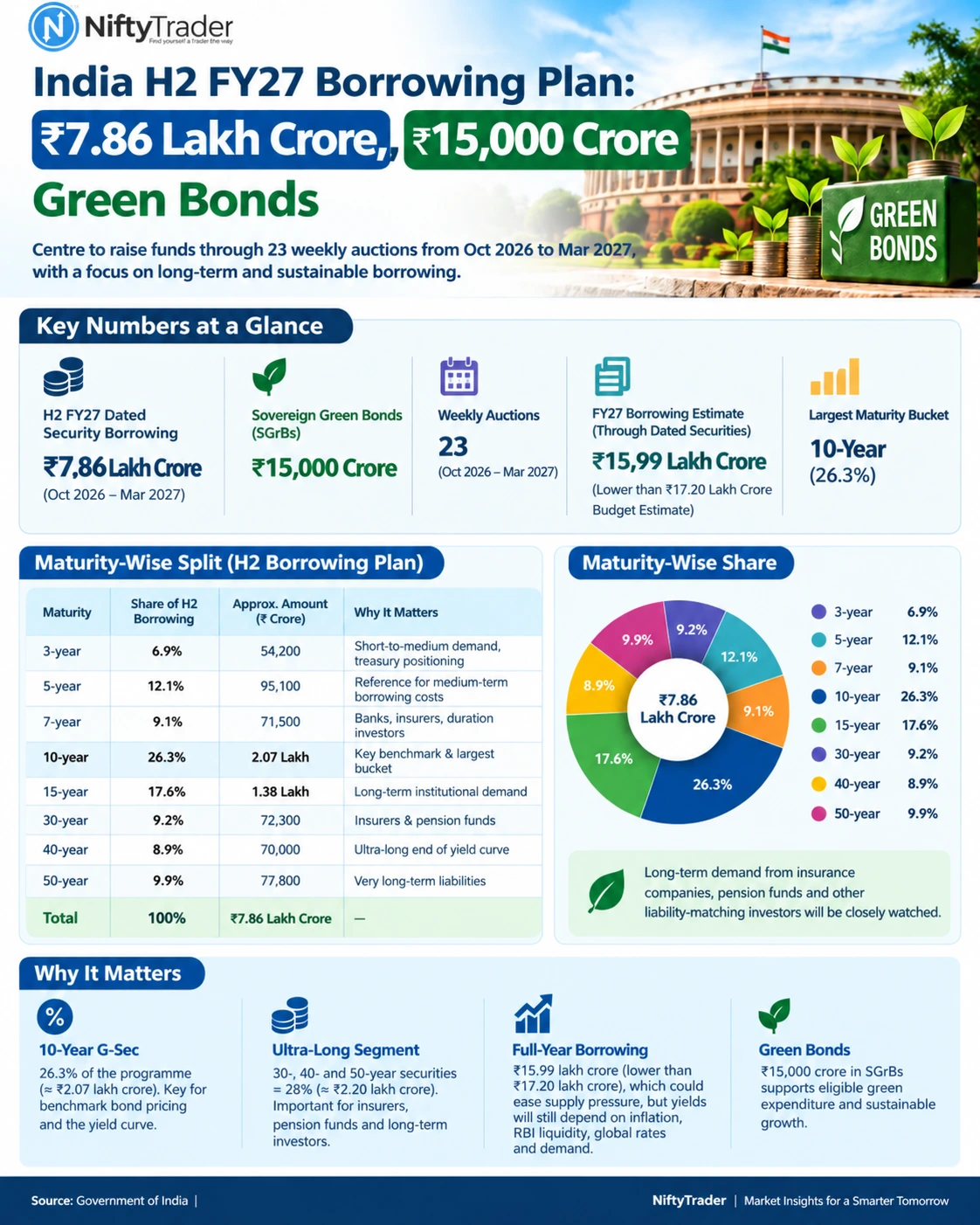
The Government of India will borrow ₹7.86 lakh crore through dated government securities in the second half of FY2026-27, including ₹15,000 crore through Sovereign Green Bonds (SGrBs). The borrowing programme will be completed through 23 weekly auctions between October 2026 and March 2027.
For FY27 as a whole, the Centre’s market borrowing through dated securities is expected to be about ₹15.99 lakh crore, lower than the Budget Estimate of ₹17.20 lakh crore.
The lower-than-budgeted borrowing requirement could reduce supply-related pressure in the government-bond market, although yields will continue to depend on inflation, RBI liquidity conditions, global interest rates and investor demand.
The H2 borrowing calendar spans securities with maturities of 3, 5, 7, 10, 15, 30, 40 and 50 years. The 10-year segment has the biggest allocation, making demand at benchmark-bond auctions especially important for the broader Indian yield curve.
Track Live: NiftyTrader: Live Options Analytics & F&O Trading Tools
Key Takeaways
H2 FY27 Borrowing: Maturity-Wise Split
The government will distribute its H2 borrowing across the yield curve instead of concentrating issuance in a single maturity.
This matters because different investor groups typically prefer different tenors: banks and mutual funds are active across short and medium maturities, while insurers and pension funds are significant buyers of longer-dated securities.
*Approximate values are calculated by applying the announced maturity share to the ₹7.86 lakh crore H2 borrowing plan. Minor differences may arise because of rounding.
The 10-year segment alone accounts for 26.3% of the programme, or roughly ₹2.07 lakh crore. The combined share of 30-, 40- and 50-year securities is 28%, equivalent to approximately ₹2.20 lakh crore. That means long-term demand from insurance companies, pension funds and other liability-matching investors will be closely watched.
Why the 10-Year G-Sec Matters
The 10-year Government of India security is the most closely watched benchmark in the domestic bond market. Its yield influences borrowing costs across the economy, including:
-
Corporate bond yields.
-
State development loan pricing.
-
Bank treasury-book valuations.
-
Debt mutual-fund returns.
-
Infrastructure-finance costs.
-
Interest-rate expectations across financial markets.
-
Equity valuations, particularly for rate-sensitive sectors.
Because the 10-year bucket accounts for the largest share of H2 issuance, the market will closely monitor auction cut-off yields, bid-cover ratios and investor demand in this maturity.
A large allocation to the 10-year segment does not automatically mean bond yields will rise. The result depends on whether demand from banks, insurers, pension funds, mutual funds and other institutional investors is sufficient to absorb the supply at acceptable yields.
Also Read: RBI’s ₹1 Lakh Crore Liquidity Drain: Bonds, Banks and Rates in Focus
What Lower FY27 Borrowing Could Mean
The revised FY27 borrowing estimate of about ₹15.99 lakh crore is below the Budget Estimate of ₹17.20 lakh crore. In general, lower expected government-bond supply can reduce supply-related pressure in the bond market.
However, the direction of yields will not be decided by the borrowing calendar alone.
The more balanced interpretation is that the borrowing estimate could be supportive at the margin, but it does not guarantee lower bond yields.
Sovereign Green Bonds: ₹15,000 Crore in H2
The H2 borrowing programme includes ₹15,000 crore through Sovereign Green Bonds. These are Government of India securities whose proceeds are earmarked for eligible green expenditure under the government’s green-finance framework.
Sovereign Green Bonds have the same sovereign repayment backing as other comparable Government of India securities. The difference is the intended use of the funds raised: proceeds are linked to eligible public expenditure with environmental or climate-related objectives.
The programme is significant because it can:
-
Deepen India’s domestic sustainable-finance market.
-
Create a sovereign benchmark for green financing.
-
Expand the investor base for climate-aligned securities.
-
Improve transparency around green public expenditure.
-
Support financing for eligible sustainable infrastructure and related expenditure.
Investors should not treat a green bond as a different credit-risk category from a conventional G-Sec of similar maturity. Both are backed by the Government of India; the distinction lies primarily in the use-of-proceeds framework.
Treasury Bill Borrowing in Q3
The Centre will also borrow ₹23,000 crore every week through Treasury Bills during the third quarter of FY27. The programme will run across 13 auction weeks.
Treasury Bills are short-term government securities with maturities of less than one year. They are used mainly for cash management, whereas dated securities are longer-term instruments used for the government’s broader funding programme.
At the announced weekly pace, gross Treasury Bill issuance in Q3 would amount to roughly ₹2.99 lakh crore across 13 auction weeks. This is a gross figure; the net impact depends on maturities, redemptions and other cash-management operations.
RBI Fixes H2 WMA Limit at ₹50,000 Crore
The Reserve Bank of India has set the Centre’s Ways and Means Advances limit at ₹50,000 crore for the second half of FY27.
Ways and Means Advances, or WMA, are temporary advances from the RBI that help the government manage short-term timing mismatches between its receipts and expenditure. For example, a large payment obligation may fall due before expected tax or other inflows arrive.
WMA should not be confused with the regular government borrowing programme. It is a short-term cash-management facility rather than a substitute for borrowing from the bond market.
The H2 WMA limit of ₹50,000 crore is lower than the ₹2.50 lakh crore limit set for the first half of FY27.
Switches, Buybacks and Greenshoe Flexibility
The government has retained the flexibility to conduct switches and buybacks of its outstanding securities.
A switch involves exchanging an existing government security for another one, often moving investors into a longer-maturity bond. This can help reduce the concentration of redemptions in a particular year.
A buyback involves the government repurchasing securities before they mature. Buybacks may help manage future repayment obligations, improve liquidity in selected securities and smooth the redemption profile.
The Finance Ministry has also retained the right to use a greenshoe option of up to ₹2,000 crore against each security specified in auction notifications.
A greenshoe option permits the government to retain additional subscriptions beyond the notified auction amount when demand is strong and bids are received at acceptable yields. It gives the issuer auction-level flexibility; it does not mean that the full additional amount will necessarily be accepted at every sale.
H1 Versus H2 FY27 Borrowing
The H2 borrowing plan follows the Centre’s H1 FY27 plan, under which the government intended to raise ₹8.20 lakh crore through dated securities in 26 weekly auctions. The H1 plan included ₹15,000 crore of Sovereign Green Bonds.
The H2 allocation places relatively greater emphasis on 15-year- and longer-dated securities than the H1 calendar. That may shift investor attention towards demand at the long end of the yield curve.
What Investors Should Watch
The borrowing announcement is an important input for fixed-income markets, but it is only one part of the broader rates outlook. Investors should track the following developments over the coming months:
-
G-Sec auction cut-off yields
These reveal the yield levels at which the government is able to raise funds. -
Bid-cover ratios
Strong bid-cover ratios generally indicate healthy investor demand relative to notified supply. -
The 10-year G-Sec yield
This is India’s most important bond-market benchmark and will be a key indicator of how investors are absorbing supply. -
Demand for 30- to 50-year securities
The long-end allocation is substantial, making demand from insurers and pension investors crucial. -
RBI liquidity operations
Repo operations, liquidity-management measures and any open-market interventions can affect banks’ ability to buy government bonds. -
Inflation data and RBI policy expectations
Inflation expectations have a direct influence on long-term yields and duration risk. -
Crude oil, the rupee and global bond yields
These factors can affect India’s inflation outlook, capital flows and bond-market sentiment. -
Fiscal-deficit and tax-collection trends
Strong revenue performance can improve confidence that the government’s financing estimates remain achievable.
What It Means for Retail Investors
Retail investors should avoid making a portfolio decision solely because of a borrowing-calendar announcement. The implications differ depending on holding period, risk tolerance and the type of fixed-income investment.
Direct G-Sec investors
-
Investors holding a government bond until maturity receive the stated coupon and principal under the terms of the security.
-
Before maturity, bond prices can rise or fall as market yields change.
-
Longer-maturity bonds generally carry greater interest-rate sensitivity than shorter-maturity bonds.
-
An investor who may need to sell before maturity should understand the possibility of mark-to-market losses.
Debt mutual-fund investors
-
Liquid and overnight funds are driven mainly by short-term interest rates and liquidity.
-
Short-duration funds have lower interest-rate sensitivity than long-duration strategies.
-
Gilt funds and long-duration funds can gain when yields fall but may see sharper declines when yields rise.
-
Dynamic bond funds depend on the fund manager’s duration and curve-positioning decisions.
Also Read: Mutual Fund Inflows Surge as Debt Adds Rs 1.88 Lakh Crore, Small-Caps Lead
Bank fixed-deposit investors
Government borrowing affects the broader interest-rate environment, but it does not directly determine bank fixed-deposit rates. Deposit rates depend on banks’ funding requirements, credit growth, competition for deposits and overall liquidity conditions.
Equity investors
Bond yields affect equity valuations because they influence the discount rate applied to future earnings. Higher yields can put pressure on richly valued shares and interest-rate-sensitive sectors, while stable or lower yields may support sentiment. Earnings growth, sector-specific conditions and overall risk appetite remain equally important.
Track Live: Participant Wise OI — FII, DII, Client, Pro Positions Today
Bottom Line
India’s H2 FY27 borrowing calendar gives the market a clear schedule for the supply of government securities through March 2027. The Centre plans to raise ₹7.86 lakh crore through 23 weekly auctions, including ₹15,000 crore of Sovereign Green Bonds.
The full-year borrowing estimate of about ₹15.99 lakh crore is lower than the ₹17.20 lakh crore Budget Estimate. That could reduce supply-related pressure on the bond market, but it does not ensure lower yields.
The real test will be whether banks, insurers, pension funds, mutual funds and other investors absorb the supply comfortably—particularly in the benchmark 10-year bond and the 30- to 50-year ultra-long segments. Inflation, RBI liquidity management, auction demand, global yields, crude oil and currency movements will determine the market’s ultimate response.
Read Next: PLI Scheme Payouts Cross ₹36,754 Crore, Investment Tops ₹2.58 Lakh Crore