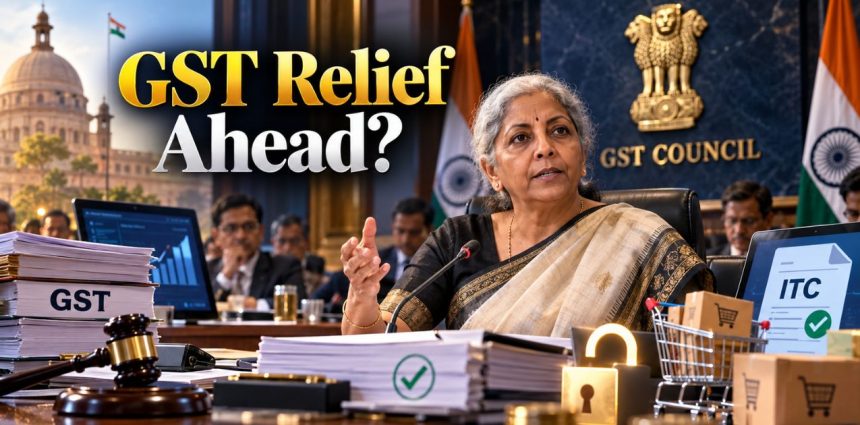
India’s next GST reform push could reshape how businesses claim input tax credit, receive refunds, register across states and deal with tax enforcement.
The October 7 GST Council meeting is expected to focus less on tax rates and more on how the GST system works for businesses.
The bigger question is how much blocked tax credit, working capital and compliance burden the government can remove from the system.
Around 9.5 lakh small e-commerce sellers could be among the biggest beneficiaries if the Council approves a proposal allowing qualifying sellers to use platform warehouses for GST registration in additional states.
Businesses could also see relief through wider input tax credit, protection for genuine buyers when suppliers default, faster refunds and changes to GST enforcement.
For employers, another proposal could potentially unlock more than ₹5,000 crore in value from group health insurance, according to an industry estimate cited by Financial Express.
However, all these measures remain proposals under consideration, not final GST rules.
GST Council, October 7: What Is on the Table?
The key proposals reportedly under discussion include:
- Wider input tax credit eligibility
- Easier registration for small e-commerce sellers
- Protection for genuine buyers when suppliers default
- Faster and more automated GST refunds
- Changes to GST arrest and prosecution provisions
- Relief from certain low-value tax disputes
- More targeted e-way bill checks
- Easier compliance for smaller businesses
The meeting therefore looks increasingly like a cash-flow and compliance reform meeting rather than another broad GST rate-reset exercise.
ALSO READ: GST Rate Changes: What You Need to Know
9.5 Lakh E-Commerce Sellers Could Get Relief
One of the most significant proposals could benefit around 9.5 lakh small online sellers.
Qualifying businesses may be allowed to use a verified e-commerce platform warehouse as their registered place of business in additional states instead of maintaining separate premises in every state where inventory is stored.
For small sellers, the benefit could go far beyond paperwork.
Maintaining separate physical arrangements across states increases the cost and complexity of national expansion.
A warehouse-based registration model could allow smaller businesses to store goods closer to customers and expand across India more easily.
If approved, it could remove one of the compliance barriers separating smaller sellers from large businesses with nationwide infrastructure.
Genuine Buyers Could Get ITC Protection
Another major proposal addresses a long-running GST problem:
Should a genuine buyer lose input tax credit because a supplier failed to deposit the tax?
Under the approach being considered, a bona fide buyer could retain otherwise eligible ITC where the transaction is genuine and properly documented.
Recovery action could instead be directed towards the supplier responsible for the default.
With GST authorities now having far more invoice-level buyer and seller data, the system may be able to identify suspicious credit closer to its actual source.
That could mark an important shift:
Protect the genuine transaction and pursue the actual defaulter.
The final safeguards will still be critical to prevent misuse through fake invoices or fraudulent transactions.
Blocked ITC Could Open Up
The Council may also consider widening input tax credit eligibility across several categories where credit is currently restricted.
Reported areas under discussion include:
- Employee group health and life insurance
- Telecom towers
- Certain pipelines outside factory premises
- Eligible vehicles and related expenses
- Certain free samples and expired goods
- Input services and capital-related expenditure in some cases
For businesses, blocked ITC effectively turns tax into an additional cost.
This becomes particularly important for capital-intensive companies and sectors where large amounts of credit remain accumulated.
Wider ITC and refund eligibility could therefore release money currently trapped inside the tax system.
₹5,000 Crore-Plus Corporate Insurance Opportunity
Employer-sponsored insurance could be one of the clearest beneficiaries.
Group health insurance premiums exceeded ₹68,000 crore in FY26.
At an 18% GST rate, the GST component on that premium pool is roughly ₹12,000 crore.
An industry estimate cited by Financial Express suggests that allowing eligible employers to claim ITC could unlock more than ₹5,000 crore in value from group health insurance.
The actual benefit would depend on the final eligibility rules and the amount of credit companies are able to utilise.
If approved, the move could lower the effective cost of employee benefits for corporates, MSMEs, banks, NBFCs, technology companies and manufacturers.
Telecom, Pharma and EVs Could Also Benefit
Capital-intensive sectors are also watching the Council closely.
Allowing greater ITC on telecom towers and related infrastructure could reduce the tax embedded in future network investment.
Meanwhile, sectors such as pharmaceuticals, textiles, fertilisers, renewable energy and electric vehicles could benefit if the refund mechanism for inverted-duty structures is widened.
For these businesses, accumulated tax credits can tie up working capital for long periods.
A key question will be whether relief eventually covers areas such as input services and capital goods, and under what conditions.
Faster GST Refunds Could Release Cash
The government is also considering greater automation of GST refunds.
Lower-risk businesses could potentially receive faster approvals, while higher-risk claims would remain subject to scrutiny.
This matters because a company may technically be entitled to a refund but still face a cash-flow problem if the money takes months to arrive.
For exporters and businesses that frequently accumulate refundable credit, faster processing could materially improve working capital.
Also Read: Why Is the Nifty Falling Despite GST +14.7%, PMI 55.1?
GST Arrest Powers May Face Changes
One of the most closely watched proposals involves GST enforcement.
The Council is expected to consider changes to GST arrest powers, including a proposal that could require judicial approval before an arrest is made.
The exact scope of any change remains subject to the Council’s decision and subsequent legal amendments.
The proposal would not remove tax recovery, interest or monetary penalties, while serious fraud and deliberate tax evasion would remain subject to the applicable criminal provisions.
The broader direction appears to be towards reserving criminal enforcement for more serious cases while relying more heavily on financial recovery and technology-led detection in routine matters.
₹5 Crore or ₹10 Crore?
The prosecution threshold remains unsettled ahead of the meeting.
Some reports point to a proposed threshold of ₹5 crore, while separate reporting on Law Committee recommendations has referred to ₹10 crore.
Neither figure should be treated as final until the GST Council makes its recommendation and the required legal changes follow.
This is one area where the final Council decision will be particularly important.
₹10,000 Disputes Could Face a New Threshold
The Council may also consider restricting certain GST demand notices involving amounts below ₹10,000.
The objective is to reduce disputes where the administrative and professional cost of handling the matter can exceed the tax amount involved.
For MSMEs, even a low-value GST dispute can generate professional fees, internal paperwork and repeated correspondence.
Reducing such cases could lower compliance costs while allowing tax officials to concentrate resources on larger and higher-risk matters.
E-Way Bill Checks Could Become More Targeted
The Council is also expected to examine changes to goods checks during interstate movement.
One reported proposal would reduce unnecessary intervention by transit states and place greater emphasis on originating and destination states, particularly where specific intelligence exists.
For logistics-heavy businesses, unnecessary vehicle stoppages can affect delivery schedules, inventory planning and transport costs.
A more targeted model could therefore reduce friction without removing enforcement where genuine risk exists.
Which Sectors Should Investors Watch?
If the reforms move forward, several sectors could see potential benefits.
Telecom: Lower tax friction on infrastructure and network investment.
Insurance and corporate employers: Potential ITC on group health and life insurance.
IT and GCC-linked businesses: Possible improvements in GST treatment of qualifying cross-border services.
Pharma, renewables and EVs: Wider refunds could release working capital.
E-commerce and MSMEs: Easier multi-state registration could lower the cost of national expansion.
But investors should separate a policy benefit from an immediate earnings benefit.
Final eligibility conditions, implementation dates and whether relief applies to existing credit will determine the actual impact on companies.
The risk for investors is that headline reform may not translate into immediate earnings if eligibility is narrow, implementation is delayed or businesses cannot fully utilise the additional credit.
Track Live:
What Happens on October 7?
The GST Council meeting on October 7 will determine which proposals move forward.
Some changes could potentially be implemented through rules, notifications or administrative processes.
Others — particularly reforms involving arrest powers, prosecution provisions and certain cross-border GST rules — may require amendments to the law.
Businesses and investors should therefore watch three things:
- Which proposals the Council actually approves
- Whether relief applies only going forward or also to existing claims
- How quickly notifications and legal changes follow
A Council recommendation should not automatically be treated as an immediately effective GST rule.
What GST 2.0 Could Mean for Businesses
October 7 could be an important GST meeting even without another major change in tax rates.
The biggest potential benefit is straightforward:
less money trapped in blocked credit, delayed refunds and compliance processes.
If the Council widens ITC, protects genuine buyers, simplifies e-commerce registration and speeds up refunds, businesses across several sectors could see meaningful working-capital relief.
But the real impact will depend on the details.
How much credit becomes usable? Who qualifies? Will relief apply to existing claims? And how quickly can businesses actually access the benefit?
Those answers will determine whether the October 7 reforms become a major GST 2.0 milestone or a more limited compliance reset.
Until the Council announces its decisions, all reported measures should be treated as proposals rather than final policy.
Read Next: Orient Cables IPO Listing: Shares Debut 65% Higher at ₹450, Hit 10% Lower Circuit
Disclaimer: The measures discussed above are proposals reported ahead of the GST Council meeting on October 7, 2026. They should not be treated as approved policy until formally recommended, notified and, where required, enacted. References to sectors or potential market impact are for informational purposes only and do not constitute investment advice.