India’s co-lending industry could face a clearer tax framework after the GST Council’s fitment committee reportedly recommended 18% GST on services provided by non-banking financial companies (NBFCs) to banks. Interest on the underlying loans would remain exempt.
The recommendation comes as the 57th GST Council meeting gets underway at Bharat Mandapam in New Delhi on October 8, 2026. The meeting, chaired by Finance Minister Nirmala Sitharaman, is examining wider changes to tax compliance, input tax credit, refunds and dispute resolution.
According to The Economic Times, the committee has recommended aligning the taxable value of NBFC services with the Reserve Bank of India’s methodology. A separate circular is expected if the GST Council approves the recommendation.
No official final approval of this specific proposal had been verified at the time of writing.
For banks, NBFCs and fintech lenders, the biggest question is not simply the 18% rate. It is how much of the income generated through a co-lending partnership will actually qualify as taxable service consideration.
That distinction could determine whether the impact remains limited to identifiable service fees or creates a larger challenge for certain lending arrangements.
Also Read: GST Council October 7: 9.5 Lakh Sellers, ITC and Arrest Rules in Focus
What Is the Proposed 18% GST on NBFC Co-Lending Services?
The reported fitment committee recommendation addresses a long-running dispute over the tax treatment of payments between banks and NBFCs.
Under the proposal, the treatment would distinguish between two components:
- Loan interest: Qualifying interest earned on the underlying loan would remain exempt from GST.
- NBFC services: Taxable services supplied by the NBFC to its banking partner would attract 18% GST, with their value determined under the proposed clarification.
A co-lending arrangement generally involves a bank and an NBFC jointly financing a loan. The bank often provides most of the funding, while the NBFC handles functions such as customer sourcing, credit assessment, servicing and collections.
The tax dispute arises when income retained by the NBFC contains elements that may be interpreted either as lending income or compensation for services.
The distinction is already recognised in the existing GST framework.
The Central Board of Indirect Taxes and Customs (CBIC) states in its banking-sector guidance that qualifying consideration represented by loan interest or discount is exempt from GST. Separate service and administrative charges are not automatically covered by that exemption.
The reported proposal seeks to clarify how these principles apply to co-lending arrangements.
However, the final tax treatment, valuation method and implementation details remain subject to the Council’s decision and subsequent official clarification.
Why the Valuation Rule Matters More Than the 18% GST Rate
For lenders, the most significant unresolved issue is the taxable base.
Two co-lending partnerships could have similar outstanding loan amounts but substantially different service-fee structures.
One NBFC may receive an explicitly agreed fee for sourcing and servicing borrowers. Another arrangement may involve more complex income-sharing provisions.
Determining which payments represent exempt interest and which represent taxable services is therefore crucial.
ET reported that the committee wants valuation aligned with RBI methodology. However, the precise GST calculation has not yet been established through a final public clarification.
There is also important historical context.
In May 2025, Financial Express reported that banks and NBFCs had discussed applying GST to service-charge values potentially equivalent to 0.5–1% of the loan amount.
The report also described a possible minimum service-charge value, with GST calculated on the higher of the minimum or the amount actually charged.
Those figures reflected proposals discussed in 2025. They are not a confirmed valuation formula for October 2026.
The distinction matters because the final rules could affect how lenders structure agreements, report service income and assess the financial cost of their partnerships.
ALSO READ: GST Rate Changes: What You Need to Know
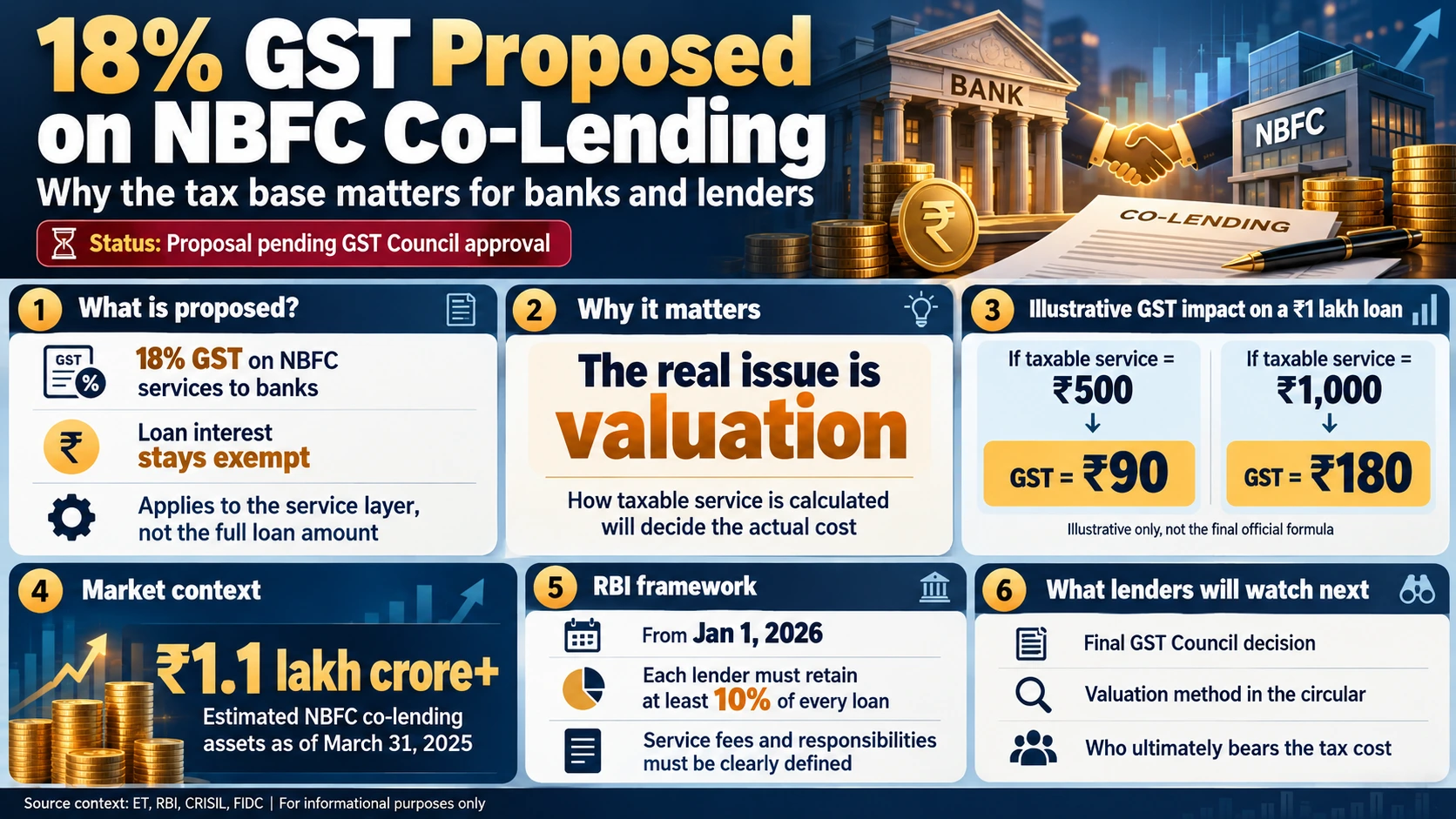
The ₹1 Lakh Loan Example: What Could 18% GST Mean?
Consider a hypothetical co-lending loan of ₹1,00,000.
If the identified taxable service consideration were ₹500, GST at 18% would amount to ₹90.
If the taxable service value were ₹1,000, GST at the same rate would amount to ₹180.
| Illustrative taxable service value | GST at 18% |
|---|---|
| ₹500 (0.5% of loan) | ₹90 |
| ₹1,000 (1% of loan) | ₹180 |
Source: NiftyTrader illustrative calculation. The 0.5%–1% range was discussed in Financial Express reporting in May 2025. It is not an officially approved GST valuation rule.
The example demonstrates an important point: 18% GST on an identified service fee is not equivalent to 18% GST on the entire loan amount.
It also does not establish how much additional tax a particular lender would owe. Existing tax payments, input-tax-credit eligibility and the eventual treatment of contractual payments would affect the actual economic outcome.
The Co-Lending GST Dispute Goes Back Several Years
The latest proposal follows a prolonged disagreement between tax authorities and the lending industry.
The central issue has been the treatment of the income spread retained by an NBFC under a co-lending arrangement.
For example, ET described a structure where a borrower pays a blended interest rate of 16%, the bank is entitled to 10% on its funded share, and the originating NBFC retains the difference on that share.
The debate is whether the relevant retained amount represents exempt lending income or compensation for services provided by the NBFC.
Industry representatives previously argued that co-lending partners jointly undertake credit risk and should not automatically be treated as supplying taxable services to one another merely because their interest entitlements differ.
In February 2025, Business Standard reported that the Revenue Department had rejected a recommendation from an SBI-led committee seeking GST relief for co-lending arrangements.
The disagreement prompted further discussions involving the Department of Financial Services, Department of Revenue, Indian Banks’ Association and Finance Industry Development Council (FIDC).
What FIDC’s March 2025 Advisory Reveals
An important development came in March 2025, when FIDC issued an advisory addressing GST applicability in co-lending arrangements.
The FIDC advisory dated March 13, 2025 explained that many lender banks already maintained separate agreements covering co-lending and the services provided by their NBFC partners.
It also noted that compensation under those service-level agreements was already being offered for GST payment.
FIDC encouraged members to identify service components clearly, document the compensation payable and address the applicable GST treatment.
This is a critical distinction for the latest debate.
The October 2026 proposal should not automatically be interpreted as introducing GST for the first time on every service provided under a co-lending arrangement.
Instead, it may provide greater clarity around the identification and valuation of taxable services, particularly where lending income and service compensation have been disputed.
The final circular will determine whether and how the interpretation changes.
RBI’s 2026 Co-Lending Rules Add Another Layer of Importance
The proposed GST clarification comes after a major regulatory expansion of India’s co-lending framework.
The RBI Co-Lending Arrangements Directions, 2025, issued on August 6, 2025, took effect from January 1, 2026, unless a regulated entity adopted them earlier under its internal policy.
The framework broadened the scope of regulated co-lending arrangements beyond the earlier priority-sector-focused model.
It covers specified commercial banks, All-India Financial Institutions and NBFCs, including housing finance companies.
Under the directions:
- Each participating regulated entity must retain at least 10% of an individual loan on its books.
- Co-lending agreements must specify responsibilities and applicable lending-service fees.
- The borrower’s interest rate must reflect a weighted blended rate based on the lenders’ respective funding shares and rates.
- Each lender’s share must be reflected in its books within 15 calendar days of disbursement.
- Originating lenders may provide default-loss guarantees of up to 5% of outstanding co-lent loans, subject to RBI conditions.
The new framework requires greater transparency over fees, responsibilities, funding contributions and lending relationships.
That makes the interaction between RBI requirements and GST valuation particularly important.
However, the RBI directions alone should not be treated as an official GST valuation circular.
India’s NBFC Co-Lending Market Has Crossed ₹1.1 Lakh Crore
The tax clarification concerns a lending model that has become an increasingly important part of India’s financial system.
According to an August 2025 CRISIL Ratings report, NBFC co-lending assets under management were estimated to have exceeded ₹1.1 lakh crore as of March 31, 2025.
Co-lending allows banks to use the customer reach and specialised underwriting capabilities of NBFCs while sharing loan funding and risk.
For NBFCs, these partnerships can improve access to funding and support loan origination without requiring the institution to finance the entire loan.
For banks, co-lending can expand access to borrowers and locations that may be more expensive to serve directly.
CRISIL also highlighted the potential benefits of RBI’s reduced minimum retention requirement for smaller and mid-sized NBFCs facing funding constraints.
The GST valuation question is therefore relevant to a business model that regulators have simultaneously sought to broaden and formalise.
However, the ₹1.1 lakh crore figure represents estimated co-lending assets, not taxable service income. It cannot be used directly to calculate a sector-wide GST liability.
Which NBFCs and Fintech Lenders Could Be Most Affected?
The potential effect will not be uniform across the sector.
Institutions that depend heavily on co-lending partnerships could face greater sensitivity to the final clarification, particularly if their agreements involve significant sourcing, servicing or other partner-service income.
The potential exposure depends on several factors.
Co-lending dependence: The proportion of a lender’s business generated through such partnerships will influence the relevance of the clarification.
Service-fee structure: Contracts with separately identified fees may present different classification questions from arrangements involving disputed retained spreads.
Ability to recover the tax: Existing contractual terms and renegotiation options will affect which partner bears the economic burden.
Input tax credit: The actual cost will depend partly on the recipient’s eligibility to claim credit under applicable GST rules.
Past disputes: The treatment of earlier tax notices and existing agreements could be important for some institutions.
None of these considerations establishes that a particular listed NBFC will suffer a specific earnings decline.
A company-level impact assessment would require details of its co-lending portfolio, taxable service income, existing tax treatment and the final rules.
Will 18% GST Make Loans More Expensive for Borrowers?
Not necessarily.
The reported proposal targets taxable services supplied between lending partners. It does not directly impose 18% GST on qualifying loan interest or the entire amount borrowed.
However, an additional unrecoverable tax cost could affect commercial decisions.
An NBFC might absorb the cost, negotiate revised compensation with its banking partner or reconsider the pricing of future arrangements.
Whether any cost eventually reaches borrowers would depend on the contracts, market competition and applicable regulatory requirements.
There is currently insufficient evidence to conclude that borrowing rates will rise by a particular amount because of this proposal.
The distinction between gross GST payable and the final economic burden is also important, especially where input tax credit is available or restricted.
What Does the GST Proposal Mean for NBFC Stocks?
For investors, the reported recommendation is a business-model and profitability issue rather than an immediate indication of changing loan demand.
A clear valuation framework could reduce regulatory uncertainty and make partnerships easier to structure.
On the other hand, lenders could face costs where previously disputed income is ultimately classified as taxable service consideration.
Investors may therefore need to examine three areas in future company disclosures:
Service-income contribution: How much revenue comes from activities performed for co-lending partners?
Profitability exposure: Would the final tax treatment introduce a material additional cost after considering recovery and tax credits?
Contractual changes: Would lenders need to amend agreements or pricing structures to comply with the clarification?
The eventual impact on NBFC share prices will also depend on broader financial-market conditions, company fundamentals and expectations already reflected in valuations.
Without company-specific data and final tax rules, there is no reliable basis to forecast a uniform decline in NBFC earnings or stock prices.
GST Council Meeting on October 8: What Happens Next?
The 57th GST Council meeting is being held in New Delhi on October 8, after being rescheduled from October 7.
According to India Today’s, the Council is considering a broader agenda covering input tax credit, faster refunds, registration, enforcement powers and dispute resolution.
Financial-sector tax clarifications are among the proposals reported ahead of the meeting.
ET has also reported a separate proposal concerning the GST treatment of notional charges associated with transfers between branches of the same bank.
For NBFC co-lending, several questions remain:
- Will the Council approve the reported 18% GST treatment?
- What precise methodology will determine taxable service consideration?
- How will the clarification distinguish exempt interest from taxable service fees?
- Will existing contracts and earlier tax disputes be addressed?
- When will the clarification take effect?
The Council’s formal recommendations and any subsequent notification or circular will be necessary to establish the practical consequences.
Bottom Line
The reported 18% GST proposal could help resolve a long-standing dispute over the tax treatment of India’s expanding co-lending industry.
But the headline rate tells only part of the story.
The decisive question is how much of an NBFC’s income from a co-lending partnership will be treated as taxable service consideration rather than exempt loan interest.
Industry discussions in 2025 already recognised GST on separately identified services, while RBI’s 2026 framework established more detailed requirements for lending partnerships.
The Council’s eventual recommendation and follow-up clarification will determine whether the proposal mainly provides greater certainty or also changes the economics of some co-lending arrangements.
For banks, NBFCs, fintech lenders and investors, the final valuation methodology remains the development to watch.
FAQs on GST for NBFC Co-Lending
Has the GST Council approved 18% GST on NBFC co-lending services?
The fitment committee has reportedly recommended the treatment. Final GST Council approval of the specific proposal had not been independently verified at the time this article was prepared.
Will NBFC co-lending loan interest attract 18% GST?
Qualifying interest on the underlying loan remains exempt under the existing GST framework. The reported recommendation concerns taxable services supplied by the NBFC to the bank.
Is the 18% GST calculated on the full loan amount?
No. The proposed treatment concerns taxable service consideration, not the entire loan principal.
What is the proposed valuation method?
ET reports that the fitment committee has recommended an approach linked to RBI methodology. The precise calculation and its application to different co-lending arrangements still require official clarification.
Could the proposal affect NBFC share prices?
It could influence investor expectations for lenders with meaningful co-lending exposure. The actual impact will depend on final rules, company-specific business models, contractual arrangements and the economic burden of any tax payable.
Disclaimer: This article is for informational purposes only. It does not constitute tax, legal or investment advice or a recommendation to buy, sell or hold securities. Readers should consult qualified professional advisers before making financial or tax-related decisions.