Yes Bank Stock Under Pressure Fall 17% in Two Days as Supreme Court AT1 Bond Verdict Raises Capital Concerns
Yes Bank shares have come under heavy selling pressure after the Supreme Court overturned the bank’s 2020 write-off of additional tier-1 (AT1) bonds worth around ₹8,415 crore. The ruling has triggered concerns over the lender’s capital position, even as S&P Global Ratings expects the bank to remain adequately capitalised.
For investors, the key question is whether the legal setback will materially affect Yes Bank’s financial strength or mainly weigh on earnings and market sentiment in the near term.
Track Live : FII DII Data Today | NSE F&O Lot Size
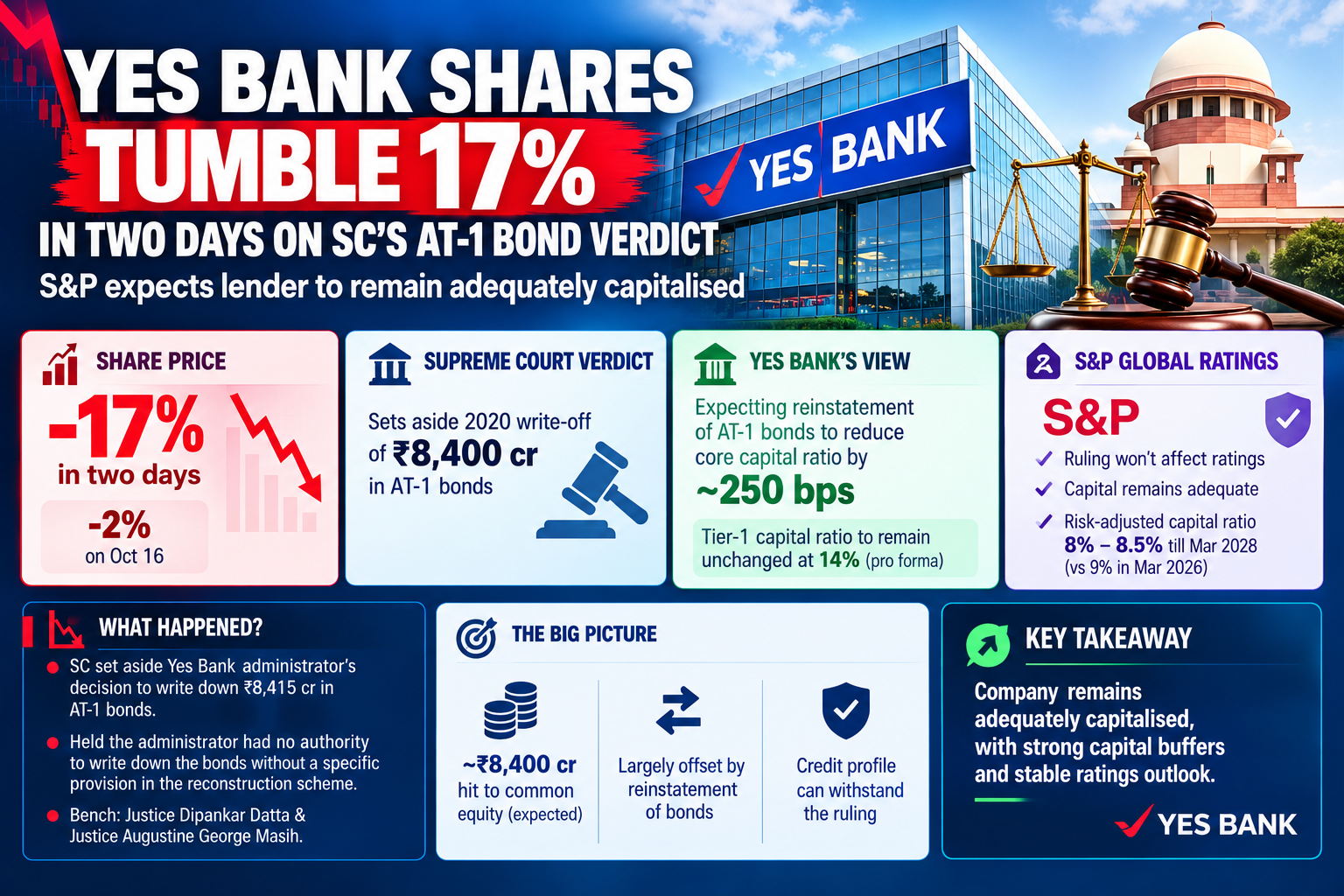
Yes Bank Stock Under Pressure 17% in two days after Supreme Court’s AT-1 bond verdict
Yes Bank shares fell around 2% on October 16, extending their two-day decline to approximately 17%. At 2:40 pm, the stock was trading 2.2% lower at ₹17.71 apiece.
The selling pressure followed the Supreme Court’s decision to set aside the write-off of ₹8,415 crore in AT1 bonds issued during Yes Bank’s 2020 reconstruction. The court held that the administrator lacked the authority to write down the bonds without a specific provision in the reconstruction scheme.
The verdict has brought renewed attention to the bank’s capital position, potential financial implications and the uncertainty surrounding the reinstatement of the bonds.
S&P Global Ratings expects Yes Bank to remain adequately capitalised and does not anticipate a rating impact from the ruling, although it expects pressure on future earnings.
Yes Bank AT-1 bond verdict: Key details in a table
| Particulars | Details |
|---|---|
| Company | Yes Bank |
| Key development | Supreme Court set aside the 2020 write-off of AT-1 bonds. |
| Bond amount | ₹8,415 crore |
| Share price movement | Shares fell approximately 17% over two sessions, according to the report. |
| Share price on October 16 | ₹17.71, down 2.2% at 2:40 p.m. IST |
| Expected CET1 impact | Around 250 basis points of reduction on a pro forma basis |
| Tier-1 capital ratio | Expected to remain at 14% on a pro forma basis |
| CET1 ratio as of March 2026 | 13.87%, according to S&P’s assessment |
| S&P rating outlook | S&P does not expect the verdict to affect the bank’s ratings, but sees pressure on earnings. |
| Projected risk-adjusted capital ratio | 8%–8.5% through March 2028, compared with 9% in March 2026 |
| Main concern | The financial impact of reinstating the bonds, future profitability and investor confidence |
Why did the Supreme Court rule against Yes Bank’s AT-1 bond write-off?
The Supreme Court upheld the Bombay High Court’s decision to set aside the bond write-off, finding that the bank’s administrator lacked the authority to write down the bonds under the final reconstruction scheme. The decision concerns the legality of the 2020 action during Yes Bank’s rescue.
Why are AT-1 bonds important in this case?
Additional Tier-1 bonds are perpetual debt instruments issued by banks to strengthen regulatory capital. They generally carry higher risk than ordinary bank deposits and can absorb losses under specified circumstances.
| AT-1 bond feature | Explanation |
|---|---|
| Maturity | Generally perpetual, with no fixed maturity date |
| Returns | Interest payments, known as coupons, subject to the instrument’s terms |
| Risk | Investors may face losses if contractual and regulatory loss-absorption conditions are triggered |
| Yes Bank case | The Supreme Court found that the specific 2020 write-off was not authorised by the final reconstruction scheme |
| Coupon payments | The court’s order says the annual coupon rate remains governed by the bond information memoranda |
| Main beneficiaries of the ruling | Bondholders whose securities were written off, subject to the terms of their instruments |
The verdict does not mean AT-1 bonds can never absorb losses. It concerns the legality of this particular write-off under the reconstruction framework.
How could the ruling affect Yes Bank’s financial position?
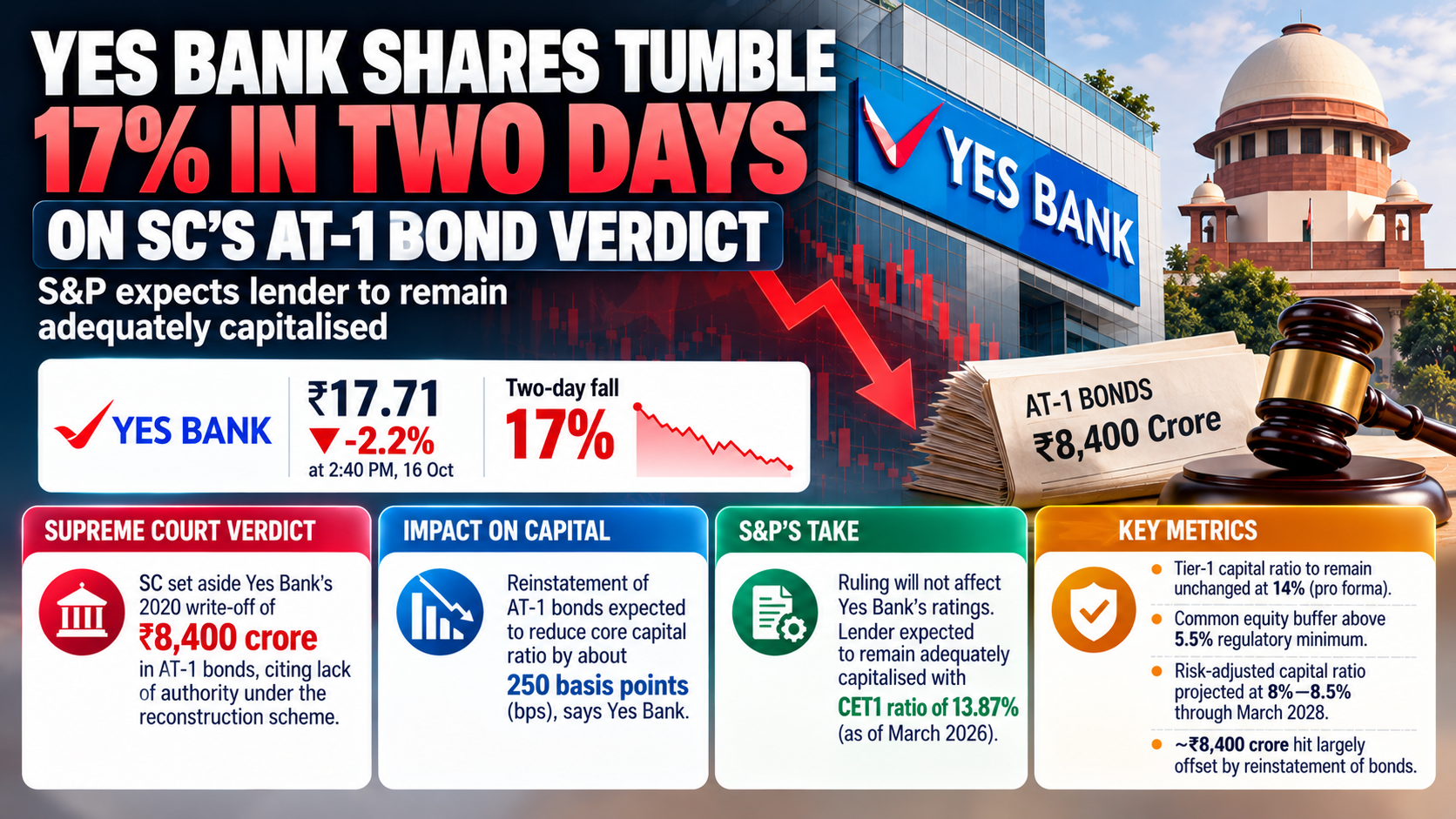
Yes Bank expects the reinstatement of its ₹8,415 crore Additional Tier-1 (AT-1) bonds to reduce its Common Equity Tier-1 (CET1) capital ratio by approximately 250 basis points, or 2.5 percentage points, based on its financial position as of June 30, 2026. However, the bank said its Tier-1 capital ratio would remain at 14% on a pro forma basis. Yes Bank is reviewing the Supreme Court’s October 15, 2026, judgment and assessing its available legal options.
- CET1 capital impact: The expected reduction of 250 basis points could lower the bank’s core capital buffer. CET1 capital is the highest-quality regulatory capital available to absorb losses.
- Tier-1 capital ratio: Yes Bank expects this ratio to remain unchanged at 14% on a pro forma basis, despite the reinstatement of the bond principal.
- S&P’s capital assessment: S&P Global Ratings said Yes Bank’s capital position remains adequate to withstand the ruling. Its CET1 ratio was 13.87% at the end of March 2026, above the stated regulatory minimum of 5.5%.
- Future capital outlook: S&P expects the bank’s risk-adjusted capital ratio to range between 8% and 8.5% through March 2028, compared with 9% in March 2026.
- Impact on earnings and ratings: S&P does not expect an immediate change in Yes Bank’s credit ratings, but it expects the ruling to weigh on future earnings.
Yes Bank Expects Core Capital Ratio to Decline by 250 Basis Points
Yes Bank said it expects the reinstatement of the previously written-off AT1 bonds to reduce its core capital ratio by approximately 250 basis points.
However, the bank stated that its Tier 1 capital ratio would remain unchanged at 14% on a pro forma basis.
The development creates an additional financial consideration for investors because capital ratios are important indicators of a bank’s ability to absorb losses and support lending. Any sustained pressure on capital could influence future growth plans and profitability.
However, the reported capital figures suggest that the immediate impact needs to be assessed alongside the bank’s existing capital buffers rather than in isolation.
Track Live : Opening Price Clues – What Pre-Market Data Says Today
S&P Expects Yes Bank to Remain Adequately Capitalised
Despite the legal setback, S&P Global Ratings does not expect the Supreme Court ruling to affect Yes Bank’s ratings, although it anticipates pressure on future earnings.
According to S&P, Yes Bank’s common equity Tier 1 ratio stood at 13.87% at the end of March 2026. The agency said the capital buffer should be sufficient to absorb the expected 250-basis-point impact while remaining above the regulatory minimum of 5.5%.
S&P also expects the bank’s risk-adjusted capital ratio to remain between 8% and 8.5% through March 2028, compared with 9% in March 2026.
The assessment offers some reassurance to investors, but it does not eliminate the possibility of earnings pressure or further volatility.
Read More : Fairfax’s IDBI Bank Takeover: Insurance and Wealth Come In, but Rakesh Sharma Stays
Here’s What Happened Today and Why Traders Reacted
The sharp fall in Yes Bank shares reflects concerns about the financial and regulatory implications of the Supreme Court verdict.
The reinstatement of AT1 bonds could affect reported capital and future earnings, while the legal outcome may also influence investor confidence in the bank’s recovery following its 2020 rescue.
For short-term traders, the stock’s approximately 17% two-day decline highlights heightened volatility and the possibility of further price swings as investors assess the implications.
However, the share-price decline alone does not establish how much of the potential financial impact has been priced in. Traders should watch official bank disclosures, trading volumes and subsequent analyst assessments.
What Yes Bank Investors Should Watch Next
The immediate focus will be on how the bond reinstatement is reflected in the bank’s financial statements, capital ratios and future earnings.
Investors should monitor upcoming disclosures, profitability trends, asset quality and any further regulatory or legal developments. The bank’s ability to maintain adequate capital while improving earnings will remain central to its recovery prospects.
For existing shareholders, the distinction is important: S&P’s assessment suggests that capital adequacy remains manageable, but the Supreme Court ruling introduces fresh uncertainty. Short-term traders may continue to face volatility, while long-term investors should evaluate the bank’s fundamentals and updated financial disclosures before making portfolio decisions.