
Indian Rupee Makes a Surprise Comeback to a Six-Week High as Jio IPO Inflows Support Gains
The Indian rupee has staged a notable recovery, reaching a six-week high on Tuesday as foreign portfolio inflows linked to the upcoming Jio Platforms IPO supported demand for the domestic currency. However, with crude oil prices hovering around $110 per barrel, investors are watching closely to see whether the rupee can maintain its upward momentum.
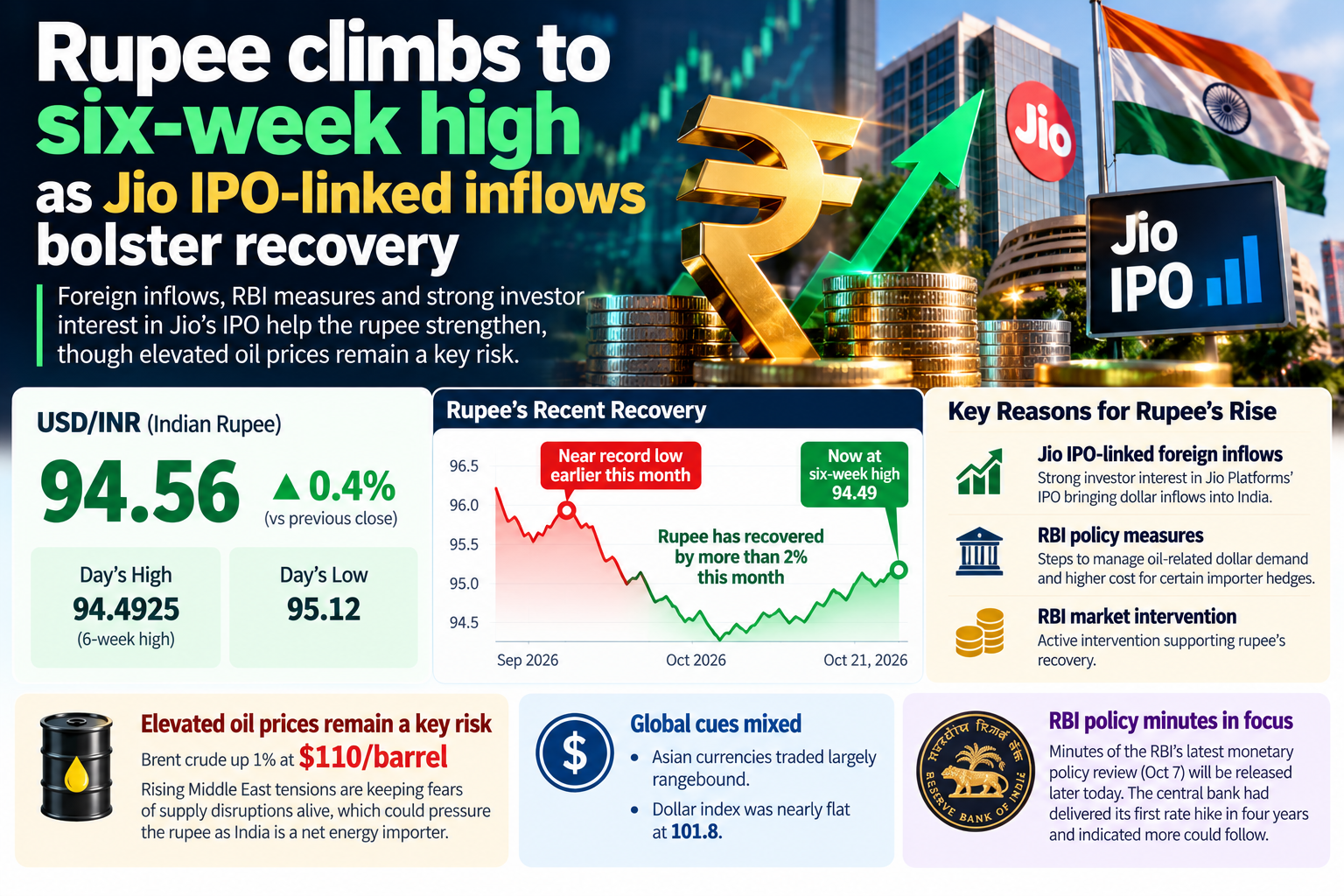
The rupee strengthened to 94.4925 against the US dollar before trimming some gains to trade at 94.56, up 0.4% on the day. The currency has recovered more than 2% after coming close to breaching record-low levels earlier this month.
Track Live : NSE Option Chain — Live | BSE Option Chain — Live Sensex & Bankex Options Data Today
Rupee Makes a Surprise Comeback : Jio Platforms IPO Inflows and RBI Measures Strengthen the Rupee
Foreign portfolio inflows associated with the Jio Platforms IPO have provided support to the Indian rupee. These inflows have added to the recovery already underway following several measures introduced by the Reserve Bank of India (RBI) last week.
The central bank redirected some oil-related dollar demand away from the spot market and increased the cost of certain importer hedges. These steps were intended to ease immediate pressure on the rupee amid strong demand for US dollars.
RBI interventions in the foreign exchange market have also reinforced the impact of these measures. Together, policy action and foreign inflows have helped the rupee recover from its recent weakness.
A trader at a state-run bank said, “Foreign banks have been on offer (on USD/INR),” adding that the next support level for the currency pair could be around 94.30.
Jio Platforms IPO inflows support the rupee
-
Expected foreign portfolio investment associated with the Jio Platforms IPO supported the currency.
-
When foreign investors bring dollars into India and convert them into rupees, demand for the Indian currency can rise.
-
The IPO could therefore provide temporary support to the rupee and influence foreign exchange flows.
-
Investors should distinguish expected IPO-related inflows from confirmed, sustained foreign investment across the broader Indian market.
Rupee Hits Six-Week High: Every Important Point for Stock Market Investors
The Indian rupee strengthened to a six-week high on October 21, 2026, supported by expected foreign currency inflows linked to the Jio Platforms IPO and measures taken by the Reserve Bank of India (RBI). However, rising crude oil prices and India’s external deficits remain major risks to a sustained recovery.
Key highlights at a glance
| Important point | Details |
|---|---|
| Rupee’s six-week high | ₹94.4925 per US dollar |
| Latest quote in the Reuters report | ₹94.56 per dollar |
| Daily gain | Around 0.4% |
| Recent recovery | More than 2% from its recent lows |
| Major support | Jio IPO-linked foreign inflows |
| RBI’s role | Currency-market intervention and measures to curb dollar demand |
| Major risk | Brent crude around $110 per barrel |
| RBI policy rate | 5.50% after the October 7 hike |
| Key event to watch | RBI monetary policy meeting minutes |
| Market outlook | Near-term rupee strength, but continued depreciation risks |
Rupee recovers to a six-week high
-
The rupee touched ₹94.4925 against the US dollar before settling back to around ₹94.56 in the report.
-
It gained approximately 0.4% during the session.
-
The currency has recovered more than 2% after approaching record-low levels earlier in October.
-
This indicates improved near-term currency sentiment, although it does not establish a long-term reversal.
Crude Oil Prices Remain a Major Risk for the Rupee
Despite the recent recovery, elevated crude oil prices remain a significant concern for India’s currency and broader economic outlook. As a net energy importer, India faces higher import costs when oil prices rise, potentially increasing demand for dollars and putting pressure on the rupee.
Brent crude rose more than 1% on Tuesday to around $110 per barrel as escalating tensions in the Middle East fuelled concerns about potential supply disruptions.
Iran reportedly told Pakistan’s army chief that it would not hold talks with Washington until its demands were met, according to Iranian media outlet Nournews. Developments in the region could influence oil prices and, in turn, affect the rupee’s direction.
₹94.30 emerges as a technical level to watch
-
A trader quoted by Reuters identified ₹94.30 per dollar as a potential support level for the USD/INR exchange rate.
-
In currency markets, support is a level where the dollar-rupee pair may encounter buying interest or struggle to move lower.
-
A move toward ₹94.30 would indicate further rupee strength if the level holds.
-
If the pair rebounds, it could indicate renewed pressure on the rupee.
HSBC Expects the Rupee to Face Renewed Pressure
Despite the recovery, HSBC analysts expect the rupee could resume a gradual weakening trend against the US dollar.
In a research note, the bank cited India’s current account deficit, higher inflation compared with its peers and the RBI’s large short foreign-exchange forward positions as factors that could weigh on the currency.
This outlook highlights the difference between short-term support and longer-term economic pressures. While IPO-related inflows and central bank measures may help the rupee, they may not fully offset structural challenges.
Track Live : Nifty Levels Today | Sensex Levels Today

RBI Policy Minutes Could Influence the Rupee and Markets
Investors are now awaiting the minutes of the RBI’s latest monetary policy review, held earlier this month. On October 7, the central bank delivered its first interest-rate hike in four years and signalled that further increases could follow.
The minutes may offer additional insight into policymakers’ concerns about inflation, currency weakness and economic risks. Traders will assess whether the RBI’s commentary changes expectations for interest rates and future currency-market intervention.
RBI measures help reduce dollar demand
The RBI introduced measures intended to ease pressure on the rupee, including:
-
Redirecting oil-related dollar demand away from the spot foreign exchange market.
-
Increasing the cost of certain importer currency hedges.
-
Intervening in the foreign exchange market to reinforce the measures.
These actions can reduce immediate pressure on the rupee, but their longer-term effectiveness depends on oil prices, capital flows and underlying economic conditions.
Here’s What Happened Today and Why Traders Reacted
The rupee’s rise reflects a combination of foreign portfolio inflows, RBI measures and intervention in the currency market. The 0.4% daily gain and recovery of more than 2% from recent weakness have improved the currency’s near-term position.
However, traders are balancing these supportive factors against the risk of persistently expensive oil. Asian currencies were largely rangebound, while the US dollar index remained nearly unchanged at 101.8.
For currency traders, the 94.30 level identified by the state-bank trader is worth monitoring as a potential support area. A sustained move in USD/INR will also depend on dollar demand, oil prices and further foreign inflows.
What the Rupee’s Recovery Means for Investors
A stronger rupee can help reduce the cost of imported goods, including crude oil, and may ease some pressure on businesses exposed to overseas purchases. Companies with significant dollar-denominated expenses could benefit if the currency remains firm.
However, the impact will vary across sectors. Exporters and businesses earning substantial revenue in US dollars may face different currency effects, while elevated oil prices could continue to pressure fuel-sensitive industries.
For investors, the key factors to watch are the USD/INR exchange rate, crude oil prices, foreign portfolio flows and the RBI’s policy signals. The rupee’s six-week high marks a recovery, but whether it lasts will depend on how these forces evolve in the coming days.