
SEBI Moves to Review IPO Rulebook as Capital Market Reforms Gather Pace
India’s capital market regulator is preparing to review the rules that govern how companies raise money from investors. The Securities and Exchange Board of India (SEBI) has formed a working group to examine regulations covering initial public offerings (IPOs), follow-on public offerings (FPOs) and other securities issuances, according to sources cited by Moneycontrol.
The move could bring changes to the regulatory framework used by companies entering the stock market or raising additional capital. For investors tracking upcoming IPOs, the key question is whether the proposed review will improve transparency and make the fundraising process more efficient.
Track Live : IPO – Latest & Upcoming IPOs List 2026 | Check Live BSE NSE IPOs
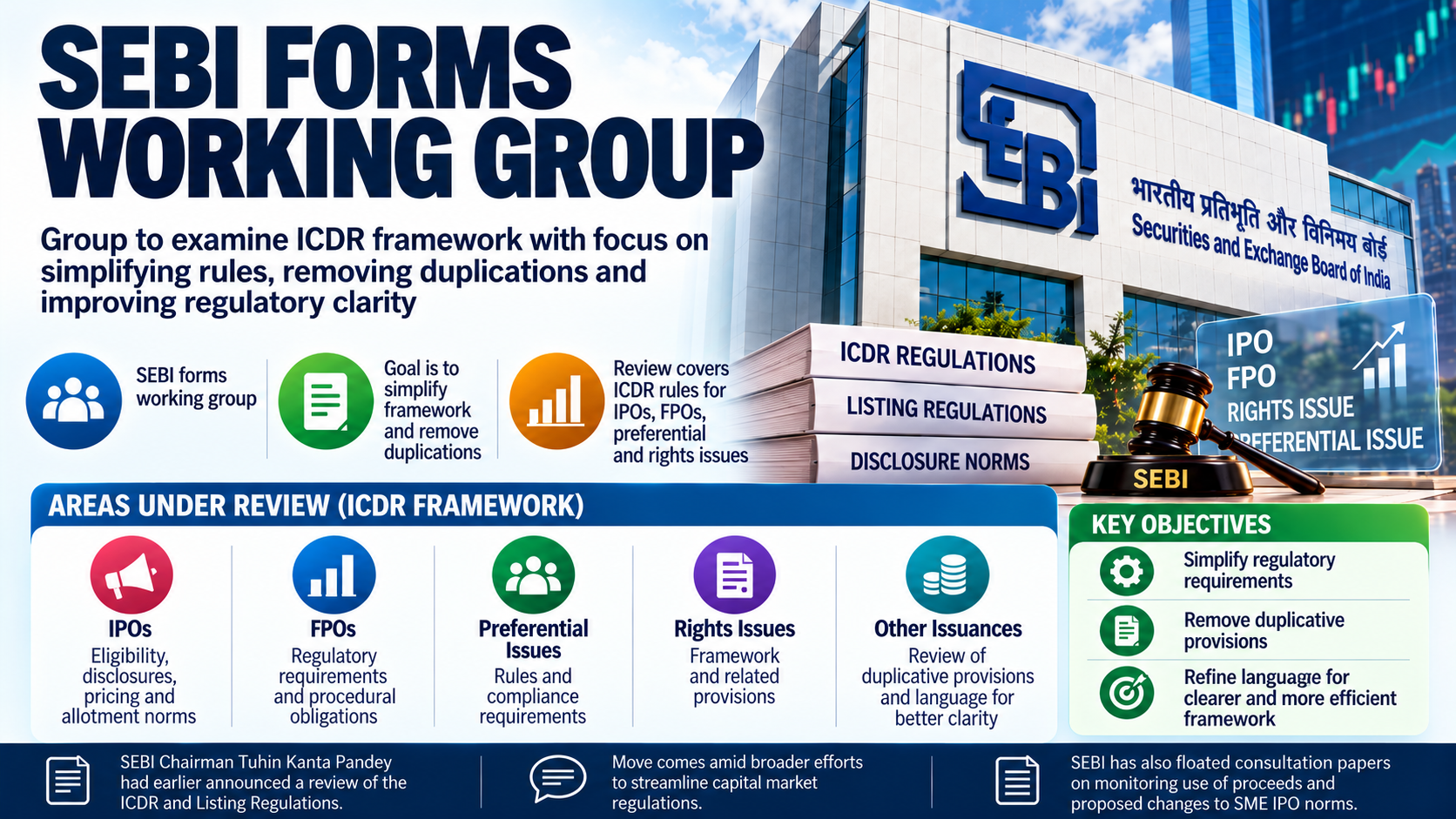
IPO Rulebook : SEBI Working Group Will Examine IPO and FPO Regulations
The working group will review SEBI’s Issue of Capital and Disclosure Requirements (ICDR) Regulations, which establish the rules companies must follow when raising capital.
The review will cover several fundraising routes, including IPOs, FPOs, preferential issues and rights issues. These regulations govern important aspects of public offerings, from eligibility and disclosures to pricing, allotment and procedural requirements.
According to industry sources, the group will focus on simplifying regulatory requirements, removing overlapping provisions and refining the language of the existing rules.
The objective is to make SEBI IPO regulations clearer and more efficient without losing sight of investor protection.
What exactly has SEBI announced?
- Regulations under review: SEBI has initiated a review of its Issue of Capital and Disclosure Requirements (ICDR) Regulations, 2018, which govern IPOs, FPOs, preferential issues, rights issues and other specified methods of raising capital.
- Main objective: The review aims to simplify regulatory requirements, remove duplicate provisions, clarify legal language and make the capital-raising framework more efficient for companies and market intermediaries.
- Review mechanism: A working group is being formed under SEBI’s Primary Markets Advisory Committee (PMAC), which advises the regulator on primary-market matters. SEBI said the decision to constitute the working group was taken at a PMAC meeting on August 12, 2026.
- Scope of the review: The group will examine relevant ICDR provisions to identify areas that may require clarification, rationalisation, modification or simplification.
- Current status: The review process has been initiated, but the reported exercise has not yet resulted in confirmed final amendments. Any proposed changes will need to follow the applicable SEBI regulatory process before implementation.
Why SEBI Wants to Simplify the Existing Regulatory Framework
Complex or overlapping regulations can increase compliance work for companies and market intermediaries. A clearer framework could help issuers understand their obligations and navigate the fundraising process more efficiently.
SEBI Chairman Tuhin Kanta Pandey had earlier indicated that the regulator would review both the ICDR Regulations and the SEBI Listing Obligations and Disclosure Requirements (LODR) Regulations.
While ICDR rules focus on raising capital, LODR regulations govern the disclosure and compliance obligations of listed companies. Reviewing both frameworks reflects SEBI’s broader effort to streamline capital market regulations.
However, the working group’s formation does not mean that any specific rule changes have been finalised. The impact will depend on the recommendations and any subsequent regulatory decisions.
Track Live : Nifty Levels Today | Sensex Levels Today
What do IPO, FPO, preferential issue and rights issue mean?
Companies use different methods to raise money from investors. According to SEBI’s investor guidance, these methods differ mainly in whether the company is unlisted or already listed and who is eligible to receive the shares.
1. IPO — Initial Public Offering
-
Meaning: An unlisted company offers shares to the public for the first time.
-
Purpose: To raise capital for expansion, business operations, debt repayment or other corporate needs. An IPO can also include existing shareholders selling their shares.
-
Example: A growing company offers shares to public investors and lists on a stock exchange.
-
Key point: An IPO provides a route for a company to become publicly listed.
2. FPO — Follow-on Public Offering
-
Meaning: An already-listed company offers shares to the public through a further public offering.
-
Purpose: To raise additional capital after its initial listing or allow existing shareholders to sell shares through an offer for sale.
-
Example: A listed company issues additional shares to fund a new factory or reduce its debt.
-
Key point: Unlike an IPO, an FPO is conducted by a company that is already listed.
3. Preferential Issue
-
Meaning: A listed company issues securities to selected investors or a specified group of persons through a private-placement route, subject to applicable SEBI regulations.
-
Purpose: To raise capital from identified investors rather than through a general public offer.
-
Example: A listed company issues new shares to a particular institutional investor to finance its expansion.
-
Key point: The offer is directed to selected investors, not the general public.
4. Rights Issue
-
Meaning: A company offers additional shares to its existing eligible shareholders, based on a specified record date and the terms of the issue.
-
Purpose: To raise funds while giving existing shareholders an opportunity to purchase additional shares.
-
Example: A company offers one additional share for every five shares held by an eligible shareholder.
-
Key point: Eligible existing shareholders receive the opportunity to subscribe, generally in proportion to their current holdings.
Key differences at a glance
| Feature | IPO | FPO | Preferential issue | Rights issue |
|---|---|---|---|---|
| Company status | Unlisted | Already listed | Generally listed under SEBI ICDR rules | Listed issuer under SEBI ICDR rules |
| Who receives the offer? | Public investors | Public investors | Selected investors | Existing eligible shareholders |
| Main purpose | Initial public offering and listing | Further public fundraising | Targeted fundraising | Fundraising from existing shareholders |
| Is it a public offer? | Yes | Yes | No, it is a private-placement route | No, it is offered to eligible existing shareholders |
Source: SEBI’s ICDR guidance and investor education materials.
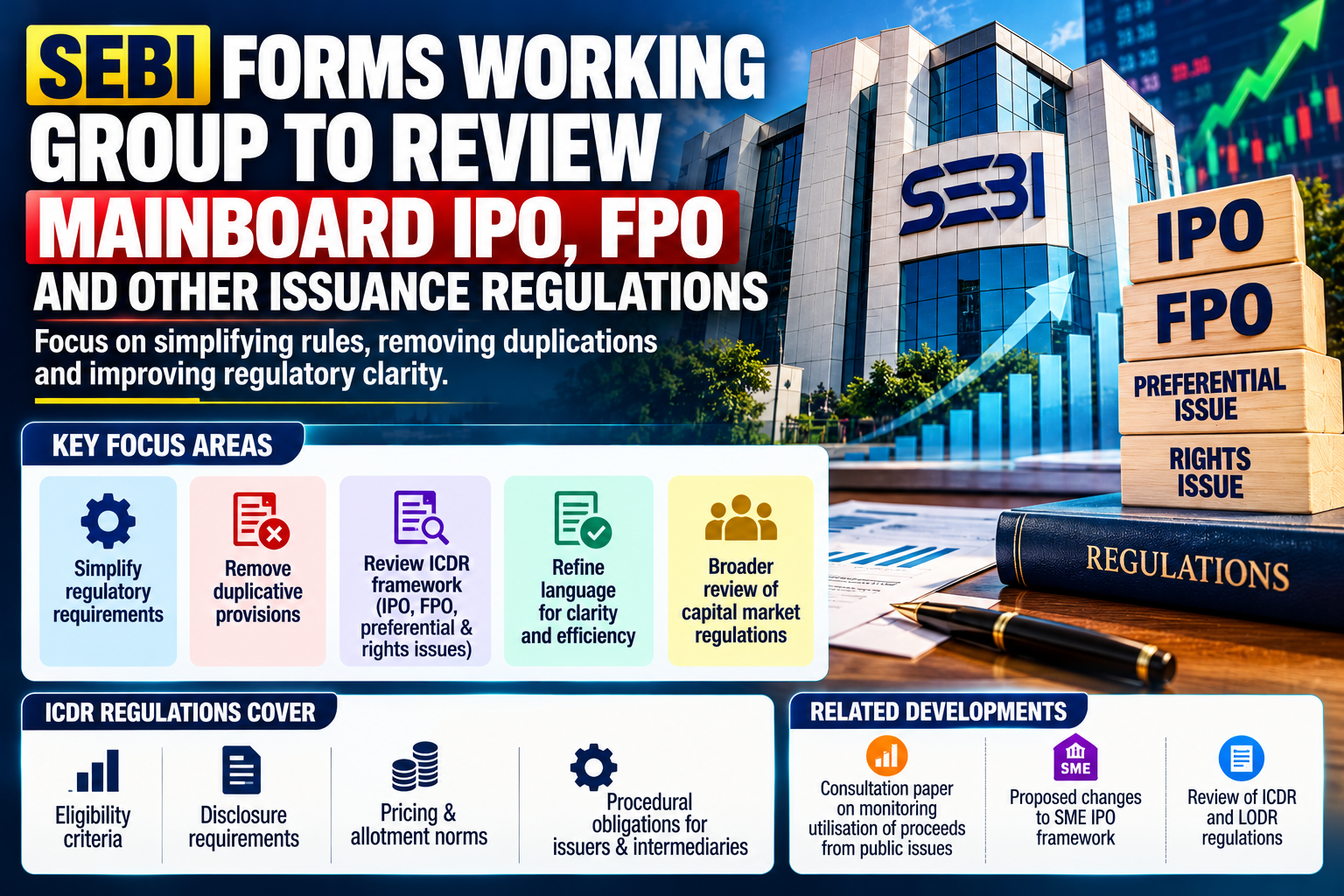
SEBI’s Other Proposals Could Also Affect the IPO Market
The latest review comes alongside other regulatory initiatives concerning public fundraising.
SEBI has floated a consultation paper proposing changes to the monitoring of funds raised through public issues. The aim is to review the framework for overseeing how companies use money collected from investors.
Separately, the regulator has proposed changes to the rules governing small and medium enterprise (SME) IPOs, including a review of eligibility criteria and other requirements.
Together, these initiatives indicate that SEBI is examining several aspects of the capital-raising process, although each proposal remains subject to its own regulatory process.
What is the ICDR Regulations framework?
ICDR stands for Issue of Capital and Disclosure Requirements. SEBI introduced the 2018 regulations to establish requirements for companies issuing securities through public issues and other specified routes.
The framework covers several important areas:
| Regulatory area | What it governs |
|---|---|
| Eligibility | Whether a company meets the applicable conditions to launch an issue |
| Disclosure requirements | Information that must be provided to investors in offer documents |
| Pricing | Rules and requirements relating to the pricing of securities |
| Allotment | How securities are allocated to eligible investors under the applicable framework |
| Promoters’ contribution and lock-in | Applicable contribution requirements and restrictions on selling certain holdings for specified periods |
| Procedures and compliance | Filing, documentation and other obligations for issuers and intermediaries |
What SEBI’s IPO Rule Review Means for Investors
For investors, the main issue is whether the review ultimately improves the quality of disclosures, strengthens accountability and makes IPO participation easier to evaluate.
A more efficient framework could support companies seeking capital and potentially improve the overall functioning of India’s primary market. Stronger clarity around fundraising and the use of proceeds could also help investors assess risks more effectively.
However, simplified rules do not automatically make every IPO attractive. Investors should continue to examine company financials, valuations, business prospects, risks and the intended use of funds before applying.
Read More : Adani Energy Solutions Q2 FY27 Results on Oct 22, Investor Call on Oct 23: What to Watch
Here’s What Happened Today and Why Traders Reacted
SEBI’s decision to review IPO and FPO regulations is a regulatory development rather than an immediate market-moving earnings announcement.
Investors may view the initiative positively if it eventually reduces unnecessary compliance burdens, improves disclosure standards and makes capital raising more predictable. Companies planning to list could benefit from greater regulatory clarity.
However, there is no confirmed evidence in the information available that the announcement alone has triggered a significant move in the broader stock market.
Traders should therefore distinguish between the potential long-term benefits of regulatory reform and immediate price movements driven by earnings, valuations, market liquidity or broader economic developments.
What Investors Should Watch Next
The next important developments will be the working group’s recommendations and any formal proposals or amendments issued by SEBI. Investors should also monitor developments concerning public-issue proceeds and SME IPO eligibility rules.
For now, the review signals a potential regulatory shift, not a confirmed change in IPO requirements. The real impact on companies, upcoming public issues and investor portfolios will become clearer once SEBI announces specific measures.