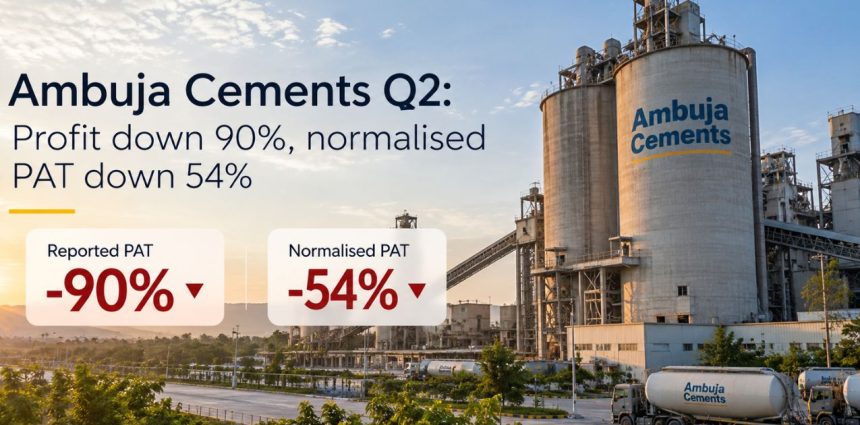
Ambuja Cements Q2 FY27 Results: Consolidated reported profit fell 90% to ₹236 crore, while normalised PAT declined 54% to ₹300 crore. EBITDA margin contracted to 13.8% as higher fuel and logistics costs squeezed profitability. Meanwhile, Ambuja Cements shares closed higher, and November futures open interest rose 6.15% in the afternoon snapshot.
Ambuja Cements shares closed 1% higher at ₹354.70 on Thursday, October 29, even as the Adani Group cement maker reported a sharp decline in September-quarter earnings. Consolidated profit after tax (PAT) plunged 90% year on year to ₹236 crore for Q2 FY27, compared with ₹2,336 crore a year earlier.
The reported decline was amplified by a ₹1,697 crore reversal of income-tax provisions in the year-ago quarter. However, the earnings picture remains weak even after adjusting for specified items: company-defined normalised PAT fell 54% to ₹300 crore.
Operating performance also deteriorated. Revenue was nearly flat at ₹9,197 crore, but operating EBITDA fell 28% to ₹1,271 crore, and the EBITDA margin narrowed to 13.8% from 19.2%.
Meanwhile, NiftyTrader’s November futures snapshot recorded a 6.15% increase in open interest alongside a higher futures price. The contrast highlights two different developments: pressure on the company’s operating earnings and increased derivatives positioning during the trading session. The futures signal does not, by itself, establish that investors have turned bullish on Ambuja’s earnings outlook.
Need to Know
- Reported vs normalised profit: Consolidated PAT fell 90% to ₹236 crore, while normalised PAT declined 54% to ₹300 crore.
- Margin squeeze: Operating EBITDA dropped 28% to ₹1,271 crore, with the margin contracting by 5.4 percentage points to 13.8%.
- Cost pressure: Ambuja attributed approximately ₹376 crore of its year-on-year EBITDA decline to geopolitical cost pressures.
- Futures positioning: November futures open interest increased 6.15% in the 3:41 PM IST snapshot, with the futures price up 1.22%.
- Next earnings test: Cement pricing, input-cost trends, capacity ramp-ups and the FY27 cost target will determine whether margins recover in H2.
Ambuja Cements Q2 FY27 Results: Key Financial Highlights
According to the company’s investor presentation, the September-quarter performance was as follows:
| Particulars | Q2 FY27 | Q2 FY26 | YoY change |
|---|---|---|---|
| Revenue from operations* | ₹9,197 crore | ₹9,175 crore | +0.2% |
| Reported consolidated PAT | ₹236 crore | ₹2,336 crore | -90% |
| Normalised PAT | ₹300 crore | ₹652 crore | -54% |
| Operating EBITDA | ₹1,271 crore | ₹1,762 crore | -28% |
| EBITDA margin | 13.8% | 19.2% | -5.4 percentage points |
| EBITDA per tonne | ₹770 | ₹1,061 | -27% |
| Cement sales volume | 16.5 million tonnes | 16.6 million tonnes | -0.6% |
Revenue figures follow the company’s investor-presentation reporting basis. Its statutory financial-results reporting separately presents revenue of ₹9,166 crore against ₹9,130 crore a year earlier. The two reporting series should not be mixed without reconciliation.
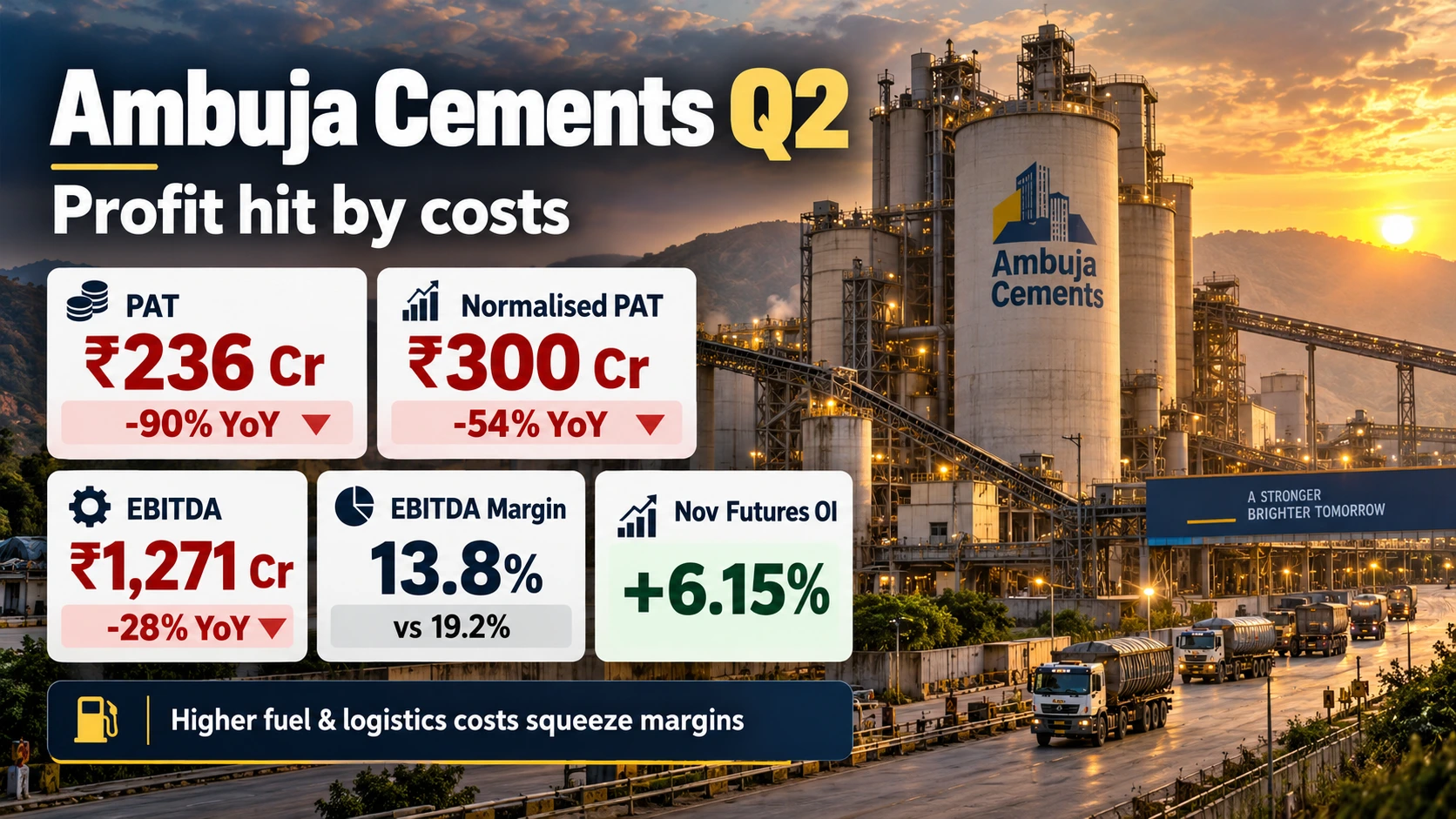
Source: Ambuja Cements Q2 FY27 investor presentation.
Why Did Ambuja Cements’ Profit Fall 90%?
The unusually steep reported profit decline partly reflects the previous year’s tax benefit.
During Q2 FY26, Ambuja recognised a ₹1,697 crore reversal of income-tax provisions relating to earlier periods. This substantially boosted the comparative quarter’s reported earnings, making the year-on-year decline appear more severe.
The company’s normalised earnings reconciliation provides additional context.
| Profit measure | Q2 FY27 | Q2 FY26 |
|---|---|---|
| Reported consolidated PAT | ₹236 crore | ₹2,336 crore |
| Company-defined normalised PAT | ₹300 crore | ₹652 crore |
| Normalised PAT decline | 54% year on year | — |
The normalisation accounts for specified items, including the previous year’s tax provision reversal and other adjustments disclosed in the investor presentation.
This makes the 90% reported decline less representative of the change in normalised earnings alone. However, the 54% fall in normalised PAT confirms that profitability remains under considerable pressure.
The operating figures reinforce that conclusion: EBITDA declined 28%, margins narrowed sharply and EBITDA per tonne fell 27%. The weaker earnings therefore cannot be explained solely by the exceptional tax benefit in the comparative quarter.
₹376 Crore Cost Impact Explains Most of the EBITDA Decline
The company’s EBITDA bridge provides one of the clearest explanations for the deterioration in operating profitability.
Operating EBITDA declined by approximately ₹491 crore, based on the rounded figures of ₹1,762 crore in Q2 FY26 and ₹1,271 crore in Q2 FY27.
According to Ambuja’s investor presentation, geopolitical cost pressures contributed approximately ₹376 crore to the decline, or roughly 77% of the total reduction.
| EBITDA pressure | Reported impact |
|---|---|
| Geopolitical cost pressures | ₹376 crore |
| Lower pricing | ₹80 crore |
| Lower volumes | ₹18 crore |
| Higher maintenance costs | ₹17 crore |
Higher petcoke and coal prices, constrained domestic coal availability, rising diesel expenses and packaging costs weighed on the business. Planned plant shutdowns also affected costs during the quarter.
Ambuja’s total cost stood at ₹4,410 per tonne, compared with ₹4,155 a year earlier. Excluding the company’s stated impact of escalated geopolitical issues, the Q2 FY27 cost would have been ₹4,182 per tonne.
The ₹228-per-tonne difference illustrates the significance of external cost pressures. The company is targeting a reduction in cost to ₹4,250 per tonne by FY27, although achieving this target will depend on execution and the direction of energy and logistics expenses.
Ambuja’s investor presentation also estimates that EBITDA per tonne would have been ₹998, rather than ₹770, excluding the stated geopolitical impact. This is an adjusted scenario, not the margin actually achieved during the quarter.
The distinction is important for the H2 outlook. Even if external pressures ease, the company will still need to improve realisations, maintain cost discipline and ramp up new capacity efficiently to restore operating profitability.
Ambuja Cements Share Price Rises Despite Weak Q2 Results
Ambuja Cements shares closed at ₹354.70 on the NSE on October 29, gaining ₹3.50, or 1%, from the previous close of ₹351.20.
The positive closing performance contrasts with the decline in both reported and normalised earnings. However, a single-session share-price rise cannot establish that the market has fully priced in the weak results or that expectations for future profitability have improved.
Price movements can reflect broader market conditions, positioning adjustments and company-specific developments. For derivatives traders, the contemporaneous futures data provides a separate measure of trading activity, but it should not be confused with evidence of improving corporate fundamentals.
Ambuja Cements November Futures OI Rises 6.15%
According to the NiftyTrader futures snapshot recorded at 3:41 PM IST on October 29, Ambuja Cements’ November 2026 futures contract showed an increase in both price and open interest.
November futures snapshot
| Indicator | Reading |
|---|---|
| NSE spot price | ₹354.70 |
| November futures LTP | ₹358.00 |
| Futures price change | +1.22% |
| Open interest | 8,11,30,800 |
| Change in open interest | +47,04,000 |
| OI percentage change | +6.15% |
| Futures premium to spot | ₹3.30 |
| Contract expiry | 23 November 2026 |
Source: NiftyTrader Ambuja Cements futures. Figures refer to the specified intraday snapshot.
The simultaneous increase in futures price and open interest is conventionally classified as a long build-up. It indicates that outstanding futures positions increased as the contract price rose.
However, open interest alone cannot identify the participants behind those positions or establish their expectations. A long build-up classification is a description of the observed price and OI combination, not a guarantee of further gains.
The snapshot also showed futures trading at a ₹3.30 premium to the spot price. That premium reflects the difference between the futures and spot quotations at the recorded time; it should not be treated as a forecast of future share-price appreciation.
For traders, the relevant question is whether the increase in OI persists alongside price strength in subsequent sessions. The next observation matters more than treating one snapshot as a definitive trend.
Ambuja Cements Option Chain: Levels to Monitor
NiftyTrader’s option-chain snapshot recorded at 3:45 PM IST on October 29 showed the following figures for the 23 November 2026 expiry.
| Option-chain indicator | Reading |
|---|---|
| Put-call ratio (PCR) | 0.8842 |
| Change-in-OI PCR | 1.3778 |
| Max pain | ₹360 |
| Highest call OI | ₹370 strike — 12,32,400 |
| Highest put OI | ₹350 strike — 10,30,800 |
Source: NiftyTrader Ambuja Cements option chain. Figures refer to the specified snapshot and may change with subsequent updates.
The ₹350 and ₹370 strikes provide reference points for monitoring concentrated option positions, while ₹360 is the calculated max-pain level.
The overall PCR below 1 indicates that call open interest exceeded put open interest under that snapshot’s measure. The change-in-OI PCR above 1 provides a different view of changes in outstanding positions. These ratios should be interpreted in context rather than as standalone buy or sell signals.
Similarly, high open interest at a strike does not guarantee that the level will hold as support or resistance. Option positions can change rapidly as prices move, traders adjust exposure and expiry approaches.
The option-chain data therefore adds a positioning perspective to the earnings story, but it does not independently confirm a sustained bullish trend.
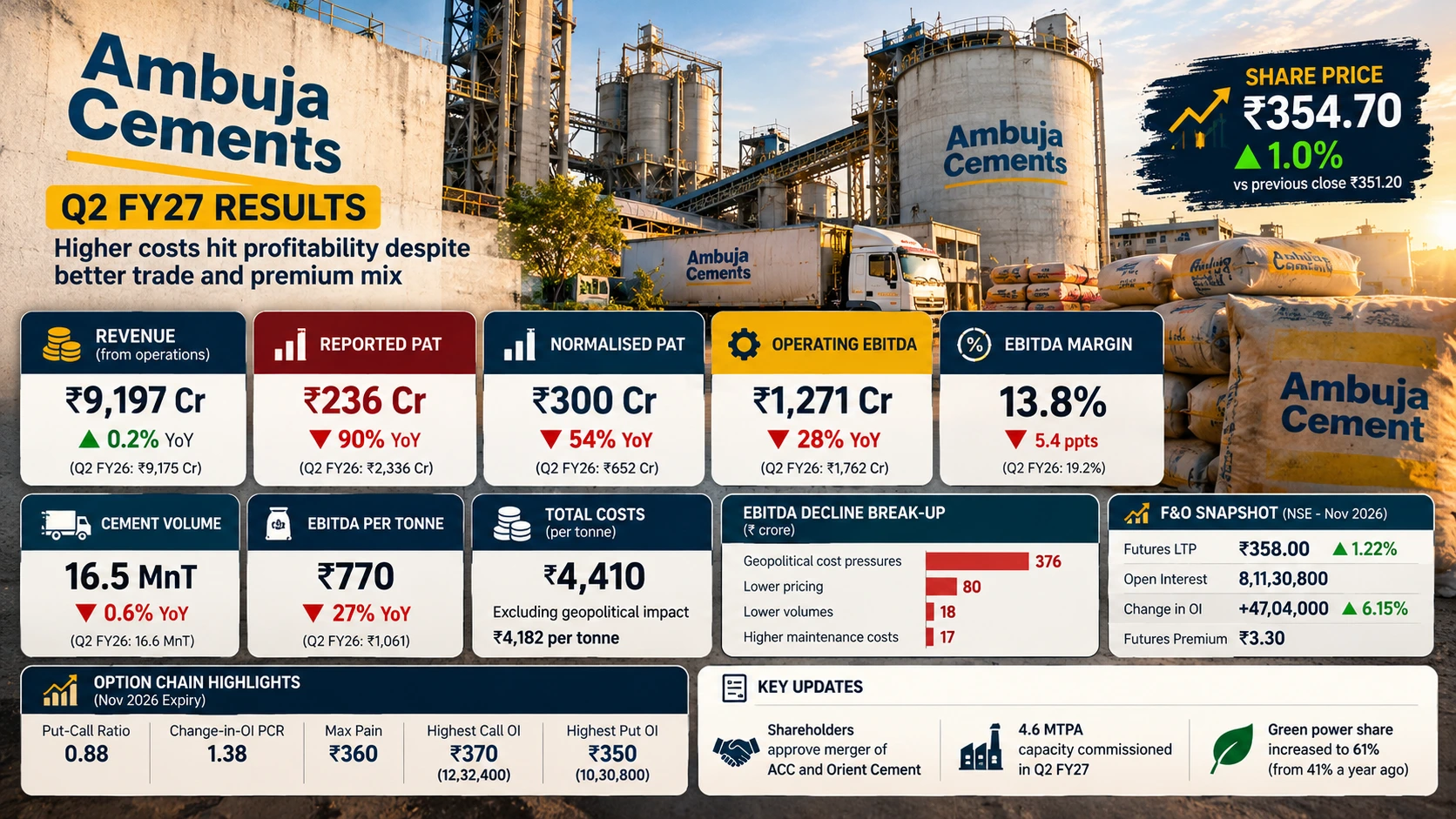
Better Premium Sales Mix Has Not Offset Margin Pressure
Ambuja’s operational performance showed improvement in product mix alongside weaker profitability.
Trade volumes increased 8.6% year on year, while trade sales rose to 74% of total cement volumes, up six percentage points. Premium products accounted for 37% of trade sales, compared with 35% a year earlier.
The blended cement share also increased to 82% from 77%. Meanwhile, green power accounted for 61% of the company’s power mix, compared with 41% in Q2 FY26.
These developments support Ambuja’s strategy of improving product mix, energy efficiency and the quality of its sales. A larger premium-product contribution and more efficient power sourcing could help support margins over time.
However, cement volume slipped to 16.5 million tonnes from 16.6 million tonnes, while the net selling price declined to ₹255 per bag from ₹258, according to the investor presentation.
The result is a clear expectation gap: an improving trade and premium mix has not yet translated into stronger earnings per tonne. Higher input costs and weaker realisations have more than offset those improvements in the latest quarter.
The next earnings report will show whether a better pricing environment and cost discipline can convert the stronger sales mix into a meaningful recovery in profitability.
H1 FY27 Results Show Broader Earnings Pressure
The first-half numbers indicate that the operating challenge extends beyond the tax-distorted Q2 comparison.
| Consolidated metric | H1 FY27 | H1 FY26 | YoY change |
|---|---|---|---|
| Revenue from operations | ₹18,697 crore | ₹19,464 crore | -4% |
| Cement sales volume | 33.6 million tonnes | 35.0 million tonnes | -4% |
| Operating EBITDA | ₹2,860 crore | ₹3,722 crore | -23% |
| EBITDA margin | 15.3% | 19.1% | -3.8 percentage points |
| Reported PAT | ₹896 crore | ₹3,377 crore | -73% |
| Normalised PAT | ₹895 crore | ₹1,612 crore | -44% |
Source: Ambuja Cements’ investor presentation.
Normalised PAT fell 44% in H1 FY27, while EBITDA declined 23%. The first-half figures reinforce the need for a sustained improvement in operating profitability rather than relying on the high-base effect to explain the latest reported decline.
For the second half, better price realisation, easing input costs and higher utilisation of newly commissioned capacity will be important in determining how quickly earnings can recover.
ACC and Orient Cement Merger Moves to the Approval Stage
Ambuja has also advanced its proposed amalgamation of ACC and Orient Cement with the parent company.
Shareholders approved the schemes at the respective NCLT-convened meetings held on September 29 for ACC and September 28 for Orient Cement. The proposals will now proceed to the National Company Law Tribunal for final sanction and remain subject to the requisite regulatory and statutory clearances.
The company’s official release says completion is expected in FY27, subject to those approvals. A more specific completion date should not be treated as confirmed unless subsequently established through an official disclosure.
Management expects the proposed merger to simplify the corporate structure, improve manufacturing and logistics coordination, unlock operating synergies and support earnings per share. These remain forward-looking expectations; shareholder approval does not mean that the amalgamation is complete or that the expected benefits have already been realised.
Ambuja ended the quarter with a debt-free balance sheet, net worth of ₹72,238 crore and cash and cash equivalents of ₹1,070 crore. This financial position provides flexibility to pursue its capacity expansion and integration plans, although the returns will depend on execution and market conditions.
H2 FY27 Outlook: Pricing and Cost Control Hold the Key
Ambuja commissioned 4.6 million tonnes per annum (MTPA) of capacity during Q2 through projects at Dahej, Salai Banwa and Kalamboli.
A further 3.2 MTPA at Bathinda and Jodhpur Penna is being stabilised and ramped up, while 2.4 MTPA at Warisaliganj is expected to be commissioned in H2 FY27.
The company expects cement volumes to grow ahead of the industry in the second half, supported by stronger trade sales and calibrated institutional business. Following the recent ₹10–15-per-bag price increase, management also expects further pricing improvement over the next couple of months.
Higher renewable-power use, capacity ramp-ups and operational efficiency are expected to support performance. However, the industry continues to face geopolitical uncertainty, elevated energy costs and seasonal demand pressures.
The recovery therefore depends on several factors working together. If cement price increases hold and input costs ease, Ambuja could improve EBITDA per tonne. If costs remain elevated or pricing gains prove difficult to sustain, volume growth alone may not be enough to restore margins.
The company’s ₹4,250-per-tonne FY27 cost target will be an important measure of execution, alongside EBITDA per tonne and the margin trajectory in the coming quarters.
Bottom Line: Ambuja’s Earnings Recovery Remains Unproven
Ambuja Cements’ Q2 FY27 results reveal two distinct developments. The previous year’s ₹1,697 crore tax provision reversal amplified the reported 90% PAT decline, but the 54% fall in normalised PAT and the 28% reduction in operating EBITDA confirm that the underlying earnings pressure remains material.
At the same time, the stock closed higher and November futures open interest rose 6.15% in the specified afternoon snapshot. That combination points to stronger derivatives positioning during the session, but does not establish that the company’s earnings outlook has improved.
For investors and traders, the next indicators to monitor are EBITDA per tonne, the effectiveness of cement price increases, progress towards the FY27 cost target and the pace of new-capacity ramp-up. Until operating margins begin to stabilise, a sustained earnings recovery remains an expectation rather than a confirmed trend.
Read Next: Adani Ports Shares Jump 6.29%; November Futures OI Surges 10.30% After Q2 Results
Disclaimer: This article is for informational and educational purposes only and is not investment advice. Futures and options data is time-sensitive, and positioning indicators do not guarantee future price movements. Investors should assess their own risk tolerance before making investment decisions.