PLI Jobs: India’s PLI Schemes Create 8.49 Lakh Jobs, But Employment Growth Remains Uneven
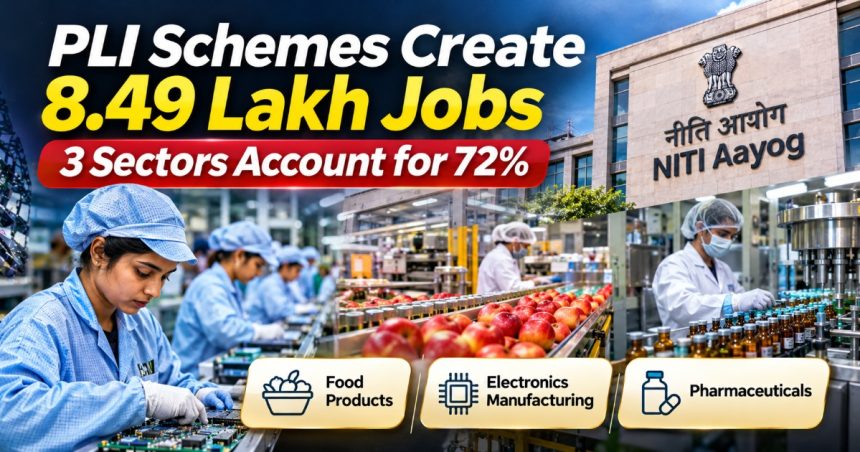
India’s ambitious manufacturing push is generating employment, but the benefits are not spreading equally across industries. The Centre’s Production-Linked Incentive (PLI) schemes created 8.49 lakh jobs up to March 2026, with three sectors accounting for nearly three-fourths of the total employment.
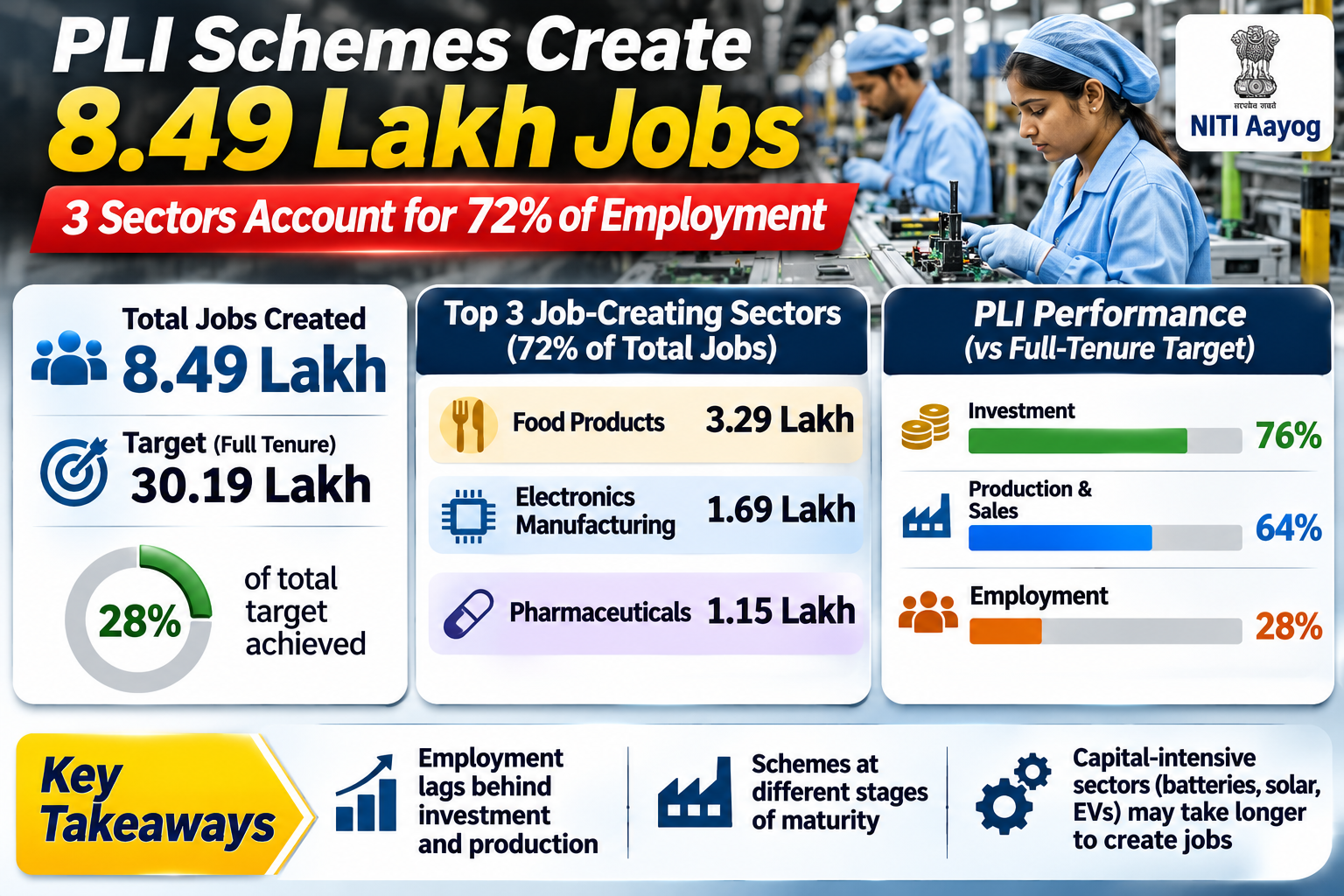
According to a NITI Aayog assessment report, food products, large-scale electronics manufacturing and pharmaceuticals together generated 6.13 lakh jobs, representing approximately 72% of the employment created across the 14 sectors covered by the programme.
However, there is another important takeaway for investors and the manufacturing industry. Despite substantial investment and production growth, employment generation remains significantly behind the programme’s overall target.
The findings raise questions about how effectively India’s PLI schemes are translating manufacturing investments into large-scale job creation.
Track Live : NSE Option Chain — Live | BSE Option Chain — Live Sensex & Bankex Options Data Today
PLI Jobs: Food Processing, Electronics and Pharma Drive 72% of PLI Employment
Food processing emerged as the biggest employment generator under the PLI programme, creating 3.29 lakh jobs by March 2026.
Large-scale electronics manufacturing followed with 1.69 lakh jobs, while the pharmaceutical sector contributed another 1.15 lakh jobs.
Together, these three industries demonstrate how manufacturing incentives are supporting employment in sectors where production capacity and domestic demand are expanding.
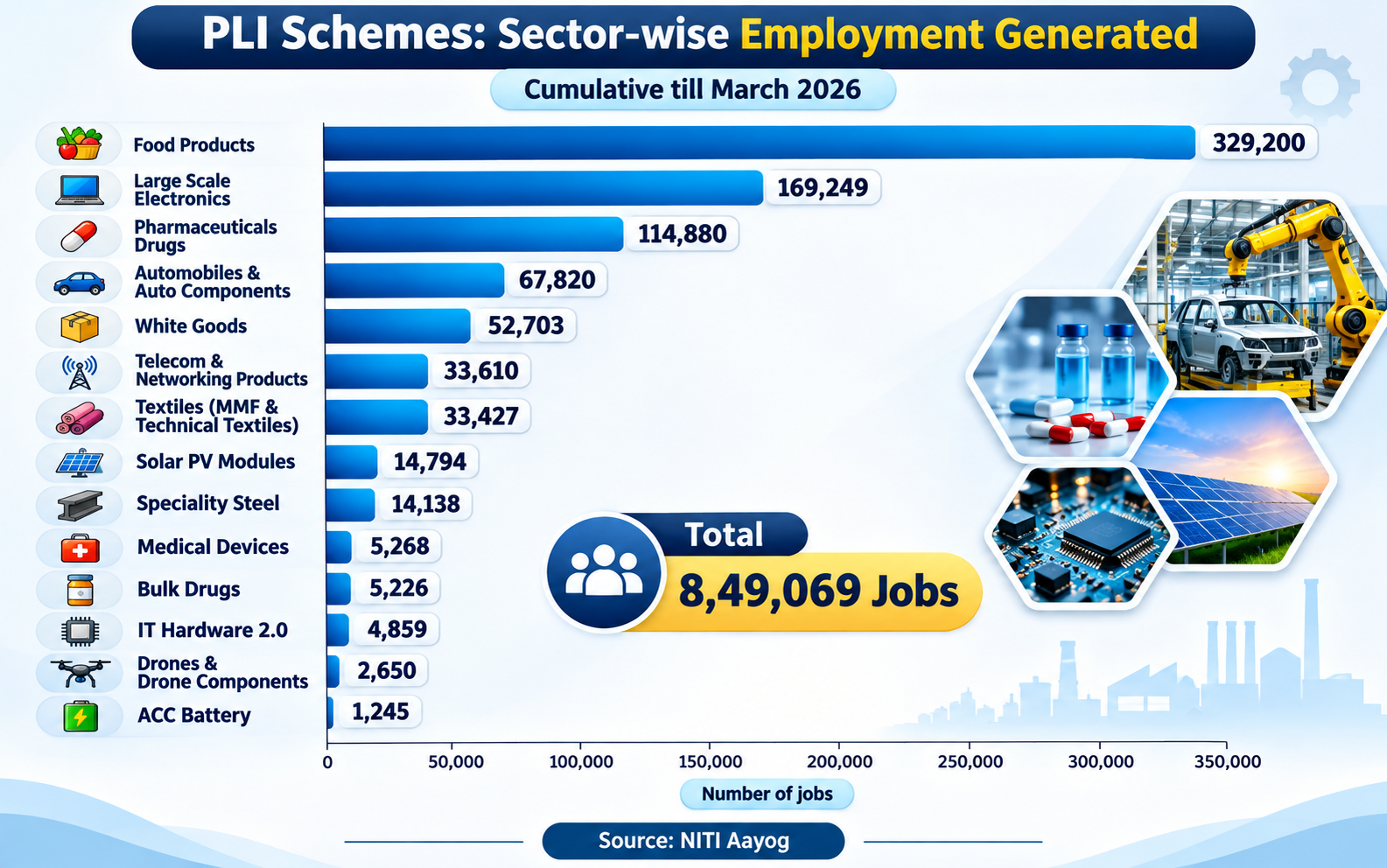
Sector-wise employment: Which industries generated the most jobs?
Beyond the top three sectors, the NITI Aayog assessment provides an important picture of employment distribution across the remaining manufacturing industries.
| Sector | Employment generated |
|---|---|
| Food products | 3,29,000 |
| Large-scale electronics | 1,69,000 |
| Pharmaceuticals | 1,15,000 |
| Automobiles and auto components | 67,820 |
| White goods | 52,703 |
| Telecom and networking products | 33,610 |
| Textiles | 33,427 |
| Solar PV modules | 14,794 |
| Medical devices | 5,268 |
| Bulk drugs | 5,226 |
| IT hardware 2.0 | 4,859 |
| Drones and drone components | 2,650 |
Track Live : Nifty Levels Today | Sensex Levels Today
| Indicator | Achievement by March 2026 |
|---|---|
| Cumulative investment | ₹2,40,138 crore |
| Production and sales | ₹22,66,412 crore |
| Employment generated | 8,49,069 |
| Incentives disbursed | ₹35,354 crore |
PLI Employment Generation Reaches Only 28% of Its Target
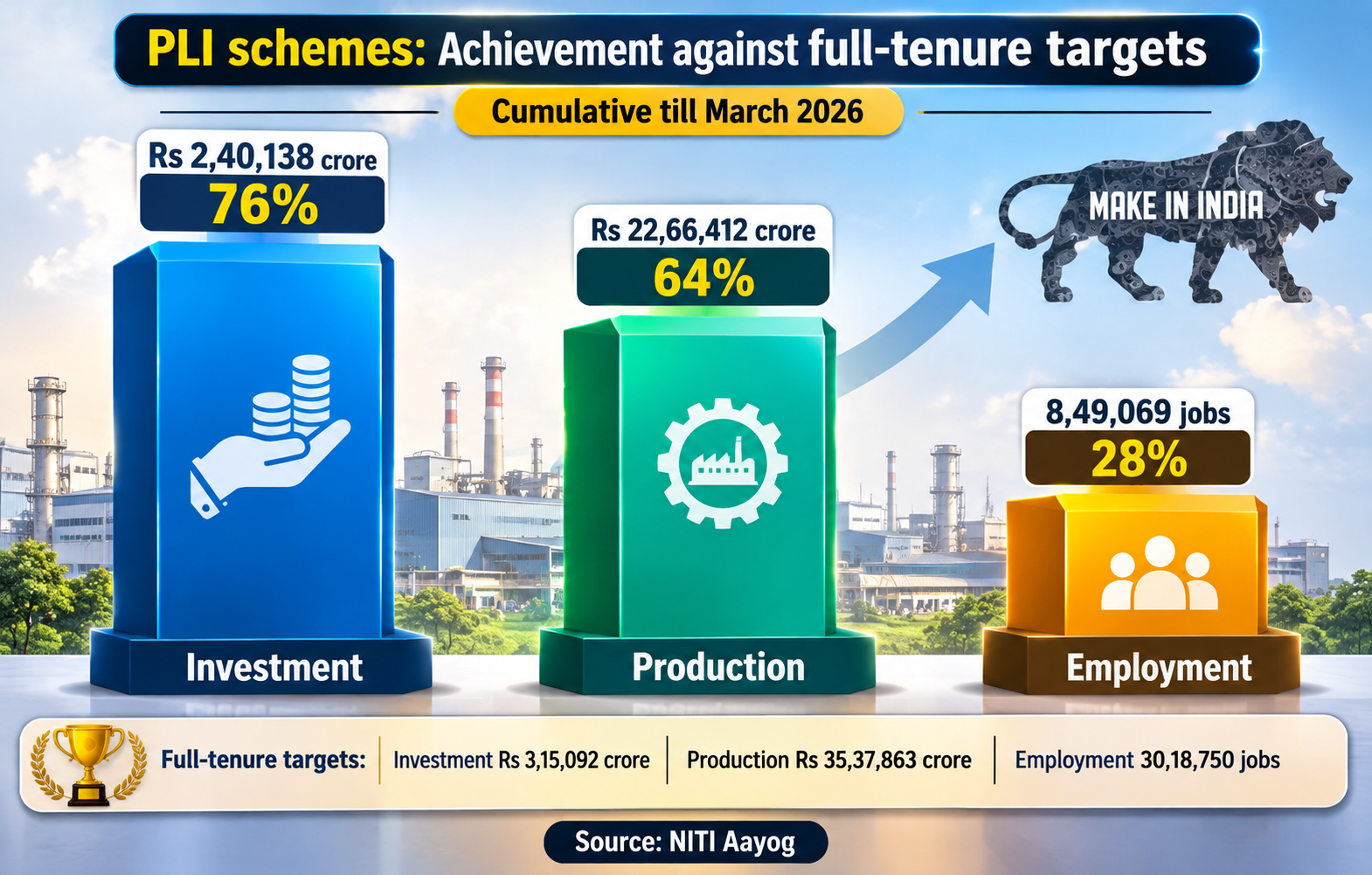
The NITI Aayog assessment also highlights a gap between investment, production and employment generation.
Cumulative investment under the PLI schemes has reached 76% of the full-tenure target, while production and sales have achieved 64%.
However, employment generation stands at just 28% of the targeted 30.19 lakh jobs.
PLI schemes: Progress against full-tenure targets
Investment 76%
Production and sales 64%
Employment 28%
PLI Schemes: Employment Generation Performance
| Key Metric | Figures |
|---|---|
| Total jobs generated by March 2026 | 8.49 lakh |
| Full-tenure employment target | 30.19 lakh |
| Employment target achieved | 28% |
| Approximate gap to target | 21.70 lakh |
| Manufacturing sectors covered | 14 |
Employment Target Achievement: 28% of the total employment target has been achieved.
Source: NITI Aayog assessment report. Figures represent progress against respective full-tenure targets.
NITI Aayog cautioned that the 14 schemes are at different stages of maturity and employment gains may take longer to emerge as manufacturing facilities become operational.
Three sectors account for 72% of all PLI-generated employment
One of the most important findings of the assessment is the concentration of employment in three sectors.
Food processing, large-scale electronics manufacturing and pharmaceuticals together generated approximately 6.13 lakh jobs.
Food processing leads with 3.29 lakh jobs
Food processing is the largest employment generator under the PLI programme.
The sector has generated approximately 329,000 jobs, representing nearly 39% of total employment across the 14 schemes.
The programme supports food manufacturing businesses through incentives linked to eligible production and sales.
Its employment contribution is particularly relevant because food processing includes activities such as manufacturing, processing, packaging and handling of food products.
Large-scale electronics manufacturing creates 1.69 lakh jobs
The large-scale electronics manufacturing sector generated approximately 169,000 jobs.
This sector has benefited from the expansion of domestic electronics and mobile-phone manufacturing.
The programme has attracted both Indian and international manufacturers, helping expand production capacity and strengthen India’s position in global electronics supply chains.
Pharmaceuticals generate 1.15 lakh jobs
The pharmaceutical sector created approximately 115,000 jobs.
The programme aims to strengthen domestic pharmaceutical manufacturing, improve production capabilities and reduce dependence on imported pharmaceutical ingredients and products.
The sector’s contribution also reflects the expansion of India’s pharmaceutical manufacturing ecosystem.
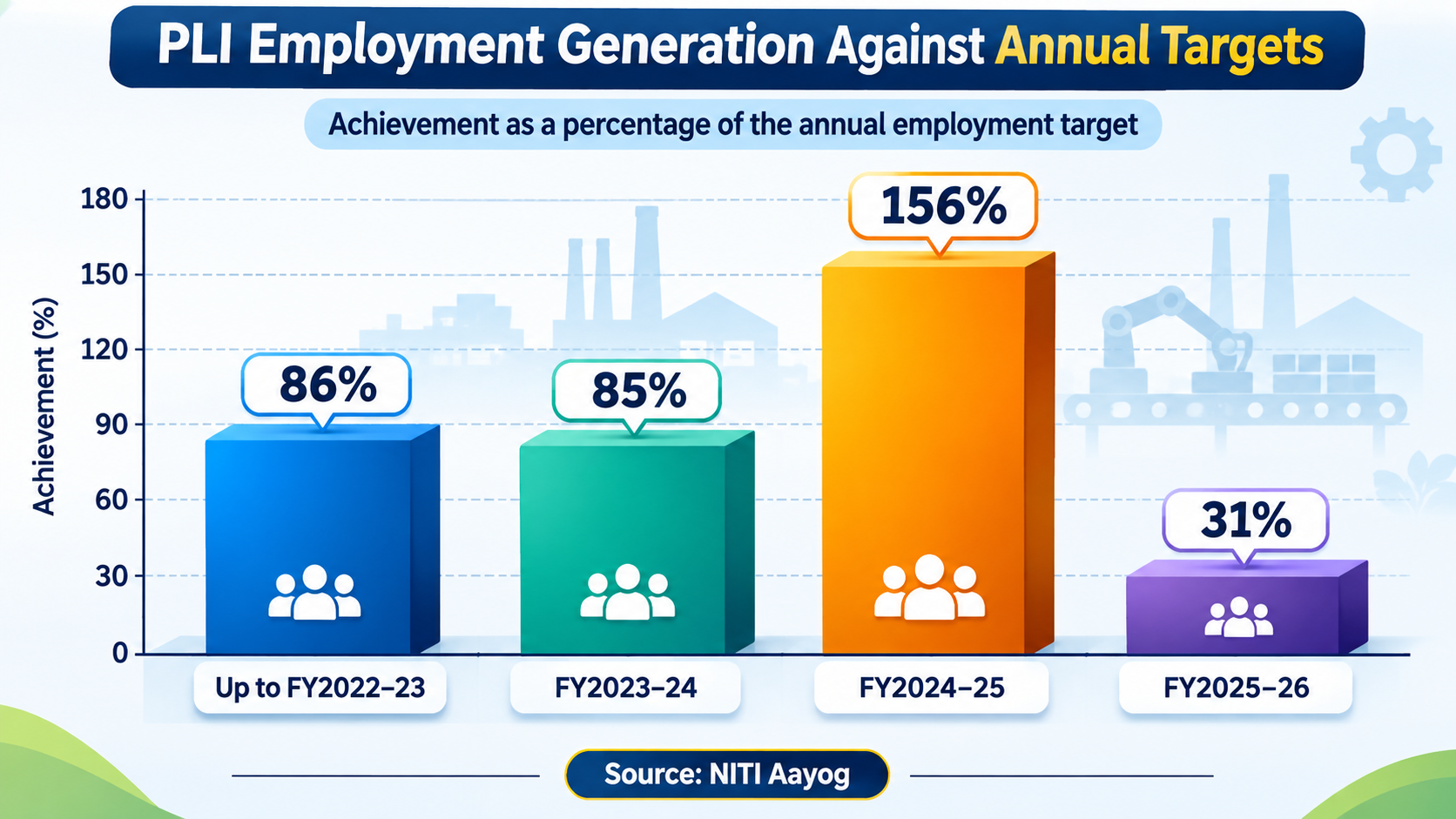
Why NITI Aayog says employment generation is taking longer
NITI Aayog has cautioned against judging the entire programme solely on its current employment performance.
The assessment notes that the 14 schemes are at different stages of maturity.
As of March 2026, approximately 58% of the combined implementation period had elapsed, while 42% remained.
PLI Scheme Implementation Progress
| Key Metric | Progress |
|---|---|
| Implementation period completed | 58% |
| Implementation period remaining | 42% |
Implementation Timeline: 58% of the implementation period has elapsed, while 42% remains.
Why electronics manufacturing has emerged as a major PLI success
Large-scale electronics manufacturing is one of the strongest-performing components of the programme.
The sector has a financial outlay of ₹34,193 crore and has contributed to the expansion of India’s mobile-phone manufacturing ecosystem.
The assessment identifies growth in:
-
Domestic manufacturing capacity.
-
Mobile-phone production.
-
Sales and exports.
-
Employment generation.
-
Participation by Indian and international manufacturers.
The expansion is important because electronics manufacturing can strengthen India’s integration into global supply chains.
Capital-Intensive Manufacturing Could Take Longer to Generate Jobs
NITI Aayog highlighted that higher investment does not automatically translate into proportionate employment, particularly in industries dependent on automation and advanced technology.
Battery manufacturing and solar module production are examples where companies may invest heavily before reaching commercial production.
The report also identified electronics manufacturing, pharmaceuticals, food processing, drones, medical devices and white goods as sectors showing relatively strong progress across multiple parameters.
Automobiles, telecom and speciality steel have progressed in investment and production but need to improve employment, exports and domestic value addition.
Government manufacturing outlay: How much money has been allocated?
The PLI programme has a combined financial outlay of ₹1,91,049 crore across 14 sectors.
However, the amount actually disbursed is significantly lower.
| Financial indicator | Amount |
|---|---|
| Total approved outlay | ₹1,91,049 crore |
| Incentives disbursed | ₹35,354 crore |
| Disbursement as a percentage of outlay | 18.51% |
This distinction matters because the approved financial outlay represents the government’s overall commitment, not the amount already paid to participating companies.
Companies receive incentives after meeting the eligibility conditions and specified production or investment requirements.
Read More : India Inflation Hits 6.09% for the Ninth Month in a Row: Will Your Loan EMI Go Up Again?
What PLI Employment Data Means for Investors and Manufacturing Stocks
For investors, the latest PLI report provides important clues about India’s manufacturing investment opportunities.
Electronics, pharmaceuticals and food processing remain important sectors to watch because of their contribution to employment and manufacturing activity.
Companies operating in solar modules, batteries, automobiles and telecom equipment could also attract attention as new manufacturing facilities move towards commercial production.
However, investors should not interpret higher government incentives or investment announcements as immediate indicators of profitability.