
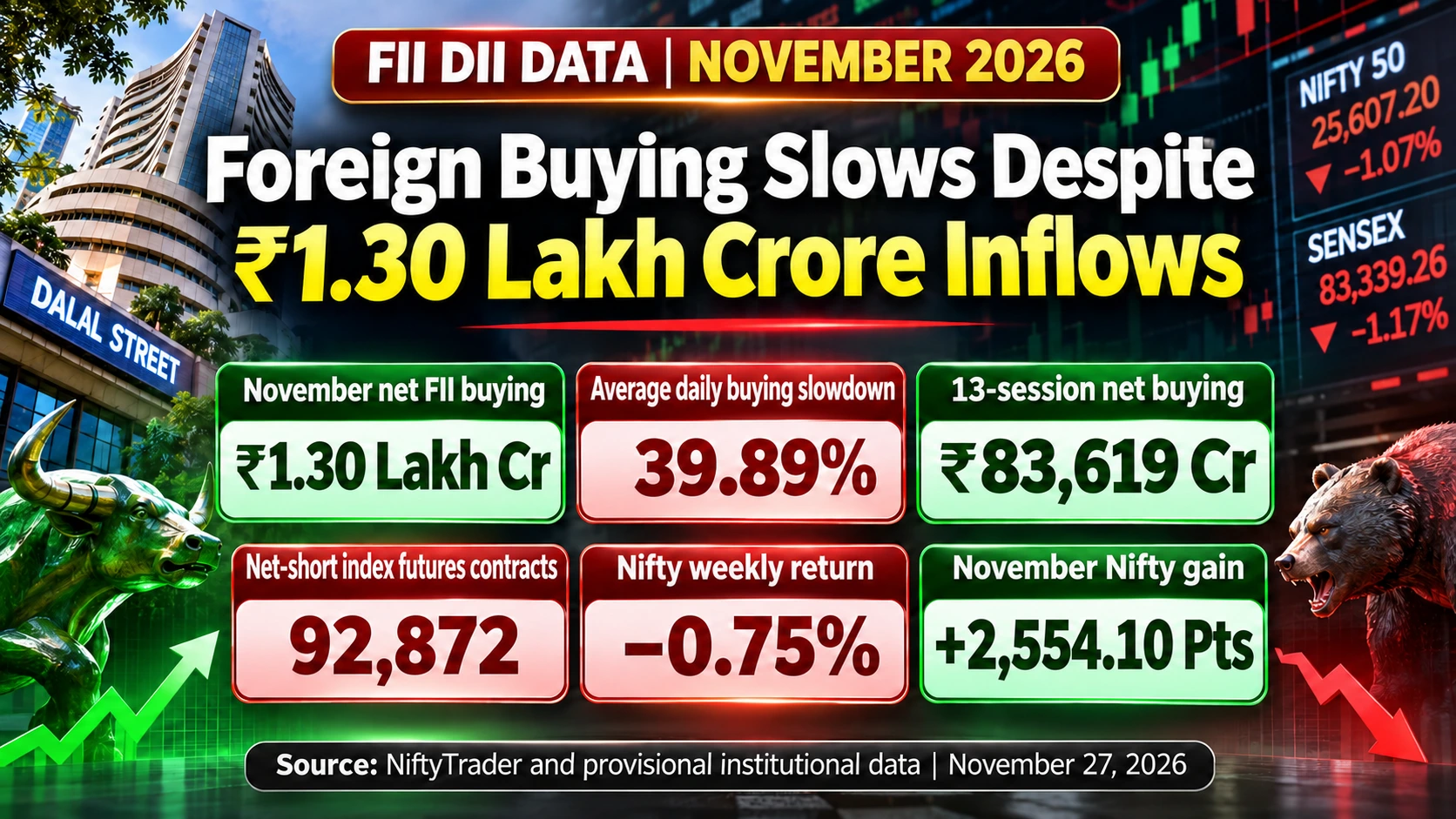
Synopsis: Foreign institutional investors have bought nearly ₹1.30 lakh crore in Indian equities in November, including ₹83,619 crore over 13 consecutive sessions. However, average daily foreign buying has slowed nearly 40%, Nifty has snapped its four-week winning streak, and FIIs hold 92,872 net-short index-futures contracts. NiftyTrader’s five-year historical analysis offers fresh insights into institutional positioning ahead of December.
Foreign institutional investors (FIIs) have made a remarkable return to India’s equity market after ten consecutive months of net selling. However, slowing purchases, substantial index-futures shorts and the latest market correction suggest that November’s rally faces an important test.
According to NiftyTrader’s latest FII DII data, foreign investors recorded net purchases of ₹1,634.33 crore on Friday, November 27, extending their post-Muhurat buying streak to 13 consecutive trading sessions. Cumulative net purchases during this period reached ₹83,619.10 crore.
Despite continued foreign buying, the Nifty 50 declined 277.30 points, or 1.07%, to close at 25,607.20, while the Sensex plunged 989.33 points, or 1.17%, to 83,339.26.
More significantly, average daily foreign purchases have slowed nearly 40% during the latest four trading sessions, even as FIIs increased their net-short index-futures exposure.
Track Live: NiftyTrader’s latest FII DII data | NIFTY 50 | SENSEX
FII DII Data Today: Foreign Buying Continues Despite Market Selloff
Foreign and domestic institutional investors traded in opposite directions on November 27, with DIIs returning to net selling after two consecutive buying sessions.
| Institutional activity | FII | DII |
|---|---|---|
| Gross purchases | ₹14,259.45 Cr | ₹17,263.65 Cr |
| Gross sales | ₹12,625.12 Cr | ₹17,820.07 Cr |
| Net activity | +₹1,634.33 Cr | −₹556.42 Cr |
Source: Moneycontrol and NiftyTrader; provisional institutional cash-market data.
Combined institutional net purchases stood at ₹1,077.91 crore. Nevertheless, both benchmark indices closed sharply lower.
Friday’s net foreign purchases were approximately 72% lower than Thursday’s ₹5,843.33 crore.
The latest session demonstrates why positive institutional flows should not automatically be interpreted as a bullish market signal. Benchmark performance also depends on the distribution of purchases across individual companies, sector-specific developments and selling by other market participants.
FIIs Buy ₹1.30 Lakh Crore in November After 10 Months of Selling
November has marked a substantial reversal in foreign institutional activity.
According to NiftyTrader’s historical cash-market series, FIIs were net sellers in every completed month between January and October 2026. March witnessed the largest monthly net selling during this period, at approximately ₹1.23 lakh crore.
November’s net foreign purchases have reached ₹1,29,578.87 crore through November 27.
Monthly FII DII Activity in 2026
| Month | FII net (₹ Cr) | DII net (₹ Cr) |
|---|---|---|
| January | −41,435 | +69,221 |
| February | −6,641 | +38,423 |
| March | −1,22,540 | +1,42,960 |
| April | −70,135 | +51,064 |
| May | −55,963 | +82,669 |
| June | −49,029 | +85,800 |
| July | −5,779 | +35,099 |
| August | −7,532 | +58,268 |
| September | −44,013 | +76,030 |
| October | −45,162 | +62,220 |
| November* | +1,29,579 | −55,454 |
Source: NiftyTrader monthly aggregates. Figures rounded to the nearest crore. November data through November 27.
Foreign institutions recorded cumulative net selling of approximately ₹4.48 lakh crore between January and October. November’s net purchases have offset nearly 29% of those outflows.
Domestic institutions have moved in the opposite direction, recording net sales of ₹55,454.13 crore this month after remaining monthly net buyers throughout the preceding ten months.
Calculations based on NiftyTrader’s monthly series show that FIIs remain net sellers of approximately ₹3.19 lakh crore in 2026, while DIIs have recorded cumulative net purchases of approximately ₹6.46 lakh crore.
The institutional turnaround has coincided with a strong recovery in Indian equities, with the Nifty 50 rising from 23,053.10 on October 30 to 25,607.20 on November 27, gaining 2,554.10 points during this period.
FIIs Buy ₹17,630 Crore This Week, Yet Nifty Falls 193 Points
Foreign investors remained net buyers throughout the holiday-shortened trading week, while domestic institutions returned to net buying on a weekly basis.
| Date | FII net (₹ Cr) | DII net (₹ Cr) |
|---|---|---|
| November 23 | +5,672.99 | −2,760.12 |
| November 25 | +4,479.08 | +4,018.72 |
| November 26 | +5,843.33 | +5,630.72 |
| November 27 | +1,634.33 | −556.42 |
| Weekly total | +17,629.73 | +6,332.90 |
Source: NSE provisional institutional cash-market data, as reported by Moneycontrol. Weekly totals calculated from daily figures. November 24 was a trading holiday.
DIIs recorded weekly net purchases of ₹6,332.90 crore despite being net sellers on November 23 and 27. Strong purchases on November 25 and 26 more than offset those outflows.
Together, both institutional groups recorded net purchases of approximately ₹23,963 crore during the week.
However, Nifty declined 193.40 points, or 0.75%, from its November 20 closing level of 25,800.60, ending a four-week winning streak.
Average Daily FII Buying Slows Nearly 40%
A closer examination of foreign purchases reveals that the buying streak continues, but its momentum has weakened.
During the first nine sessions of the current streak, FIIs purchased ₹65,989.37 crore, averaging ₹7,332.15 crore per session.
During the latest four sessions, average daily purchases declined to ₹4,407.43 crore, representing a reduction of 39.89%.
The slowdown does not necessarily indicate an imminent reversal in foreign flows, but it highlights weakening buying intensity following November’s substantial market recovery.
Why Do FII Buying Streak Figures Differ?
CNBC-TV18 reported a 19-session FII buying streak through November 27, while NiftyTrader recorded 13 consecutive buying sessions following Muhurat trading.
The longer figure corresponds to a regular-session buying run beginning October 30, excluding the special Muhurat session.
Moneycontrol’s daily cash-market records show marginal FII net selling of ₹0.25 crore during the November 8 Muhurat session. This article follows NiftyTrader’s methodology and uses the uninterrupted 13-session post-Muhurat buying streak from November 9.
FIIs Hold 92,872 Net-Short Index Futures Contracts
The derivatives market presents a more complex picture than the strong cash-market inflows suggest.
According to NiftyTrader’s participant-wise open interest data, foreign investors held 36,644 long index-futures contracts against 1,29,516 short contracts on November 27.
| FII derivatives positioning | Contracts |
|---|---|
| Index-futures longs | 36,644 |
| Index-futures shorts | 1,29,516 |
| Net-short index futures | 92,872 |
| Stock-futures longs | 33,97,359 |
| Stock-futures shorts | 25,55,574 |
| Net-long stock futures | 8,41,785 |
Approximately 78% of FIIs’ outstanding index-futures contracts were short, with a long-to-short ratio of around 0.28.
Their net-short position widened by 4,403 contracts on Friday as foreign institutions reduced long positions by 1,016 contracts and added 3,387 short contracts.
However, FIIs remained substantially net long in individual stock futures.
One possible explanation is portfolio hedging, where institutions maintain exposure to selected equities while using index futures to manage broader market risk.
NiftyTrader’s combined institutional framework classifies the current combination as Profit Lock — Bullish Weak.
The classification identifies divergence between cash-market activity and derivatives exposure rather than confirming that institutions are booking profits or protecting existing gains.
FII Options Data Indicates Additional Downside Caution
Friday’s index-options positioning provides another layer of insight.
FIIs increased long call positions by 2,02,823 contracts and short call positions by 2,57,298 contracts. They also added 66,533 long put contracts while reducing short put positions by 32,309 contracts.
At Friday’s close, foreign institutions were net short 1,63,977 index-call contracts and net long 3,14,421 index-put contracts.
Such positioning can be consistent with downside protection. However, aggregate options positions across different strikes and expiries may also reflect spreads, arbitrage and other strategies.
These figures cannot establish individual institutional investors’ intentions or confirm a bearish market forecast.
What Five Years of NiftyTrader Data Reveal About FII Buying Streaks
Does continuous foreign buying necessarily translate into strong market returns?
NiftyTrader’s proprietary five-year historical analysis offers an interesting perspective.
The dashboard reports 50 historical episodes involving at least three consecutive sessions of net foreign buying and examines Nifty’s subsequent ten-session performance.
| Historical indicator | Result |
|---|---|
| Historical episodes | 50 |
| Average 10-session Nifty return | +0.1% |
| Positive-return episodes | 30 of 50 |
| Positive-return frequency | 60% |
| Best observed return | +4.7% |
| Best-performing episode | July 2022 |
Source: NiftyTrader proprietary historical dashboard analysis.
Although Nifty generated positive returns in 60% of the observed episodes, its average subsequent return was only 0.1%.
The findings highlight an important distinction between the frequency of market gains and their magnitude. Continuous foreign buying has not consistently translated into substantial short-term index returns.
The analysis considers buying streaks of at least three sessions, not specifically 13-session streaks. It does not incorporate historical derivatives positioning, and the dashboard-reported results have not been independently replicated.
These observations provide historical context rather than a forecast of December’s market performance.
Why Is Nifty Falling Despite Strong Foreign Buying?
The latest correction comes after a substantial recovery in Indian equities.
According to Reuters’ November 27 market report, Indian benchmarks had gained nearly 15% over the preceding four weeks before encountering renewed selling pressure.
Brent crude futures climbed approximately 5% during the latest week to $97 per barrel, raising concerns about India’s inflation, import expenditure and external balances.
Heavyweight financial stocks declined 1.9% during the week, while the IT index gained 4.6%. Twelve of the 16 major sectors tracked by Reuters recorded weekly losses.
The contrasting sector performance highlights how positive institutional cash flows can coexist with benchmark weakness.
GDP Data and RBI Policy: Two Major Tests for December
The coming week brings two significant economic developments that could influence institutional positioning.
According to MoSPI’s official advance release calendar, India’s second-quarter FY27 GDP estimates are scheduled for release on November 30.
A Moneycontrol economist poll and a separate Mint survey project real GDP growth of 7.6% for the July–September quarter, compared with 7.8% in the preceding quarter.
The RBI’s Monetary Policy Committee is scheduled to meet from December 2 to 4.
According to Reuters’ monetary policy report, more than 90% of surveyed economists expect a 25-basis-point repo rate increase to 5.75%. However, money-market indicators suggest that a larger 50-basis-point increase cannot be ruled out.
These economic developments could influence foreign investor positioning as December begins.
For investors, November’s institutional reversal remains significant. However, slowing foreign purchases and substantial index-futures shorts reinforce the need to track whether continued institutional buying translates into broader market gains.
Read Next: Asian Markets Today: China Chip Index Jumps 19.5%, KOSPI Gains 4.34%
Disclaimer: Institutional cash-market figures are provisional and subject to revision. Historical observations and derivatives positioning do not guarantee future returns. This article is for informational and educational purposes only and does not constitute investment advice.