
Synopsis: Bitcoin’s recovery above $62,000 proved short-lived as the cryptocurrency slipped below $60,000, while Ethereum fell towards $1,650. US spot Bitcoin ETFs recorded a record $5.78 billion in November net withdrawals through November 27, while Bitcoin and Ethereum futures liquidations reached $276 million. Shrinking stablecoin liquidity and upcoming Federal Reserve policy developments continue to cloud the recovery outlook.
Bitcoin and Ethereum failed to sustain Friday’s recovery, extending weakness in the cryptocurrency market despite a strong rebound on Wall Street. Persistent ETF withdrawals, leveraged-position liquidations and contracting stablecoin liquidity continue to challenge investor confidence.
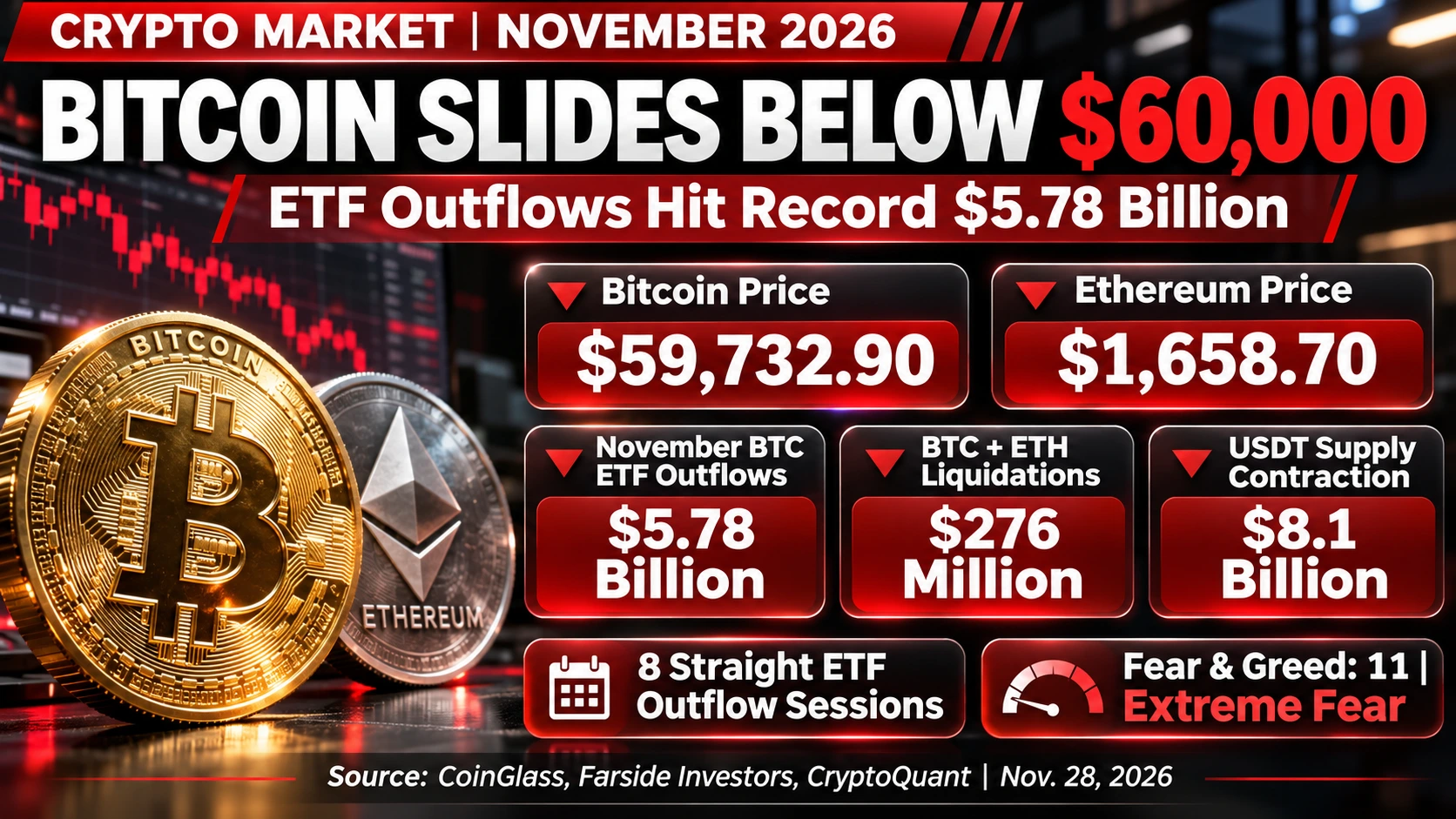
According to CoinGlass market snapshots retrieved on November 28, Bitcoin was trading at $59,732.90, down 3.38% over the preceding 24 hours. Ethereum traded at $1,658.70, recording a 24-hour decline of 4.37%.
Bitcoin had climbed above $62,000 on Friday before reversing sharply, with its recent 24-hour trading range extending from $58,750 to $62,206.90.
The reversal comes as US spot Bitcoin exchange-traded funds (ETFs) recorded another $389 million in net withdrawals on Friday, pushing November’s cumulative outflows to a record $5.78 billion through November 27.
Track Live: Crypto Option Chain India — Live Bitcoin & Ethereum Options on Delta Exchange
Crypto Market Today: Bitcoin and Ethereum Lose Recovery Momentum
Friday’s rebound had raised hopes of stabilisation following several weeks of selling. However, renewed weakness has pushed both leading cryptocurrencies below important psychological price levels.
| Market indicator | Bitcoin (BTC) | Ethereum (ETH) |
|---|---|---|
| Price | $59,732.90 | $1,658.70 |
| 24-hour change | −3.38% | −4.37% |
| Market capitalisation | $1.20 trillion | $202.61 billion |
| 24-hour high | $62,206.90 | $1,743.70 |
| 24-hour low | $58,750 | $1,632.90 |
Source: CoinGlass, market snapshots retrieved on November 28, 2026.
The Crypto Fear and Greed Index stood at 11, indicating extreme fear.
Bitcoin remained approximately 53% below its October 2025 record of $126,198.10, highlighting the scale of the broader market correction.
Unlike conventional equities, cryptocurrencies trade continuously, leaving investors exposed to weekend price fluctuations even when traditional stock exchanges and regulated ETF markets are closed.
Track Live: Crypto Price Today — Bitcoin, Ethereum & Live Rates
Bitcoin ETF Outflows Hit Record $5.78 Billion in November
Persistent withdrawals from US spot Bitcoin ETFs remain a significant challenge for the cryptocurrency market.
Calculations based on Farside Investors’ daily ETF records show that cumulative November net withdrawals reached $5.78 billion through November 27.
The figure has already surpassed the previous monthly outflow record of approximately $4.51 billion, recorded in June 2026, with November’s final US trading session still remaining.
Friday’s $389 million withdrawal marked the eighth consecutive trading session of net outflows.
Bitcoin and Ethereum ETF Flows This Week
| Date | Bitcoin ETF flows | Ethereum ETF flows |
|---|---|---|
| November 23 | −$569.7 million | −$84.9 million |
| November 24 | −$231.4 million | −$64.1 million |
| November 25 | −$453.0 million | −$68.5 million |
| November 27 | −$389.0 million | −$69.4 million |
| Weekly total | −$1.64 billion | −$286.9 million |
Source: Farside Investors’ Bitcoin and Ethereum ETF records. Weekly totals calculated from daily net flows. November 26 was a US market holiday for Thanksgiving.
Together, Bitcoin and Ethereum ETFs recorded $1.93 billion in net withdrawals during the holiday-shortened week.
The continued redemptions indicate weak demand through regulated cryptocurrency investment products, even during temporary price rebounds.
However, ETF flows represent only one segment of the cryptocurrency market and do not capture all institutional or retail investment activity.
BlackRock’s IBIT Accounts for 83.5% of November Bitcoin ETF Withdrawals
A closer examination of individual funds reveals that November’s ETF withdrawals have been heavily concentrated in BlackRock’s iShares Bitcoin Trust (IBIT).
The fund recorded approximately $4.83 billion in cumulative net withdrawals through November 27, accounting for 83.5% of aggregate net outflows across US spot Bitcoin ETFs.
Bitcoin ETF Outflows on November 27
| Bitcoin ETF | Net outflow |
|---|---|
| BlackRock IBIT | $327.2 million |
| Fidelity FBTC | $20.8 million |
| Bitwise BITB | $12.3 million |
| ARK 21Shares ARKB | $5.7 million |
| Grayscale GBTC | $23.0 million |
| Total | $389.0 million |
BlackRock’s IBIT alone recorded approximately $1.34 billion in net withdrawals during the latest trading week.
Importantly, ETF redemptions reflect investor activity within these products rather than necessarily indicating that BlackRock itself has adopted a bearish investment position on Bitcoin.
Bitcoin and Ethereum Futures Liquidations Reach $276 Million
The cryptocurrency sell-off has also triggered substantial liquidations across derivatives markets.
According to CoinGlass market snapshots retrieved on November 28, combined Bitcoin and Ethereum futures liquidations reached approximately $276.09 million over their respective preceding 24-hour periods.
| Cryptocurrency | Total liquidations | Long liquidations | Short liquidations |
|---|---|---|---|
| Bitcoin | $164.19 million | $129.48 million | $34.71 million |
| Ethereum | $111.90 million | $92.46 million | $19.44 million |
| Combined | $276.09 million | $221.94 million | $54.15 million |
Source: CoinGlass, November 28, 2026. Combined figures calculated from separate market snapshots.
Long positions accounted for approximately 80.4% of the combined liquidation value, highlighting the pressure faced by leveraged traders betting on rising cryptocurrency prices.
Liquidations occur when traders can no longer maintain the margin required for leveraged positions, resulting in forced closures that can amplify market volatility.
These figures should not be confused with spot-market selling or ETF redemptions, which measure different forms of market activity.
Bitcoin and Ethereum Options Expiry Highlights Market Caution
The cryptocurrency market also faced a substantial monthly derivatives expiry on November 27.
According to Deribit data reported by CoinDesk, approximately $7 billion in Bitcoin options and $600 million in Ethereum options were scheduled to expire, representing an estimated combined notional value of $7.6 billion before settlement.
Subsequent reporting by Decrypt, citing CryptoQuant, placed the actual Bitcoin options expiry at nearly $6.8 billion.
According to Deribit data reported by CoinDesk, Bitcoin’s overall options put-call open-interest ratio increased from 0.55 in late October to 0.81 ahead of the November monthly expiry, while the November 27 expiry-specific ratio stood at 0.89.
The shift is consistent with increased downside caution, although aggregate options positions can also reflect hedging, spreads and other trading strategies.
Options expiry may influence short-term volatility, but its notional value does not represent actual cash withdrawals or forced cryptocurrency sales.
USDT Supply Contracts $8.1 Billion, Raising Liquidity Concerns
Beyond ETF withdrawals and leveraged liquidations, declining stablecoin supply presents another challenge.
According to CryptoQuant’s research, Tether’s USDT supply across Ethereum and Tron contracted by approximately $8.1 billion, or 4.4%, over the 60 days through November 23.
This represented the largest such contraction since August 2022.
Almost the entire decline came from Ethereum-based USDT, while supply on Tron remained broadly unchanged.
Stablecoins facilitate cryptocurrency purchases, transfers and trading. Their supply can therefore offer insights into available liquidity across parts of the digital asset ecosystem.
The contraction does not establish that further cryptocurrency price declines are inevitable. Nevertheless, when combined with persistent ETF withdrawals, it highlights potential obstacles to a sustained recovery.
Bit Digital Sells 29,825 ETH to Reduce Debt by $50 Million
Corporate disclosures are also revealing how digital asset companies are managing their balance sheets during the downturn.
Nasdaq-listed Bit Digital announced on November 25 that it had sold 29,825 Ethereum tokens between November 15 and 23, generating approximately $50 million in net proceeds.
According to its official SEC disclosure, the proceeds reduced its outstanding secured borrowing from Galaxy from $100 million to $50 million.
| Bit Digital transaction | Details |
|---|---|
| Ethereum sold | 29,825 ETH |
| Average selling price | Approximately $1,676 |
| Net proceeds | Approximately $50 million |
| Remaining Galaxy borrowing | $50 million |
| Remaining ETH and equivalents | 134,532 |
| Remaining pledged collateral | 69,089 LsETH |
The original borrowing supported bridge financing for WhiteFiber’s data-centre development and other growth initiatives.
The transaction illustrates how corporate financing requirements can generate cryptocurrency selling independently of short-term price expectations.
However, Bit Digital’s decision does not establish a broader selling trend across all cryptocurrency treasury companies.
Why Is Bitcoin Falling Despite Wall Street’s Recovery?
Bitcoin’s weakness contrasts sharply with the latest recovery in US equities.
According to the Associated Press, Wall Street recorded its strongest week in more than a year following volatile trading in technology stocks.
| US benchmark | Friday gain | Weekly gain |
|---|---|---|
| Dow Jones | +1.2% | +5.5% |
| S&P 500 | +1.6% | +5.6% |
| Nasdaq Composite | +2.3% | +6.7% |
Source: Associated Press, November 27.
Despite improving equity market sentiment, Bitcoin failed to sustain its recovery above $62,000.
The divergence highlights the importance of cryptocurrency-specific pressures, including ETF redemptions, weakening liquidity and leveraged-position liquidations.
Bitcoin Outlook: Three Major US Economic Events Ahead
The cryptocurrency market faces several important economic developments in early December.
| Economic event | Scheduled date |
|---|---|
| November US employment report | December 4 |
| Federal Reserve policy meeting | December 8–9 |
| November US CPI report | December 10 |
Sources: US Bureau of Labor Statistics and Federal Reserve.
Reuters reported that economists expect US nonfarm payrolls to increase by approximately 90,000 in November, following October’s addition of 165,000 jobs.
A separate Reuters poll found that all 101 surveyed economists expected another 25-basis-point Federal Reserve rate increase in December, with 56 anticipating that it would be the final hike of the current cycle.
The November CPI release is scheduled for December 10, one day after the policy meeting, making the December 4 employment report particularly relevant to near-term interest-rate expectations.
For cryptocurrency investors, the key developments to monitor are whether ETF withdrawals moderate, leveraged liquidations ease and stablecoin liquidity stabilises.
November’s record ETF redemptions demonstrate that the cryptocurrency market continues to face significant challenges. While short-term rebounds remain possible, improving investment demand and liquidity would provide stronger evidence of a sustained recovery.
Read Next: FII DII Data: FIIs Buy ₹1.30 Lakh Crore in November, Yet Nifty Falls This Week — Here’s Why
Disclaimer: Cryptocurrency prices fluctuate continuously, and ETF flow figures are subject to revision. This article is for informational and educational purposes only and does not constitute investment advice.