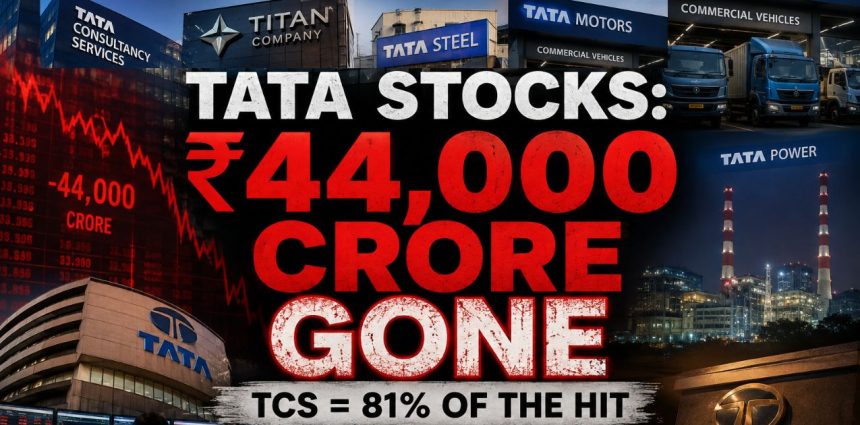
Two trading days. Rs 44,000 crore gone. And one stock alone swallowed 81% of the damage. Listed Tata Group companies have shed nearly Rs 44,000 crore in combined market capitalisation over the two trading sessions through Thursday morning, after N Chandrasekaran informed the Tata Sons board he will not seek reappointment as chairman when his term ends on February 20, 2027.
The decision, disclosed just days before the August 18 Tata Sons AGM, has reopened a leadership uncertainty the group has not faced since Cyrus Mistry’s ouster a decade ago.
TCS alone accounts for four-fifths of the erosion
According to Capitaline Plus data, the combined market cap of Tata Group’s listed companies fell to Rs 27.04 lakh crore as of Thursday morning, down from Rs 27.48 lakh crore on Tuesday. Tata Consultancy Services, the group’s most valuable listed entity, accounted for Rs 35,421 crore of that erosion — 81% of the total group-wide decline.
Titan Company was the second-biggest value destroyer, losing Rs 7,040 crore, followed by Tata Steel (Rs 3,371 crore), Trent (Rs 1,717 crore), and Tata Consumer Products and Tata Motors Passenger Vehicles (Rs 2,266 crore each).
TCS was already carrying weight into this week: Reuters reported the stock had lost more than a quarter of its value in 2026 as clients cut discretionary technology spending. That makes this week’s succession-linked slide an added hit on an already-weak stock, not an isolated event.
TCS matters to Tata Sons beyond its market capitalisation. Reuters notes that the IT major has historically been Tata Sons’ biggest source of recurring cash through dividend income. That makes prolonged weakness in TCS more relevant to the wider Tata ecosystem than its share-price decline alone.
Two-day market cap erosion by company
| Company | Market Cap Erosion (Aug 11–13) |
|---|---|
| TCS | Rs 35,421 crore |
| Titan Company | Rs 7,040 crore |
| Tata Steel | Rs 3,371 crore |
| Tata Consumer Products | Rs 2,266 crore |
| Tata Motors Passenger Vehicles | Rs 2,266 crore |
| Trent | Rs 1,717 crore |
Source: Capitaline Plus data, as reported August 13, 2026
Why Chandrasekaran stepped back
The dispute had been building for months. Reuters reported that Tata Sons postponed a decision on Chandrasekaran’s reappointment in February after Noel Tata, chairman of Tata Trusts, opposed the move.
Four of the six Tata Sons directors supported extending Chandrasekaran’s tenure, but the proposal did not secure a consensus. The disagreement involved issues including whether Tata Sons should remain unlisted, losses at Air India and other newer businesses, and the proposed exit of Shapoorji Pallonji Group as a minority shareholder.
Chandrasekaran later said six months had passed without a resolution and asked the board to begin succession planning instead.
What the Street is watching
Anirudh Garg, Fund Manager and Partner at INVasset PMS, said a sentiment hit across Tata Group stocks was the expected outcome, with the scale of the fall tied directly to how much clarity investors have on succession.
He pointed to 2016 as a precedent: Tata stocks wobbled through the Mistry episode and recovered once operating performance reasserted itself, while Chandrasekaran’s own appointment in 2017 was met with gains because it ended a period of uncertainty.
In his view, the bigger risk to watch is not any one leader’s exit but a prolonged standoff between Tata Trusts and Tata Sons, since friction between a holding company and its principal shareholder tends to weigh on capital allocation across the group over time.
The one stock that didn’t fall
Not every Tata company moved lower.
Tata Motors Commercial Vehicles bucked the trend, adding Rs 10,533 crore in market cap after posting a strong set of June-quarter numbers on August 12: standalone revenue rose 23% year-on-year to Rs 19,329 crore, commercial vehicle wholesales climbed 26% to 108,700 units against industry growth of 18%, and profit before exceptional items rose 26% to roughly Rs 2,057 crore.
Management guided for double-digit year-on-year volume growth in the September quarter, citing robust July demand despite the monsoon.
Brokerage JM Financial raised its FY27 EBITDA margin estimate by 30 basis points to 12.3% following the results and retained a buy rating, lifting its target price to Rs 535 from Rs 475, based on a sum-of-parts valuation that assigns 14x EV/EBITDA, up from 13x, to the standalone business, including the Tata Cummins joint venture.
TCS and Tata Motors CV: Aug 12 Snapshot
| Metric | TCS | Tata Motors CV |
|---|---|---|
| Aug 12 close | Rs 2,349.70 | Rs 456.85 |
| Day’s change | -3.93% | +1.59% |
| 52-week range | Rs 1,976.80 – Rs 3,350.00 | Rs 306.30 – Rs 509.00 |
| What moved it | Succession uncertainty — unrelated to Q1 earnings | Strong Q1 FY27: Revenue +23%, PAT +26% |
Source: Exchange data and company filings, as of August 13, 2026
Check Live: TATA CONSULTANCY SERVICES Options Chart
What happens next
All eyes now turn to the August 18 Tata Sons AGM. Garg’s base case: a clean outcome, either a negotiated reappointment or an orderly handover, would let group stocks claw back recent losses, much as they did in 2017.
A prolonged standoff, on the other hand, would put the group’s long-standing governance premium in question, a bigger swing factor for long-term investors than any single executive’s tenure.
NiftyTrader Desk View
The market’s reaction here is less about Chandrasekaran personally and more about process. A nine-year chairman stepping back without a named successor, just two trading sessions before the August 18 AGM, is the kind of governance-clarity gap that markets price immediately and re-price just as fast once resolved.
TCS bearing 81% of the group-wide hit does not, by itself, establish a deterioration in its underlying business — the stock also entered this episode with separate pressure from softer discretionary technology spending.
The more telling number for traders to track over the next week isn’t the erosion figure itself, but whether Tata Trusts and Tata Sons arrive at the August 18 AGM with a joint statement or a contested vote, that outcome, not the chairman’s identity, is what typically sets the multiple Tata Group stocks trade at over the following two to three quarters.
Disclaimer
This article is for informational purposes only and does not constitute investment advice, a recommendation, or a solicitation to buy or sell any security.
NiftyTrader.in is not a SEBI-registered investment advisor. Views expressed by third-party analysts and fund managers are their own and not those of NiftyTrader.
Equity markets are subject to risk; readers are advised to consult a SEBI-registered financial advisor before making investment decisions.
Read Next: 205 Million Eternal Shares in Play: The MSCI Trigger Traders Need to Watch
Frequently Asked Questions
Q1. Why did Tata Group stocks fall in August 2026?
Tata Group stocks fell after N Chandrasekaran informed the Tata Sons board on August 12, 2026, that he would not seek reappointment as chairman beyond February 2027, raising near-term uncertainty over group leadership ahead of the August 18 AGM.
Q2. How much market value did Tata Group companies lose?
Listed Tata Group companies lost close to Rs 44,000 crore in combined market capitalisation over two trading days, according to Capitaline Plus data, with TCS accounting for 81% of the decline.
Q3. Did all Tata Group stocks fall?
No. Tata Motors Commercial Vehicles rose after reporting strong Q1 FY27 results, adding Rs 10,533 crore in market cap even as most other group stocks declined.
Q4. What is the next key event for Tata Group investors?
The Tata Sons annual general meeting on August 18, 2026, where the board is expected to address the chairmanship succession process.