Need to Know
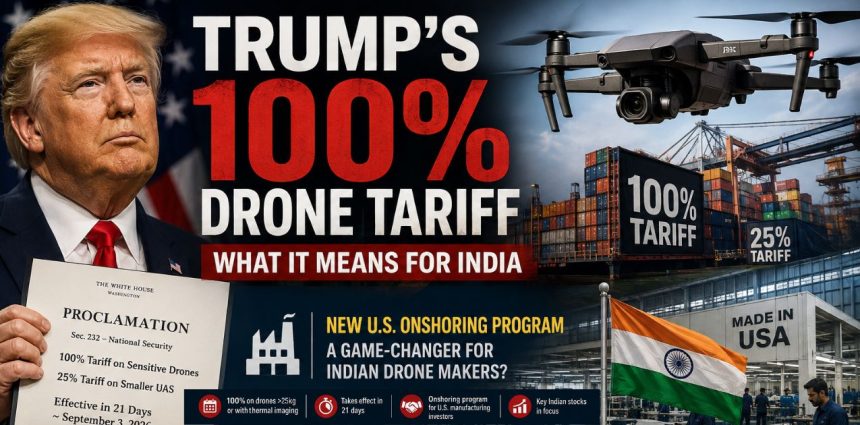
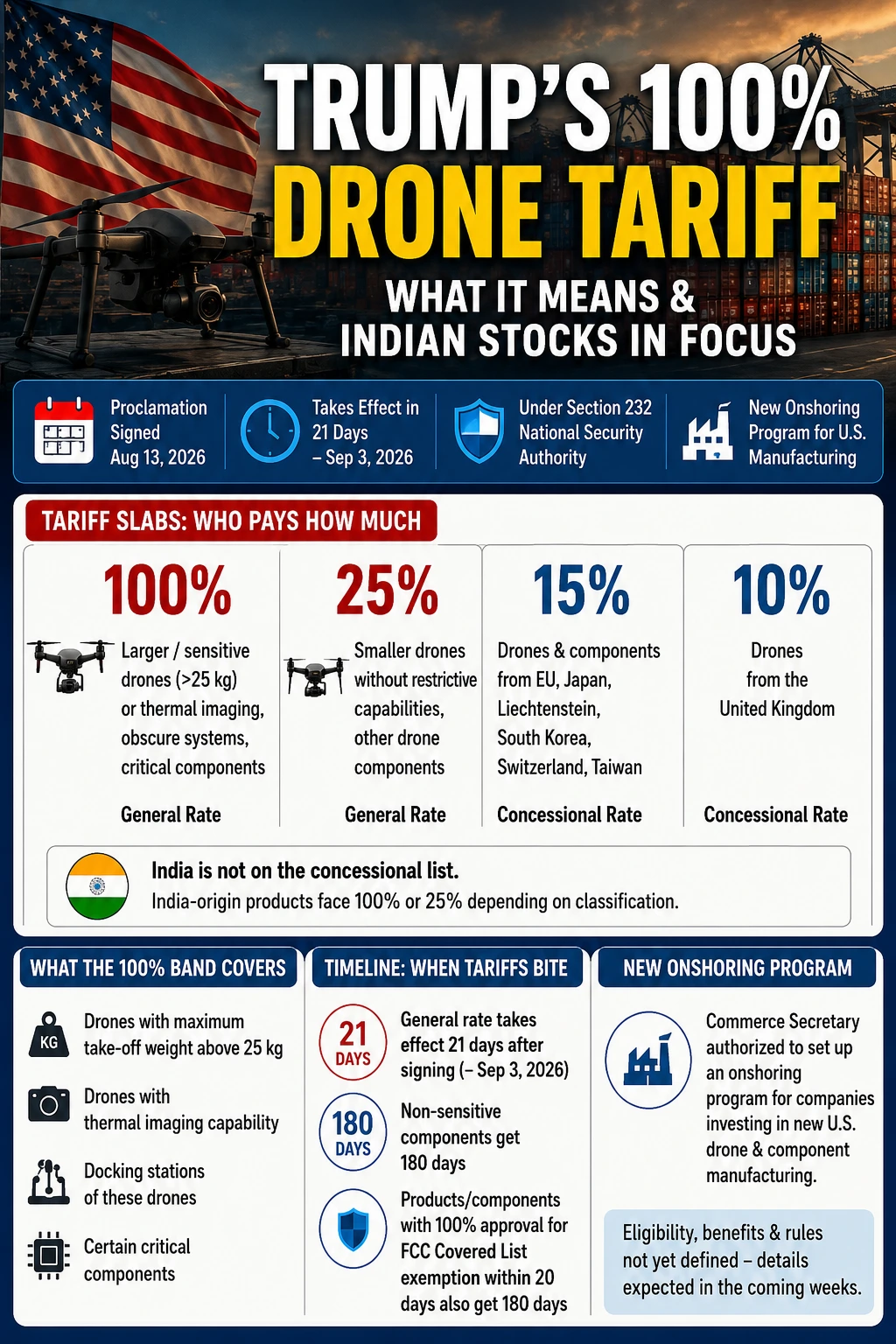
- US President Donald Trump signed a proclamation on August 13, 2026, imposing a 100% tariff on larger, “sensitive” drones and a 25% tariff on smaller unmanned aircraft systems (UAS), effective in 21 days — around September 3, 2026.
- The 100% band covers drones with maximum take-off weight above 25 kg or thermal-imaging capability, plus their docking stations and critical components.
- New detail most coverage has missed: the proclamation also authorises the Commerce Secretary to launch an onshoring program for companies investing in US drone manufacturing — eligibility and benefits aren’t defined yet, but it’s a program Indian players with US manufacturing plans should watch.
- The catch: tariffs land in 21 days, but a competitive US drone supply chain takes years to build — that gap is the real uncertainty in this policy.
- Concessional rates apply by origin: 15% for the EU, Japan, Liechtenstein, South Korea, Switzerland and Taiwan; 10% for the UK. India is not on either list.
- The order builds on two executive orders from June 2025 — not April 2026, as some reports have stated — on drone dominance and airspace sovereignty.
- India-linked stocks in focus: ideaForge Technology, Zen Technologies, Paras Defence and Space Technologies, Bharat Electronics.
Also Read: Russia Sanctions Bill Clears US Senate: India Faces 100% Tariff Risk
What the Proclamation Covers
President Trump signed the drone tariff proclamation using Section 232 national security authority, the same mechanism the administration has used on steel, aluminium, copper, trucks, automobiles, timber, lumber and pharmaceuticals since returning to office.
Commerce Secretary Howard Lutnick’s investigation found the US too reliant on foreign drone suppliers, with imports from certain foreign entities posing security and cybersecurity risks that domestic manufacturers cannot yet offset.
The White House fact sheet is specific about scope: the 100% band targets drones with a maximum take-off weight above 25 kilograms or thermal-imaging capability, pushing larger commercial, industrial and defence-grade platforms into the higher bracket, while drones outside those specified sensitive characteristics fall into the lower 25% category.
Tariff Slabs: Who Pays How Much
| Rate | Applies To |
|---|---|
| 100% | Larger/sensitive drones (>25kg or thermal-imaging), docking stations, critical components — general rate |
| 25% | Smaller drones without sensitive capabilities, other drone components — general rate |
| 15% | Drones and components from the EU, Japan, Liechtenstein, South Korea, Switzerland, Taiwan |
| 10% | Drones from the United Kingdom |
India is not among the countries listed for preferential 10–15% rates. Indian-origin products would therefore face the applicable standard tariff category, 100% if they fall within the sensitive category, or 25% if they fall within the lower-rate category.
Timeline: When the Tariffs Bite
The general rate takes effect 21 days after signing, around September 3, 2026. Components of drones that are not particularly sensitive get 180 days, and so do products and components the Department of War approves for exemption from the FCC Covered List within 20 days of signing.
Commerce’s New Onshoring Program — The Real Story for Indian Manufacturers
Buried in the fact sheet is a detail that matters more for Indian stock-pickers than the drone tariff percentages themselves: the proclamation authorises the Commerce Secretary to set up an onshoring program for companies that invest in new US drone and drone-component manufacturing capacity. The fact sheet confirms the authority exists, it does not yet specify eligibility criteria or what the benefits will look like.
ideaForge Technology has already signed a joint venture with First Breach Inc. to manufacture drones in the US, a structure that could become strategically relevant if Commerce’s eventual onshoring rules cover US-based drone manufacturing by foreign-linked companies.
More broadly, Indian companies with genuine US manufacturing capacity could potentially gain an advantage over pure exporters, depending on how Commerce structures the programme. The rules themselves, expected in the coming weeks, are the detail to watch.
The Catch: Tariffs Can Move Faster Than Factories
Washington can make imported drones more expensive in 21 days. Building a competitive domestic drone supply chain will take considerably longer.
That creates the biggest uncertainty in Trump’s strategy. If US manufacturers scale quickly, the tariffs could accelerate domestic production and investment. If capacity takes longer to develop, buyers could initially face higher equipment and component costs.
For investors, that makes actual factory investment, procurement contracts and component localisation more important than the tariff headline alone.
Why Washington Is Acting Now
The proclamation is the latest step in a policy line that goes back further than some coverage suggests. In June 2025, not April 2026, President Trump signed two separate executive orders: one to unleash “American drone dominance” by prioritising US-manufactured drones and their exports, and a second to assert American sovereignty over US airspace amid rising misuse of drones.
Thursday’s proclamation converts that policy intent into an actual drone tariff structure, using the same Section 232 authority already applied to steel, aluminium, copper, trucks, automobiles, timber, lumber and pharmaceuticals.
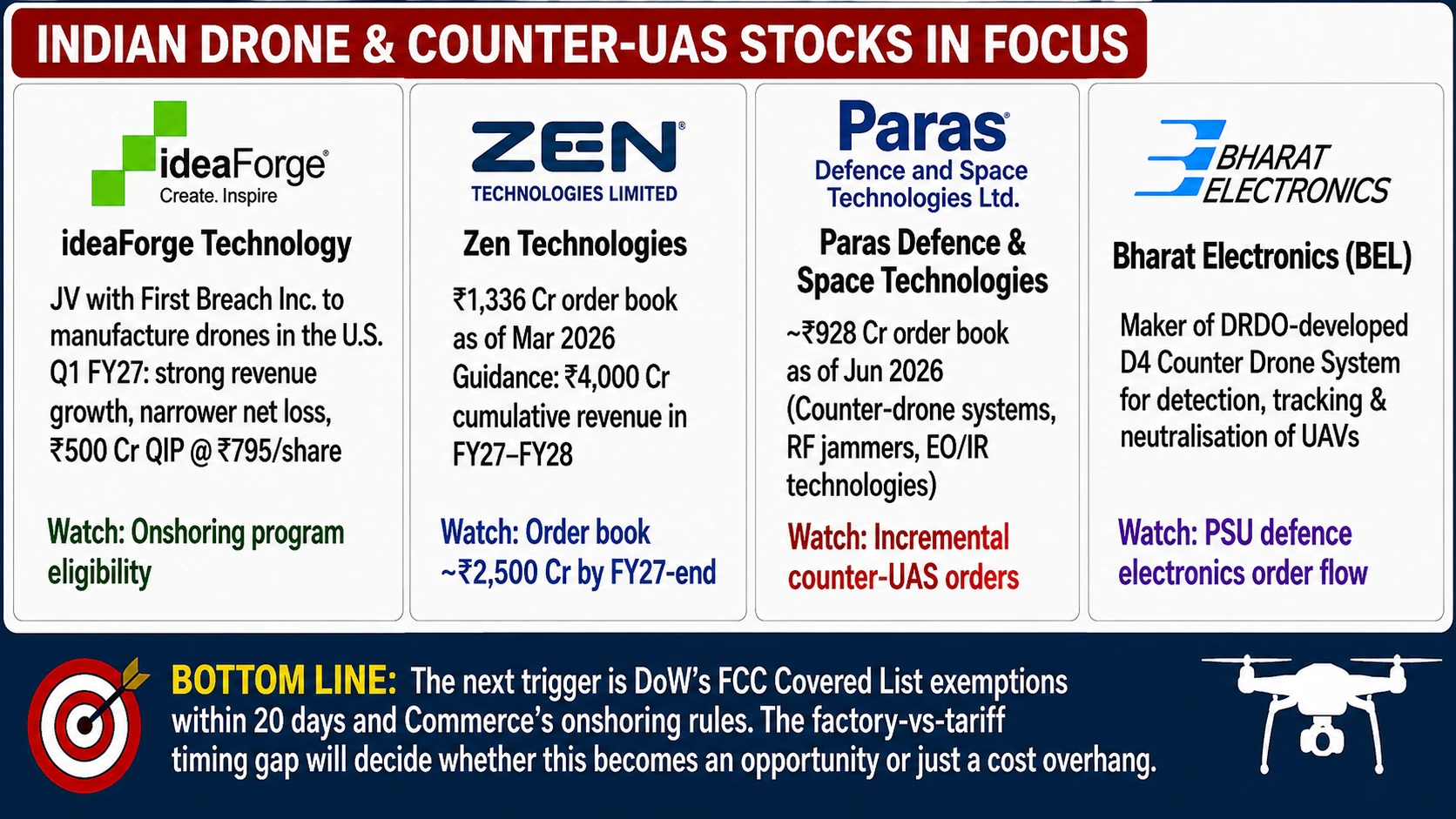
NiftyTrader Desk View: India’s Drone & Counter-UAS Stocks in Focus
| Stock | Key Technical Trigger | Trader View |
|---|---|---|
| ideaForge Technology | JV with First Breach Inc. to manufacture drones in the US — relevant if Commerce’s onshoring rules end up covering foreign-linked manufacturers. Also reacted to Q1 FY27 results (sharp YoY revenue growth, narrower net loss) and a ₹500-crore QIP priced at ₹795/share. | Onshoring-program eligibility, once defined, is the theme to track — not just the JV headline |
| Zen Technologies | ₹1,336 crore order book as of March 2026, with management guiding to ₹4,000 crore of cumulative revenue across FY27–FY28 | Management expects the order book to reach ~₹2,500 crore by FY27-end — a more concrete near-term marker than the cumulative revenue guidance |
| Paras Defence and Space Technologies | Order book of approximately ₹928 crore as of June 2026, spanning counter-drone systems, RF jammers and EO/IR technologies | Incremental counter-UAS order inflow is the swing factor |
| Bharat Electronics (BEL) | Produces the DRDO-developed D4 Counter Drone System for real-time detection, tracking and neutralisation of UAVs | Broader PSU defence-electronics order flow is the metric to read alongside this |
Source: Company order-book disclosures and exchange filings. Price levels are indicative — refresh against live quotes before publishing.
- stocks in focus
Global trade-policy headlines like this one tend to show up quickly in institutional positioning. Track daily FII/DII activity on the NiftyTrader FII-DII Tracker to see how smart money is reading the defence and industrials space this week.
Bottom Line
The next trigger isn’t the tariff rate itself, it’s which products and components the Department of War approves for FCC Covered List exemption within 20 days of signing (earning them a 180-day runway instead of 21), plus whatever eligibility rules Commerce eventually attaches to the new onshoring program.
Whether this strategy works also hinges on the factory-vs-tariff timing gap: if domestic capacity doesn’t scale as fast as the duties bite, buyers absorb higher costs before any onshoring benefit shows up.
That gap, not the headline tariff rate, is what determines whether this becomes an India-relevant opportunity or just a cost overhang.
Read Next: Stocks to Watch Today: 80% Profit Drop, 118% Surge and a ₹2,896-Cr Deal
FAQs
Q1. What is the new US tariff rate on sensitive drones?
100% ad valorem on drones with maximum take-off weight above 25 kg or thermal-imaging capability, plus their docking stations and critical components.
Q2. What tariff applies to smaller drones?
25% ad valorem on smaller UAS that lack these sensitive capabilities, and on other drone components.
Q3. When do the tariffs take effect?
21 days after the August 13, 2026 signing (around September 3, 2026) for the general rate; 180 days for non-sensitive components and for products and components the Department of War approves for exemption from the FCC Covered List within 20 days of signing.
Q4. Does India get a concessional drone tariff rate?
No. The 15% rate applies only to the EU, Japan, Liechtenstein, South Korea, Switzerland and Taiwan, and the 10% rate applies only to the UK. India-origin products fall under the standard 100% or 25% category depending on classification.
Q5. Which Indian stocks are in focus after this order?
ideaForge Technology, Zen Technologies, Paras Defence and Space Technologies, and Bharat Electronics, given their exposure to drone manufacturing and counter-UAS systems.
Disclaimer: This article is for informational purposes only and does not constitute investment advice. The stocks mentioned are for reference and do not amount to a buy/sell recommendation. Investors are advised to consult a SEBI-registered financial advisor before making any investment decisions.