India-US Trade Could Hit $500 Billion as Gor Calls for Fewer Barriers
The India-US economic relationship could be heading towards a much bigger phase, with bilateral trade potentially reaching $500 billion by 2030. US Ambassador to India Sergio Gor has described the economic potential between the two countries as “unbelievable and incredible”, while urging both sides to remove policy and regulatory hurdles.
Speaking at the IACC National Convention 2026, Gor said stronger trade, technology cooperation and investment could create opportunities for companies and workers in both countries.
For investors, the message matters because the next phase of India-US cooperation could directly influence sectors such as technology, artificial intelligence, semiconductors, defence, aerospace, energy and pharmaceuticals.
Track Live : NSE Option Chain — Live
Why the India-US trade relationship is attracting attention
Gor said Indian companies investing in the US can benefit from access to one of the world’s largest markets while creating employment in both countries.
“When Indian companies invest in America, it’s a win-win situation. You gain access to the world’s most dynamic market, and you create jobs in India and the United States,” Gor said.
His comments underline the growing two-way investment relationship between India and the US.
The scale of corporate engagement is also increasing. Gor highlighted meetings with major American companies as evidence of the depth of business interest in India.
“Last week, in one day, I had Meta, I had the CEO of Netflix, and I had the CEO of Rolls-Royce. And that’s all before noon. That’s a typical day for us,” he said.
Friction Points to Address
- Regulatory Predictability: Establishing stable, predictable taxation and regulatory frameworks so businesses can plan long-term investments securely.
- Intellectual Property: Strengthening IP protections to foster a safe environment for innovation.
- Tech & Export Trust: Building candid, trust-based engagement on export controls and technology transfers to deepen critical technological ties.
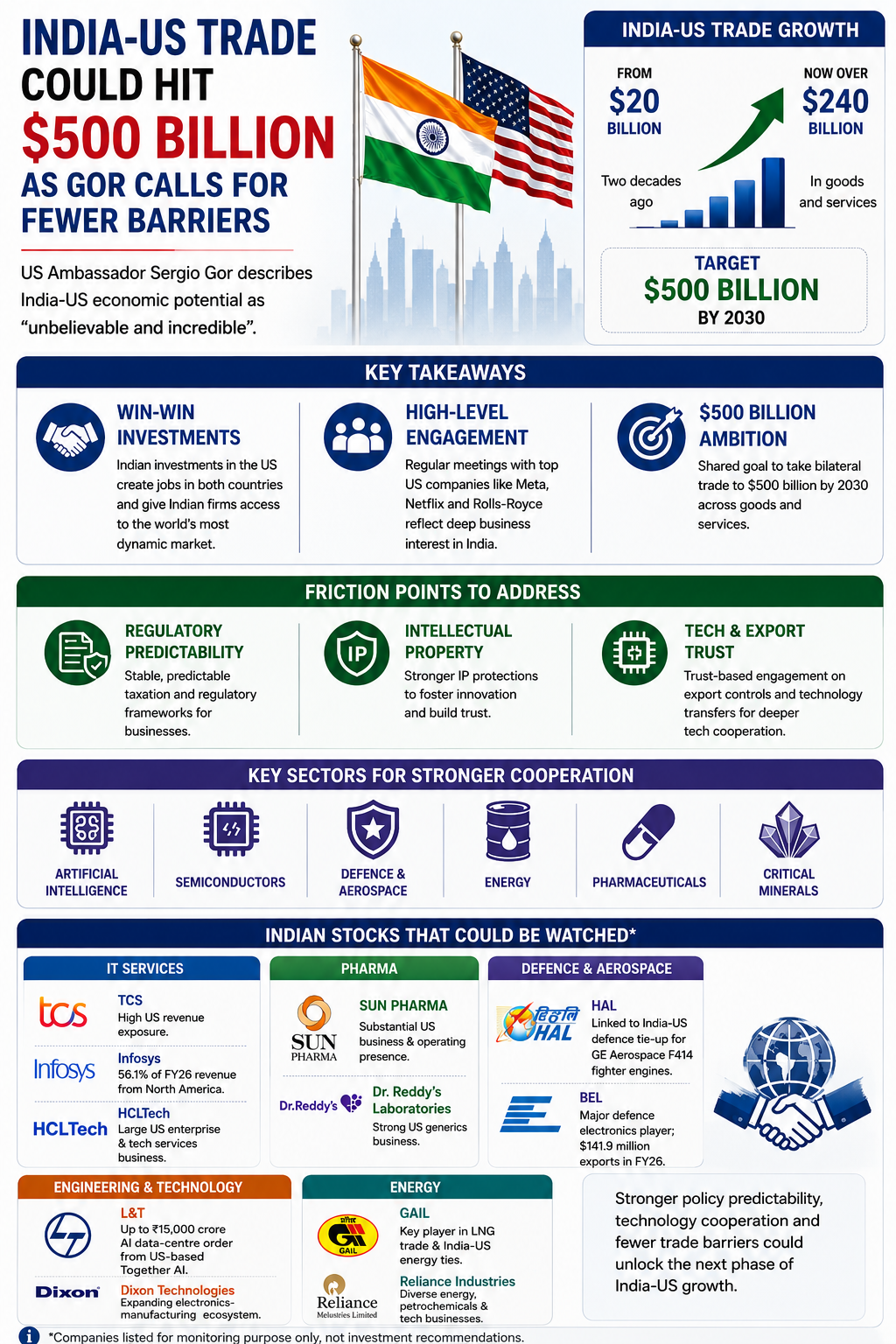
India-US trade has surged from $20 billion to over $240 billion
The growth in bilateral trade has been significant.
According to Gor, trade in goods and services between India and the US has increased from around $20 billion to more than $240 billion over the past two decades.
“In just over two decades, our bilateral trade has shattered records, skyrocketing from about $20 billion to over $240 billion in goods and services,” Gor said.
The two countries now have an ambition of taking bilateral trade to $500 billion by 2030.
For Indian businesses and investors, reaching that target could mean a much larger addressable market for exporters, technology companies, manufacturers and service providers.
Key Takeaways
- $500 Billion Target: Ambassador Gor emphasized that bilateral trade—which has already grown from $20 billion to over $240 billion—has the potential to hit $500 billion.
- Win-Win Investments: Indian investments in the US are viewed as mutually beneficial, creating jobs in both nations and giving Indian firms access to dynamic American markets.
- High-Level Engagement: US leadership is highly engaged with India, with regular daily meetings involving tech and industry giants like Meta, Netflix, and Rolls-Royce.
Policy predictability could become the next big trade trigger
Gor said the full potential of the India-US economic relationship cannot be unlocked without addressing several “friction points”.
He called for predictable taxation and regulatory frameworks, greater trust around export controls and technology transfers, and stronger intellectual property protection.
“We need predictable taxation and regulatory frameworks that allow businesses to thrive. We need candid, trust-based engagement on export controls and technology flows. And we need rock-solid intellectual property protections,” Gor said.
These issues could become increasingly important as companies expand cross-border investments.
Greater policy certainty can reduce investment risks and make it easier for companies to plan long-term projects involving technology, manufacturing and supply chains.
Read More : Rupee Slips to 95.68 as Crude Nears $91 and Dollar Demand Rises
AI, semiconductors and defence could drive the next phase
Technology is expected to remain at the centre of the India-US relationship.
Gor identified artificial intelligence, quantum computing, semiconductors, defence and critical minerals as key areas for deeper cooperation.
He said President Donald Trump and Prime Minister Narendra Modi had placed strategic technologies at the centre of the bilateral relationship.
A trust initiative launched early in Trump’s second term is also aimed at accelerating cooperation across these sectors.
For investors, this creates potential opportunities across India’s technology and manufacturing ecosystem, particularly where global companies are looking to diversify supply chains.
India’s pharmaceutical and energy links strengthen US trade ties
The relationship also extends beyond technology.
Gor highlighted India’s importance to the US pharmaceutical supply chain, noting that India supplies around 40% of US generic pharmaceuticals.
“The reason we get 40% of our generic pharmaceuticals from India, which is an incredible number, is because we trust India,” he said.
He also pointed to expanding energy cooperation between the two countries.
“There’s a reason we’re working on energy at unprecedented levels. Our LNG or LPG imports and exports were at 40% last year because we trust India,” Gor said.
The comments highlight how India-US trade is increasingly spread across multiple strategic industries.
Track Live : NSE Commodity Option Chain — Live MCX Options Data for Crude Oil, Gold, Silver & More
Indian Stocks That Could Be Watched
Track Live : Stock Market Today
These are not stock recommendations. They are companies investors could monitor if India-US trade, investment and technology cooperation expands. Gor specifically highlighted technology, defence, energy and pharmaceuticals, while calling for fewer trade and regulatory friction points.
IT Services
- TCS — North America generated about ₹1.35 lakh crore of FY26 revenue, making the US market a major part of its business.
- Infosys — 56.1% of FY26 revenue came from North America, giving the company significant exposure to US technology spending.
- HCLTech — Its large US enterprise and technology-services business makes it relevant if India-US cooperation in AI and digital technology deepens.
Pharma
- Sun Pharma — Has a substantial US business and US operating presence; the company is also among Indian firms planning significant US investment.
- Dr. Reddy’s Laboratories — Its established US generics business makes it relevant to any changes in pharmaceutical trade, regulation or market access.
Defence & Aerospace
- HAL — The company is linked to the India-US defence technology relationship through the planned co-production of GE Aerospace F414 fighter engines in India.
- BEL — A major Indian defence-electronics player that could benefit from deeper cooperation in defence technology and electronics; it recorded $141.9 million in exports in FY26.
Engineering & Technology
- L&T — Its recent up to ₹15,000 crore AI data-centre order from US-based Together AI highlights its growing role in India-US technology infrastructure.
- Dixon Technologies — Its expanding electronics-manufacturing ecosystem makes it relevant to the broader India-US supply-chain and electronics opportunity.
Energy
- GAIL — Could remain on investors’ radar as India-US energy trade expands, particularly in LNG.
- Reliance Industries — Its energy, petrochemicals and technology businesses give it multiple links to the broader India-US commercial relationship.
Global AI cooperation could strengthen India’s technology position
Gor also pointed to India’s growing role in global technology cooperation.
He highlighted the Global AI Summit in New Delhi, noting the strong presence of American companies.
“Even though it was called the Global AI Summit, 90% of those companies are American. And why was it held in India? Because this is the crossroads where we can take things forward,” Gor said.
That positioning could become increasingly important as AI, semiconductors and advanced computing attract global investment.
Why investors should keep the India-US relationship on the radar
The India-US trade relationship has already expanded dramatically, rising from about $20 billion to more than $240 billion in goods and services.
The proposed $500 billion target by 2030 raises the stakes further.
For investors, the opportunity lies not simply in the headline number but in the sectors that could benefit as trade, technology partnerships and investment expand.
If both countries can reduce regulatory friction and improve policy predictability, the India-US economic relationship could become an increasingly important long-term market catalyst.