Elon Musk’s satellite company has gone back to India’s space regulator with a bigger, bolder pitch: nearly 30,000 satellites and the ability to connect ordinary phones straight to space. Here’s what changed since its last rejected bid, and what it means for India’s fast-growing satellite race.
Quick facts
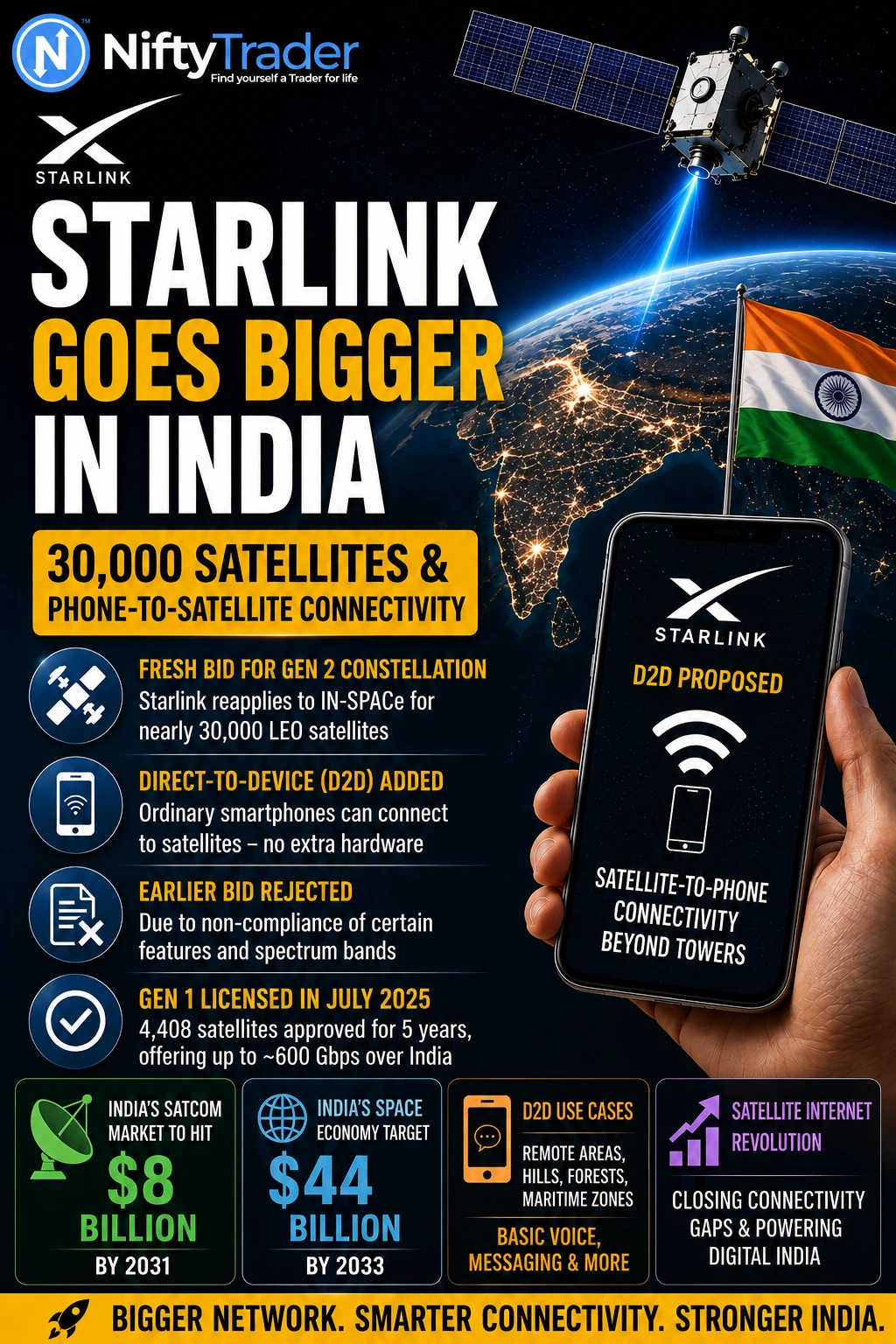
- Starlink has filed a fresh application with IN-SPACe for its Gen 2 constellation, seeking authorisation for nearly 30,000 low-Earth-orbit satellites
- The new bid adds direct-to-device (D2D) technology — letting ordinary smartphones connect to satellites without extra hardware
- IN-SPACe rejected Starlink’s earlier Gen 2 bid because certain features and spectrum bands didn’t meet Indian requirements
- Starlink’s smaller Gen 1 network (4,408 satellites) has been licensed in India since July 2025
- India’s satellite communication market is projected to nearly double, from roughly $3.8 billion to almost $8 billion by 2031
What just happened
Elon Musk’s Starlink has resubmitted its application to the Indian National Space Promotion and Authorisation Centre (IN-SPACe), seeking approval for its second-generation, or Gen 2, satellite constellation, according to a report by The Economic Times that cited people aware of the matter. Reuters, which also covered the development, said it could not independently verify the specifics of the filing.
The new application covers close to 30,000 satellites operating in low Earth orbit at altitudes between 340 and 615 kilometres. Globally, SpaceX plans to eventually field around 42,000 Gen 2 satellites, but has sought Indian authorisation for a smaller slice for now — with room to apply for more later, per the report.
This isn’t Starlink’s first attempt. The company already tried and failed to get its Gen 2 constellation cleared in India once before. What’s changed this time is the addition of direct-to-device connectivity, a capability that arrives just as New Delhi is actively working out the rules for exactly this kind of technology.
Why the first Gen 2 bid got rejected
IN-SPACe’s earlier rejection of Starlink’s Gen 2 application came down to a mismatch between what SpaceX wanted to deploy and what Indian rules allowed at the time — specifically, certain technical features and the spectrum bands the constellation relies on didn’t conform to domestic requirements.
Only Starlink’s Gen 1 network cleared the bar. IN-SPACe authorised it in July 2025 for a five-year period, covering 4,408 satellites capable of delivering roughly 600 Gbps of throughput over India, and offering conventional satellite broadband rather than phone-to-satellite connectivity.
The gap between the two outcomes explains why this second Gen 2 filing matters: it’s Starlink’s attempt to correct whatever the regulator flagged the first time, while layering in a feature — D2D — that didn’t even exist as a serious regulatory conversation in India when the earlier application was filed.
The new ingredient: direct-to-device technology
D2D is the headline addition in this filing, and it’s a meaningfully different product from ordinary satellite broadband. Instead of requiring a dish and router, D2D lets a standard smartphone talk directly to a satellite for basic connectivity — useful in places where mobile towers don’t reach, such as remote hill terrain, forests, or India’s maritime Exclusive Economic Zone.
Globally, Starlink already offers an early version of this through its Direct-to-Cell partnership with T-Mobile in the US, currently limited to messaging and basic voice and priced as a $10–15 monthly add-on. That’s a useful benchmark for what India might eventually see — a supplementary emergency and coverage-gap layer, not a full replacement for 4G or 5G.
The timing is deliberate. India’s Telecom Regulatory Authority (TRAI) opened a consultation in April 2026 specifically examining whether D2D services should run on spectrum earmarked for mobile satellite services, with TRAI’s chairman saying the process is meant to bring regulatory certainty to satellite network deployment, D2D included. Starlink’s refiled application effectively positions it to move the moment that framework lands.
Also Read: Reliance Jio’s 1,650-Satellite LEO Plan Moves to IN-SPACe Review
The regulatory maze still ahead
Even with a stronger application, Starlink isn’t close to switching on Gen 2 services. India’s satellite spectrum regime has grown more layered over the course of 2026, not less.
The government has settled on assigning satcom spectrum administratively rather than through auctions, with TRAI deciding the pricing formula. But the draft Telecommunications (Spectrum Assignment by Administrative Process) Rules published in June 2026 currently apply only to geostationary operators — VSAT, teleport and broadcast services.
The non-geostationary segment that Starlink, Eutelsat OneWeb and Amazon’s satellite arm actually operate in is still governed by separate, pending recommendations that TRAI has already submitted to the Department of Telecommunications (DoT) but that haven’t been finalised.
On top of that, the draft framework adds a multi-step approval chain: security clearance first, then a letter of intent, then a licence, then spectrum assignment — and even after all of that, a separate government approval is required before a satellite network can actually interconnect with mobile phones, landlines or the internet. In other words, spectrum approval is a milestone, not a finish line.
Starlink vs. the competition: where India’s satellite race stands
Starlink isn’t chasing an empty market. Three other constellations are already jostling for position in Indian skies, each at a different stage of readiness.
| Operator | Constellation | Satellites (India bid / in orbit) | Status in India |
|---|---|---|---|
| Starlink (SpaceX) | Gen 1 (live) + Gen 2 (reapplied) | Gen 1: 4,408 approved; Gen 2: ~30,000 sought | Gen 1 licensed since July 2025; Gen 2 under fresh review |
| Jio Satellite Communications (with SES) | Proposed LEO network | ~1,600 satellites proposed | Licensed; reportedly piloting D2D messaging |
| Eutelsat OneWeb (100% Bharti-owned) | OneWeb | ~630–650 satellites in orbit | Licensed and operational |
| Amazon Leo (Project Kuiper) | Kuiper | ~300+ in orbit globally (of 3,236 planned) | India licence still under inter-ministerial review; no IN-SPACe approval yet |
The pattern is telling: Starlink and Eutelsat OneWeb already have a foothold, Jio has regulatory cover through its SES partnership, and Amazon is the clear laggard — both in satellites launched and in Indian paperwork. A Gen 2 approval, especially one bundled with D2D, would stretch Starlink’s lead over all three rivals in coverage depth and capacity at once.
The numbers behind India’s satcom gold rush
The commercial stakes explain why every regulatory move here gets watched so closely. India’s satellite communication market is estimated at roughly $3.8 billion in 2026 and is projected to nearly double to almost $8 billion by 2031, growing at about 16% a year, according to Mordor Intelligence. IN-SPACe’s own decadal vision puts India’s broader space economy at $44 billion by 2033, with satellite broadband cited as a core growth driver.
D2D specifically threatens to reshape a much bigger pie: India’s telecom sector, which pulled in close to ₹3 lakh crore (roughly $36 billion) in revenue in FY25.
Average revenue per mobile user for Jio and Airtel currently sits between ₹200 and ₹250 a month — a fraction of what satellite bandwidth costs to deliver, which runs 10 to 20 times more per gigabyte than terrestrial 4G or 5G.
That economics gap is exactly why D2D is being pitched as a complement to towers in dead zones rather than a competitor for everyday data use — at least for now.
There’s also a policy push behind all this: the government’s National Broadband Mission 2.0 wants satellite connectivity to help reach roughly 270,000 villages with high-speed broadband and lift rural internet penetration from 45 to 60 users per 100 people by 2030. That target is difficult to hit without exactly the kind of capacity a 30,000-satellite Gen 2 network could add.
What happens next
Approval isn’t guaranteed, and even a green light wouldn’t switch on D2D overnight, NGSO spectrum rules, pricing, and interconnection permissions all still need to be finalised by DoT and TRAI.
But the refiled application signals Starlink is positioning itself to move fast the moment India’s satellite-to-phone framework is locked in, rather than waiting for perfect regulatory clarity before making its case.
With Jio, Airtel-backed OneWeb and Amazon all circling the same opportunity, whichever player clears the paperwork first stands to set the terms for how satellite-to-phone connectivity actually reaches Indian users.
Read Next: AB Capital’s Gold Loan Bet: Building a 1,000-Branch Network
FAQ
What’s the difference between Starlink Gen 1 and Gen 2 in India?
Gen 1 (4,408 satellites, already approved) offers traditional dish-and-router satellite broadband. Gen 2 is a far larger, more advanced network that adds direct-to-device connectivity for ordinary smartphones.
Has Starlink launched commercially in India yet?
Not yet. Starlink has reportedly listed a residential plan on its India website — around ₹8,600 a month plus a ₹34,000 hardware kit with a 30-day trial — but a firm commercial launch date hasn’t been officially confirmed.
Why did IN-SPACe reject the earlier Gen 2 application?
Certain technical features and the spectrum bands proposed didn’t meet Indian regulatory requirements, according to reports on the rejection.
Who are Starlink’s biggest rivals in India?
Jio Satellite Communications (with SES), Eutelsat OneWeb (owned by Bharti Airtel), and Amazon’s Leo/Kuiper constellation, which is still awaiting Indian regulatory clearance.
Disclaimer: This article is for informational and educational purposes only and is based on publicly available reports, regulatory developments and company disclosures. Starlink’s Gen 2 application and direct-to-device plans remain subject to approvals and regulatory requirements in India. Details may change as IN-SPACe, TRAI and the DoT issue further decisions or updates. This is not investment, financial or legal advice.