Key Takeaways
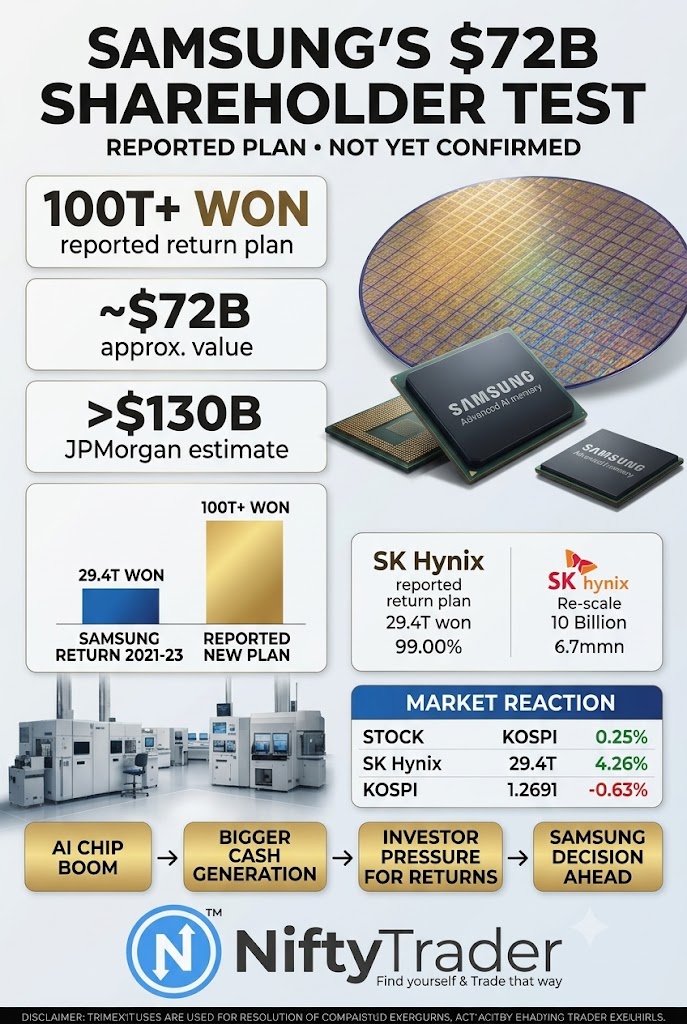
- Samsung Electronics is reportedly planning a shareholder return programme exceeding 100 trillion won (over $71.75 billion), more than the company’s entire 2021-2023 return cycle of 29.4 trillion won.
- JPMorgan estimates Samsung’s eventual package could exceed $130 billion, well above the ~$72 billion figure currently being reported.
- The plan follows SK Hynix’s 40.04 trillion won (~$29 billion) buyback and cancellation of 24.07 million shares, the largest such programme ever announced by a listed South Korean company, approved a day earlier.
- Samsung stock surged 9.49% to 271,000 won and SK Hynix jumped 12.73% to 1.69 million won on August 20, pushing the Kospi up 5.89% and triggering a buy-side sidecar.
- The rally extends a volatile 2026 for Korean equities, the Kospi fell into a bear market in July before rebounding more than 20% within weeks.
Also read: Samsung, SK Hynix Post $59.7B Q1 Profit, Beat India Inc
A Number Bigger Than Samsung’s Last Three Years Combined
Samsung Electronics could be preparing one of its biggest shareholder-return moves yet. A reported shareholder return programme worth more than 100 trillion won, over $71.75 billion, would exceed the 29.4 trillion won Samsung returned across its entire 2021-2023 programme, according to the company’s own investor-relations disclosures. For context, Samsung’s current annual regular dividend under its 2024-2026 policy stands at 9.8 trillion won, a single year’s payout, not a three-year total, so it isn’t directly comparable in scale to either figure above.
A MoneyToday report cited by Reuters and other international outlets on Thursday said Samsung’s board will meet at the end of August to approve the plan, expected to include a special dividend funded by 50% of free cash flow. Samsung has not officially commented, though it flagged last month that its board was already weighing this year’s shareholder return strategy alongside future growth investments.
The $58 Billion Gap Nobody’s Talking About
Here’s what makes this story bigger than the headline number: JPMorgan has told clients that Samsung’s eventual return package could stretch beyond $130 billion, Bloomberg reported, nearly $58 billion above the ~$72 billion figure currently circulating. That gap matters because it signals analysts think Thursday’s report may be the floor, not the ceiling, of what Samsung ultimately announces. Nothing is confirmed until the board meets, but the spread between “what’s reported” and “what Wall Street expects” is itself a signal of how aggressively the market is now pricing Korea’s chip supercycle.
Check Live to Explore: NIFTY50, SENSEX, BANK NIFTY, INDIA VIX
SK Hynix Set the Bar First
Samsung’s reported plan follows a landmark move by domestic rival SK Hynix, whose board approved a 40.0434 trillion won (roughly $29 billion) buyback and cancellation programme on Wednesday, the largest such shareholder-return programme ever announced by a listed South Korean company, according to Reuters. The buyback covers 24.07 million shares, about 3.3% of its roughly 730.49 million outstanding shares, and SK Hynix also committed over 50% of the free cash flow it generates between 2025 and 2027 to shareholder returns, a benchmark analysts are now using to gauge how far Samsung could go.
A Rebound That Extends a Wild Year for Korean Stocks
The news triggered an immediate market reaction. Samsung climbed 9.49% to close at 271,000 won, while SK Hynix surged 12.73% to 1.69 million won on Thursday, per the Korea Times and Korea JoongAng Daily. The rally pushed the Kospi up 5.89% to 6,852.58, recovering most of the previous session’s decline, and activated a buy-side sidecar, the index’s 49th this year. Foreign investors were net buyers of roughly 1.7 trillion won of Korean shares on the day.
It caps a volatile stretch for Korean equities: the Kospi tumbled into bear-market territory during a tech-driven selloff in late July, then rebounded more than 20% within weeks to reclaim bull-market status by mid-August, according to CNBC. Thursday’s chip-driven surge extends that recovery further, coming a day after a global bond-market rout, tied to US 30-year Treasury yields hitting their highest level since 2007, had dragged Samsung down 7.54% and SK Hynix down 9.93%.
The same “strong global cues” theme carried into Indian trade: the Sensex opened up 558.77 points (0.72%) at 77,468.45 and the Nifty gained 147.15 points to open at 24,225.45, per India TV News, with FIIs net buyers of Rs 407.99 crore and DIIs buying Rs 3,973.72 crore in the prior session.
Track live institutional flow data on the NiftyTrader FII-DII Tracker.
Why Samsung Won’t Just Copy SK Hynix’s Playbook
Unlike SK Hynix’s buyback-led approach, Samsung’s plan is reportedly centred on cash dividends rather than share repurchases, partly because buybacks could trigger regulatory complications tied to Samsung Life Insurance and Samsung Fire & Marine Insurance, both of which hold stakes in the electronics arm. It’s a structural constraint SK Hynix doesn’t share, and one reason the two companies’ return strategies look so different despite both riding the same AI memory boom.
What Happens Next
With roughly 167 trillion won ($119.8 billion) in net cash, Samsung is weighing bigger payouts against heavy capex commitments, including its Taylor, Texas fab expansion. Until the board meets later this month, both the size and structure of the plan remain unconfirmed, leaving investors to weigh a reported figure above $72 billion against JPMorgan’s estimate that the eventual package could exceed $130 billion.
Bottom Line
Samsung’s reported 100-trillion-won shareholder return plan would rank among South Korea’s largest corporate shareholder-return programmes, and would beat everything the company returned across its entire previous three-year programme. Combined with SK Hynix’s own record-setting buyback and a $58 billion gap between the current report and JPMorgan’s outer estimate, Thursday’s rally shows how far investor expectations have run ahead of a board decision that’s still weeks away from being confirmed.
Read Next: Starlink Returns to India With Bid for 30,000 Satellites That Can Reach Your Phone
Disclaimer: This article is for informational purposes only and does not constitute investment advice. Readers are advised to consult SEBI-registered financial advisors before making any investment decisions. NiftyTrader does not take responsibility for any losses arising from investment decisions based on this content.