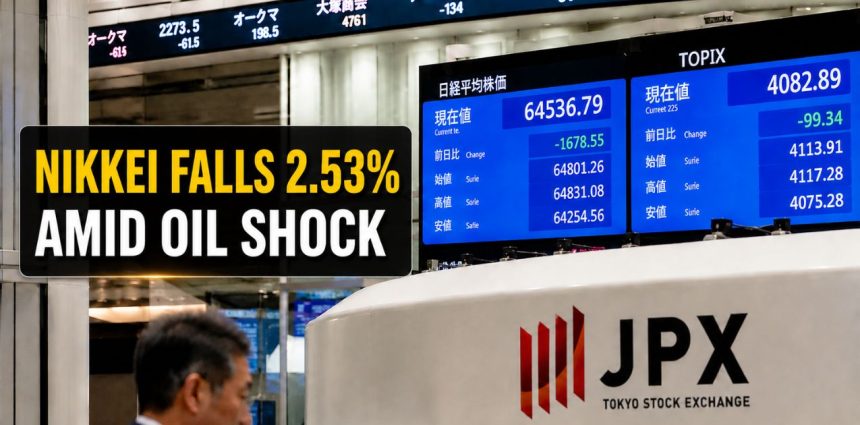
The Nikkei crashes nearly 3% on Wednesday, dragging the Topix out of a nine-session winning streak, as a fresh round of US airstrikes on Iran sends crude oil surging and pushes Japanese government bond yields to territory unseen since the mid-1990s. The selloff spilled into Indian markets too, with the Sensex and Nifty opening lower on the same worries over oil and inflation.
Nikkei, Topix Snap Nine-Day Rally in a Steep Selloff
The Nikkei 225 fell as much as 2.95% to 64,254.56 as of 0154 GMT on Wednesday, while the broader Topix dropped 2.37% to 4,082.89, putting an end to a nine-session winning run for the Topix gauge.
The selloff was visible from the opening bell: within the first 15 minutes of trade, the Nikkei had already shed 2.14% to 64,801.26, while the Topix dropped 1.62% to 4,113.91, with electric appliance, nonferrous metal, and transport equipment shares among the earliest decliners. By the close, the Nikkei pared some of its intraday losses to end down 2.53% at 64,536.79, still enough to erase roughly ¥31.8 trillion, or $202 billion, in market value in a single session, one of the region’s steepest one-day drops this year.
Market breadth told the same story: about 93% of the more than 1,300 stocks on the Tokyo Stock Exchange’s Prime Market fell on Wednesday, with only around 5% advancing and 1% unchanged.
| Session Point | Nikkei 225 | Topix |
|---|---|---|
| Tuesday close | 66,215.34 | 4,181.86 |
| Wed., first 15 min | 64,801.26 (-2.14%) | 4,113.91 (-1.62%) |
| Wed., ~11 AM JST | 64,254.56 (-2.95%) | 4,082.89 (-2.37%) |
| Wed., close | 64,536.79 (-2.53%) | not independently confirmed at filing |
Source: Economic Times/Reuters (mid-session); Xinhua (open); market data trackers (close)
Check Live: World News Today – Global Market & Economy Updates
A Fresh Round of US-Iran Strikes Reignites the Region’s Oldest Market Risk
Wednesday’s slide traces back to a fresh flare-up in the 2026 Iran war, which had cooled somewhat over the past month. The US and Iran resumed direct strikes this week after roughly a month of relative calm, with American forces hitting Iranian rocket-launcher positions on Larak Island while Tehran retaliated with strikes on the UAE and Jordan.
US Central Command said it began the fresh wave of strikes on Islamic Revolutionary Guard Corps targets after Iran attacked commercial shipping and American forces in the region, with explosions reported in the southern Iranian cities of Bandar Abbas and Chabahar.
President Trump also extended explicit threats to Iran’s Kharg Island terminal, through which roughly 90% of the country’s crude exports flow, adding a fresh supply-disruption premium to an already jittery oil market.
Oil Surges Past $90 a Barrel
Brent crude jumped as much as 4.4% intraday, spiking from Tuesday’s close of $88.37 to a session high of $92.31, as traders repriced the risk of a direct hit on Middle Eastern supply. That built on a rally that had already pushed crude above $90 a barrel earlier in the week, its highest level since late July, after the US struck Iranian targets following attacks on two oil tankers transiting the Strait of Hormuz, with an Iranian military source warning any response from Tehran would be “many times greater.” A separate crude contract jumped nearly 6% to around $90.86 a barrel on the same news.
The disruption has already reshaped global crude flows. The US Energy Information Administration estimates that oil shipments through the Strait of Hormuz have collapsed to roughly 4.9 million barrels a day in the second quarter of 2026, down from about 21.6 million barrels a day before the conflict began in February. That has forced Asian refiners in China, Japan, and South Korea to source crude from as far away as Argentina to offset lost Middle Eastern barrels.
Japanese Bond Yields Break Through Three Decades of History
Japanese government bond yields climbed to multi-decade highs alongside the equity selloff. The 10-year JGB yield rose as high as 3.01% on Wednesday, its highest level since September 1996, while the two-year yield touched 1.83%, the highest since April 1995. The 10-year yield had already breached the 3% mark for the first time since 1996 in Tuesday’s session before easing slightly to around 2.995%; Wednesday’s oil-driven shock pushed it straight back through that level, reinforcing bets that the Bank of Japan may need to move faster on policy normalization than markets had priced in.
Autos and Banks Slide, Drugmakers Buck the Trend
The rise in yields hit growth-oriented technology and chip-related shares hardest, while automakers also came under pressure: Toyota Motor fell 2.5% and Honda Motor declined 2.39%. Financial stocks, which typically benefit from higher rates, moved lower anyway, with Mitsubishi UFJ Financial Group and Sumitomo Mitsui Financial Group each down 0.8%, notable because banks usually gain from improved lending spreads in a higher-rate environment, suggesting broader risk aversion outweighed that benefit on Wednesday.
Defensive drugmakers were the exception. Sumitomo Pharma gained 1.48%, and Shionogi & Co rose 0.92%, making them the top percentage gainers on the Nikkei for the session.
| Stock | Move |
|---|---|
| Toyota Motor | -2.5% |
| Honda Motor | -2.39% |
| Mitsubishi UFJ Financial Group | -0.8% |
| Sumitomo Mitsui Financial Group | -0.8% |
| Sumitomo Pharma | +1.48% |
| Shionogi & Co. | +0.92% |
Source: Economic Times/Reuters
What It Means for Indian Markets
The chain worth watching: Iran conflict → higher crude → inflation concerns → higher-for-longer rate expectations → pressure on valuations and growth stocks.
India’s own benchmarks opened lower in sympathy. The BSE Sensex slipped 472.96 points, or 0.61%, to 76,471.32, while the Nifty 50 dropped 196.60 points to 23,859.20, against Tuesday’s closing levels of 76,944.28 and 24,055.80, respectively. The broader BSE Smallcap Select index fell 1.04% to 9,117.94.
The move came with an unusual twist: foreign institutional investors turned net buyers of Indian equities worth Rs 1,143.38 crore on Tuesday, snapping two sessions of selling, while domestic institutions bought a further Rs 1,846.94 crore. The rupee closed at a two-month high of Rs 94.95 against the dollar the same day, helped by a robust 7.8% GDP growth print, even as crude prices climbed, a divergence from the usual playbook where rising oil weakens the currency.
India imports close to 90% of its crude oil needs, so every sustained rise in Brent adds pressure on the import bill, the rupee, and inflation. Economists have previously estimated that a sustained $10-a-barrel increase in crude can widen India’s current account deficit by roughly 40-50 basis points. Because India does not buy Iranian crude directly, analysts note the transmission is indirect, a modest headwind to the import bill and the rupee rather than an outright supply shock. If crude were to sustain a much higher trajectory, oil marketing companies could again face pressure on marketing margins, making fuel-pricing policy an important secondary risk for investors.
| Metric | Value |
|---|---|
| Sensex (open, Sep 2) | 76,471.32 (-472.96 pts / -0.61%) |
| Sensex (Sep 1 close) | 76,944.28 |
| Nifty 50 (open, Sep 2) | 23,859.20 (-196.60 pts) |
| Nifty 50 (Sep 1 close) | 24,055.80 |
| BSE Smallcap Select | 9,117.94 (-1.04%) |
| FII flow (Sep 1) | Net buy ₹1,143.38 crore |
| DII flow (Sep 1) | Net buy ₹1,846.94 crore |
| Rupee (Sep 1 close) | ₹94.95/USD (2-month high) |
Source: India TV News, exchange data
Check Live: FII DII DATA | NIFTYTRADER
Key Takeaways for Indian Investors
- Nikkei and Topix fell sharply as renewed US-Iran strikes reignited the oil-and-yields risk that has driven Japanese markets on and off since February.
- Brent’s move back above $90 a barrel is the number to watch; a sustained break higher would widen India’s import bill and pressure the rupee, even without direct Iranian crude purchases.
- Japan’s 10-year yield crossing 3% for the first time since 1996 raises the odds of a Bank of Japan rate move this month, a factor that could ripple into global risk appetite.
- Indian markets fell in sympathy, but FII and DII buying on Tuesday suggests domestic demand for equities remains intact for now.
- Watch oil marketing company margins and fuel-pricing headlines as a secondary risk if Brent extends its rally.
Read Next: ₹98,353 Crore Block Deal Wave: Who Is Absorbing India’s Stock Supply?
FAQ
Q: Why did the Nikkei crash on Wednesday?
A: A fresh round of US airstrikes on Iranian military targets and Iran’s retaliation against US allies in the region sent Brent crude surging past $90 a barrel and pushed Japanese bond yields to their highest since the 1990s, triggering a broad selloff in Japanese equities.
Q: How much did oil prices rise after the latest US-Iran strikes?
A: Brent crude jumped as much as 4.4% intraday to a session high of $92.31 a barrel, extending a rally that had already taken crude above $90 earlier in the week.
Q: Did Indian stock markets react to the Iran-driven selloff in Japan?
A: Yes. The Sensex and Nifty 50 both opened lower on Wednesday, tracking weak global cues and rising crude oil prices, though FII and DII buying the previous session offered some support.
Q: Why does Japan’s 10-year bond yield crossing 3% matter?
A: It’s the highest level since September 1996, signaling markets expect the Bank of Japan to keep raising interest rates, which raises borrowing costs and pressures growth-oriented stocks like technology and chipmakers.
Q: Could this push up petrol and diesel prices in India?
A: Not immediately, India doesn’t import Iranian crude directly, and oil marketing company margins would need sustained pressure from a much higher crude trajectory before pump prices are likely to move. A sustained break well above $100 a barrel would be the level to watch.
Disclaimer: This article is for informational purposes only and does not constitute investment advice. Market conditions can change rapidly, particularly during periods of geopolitical and economic uncertainty. Investors should conduct their own research and consult a qualified financial adviser before making investment decisions.