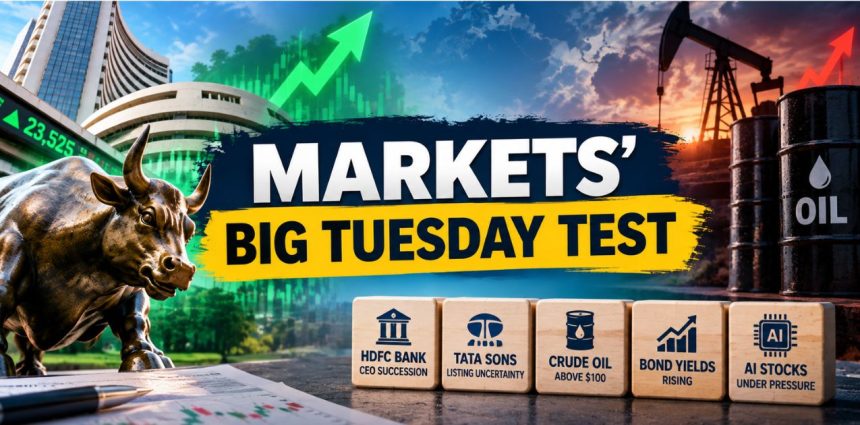
GIFT Nifty points to a stronger start after five weekly losses, but HDFC Bank’s CEO succession, Tata Sons’ listing uncertainty, expensive crude, rising bond yields and fresh AI-stock pressure could make Tuesday’s market far more complicated than the opening suggests.
Indian equities return to trading on Tuesday with a rare clash between positive domestic triggers and a difficult global backdrop.
GIFT Nifty was trading around 23,525 early Tuesday, pointing to a positive start for the Nifty 50 after the index closed at 23,398.10 on Friday. But the recovery comes after the Nifty and Sensex each lost about 4.8% over the preceding five weeks, while rising oil prices, higher global bond yields and Middle East tensions continue to limit investor confidence.
The corporate news flow, meanwhile, is unusually heavy.
HDFC Bank has formally moved its CEO succession process to the Reserve Bank of India. Tata Sons is facing renewed pressure over a potential listing after the RBI rejected its request to surrender its core investment company registration. Solar Industries has announced a $1.36-billion acquisition in South Africa, KEC International has secured ₹1,303 crore of fresh orders, and Coforge is rebuilding its board after a governance dispute.
There is also a bigger macro question hanging over all of them.
Brent crude remains above $100 a barrel, India’s 10-year government bond yield has moved above 7%, the rupee ended last week at ₹95.55 per dollar, and the US 10-year Treasury yield has crossed the psychologically important 5% mark. India’s August CPI also accelerated to 4.82%, increasing pressure on the RBI’s policy outlook.
That creates the key market tension for Tuesday: a stronger opening does not automatically signal a stronger trend.
Check Live: GIFT NIFTY, BANK NIFTY, NIFTY 50, SENSEX
HDFC Bank CEO Succession: Two Names, but the Bank Has Not Officially Named Them
HDFC Bank is likely to remain the most closely watched stock in early trade.
The bank’s board announced on September 12 that it had approved two candidates for the MD & CEO position and submitted their names to the RBI in order of preference, together with proposed remuneration, for a three-year term. The bank’s exchange disclosure did not identify the candidates.
Multiple media reports have since identified the two reported contenders as Kaizad Bharucha, HDFC Bank’s deputy managing director, and Anup Bagchi, MD & CEO of ICICI Prudential Life Insurance. The internal-versus-external choice could have different implications for investors, but these names should be treated as reported candidates rather than as names officially disclosed by HDFC Bank.
The succession comes ahead of incumbent MD & CEO Sashidhar Jagdishan’s current term ending on October 26, 2026. HDFC Bank has simultaneously approved the reappointment of V Srinivasa Rangan as a whole-time director, the appointment of Jimmy Tata as a whole-time director subject to RBI approval, and the creation of one additional whole-time director position.
That additional board position matters because the bank is effectively expanding its executive leadership structure at the same time as it works through the CEO transition.
The stock market, however, is likely to look beyond the appointment itself.
Nomura has maintained a Buy call on HDFC Bank with a ₹950 target price, arguing that an internal appointment could offer near-term continuity, while a credible external candidate accompanied by a clear growth strategy could become a stronger catalyst for a re-rating. The brokerage’s view also points to the bank’s significant recent underperformance as a potential source of upside should confidence return.
The immediate uncertainty is therefore not simply who gets the job.
It is whether the eventual appointment changes investor expectations around growth, deposits, margins and returns.
Also Check: HDFC BANK Options Chart | Nifty Trader
Nifty Starts Higher. Why the Macro Picture Is Still Uncomfortable
Friday’s session offered a small warning about how fragile market sentiment has become.
The Nifty fell 0.34% to 23,398.10, while the market remained heavily skewed toward declining stocks. Reuters noted that Indian equities had fallen for the fifth consecutive week, with the Nifty and Sensex each down about 4.8% over the prior five weeks.
GIFT Nifty now indicates a positive start.
But the macro environment has become significantly more complicated since the previous major market move.
Oil Is Still the Biggest Variable
Brent crude is trading above $100 a barrel as Middle East supply concerns remain elevated. Reuters reported Brent near $107 on Tuesday morning, with geopolitical tensions continuing to threaten oil flows.
For India, the issue goes beyond petrol and diesel.
India imports the majority of its crude requirement, meaning a prolonged oil shock can simultaneously pressure inflation, the current account, the rupee and corporate costs.
That is particularly uncomfortable when domestic inflation has already started moving higher.
India’s August CPI Accelerated to 4.82%
India’s annual retail inflation rose to 4.82% in August, compared with 4.45% in July and 4.80% expected in a Reuters economist poll. Reuters reported that price pressure broadened beyond food and fuel, with core inflation also increasing.
That does not automatically mean an immediate RBI rate hike.
In fact, economist expectations remain divided over whether policymakers would wait until December or respond earlier if crude remains elevated and inflation broadens further.
And that uncertainty is precisely what markets will have to price.
The Rupee and Bond Market Are Adding Another Layer
The rupee ended last week at ₹95.55 per dollar, losing more than 1% during the week. India’s 10-year benchmark yield ended at 7.0233%, extending its rise for a fourth straight week.
The RBI has also announced open-market bond sales totalling ₹1 lakh crore, with auctions scheduled in three tranches during September. The move is intended to absorb surplus liquidity from the banking system.
For equities, higher domestic yields can complicate the recovery trade by increasing the cost of capital and potentially reducing the relative appeal of risk assets.
Wall Street’s AI Selloff Adds Pressure to Indian IT Stocks
The technology trade is facing a different kind of uncertainty.
Global AI-linked shares came under pressure after Anthropic CEO Dario Amodei publicly argued that companies should slow the development of their most powerful AI models because of safety concerns. The episode added to an already fragile technology-market narrative.
Nvidia fell around 3.4%, while the Philadelphia Semiconductor Index dropped sharply on Monday, intensifying concern around expensive AI exposures.
For Indian IT companies, that does not mean AI spending has suddenly disappeared.
The more immediate risk is valuation and sentiment.
Indian technology shares have already been sensitive to the prospect of rapid AI-driven change in service delivery, pricing and employee productivity. A renewed selloff in US technology stocks can therefore affect Indian IT valuations even before company-specific earnings estimates materially change.
That puts Coforge and other large IT names under the microscope at a time when the domestic market itself is already struggling to establish a durable recovery.
Also Read: AI Stocks Slide: Nvidia and SoftBank Hit as Leaders Call for a Slowdown
Tata Sons Listing Question Returns — But an IPO Is Not Imminent
Tata Group stocks have another major regulatory development to digest.
The RBI has rejected Tata Sons’ request to surrender its registration as a core investment company, according to people familiar with the matter. The decision moves the holding company closer to the regulatory path that could require a public listing. Tata Sons has historically remained privately held.
That puts listed Tata entities such as TCS, Tata Motors, Tata Steel, Tata Power, Tata Chemicals, Tata Consumer Products, Indian Hotels and Tata Investment Corporation back in focus.
But investors should distinguish between two very different statements:
A regulatory obstacle to remaining private does not mean a Tata Sons IPO is launching tomorrow.
Timing, structure, valuation and any legal or regulatory challenge remain important variables. Tata Sons could also potentially challenge the RBI’s decision, according to current reporting.
That makes the immediate market reaction more likely to be driven by expectations around potential value unlocking than by an actual near-term listing event.
Solar Industries Makes a $1.36-Billion Mining Bet
Solar Industries has delivered one of the day’s largest corporate catalysts.
Its subsidiary has agreed to acquire South Africa’s Omnia Holdings for approximately $1.355 billion, or roughly ₹12,951 crore, in an all-cash transaction. The deal is expected to close in early-to-mid 2027, subject to regulatory and other conditions.
Omnia’s operations span mining and agriculture, with a large international presence. The acquisition would significantly expand Solar Industries’ global explosives and blasting footprint.
The strategic opportunity is substantial.
But the market will eventually have to answer a harder question: how much of that opportunity converts into attractive returns after funding, integration and execution costs?
That makes Solar Industries a particularly important stock to watch because the size of the acquisition changes the company’s growth story while also increasing the importance of execution.
KEC International Adds ₹1,303 Crore of Orders
KEC International has secured new orders worth ₹1,303 crore across its transmission and distribution and cables businesses.
The projects span India, Saudi Arabia and the Americas, taking the company’s year-to-date order intake to more than ₹7,600 crore.
The order win strengthens visibility for the infrastructure contractor, but investors will likely focus on the conversion of the order pipeline into revenue and margins.
This distinction is increasingly important across capital-goods stocks.
A large order book can support future growth, but it does not automatically translate into near-term earnings acceleration.
Coforge Is Repairing Its Board as Investors Watch Growth
Coforge has a separate problem from the broader IT-sector selloff.
The company has appointed executive search firm Egon Zehnder to identify two additional independent directors after the exits of chairman O.P. Bhatt and Nomination and Remuneration Committee chair D.K. Singh. Independent director Beth Boucher has taken over as NRC chair, while Vivek Sharma is serving as interim chairman.
The governance issue has already weighed on sentiment.
Yet the company maintains that the developments have not affected its operations, financial reporting or business outlook. That leaves investors watching two separate stories at once: whether governance confidence can be restored quickly and whether the company’s AI-led growth strategy remains intact.
Brokerages have remained constructive.
CLSA has a High-Conviction Outperform with a ₹2,170 target, while Nomura has maintained a Buy with a ₹1,860 target, according to the market reports carried Tuesday.
The divergence between governance concerns and continued brokerage optimism could keep Coforge unusually sensitive to fresh developments.
Pranav Constructions Makes Its Market Debut
Pranav Constructions is another stock that could attract significant attention because Tuesday is its listing day.
The company raised ₹351.03 crore through an IPO priced at ₹118–124 a share. The issue was subscribed 126.34 times, according to IPO-market data reported ahead of its debut.
That creates an important test for market sentiment.
Massive subscription demand can signal strong investor appetite, but the listing session is where that demand becomes actual price discovery.
A premium debut would reinforce the current risk appetite in parts of the primary market.
A weaker-than-expected listing, meanwhile, could expose a gap between IPO enthusiasm and secondary-market demand.
Indiabulls Limited’s ₹1,050-Crore Fintech Acquisition
Indiabulls Limited, formerly Yaari Digital Integrated Services, has entered into an agreement to acquire a 70% stake in Fintech Cloud Private Limited for ₹1,050 crore.
The transaction values Fintech Cloud at about ₹1,500 crore and is aimed at expanding Indiabulls’ exposure to technology-enabled solutions for NBFCs.
The distinction between Indiabulls Limited and the group’s other historically branded entities is important for investors because the deal should not be attributed to Indiabulls Housing Finance or Indiabulls Real Estate.
The market will likely focus on whether the acquisition can generate meaningful strategic and financial benefits rather than simply increasing the company’s fintech footprint.
PNC Infratech Has a Negative Trigger
Not every stock on Tuesday’s list has a positive catalyst.
PNC Infratech disclosed that the National Highways Authority of India has extended the debarment of Awadh Expressway Private Limited, a concessionaire promoted by the company, for three years.
The action prevents the relevant entity from participating in NHAI/MoRTH bidding during the period.
That makes PNC Infratech one of the clearest downside-specific triggers in an otherwise heavily positive corporate-news list.
The key variables now are the financial impact, the effect on future order opportunities and the outcome of any legal remedy pursued by the company.
Strides Pharma, Solar, HDFC Bank and Other Stocks Also in Focus
Strides Pharma Science is in focus after a US FDA inspection of its Alathur facility concluded with three observations on Form 483. The company has said it will respond within the stipulated period.
Sun Pharma remains on investors’ radar amid broader pharmaceutical-stock activity.
HFCL, Aurobindo Pharma, Horizon Industrial Parks, Lalithaa Jewellery Mart, KEC International and other names feature across Tuesday’s market-news flow as investors assess fresh corporate announcements.
The important distinction is that not every company-specific headline carries the same market weight.
HDFC Bank’s CEO succession and Tata Sons’ regulatory position have broader index and sector implications, while a single order win or inspection update may matter primarily to the individual stock.
Where the Nifty Goes From Here
The Nifty’s immediate technical battle remains around the recent support and resistance zones.
The index has defended the broader 23,200–23,230 area, while the 23,500–23,600 region remains the more important recovery test cited by market analysts.
A sustained move through that resistance zone would improve the near-term setup.
A failure to hold the recent support area, however, would keep the broader bearish structure intact and could expose the index to another leg lower.
That distinction is particularly important today because GIFT Nifty’s early strength could create an optimistic opening before the market has actually resolved any of its larger macro risks.
Track live institutional activity through NiftyTrader’s FII-DII Tracker and monitor the Nifty and Bank Nifty Option Chain for changes in positioning as the session develops.
The Real Test Is What Happens After the Opening Bell
Tuesday’s most interesting market signal may not be the opening level at all.
It may be whether gains broaden beyond a small group of heavyweight stocks.
HDFC Bank has a major succession catalyst. Tata Group stocks have a new regulatory development. Solar Industries has announced a transformational acquisition. KEC has added orders. Coforge is repairing its governance structure.
But all of those stories are competing against the same macro forces:
oil above $100, a rupee near ₹95.55, India’s 10-year yield above 7%, a US 10-year yield around 5%, higher inflation and fresh weakness in AI-linked global equities.
That is why the market could produce a misleading first impression.
A green opening may reflect bargain hunting after five weekly losses.
A sustained recovery would require something more: improving breadth, follow-through buying and evidence that investors are willing to look beyond the macro risks.
For now, that confirmation is still missing.
What Traders Should Watch on September 15
The first question is whether Nifty can move and hold above the 23,500 area after the opening volatility.
The second is whether Bank Nifty can sustain strength alongside HDFC Bank.
The third is whether IT stocks stabilise despite the renewed global AI selloff.
The fourth is whether oil remains above $100 and continues to feed into inflation and currency concerns.
And the fifth is whether individual corporate catalysts — particularly HDFC Bank, Solar Industries, Tata stocks and KEC International — attract enough buying to offset the broader risk-off pressure.
That combination makes Tuesday’s market far more than another routine “stocks to watch” session.
It is a test of whether stock-specific good news can finally overpower the macro headwinds that have driven Indian equities lower for five straight weeks.
Key Takeaways
- HDFC Bank has submitted two CEO candidates to the RBI; media reports identify Kaizad Bharucha and Anup Bagchi, but the bank’s official disclosure did not name them.
- Tata Sons faces renewed listing pressure after the RBI rejected its deregistration request, although a regulatory listing path should not be confused with an immediate IPO.
- Solar Industries has announced a roughly ₹12,951-crore acquisition of Omnia Holdings, while KEC International added ₹1,303 crore of new orders.
- Coforge is rebuilding its board with Egon Zehnder searching for two independent directors as brokerages continue to maintain positive views.
- Oil, inflation, the rupee and bond yields remain the biggest market-wide risks, meaning a positive opening alone may not confirm a durable recovery.
Read Next: US Stocks Slip at open: Nasdaq Futures Down 1.5% as Oil Jumps Nearly 3%, AI Fears Weigh
Disclaimer: The information provided in this article is for educational and informational purposes only and should not be construed as investment advice, a recommendation to buy or sell any security, or a solicitation to invest. Securities-market investments are subject to market risks. Investors should undertake their own research or consult a SEBI-registered Investment Adviser before making any investment decision. Brokerage ratings and target prices mentioned in this article belong to the respective brokerages and are not recommendations from NiftyTrader.