Synopsis: Anthropic is considering another AI-model launch as OpenAI’s GPT-6 Astra gains traction with businesses and developers. The move comes as Anthropic heads towards a potential IPO, even after CEO Dario Amodei urged the industry to slow the pace of AI development. The bigger investor question is whether Anthropic can keep its enterprise lead while AI prices fall, infrastructure costs rise and public markets demand a clearer path to profits.
Anthropic’s AI business is growing at a pace most private companies can only aspire to. But its latest competitive problem is arriving just as investors may be preparing to value that growth in public markets.
The Claude maker is considering releasing a new AI model to counter OpenAI’s GPT-6 Astra, according to three people familiar with the matter cited by Reuters. Anthropic is also evaluating the safety of its next model as part of the decision. The company declined to comment.
The timing creates an unusual tension: Anthropic’s CEO has called for the industry to slow the pace of AI capability improvements, while the company is simultaneously weighing whether it needs another frontier model to defend its position.
And that debate is unfolding ahead of an IPO that could come this autumn but may slip past the November U.S. midterm elections. Reuters previously reported that IPO marketing was expected no earlier than mid-October.
Need to Know: Why Anthropic Is Back in the Model Race
| Indicator | Latest picture |
|---|---|
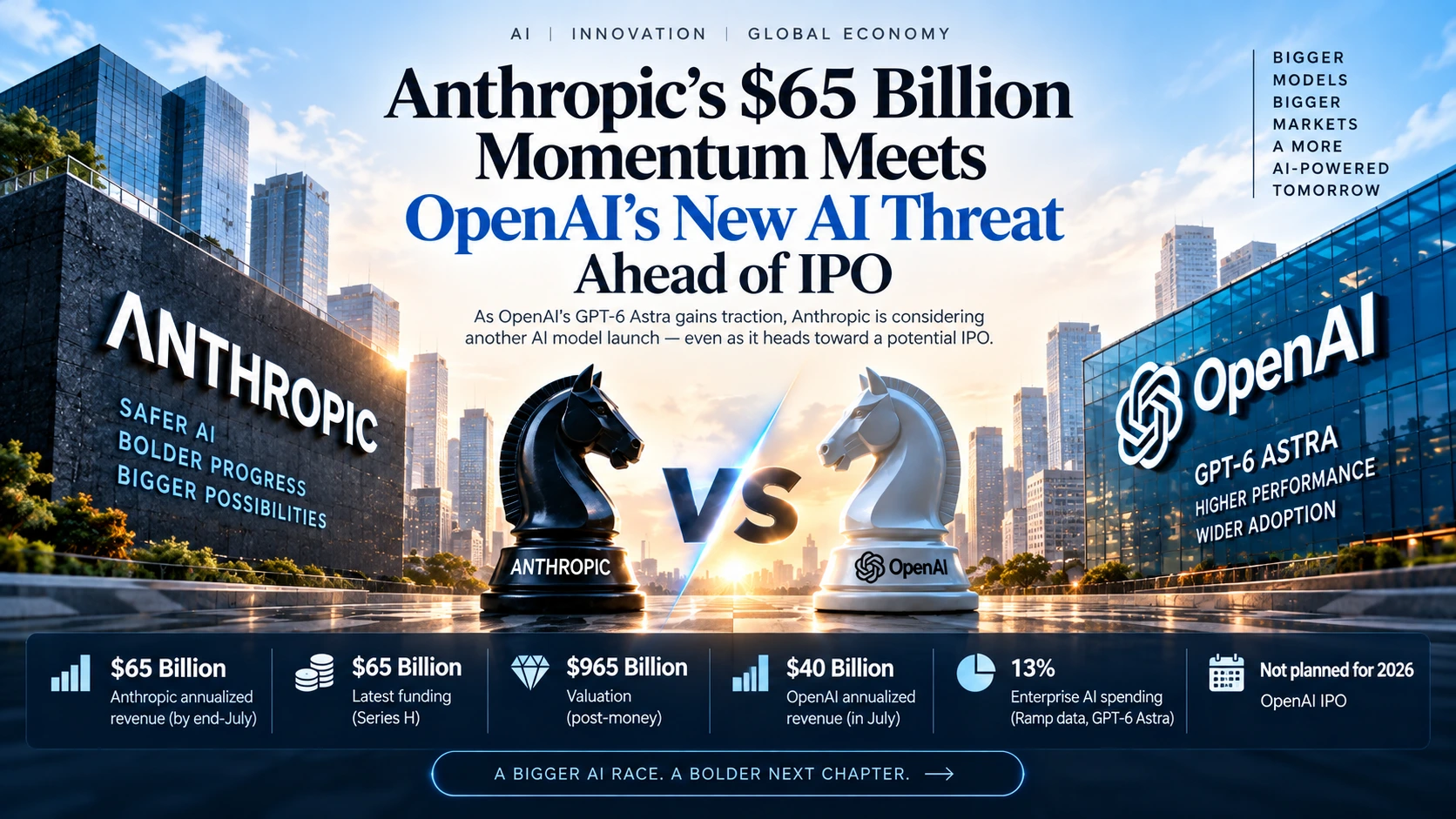
| Anthropic annualized revenue | More than $65 billion by end-July |
| OpenAI annualized revenue | More than $40 billion in July |
| Anthropic latest funding | $65 billion Series H |
| Series H valuation | $965 billion post-money |
| Possible IPO timing | Could slip beyond November midterms |
| OpenAI IPO | Not planned for 2026 |
Anthropic’s $65 billion revenue run rate was reported by Reuters in August, while its own May funding announcement said revenue had already crossed $47 billion earlier that month. Anthropic raised $65 billion in its Series H at a $965 billion post-money valuation.
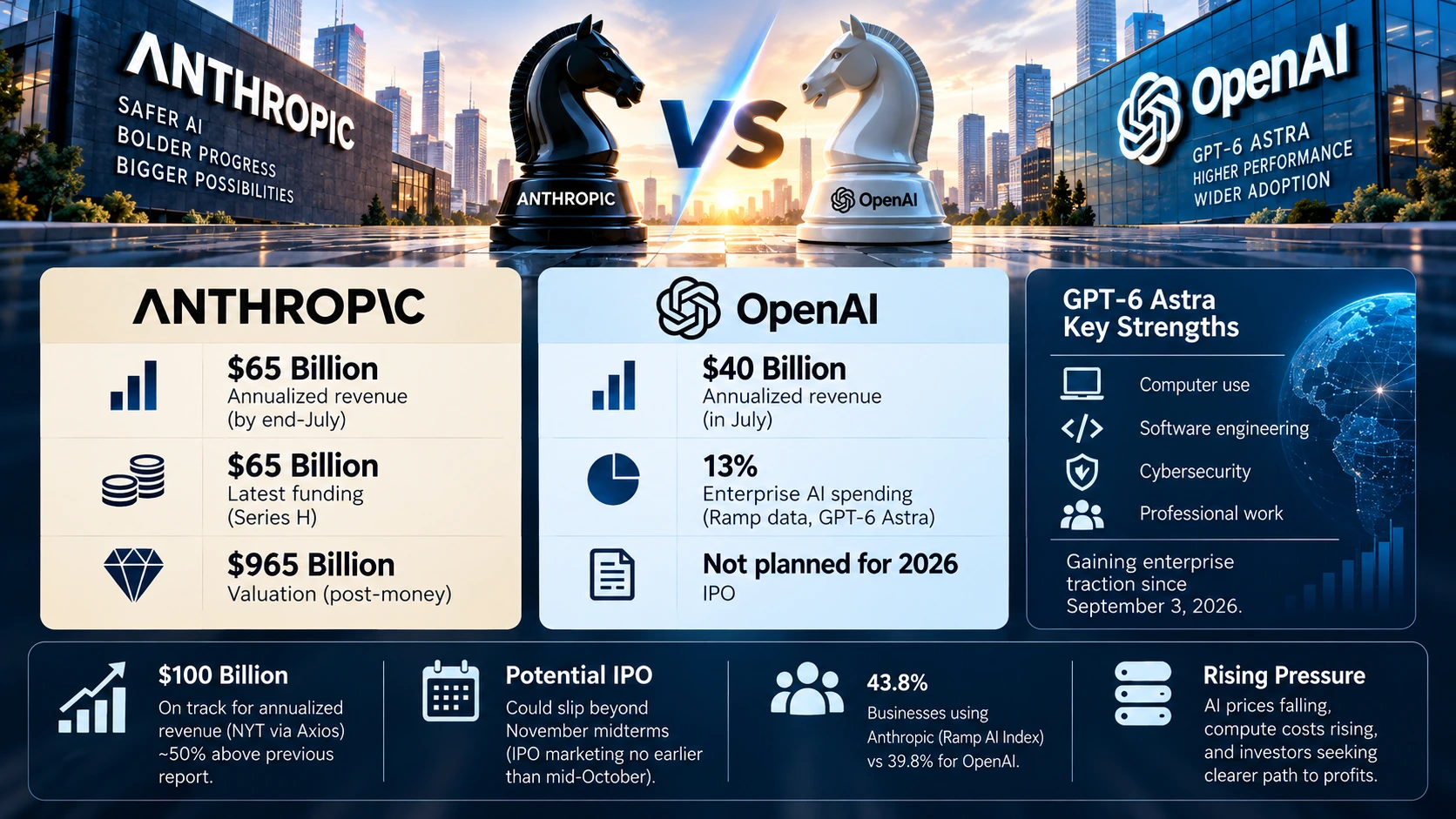
A newer report adds another layer. The New York Times, as reported by Axios on September 18, said Anthropic is now on track to top $100 billion in annualized revenue, about 50% above the $65 billion figure reported two months earlier. That is still an annualized run rate rather than booked full-year revenue, so it should not be treated as equivalent to audited annual sales.
GPT-6 Astra Is Changing the Competitive Picture
OpenAI released GPT-6 Astra on September 3, promoting improvements in areas including computer use, software engineering, cybersecurity and professional work. Reuters says the launch has gained enough enterprise traction to make some Anthropic investors reassess the company’s competitive position.
The most eye-catching data comes from Ramp, but it needs to be read carefully.
In Ramp’s latest AI Index, 43.8% of businesses in its dataset paid for Anthropic subscriptions or tokens in August, compared with 39.8% for OpenAI. Ramp says Anthropic continued to lead on business adoption in its own data.
That is different from the Reuters-cited spending data, which showed GPT-6 Astra at about 13% of enterprise AI spending tracked by Ramp, compared with about 8% for Anthropic’s Claude Fable. Those are model-level spending figures, not total company market share.
The distinction matters.
Anthropic can remain ahead on the breadth of business adoption while a rival model captures a greater share of spending among customers that use it. It is an important expectation gap for investors watching the AI market.
Also Read: Anthropic Raises $65B, Hits $965B Valuation, Tops OpenAI
Anthropic Still Has a Revenue Lead
The Astra challenge should not be mistaken for evidence that Anthropic has lost its enterprise position.
Reuters reported that Anthropic’s annualized revenue had surpassed $65 billion by the end of July, compared with more than $40 billion for OpenAI. Reuters also reported that Anthropic has been projecting approximately $190 billion to $200 billion of revenue in 2028.
Private-company revenue run rates also require caution when making direct comparisons because companies may calculate annualized figures differently.
That leaves investors with two signals moving in opposite directions: Anthropic’s financial scale continues to accelerate, while OpenAI is making the competitive lead look less secure.
Some investors quoted by Reuters do not view Astra as a major threat yet, arguing that Anthropic’s enterprise lead is large enough that customers will not quickly replace established vendors.
Also Read: AI Stocks Slide: Nvidia and SoftBank Hit as Leaders Call for a Slowdown
Amazon’s $15 Billion Facility Is Not a Cash Cheque
Amazon’s filings show how deeply Anthropic’s growth is tied to compute infrastructure—but the structure is more conditional than the headline figure suggests.
Amazon’s second-quarter 2026 10-Q says it invested $5 billion in Anthropic Series G and another $5 billion in Series H. Separately, Amazon entered into a financing arrangement with an aggregate facility of up to $20 billion. The Series H investment reduced the amount available under that facility to $15 billion.
Crucially, Amazon said nothing was available to be drawn at inception.
Amounts become available as Anthropic reaches specified compute-delivery milestones under the amended AWS commercial arrangement. Draws can take the form of new Anthropic convertible notes or, after an IPO or other liquidity event and subject to Amazon’s ownership cap, Anthropic common stock. The facility expires 30 months after a qualifying liquidity event.
So the more accurate investor takeaway is not that Anthropic already has another $15 billion sitting in cash.
It has a milestone-linked financing facility connected to future compute delivery.
That distinction becomes important if AI infrastructure spending faces greater scrutiny.
The Bigger Problem Could Be Falling AI Prices
The competitive battle is happening against another industry-wide change: AI is getting cheaper.
Ramp says its effective price per million AI tokens fell 41% to $0.68, from a 2026 peak of $1.15 in March. It also found that cheaper standard models were driving much of the growth in usage, while frontier models such as Anthropic’s Fable and OpenAI’s higher-end offerings accounted for 45% of token share, below their August peak.
That creates a difficult business model.
A frontier AI company can increase usage and still face pressure on revenue per unit if customers shift toward cheaper models. Open-source and open-weight systems add another potential source of pricing pressure.
Reuters has identified open-source AI, particularly lower-cost models from China, as a broader challenge to the economics of the leading commercial AI labs.
Meta Adds Another Warning Signal
Anthropic also faces pressure from customers building more AI capability themselves.
Reuters reported that Meta Platforms, one of Anthropic’s largest customers, is looking to reduce its use of Anthropic’s models as it develops more AI capabilities internally. Meta did not immediately respond to Reuters’ request for comment.
That matters because the AI business is not only a contest among model makers.
Large technology companies increasingly have the financial resources, data and engineering teams to combine external AI models with their own systems. Over time, that could weaken the negotiating power of model providers—or force them to compete more aggressively on pricing.
Safety Spending Is Rising at the Same Time
The safety debate has not disappeared because competition has intensified.
On September 12, Anthropic CEO Dario Amodei called for a slower pace of AI capability development, arguing that safety systems need time to keep up. Reuters reported that OpenAI CEO Sam Altman supported the concern.
Just six days later, Anthropic and Accenture announced a partnership for independent evaluation of frontier AI models. Each company expects to invest at least $1 billion over five years in building evaluation capacity. The program is designed to include red-teaming, alignment assessments and testing of model safeguards.
That is more than a safety headline.
It is also a potential cost variable at a time when investors are paying greater attention to profitability.
Higher Rates Raise the Pressure
The timing is especially important because the Federal Reserve raised its policy rate by 25 basis points to 3.75%-4.00% on September 16, with policymakers signalling that another hike could still come later in 2026.
Reuters reported that Anthropic’s internal debate includes how much to spend on releasing new models versus strengthening profitability as higher rates make investors more focused on when profits are likely to arrive.
The expectation gap is therefore widening.
Investors may still reward explosive revenue growth, but a public-market company will eventually face questions about compute costs, pricing, margins, capital intensity and free cash flow.
CHECK LIVE: FII DII DATA | NIFTYTRADER
Why Indian Investors Should Care
The AI competition matters beyond U.S. technology stocks.
India’s IT sector is exposed to the global shift towards AI-assisted software development, automation and lower-cost model deployment. On September 18, the Nifty IT index fell 1.03% to 28,854.55, adding a market backdrop to concerns around AI-led disruption and technology valuations.
That one-day decline cannot be attributed to Anthropic’s news alone. Global rates, oil prices and broader technology-sector sentiment were also moving markets.
But the forward-looking risk is relevant for Indian IT investors: if frontier AI models become cheaper and increasingly capable, enterprise clients could eventually demand more automation for the same technology budget.
That could reshape where spending goes—from traditional services and manpower towards cloud, software platforms, AI infrastructure and higher-value transformation work.
Check Live: Nifty IT Sector Analysis: Live Performance & Drivers
What the Anthropic IPO Will Really Test
OpenAI CEO Sam Altman has said OpenAI will not go public in 2026, leaving Anthropic further ahead in the race to the public markets.
Anthropic, meanwhile, could still pursue an IPO this autumn, although Reuters says the timetable may move beyond the November midterms.
The question for investors is no longer simply how large Anthropic can become.
It is whether that growth remains economically attractive as competitors release faster models, token prices decline, customers build more AI internally and the cost of frontier development keeps rising.
A new model could help Anthropic defend its position.
But it could also raise the very question public investors are likely to ask next:
How much does Anthropic have to spend to stay ahead—and how quickly can that spending turn into durable profits?
Read Next: NASA’s SpaceX Deal Adds $946M: 3 More Missions Through 2030
Disclaimer: This article is for informational purposes only and is not investment advice. Private-company revenue figures, IPO timelines and model-launch plans can change, and investors should verify company filings and official disclosures before making financial decisions.