NLMC Board Meets: Rs.5,000 Crore Worth of Surplus Assets Cleared for Next Stage
India’s government asset monetisation drive is moving into another key phase. The National Land Monetization Corporation (NLMC) has recommended proposals involving assets worth more than ₹5,000 crore, while its board called for faster execution of the identified projects.
The development comes as the government continues efforts to unlock value from surplus land and building assets held by Central Public Sector Enterprises (CPSEs) and other government entities.
Track Live : NSE Option Chain — Live | BSE Option Chain — Live Sensex & Bankex Options Data Today
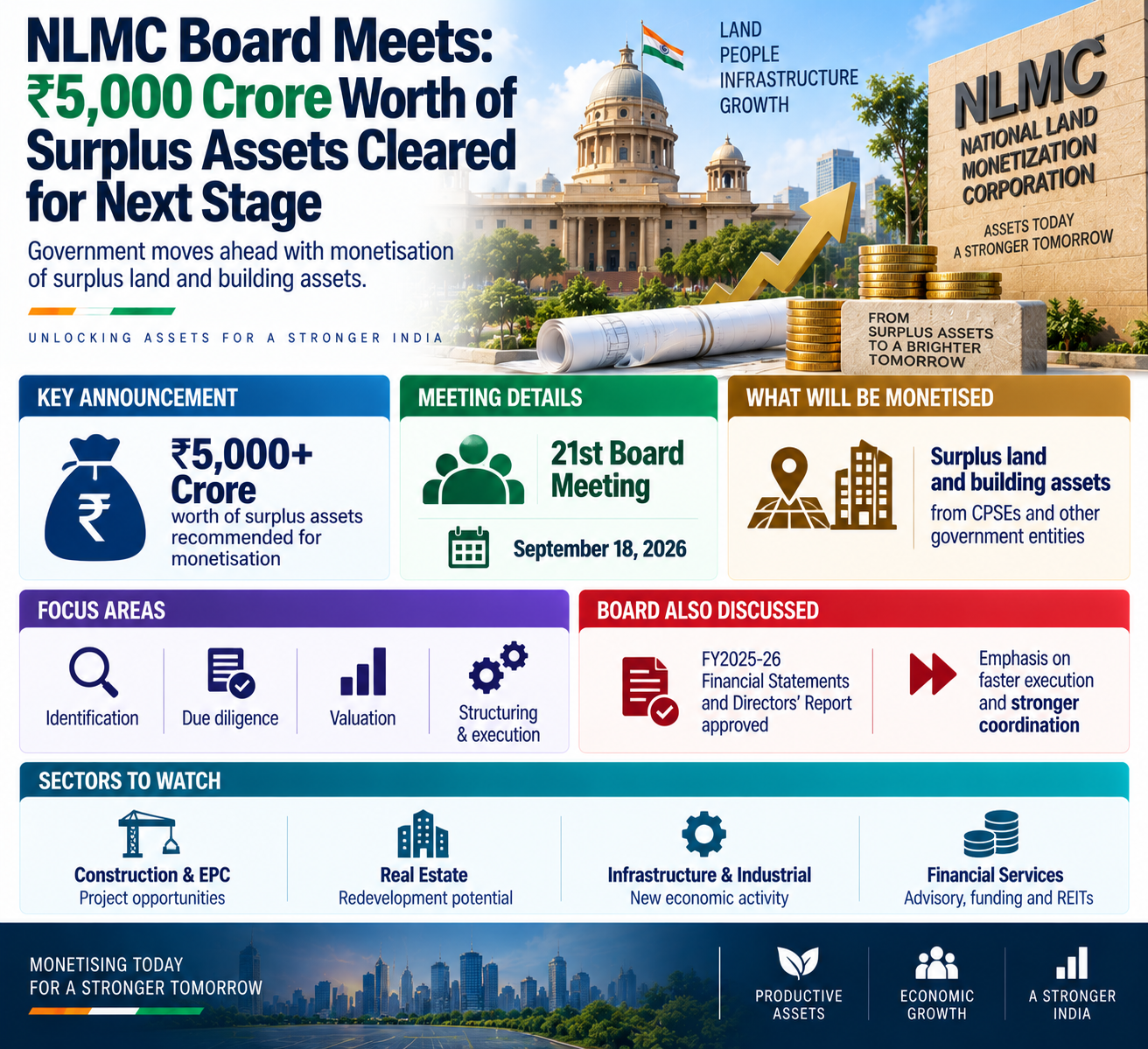
NLMC Board Meets puts ₹5,000 crore-plus assets on the monetisation track
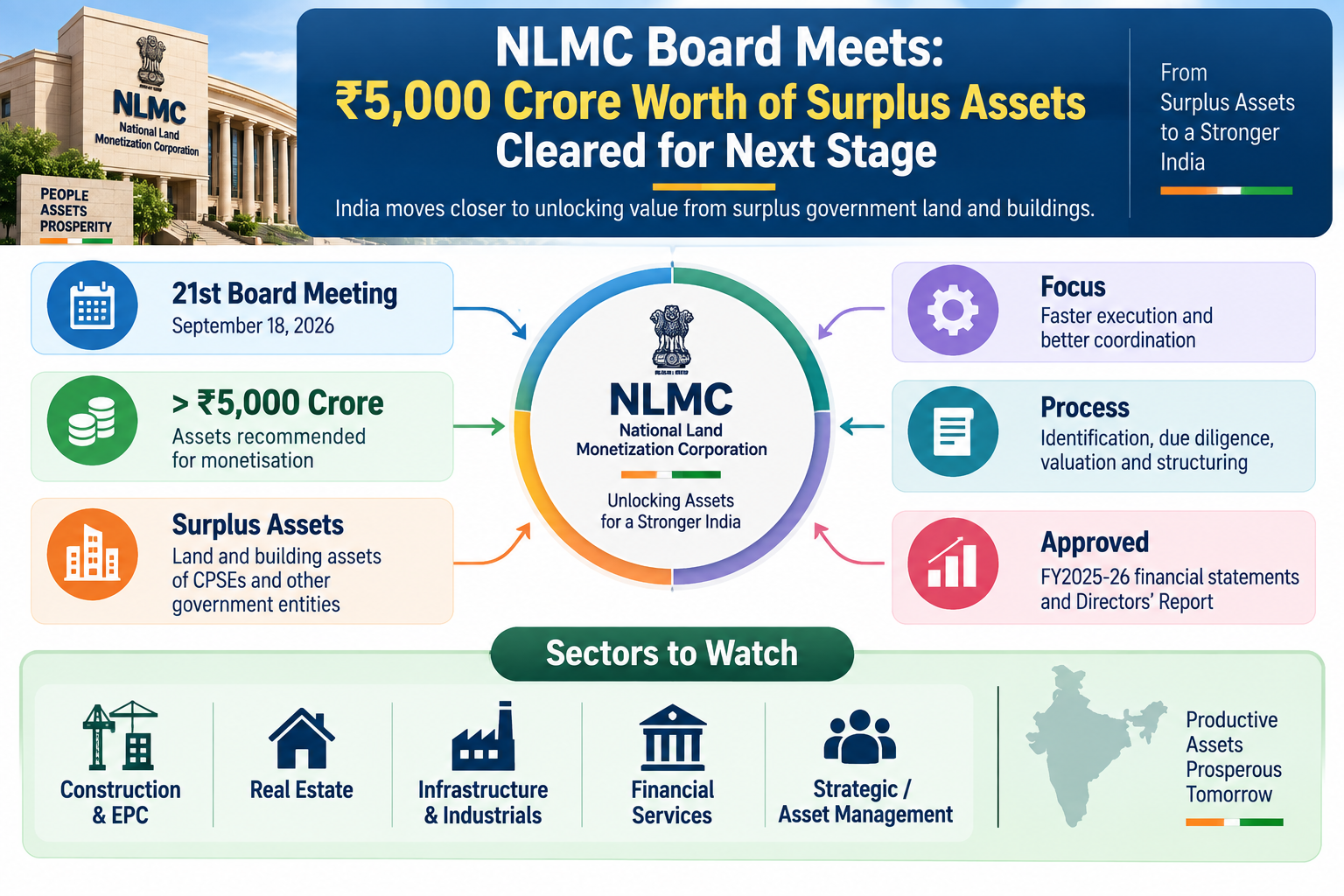
The recommendation was made during the 21st meeting of NLMC’s Board of Directors on September 18, according to the Ministry of Finance.
The board reviewed the progress of NLMC’s asset monetisation programme, along with its financial performance and institutional initiatives.
The proposals involve surplus land and building assets identified for monetisation. The objective is to move these underutilised public assets toward value realisation through appropriate and transparent mechanisms.
NLMC has been working with CPSEs and other government entities to identify suitable assets, conduct due diligence, undertake valuation and structure monetisation processes.
Key Details
| Detail | Verified information |
|---|---|
| NLMC meeting | 21st Board of Directors meeting |
| Meeting date | September 18, 2026 |
| Value of proposals | More than ₹5,000 crore |
| Assets | Surplus land and building assets |
| Asset owners | CPSEs and other government entities |
| Focus | Accelerating monetisation and unlocking value from underutilised assets |
| Process | Identification, due diligence, valuation and structuring of monetisation |
| Board action | Recommended proposals for monetisation |
| Other approval | FY2025-26 Annual Financial Statements and Directors’ Report approved |
| Administrative control | Department of Public Enterprises, Ministry of Finance |
Board stresses faster execution and coordination
The focus of the latest meeting was not only on identifying assets but also on accelerating execution.
The board discussed implementation requirements and ways to ensure that identified assets progress through the required monetisation process without unnecessary delays.
It also stressed stronger coordination between NLMC and stakeholder entities.
This could be important because the value of asset monetisation ultimately depends on how quickly identified properties move from assessment and valuation to actual transactions or other approved monetisation structures.
Track Live : Opening Price Clues – What Pre-Market Data Says Today
Stocks and sectors investors should watch
The NLMC development is relevant across several sectors because monetisation of surplus government land and buildings can potentially create opportunities for redevelopment, infrastructure activity, financing and commercial use. However, the actual impact on individual companies will depend on the location and nature of the assets, transaction structure, valuation, buyers and subsequent development plans. NLMC itself says monetisation can enable productive use through industrial, commercial, tourism and infrastructure projects.
| Sector/company type | Why investors may track it |
|---|---|
| Construction & EPC | Redevelopment or infrastructure projects on monetised land could create opportunities for construction, engineering and EPC companies, depending on the eventual project structure and winning contractors. |
| Real estate | Large surplus land parcels, particularly in commercially attractive locations, could potentially create development opportunities for residential, commercial or mixed-use projects. |
| Infrastructure | Asset monetisation forms part of the broader government framework for unlocking value from public assets and supporting infrastructure investment. The government’s NMP 2.0 also includes highways, railways, power, ports, urban infrastructure and other sectors. |
| PSU companies | Asset-owning CPSEs could potentially unlock value from surplus or non-core land and buildings, although the financial impact will vary by company and asset. |
| Banks/NBFCs | Large property and infrastructure transactions can potentially generate financing requirements, creating opportunities for lenders where projects are commercially viable and funding is sanctioned. |
| Logistics & industrial real estate | Strategically located industrial land could potentially support warehouses, logistics parks or industrial developments if the assets are suitable and attract private-sector participation. |
Read More : India’s Software Exports to US Cross $119 Billion in FY26 as American Share Hits 54.1%
The much bigger ₹16.72 lakh crore context
The latest NLMC recommendation sits within a much larger government asset-monetisation programme. In February 2026, the government launched National Monetisation Pipeline 2.0 (NMP 2.0), which estimates an aggregate monetisation potential of ₹16.72 lakh crore between FY2026 and FY2030. The estimate includes ₹5.8 lakh crore of private-sector investment linked to the pipeline.
This provides useful context for the more than ₹5,000 crore of NLMC proposals recommended on September 18. The two figures should not be treated as directly comparable transactions: the ₹5,000-crore figure relates to specific NLMC proposals involving surplus land and buildings, while ₹16.72 lakh crore is the five-year indicative value of the broader NMP 2.0 pipeline covering multiple infrastructure and public-asset sectors.
NMP 2.0 covers a wide range of sectors
The government’s five-year pipeline includes:
| Sector | FY2026–FY2030 monetisation value |
|---|---|
| Highways, MMLPs & ropeways | ₹4.42 lakh crore |
| Power | ₹2.765 lakh crore |
| Ports | ₹2.637 lakh crore |
| Railways | ₹2.623 lakh crore |
| Coal | ₹2.16 lakh crore |
| Mines | ₹1 lakh crore |
| Urban infrastructure | ₹52,000 crore |
| Civil aviation | ₹27,500 crore |
| Petroleum & natural gas | ₹16,300 crore |
| Warehousing & storage | ₹10,000 crore |
| Telecom | ₹4,800 crore |
| Tourism | ₹1,200 crore |
| Total | ₹16.72 lakh crore |
The figures are the government’s indicative Total Monetisation Value (TMV) targets for FY2026-30.
Highways, power, ports and railways form the largest pools
Highways—including multimodal logistics parks and ropeways—account for the largest portion of the pipeline at ₹4.42 lakh crore, or about 26% of the total.
Power represents ₹2.765 lakh crore, while ports and railways account for ₹2.637 lakh crore and ₹2.623 lakh crore, respectively. Coal and mining add another ₹3.16 lakh crore.
This means the programme extends well beyond surplus land and buildings: it is designed as a broader mechanism for unlocking value from operating public infrastructure assets and using monetisation to support infrastructure financing.
Why the government’s asset monetisation strategy matters
NLMC is a wholly owned Government of India company under the administrative control of the Department of Public Enterprises, Ministry of Finance.
Its mandate is to undertake and facilitate monetisation of surplus land and building assets belonging to CPSEs and other government entities.
The Ministry of Finance said NLMC will continue focusing on efficient, transparent and value-oriented monetisation while working with ministries, departments, CPSEs and other government entities.
For investors, the next key signal will therefore be whether the recommended proposals translate into actual asset transactions and measurable value creation in the coming months.