
NSE Stock Set for Additional Listing on Metropolitan Stock Exchange of India Starting September 24
The much-awaited NSE listing is set to get another twist. Along with the BSE debut on September 24, NSE shares will also be admitted for trading on the Metropolitan Stock Exchange of India (MSEI), giving investors another exchange platform to trade the stock.
MSEI said in a September 23 circular that NSE equity shares will be admitted to its Capital Market Segment under the “Permitted to Trade” category from September 24.
For investors waiting for the NSE IPO listing, attention is now shifting from subscription numbers to the actual market debut, trading volumes and the stock’s ability to sustain its valuation.
Track Live : NSE Commodity Option Chain — Live MCX Options Data for Crude Oil, Gold, Silver & More
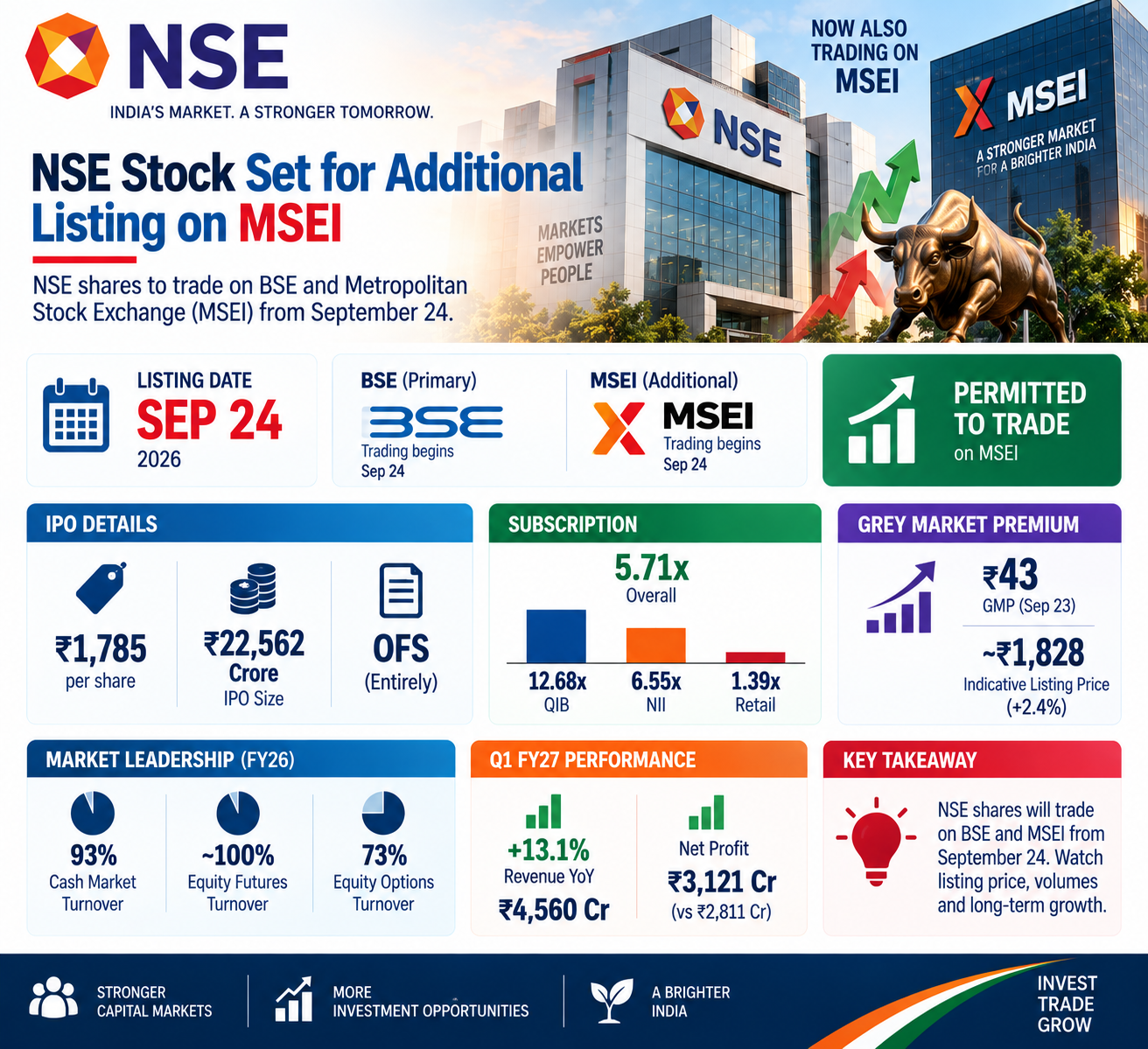
NSE Stock Set for Additional Listing will now trade on MSEI alongside BSE
The MSEI admission gives NSE shares an additional trading venue from the listing day.
The development is significant for the exchange ecosystem because NSE itself will become a listed company while its shares are simultaneously available for trading on another recognised stock exchange.
Market participants will closely watch liquidity and trading activity after the NSE listing begins.
Trading and Listing Details
- Effective Date: September 24, 2026
- Primary Venue: BSE (Designated Exchange)
- Additional Venue: Metropolitan Stock Exchange of India (MSEI)
- Category: Permitted to Trade
- IPO Price: ₹1,785 per share (upper band)
- Grey Market Premium (GMP): Around ₹43, indicating a tentative listing price near ₹1,828 (~2.4% gain)
Why NSE’s Listing Is Important for the Stock Market
- NSE is market infrastructure, not a typical new listing: The exchange holds a dominant position in India’s capital markets, with about 93% share in cash-market turnover, nearly 100% in equity futures and around 73% in equity options in Q4 FY26.
- Investors get direct exposure to exchange economics: NSE’s listing gives public-market investors direct exposure to the business of operating a major exchange, including trading, clearing, market data, indices and related market services.
- Trading volumes matter for earnings: NSE’s revenue is closely linked to market activity and transaction volumes. Reports indicate transaction charges accounted for roughly 79% of FY26 operating revenue, making trading activity an important earnings driver.
- Derivatives are particularly important: Equity options represented about 77% of NSE’s transaction revenue in FY26, meaning changes in derivatives volumes, regulations or taxation can materially affect the business.
- Regulation can directly affect the business: Changes to derivatives trading rules, transaction taxes or other market regulations can influence volumes and, consequently, exchange revenues.
- The listing creates a new listed market-infrastructure stock: NSE’s ₹22,561-crore IPO was entirely an Offer for Sale, meaning the listing provides public-market access to an established exchange business rather than raising fresh capital for NSE itself.
NSE IPO GMP points to a modest listing premium
According to market observers cited in reports, the grey market premium for NSE shares was around Rs 43 per share on September 23, down from Rs 65 a day earlier.
Against the IPO price of Rs 1,785, that indicated a potential price of around Rs 1,828.
However, GMP is an unofficial market indicator and can change rapidly. It should not be treated as a guarantee of the NSE listing price or future returns.
NSE IPO: Key Numbers
| Metric | Detail |
|---|---|
| IPO price | ₹1,785 per share |
| IPO size | ₹22,561.57 crore |
| Overall subscription | 5.71x |
| QIB subscription | 12.68x |
| NII subscription | 6.55x |
| Retail subscription | 1.39x |
| Listing date | September 24, 2026 |
| IPO structure | Entirely Offer for Sale (OFS) |
| Planned BSE listing | September 24, 2026 |
| MSEI trading | September 24, 2026 |
The final IPO data confirms that NSE received bids for about 50.58 crore shares against 8.86 crore shares on offer, resulting in 5.71x overall subscription. The QIB, NII and retail portions were subscribed 12.68x, 6.55x and 1.39x, respectively.
NSE’s official issue information shows the ₹1,700–₹1,785 price band, while MSEI has separately admitted NSE shares under its “Permitted to Trade” category from September 24.
NSE enters the market with a dominant business position
The NSE IPO listing comes as the exchange continues to hold a dominant position in several segments of India’s capital markets.
According to the Redseer report cited in the IPO documents, NSE accounted for 92.99% of India’s cash market turnover and 99.79% of equity futures turnover in FY26.
Its equity-options market share based on premium turnover stood at 74.71%.
NSE was also the world’s largest derivatives exchange by number of contracts traded in calendar 2025, according to Futures Industry Association data.
Track Live : NSE Option Chain — Live | BSE Option Chain — Live Sensex & Bankex Options Data Today
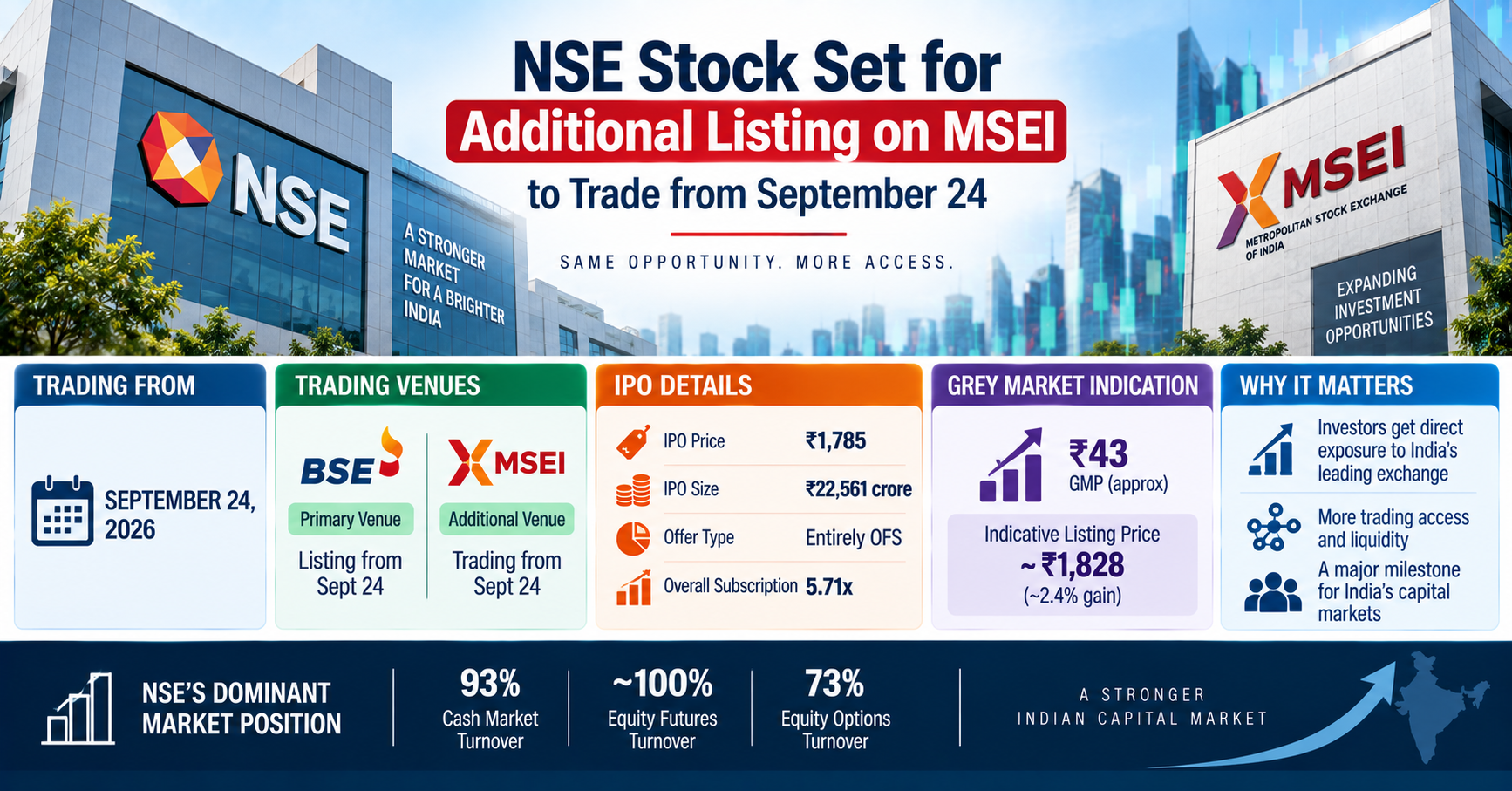
NSE’s investor base has expanded rapidly
The exchange’s registered investor base has grown sharply in recent years.
Its unique registered investor base increased from 30.87 million in March 2020 to 132.37 million in June 2026, representing a CAGR of 26.23%.
As of June 30, 2026, NSE had 261.36 million registered investor accounts, 1,328 trading members and 3,005 listed entities.
The market capitalisation of companies listed on its platform stood at Rs 474.08 lakh crore.
NSE’s earnings recovery will matter after listing
The NSE IPO listing also comes after a weaker FY26, when regulatory changes affecting derivatives trading and higher securities transaction tax affected the company’s financial performance.
However, the company reported stronger numbers in the first quarter of FY27.
Revenue from operations increased 13.1% year-on-year to Rs 4,560 crore, while net profit rose to Rs 3,121 crore from Rs 2,811 crore a year earlier.
For investors, future earnings growth will therefore be an important factor in assessing the NSE share price after listing.
Read More : SEBI Board Meeting: Advertising Code, PMS Reforms and REIT Fundraising Rules on Table
What does “Permitted to Trade” on MSEI mean for investors?
- Additional trading venue: NSE shares will be available for trading on MSEI from September 24, 2026, alongside their BSE trading debut. MSEI has formally admitted the shares under its “Permitted to Trade” category.
- It is not a separate NSE listing: “Permitted to Trade” means MSEI allows its members to trade the security, but the company does not enter into a separate listing agreement with MSEI and therefore does not provide the full set of listing disclosures to MSEI.
- Price differences can occur: With the same NSE shares trading on more than one exchange, prices can temporarily differ because of variations in orders, liquidity and execution. Professional traders may monitor such spreads, but they are not automatically risk-free arbitrage opportunities because transaction costs, execution risk and settlement considerations apply.
- Broker access will matter: Investors will need to check whether their broker provides MSEI trading access and whether the NSE security is enabled on its platform. Moneycontrol reported that Groww and Zerodha were testing MSEI access, while both have participated in MSEI fundraising rounds.
- Liquidity is an important watchpoint: Being available on MSEI does not necessarily mean the exchange will immediately have trading volumes comparable with BSE. Investors should watch bid-ask spreads, traded volumes and order depth.
What the NSE listing means for traders and investors
The September 24 debut will provide the first real-time test of investor demand for NSE shares after the IPO.
Traders are likely to focus on the opening price, volumes and intraday volatility, while long-term investors may pay greater attention to earnings, regulatory changes and the exchange’s dominant market position.
The additional MSEI trading venue also expands the platforms on which NSE shares can be traded. Reports have indicated that major retail brokers such as Groww and Zerodha have been testing MSEI access for cash-market customers, although the availability for individual investors will depend on broker implementation.
The immediate market focus, therefore, is clear: NSE shares will face their first full test of price discovery on September 24, with BSE and MSEI trading beginning alongside the much-awaited public-market debut.