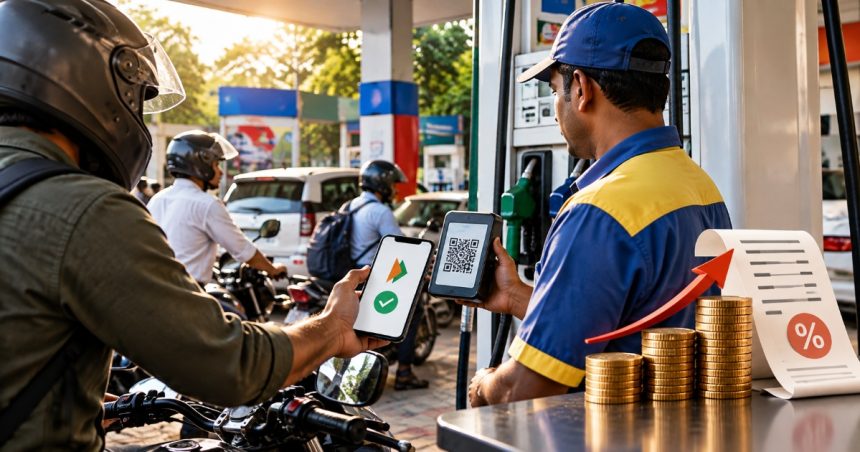
UPI MDR Exemption for Petrol Pumps: Govt Signals Review Ahead of Oct 15 Rollout
A new payment rule could soon change how customers pay at petrol pumps, with the government likely to examine a demand for complete exemption from UPI Merchant Discount Rate (MDR) on fuel transactions above Rs 2,000.
The issue has gained attention ahead of the October 15 implementation of the new UPI MDR framework. Petrol pump dealers say the proposed charges could put additional pressure on already limited operating margins.
Track Live : Opening Price Clues – What Pre-Market Data Says Today
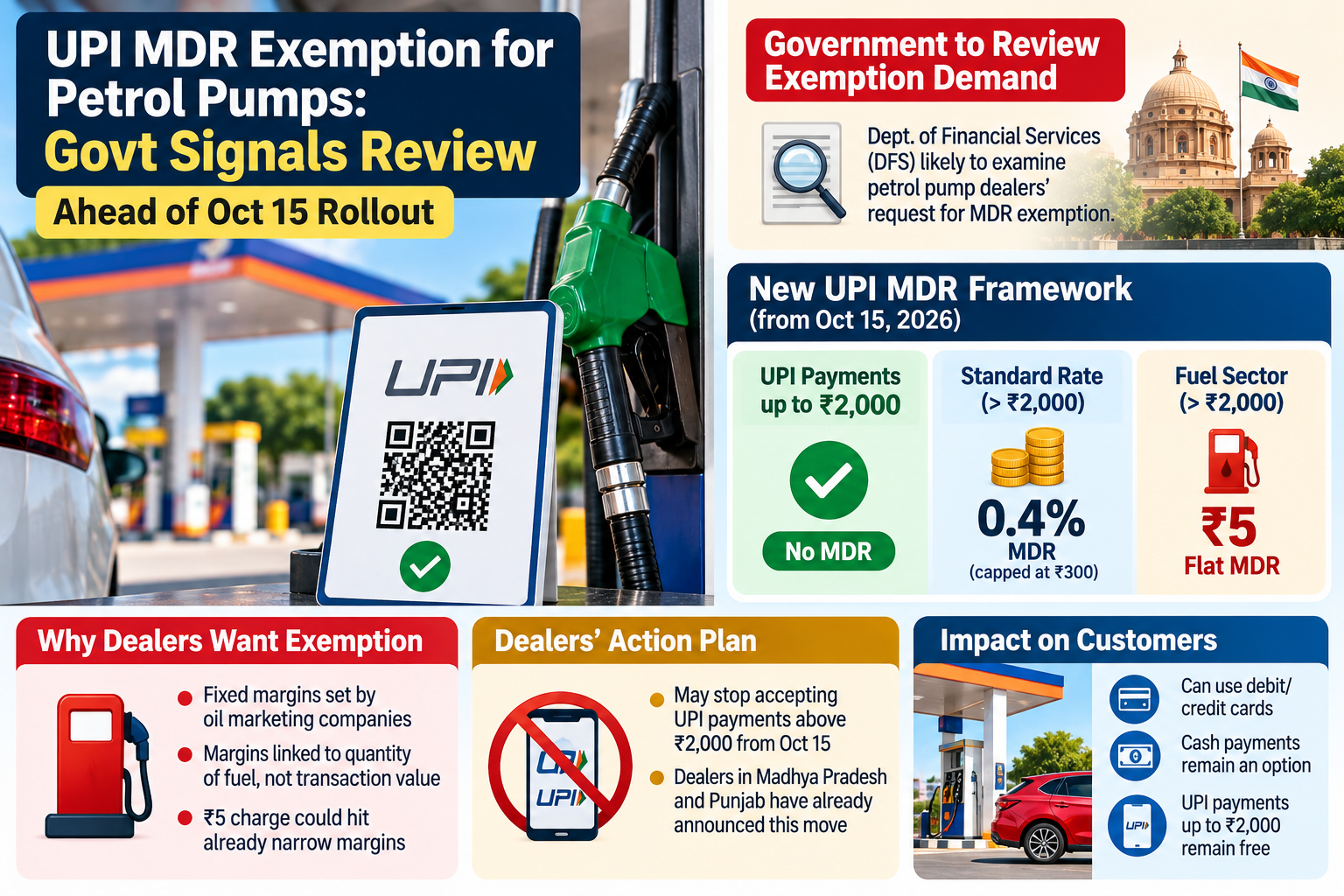
Government may review petrol pump UPI MDR Exemption demand
The Department of Financial Services (DFS) is likely to examine the representation seeking relief for petrol pumps, according to government sources.
One source said the matter is likely to be reviewed, while another said the issue could be discussed at a higher level before any final decision is taken.
However, sources at the higher level said no proposal seeking changes to the announced MDR structure has reached them “as of now.”
The Finance Ministry and Petroleum Ministry have also been approached for comments, but no response has been received so far.
The Core Conflict: Fuel Dealers vs. New Rules
- The Upcoming Rule (Effective Oct 15, 2026): Person-to-merchant (P2M) UPI transactions above ₹2,000 will attract an MDR. While the standard rate is capped at 0.4%, the fuel sector is slated for a flat MDR of ₹5 on qualifying transactions. Transactions of ₹2,000 or less remain entirely free.
- The Dealers’ Argument: The All India Petroleum Dealers Association (AIPDA) wrote to Finance Minister Nirmala Sitharaman, pointing out that petrol pump margins are fixed by Oil Marketing Companies (OMCs) based on the quantity of fuel sold, not the monetary value. Absorbing a flat ₹5 fee per large transaction structurally eats into their narrow, predetermined earnings.
- Threat of Non-Cooperation: Dealers in states like Madhya Pradesh and Punjab have already announced they will stop accepting UPI payments above ₹2,000 starting October 15 if the rule is enforced, forcing customers to switch back to cash or credit/debit cards.
Petrol pump dealers want UPI MDR charges removed
The All India Petroleum Dealers Association (AIPDA) has sought a complete exemption from MDR and related transaction charges for UPI payments above Rs 2,000 at petrol pumps.
In a September 16 letter to Finance Minister Nirmala Sitharaman, AIPDA president Ajay Bansal sought government intervention over the additional payment processing costs.
The association argues that petrol pump dealers operate on fixed margins determined by oil marketing companies.
Since these margins are largely linked to the quantity of fuel sold rather than the transaction value, dealers say they cannot increase earnings simply because customers make larger UPI payments.
Track Live : NSE Option Chain — Live | BSE Option Chain — Live Sensex & Bankex Options Data Today
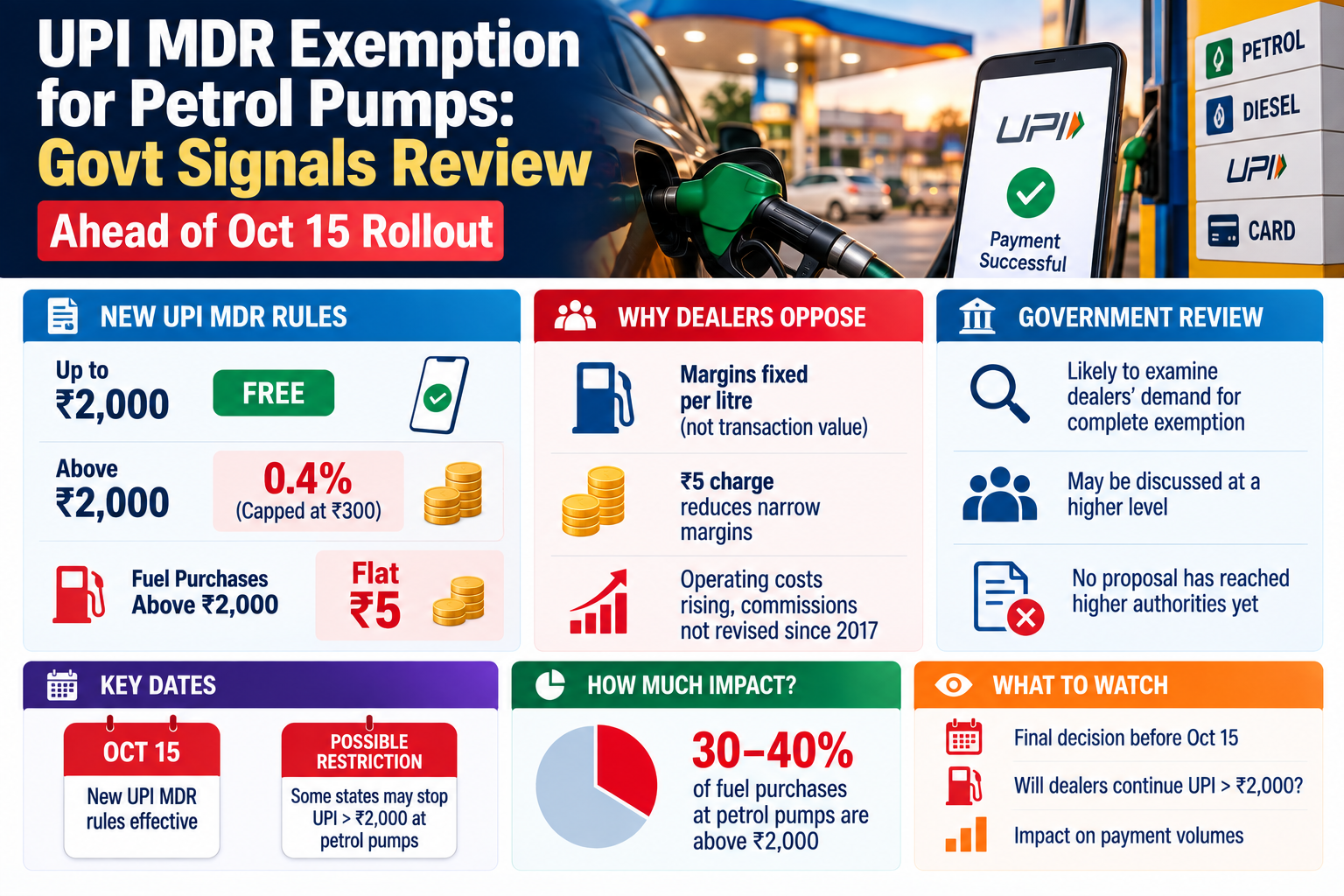
Why petrol pump dealers are opposing the ₹5 charge
The All India Petroleum Dealers Association (AIPDA) has asked for a complete exemption from MDR on UPI payments at petrol pumps, arguing that dealers operate on fixed, per-litre margins rather than margins linked to the transaction value. The association says operating costs have risen while dealer commissions have not been revised since October 2017.
How much business could be affected?
Petroleum dealers have indicated that UPI transactions above ₹2,000 account for around 30–40% of purchases at retail outlets. This makes the proposed ₹5 charge potentially significant when accumulated across a large number of daily transactions.
New UPI MDR framework starts from October 15
Under the proposed framework, eligible person-to-merchant UPI transactions above Rs 2,000 will attract MDR from October 15.
The standard MDR rate has been set at 0.4%. However, specified sectors, including fuel, will face a flat Rs 5 MDR on qualifying transactions.
UPI transactions of up to Rs 2,000 will remain outside the MDR framework.
The proposed changes have triggered concern among fuel retailers because even a fixed charge can directly add to their payment-related costs.
Petrol pump dealers threaten to restrict UPI payments
The MDR issue is already affecting payment plans at fuel outlets in some states.
Petrol pump dealers in Madhya Pradesh and Punjab have said they could stop accepting UPI payments above Rs 2,000 from October 15 if the charges remain unchanged.
Dealers in Madhya Pradesh have indicated that customers would still be able to use cards for larger payments.
The state association has also sought an exemption for fuel retailers.
Read More : Reliance’s Bond Spree: Rs.22,000 Crore Raised in Two Weeks as Rates Stay Favourable
What changes from October 15?
Under the new framework:
- UPI payments up to ₹2,000 remain free.
- Standard P2M transactions above ₹2,000 attract 0.4% MDR, capped at ₹300.
- Fuel purchases above ₹2,000 attract a flat ₹5 MDR.
- The customer does not directly pay the MDR; it is a merchant-side payment ecosystem charge.
- Around 96% of P2M UPI transactions are expected to remain unaffected.
Petrol pumps could restrict large UPI payments
Dealers in Madhya Pradesh and other states have warned that they may stop accepting UPI payments above ₹2,000 from October 15 if the MDR remains. This could push customers towards cards or cash for larger fuel purchases.
Here’s what happened today and why traders reacted
The government review is important because a change in the MDR framework could directly affect petrol pump dealers, payment companies and customers.
For fuel retailers, an exemption would remove a new transaction cost. If the current framework remains unchanged, dealers may increasingly encourage customers to use cards or other payment methods for transactions above Rs 2,000.
For UPI ecosystem participants, the impact will depend on how the final rules are implemented and whether additional sector-specific exemptions are introduced.
What investors and businesses should watch next
The key date is October 15, when the new UPI MDR framework is scheduled to take effect.
Investors should watch for any decision from the Finance Ministry or Petroleum Ministry on the AIPDA representation.
The response from petrol pump dealers will also be important. Any widespread restriction on UPI payments above Rs 2,000 could influence digital payment volumes and customer payment behaviour at fuel outlets.