A new US House bill proposes sharply higher civil monetary penalties for certain serious H-1B violations, including a maximum penalty of $250,000 per violation and a minimum 10-year employer debarment in the most serious category. The proposal is not law, but it adds another compliance risk for employers and Indian IT investors to watch.
The US H-1B programme is facing a fresh escalation in enforcement risk.
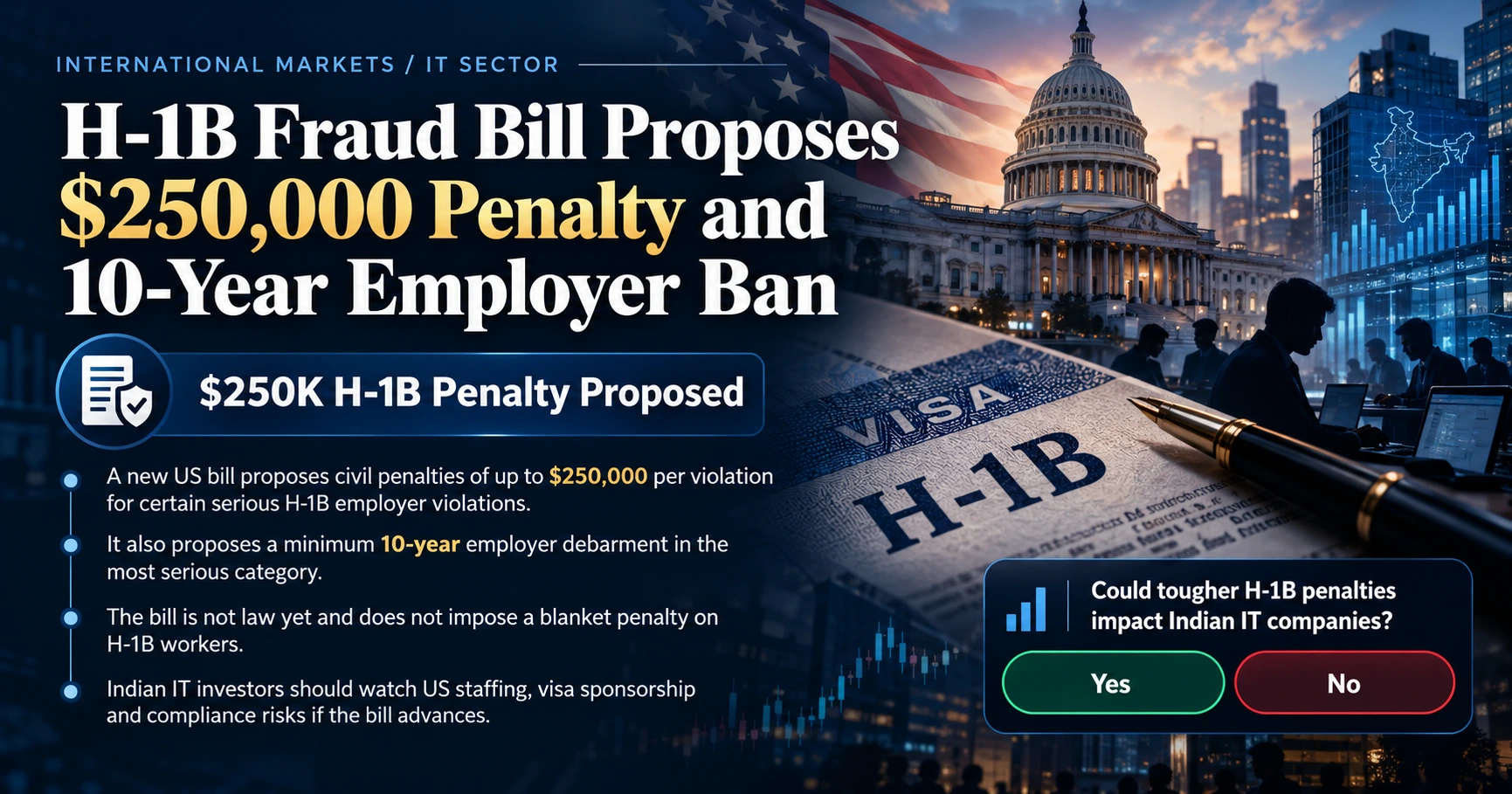
The H-1B Visa Fraud Crackdown Act, H.R. 10643, proposes raising the statutory penalty for the most serious covered H-1B violation from $35,000 to as much as $250,000 per violation.
It would also increase the associated minimum debarment period from three years to 10 years.
But the proposal is significantly narrower than the headline numbers may suggest.
It does not impose a $250,000 charge on every H-1B worker, nor does it create a blanket 10-year immigration ban on Indian professionals.
The proposed penalties concern specified employer violations and certain immigration-document fraud.
H-1B Bill at a Glance
Bill: H.R. 10643, H-1B Visa Fraud Crackdown Act
Introduced: October 1, 2026
Status: Referred to the US House Judiciary Committee
Highest proposed civil monetary penalty: $250,000 per violation
Proposed minimum employer debarment: 10 years for the most serious covered category
Is it law? No
India relevance: Indian-born beneficiaries accounted for 71% of approved H-1B beneficiaries in FY2024.
What Does the New H-1B Bill Propose?
H.R. 10643 was introduced in the US House on October 1, 2026, by Representative Beth Van Duyne and five other Republican lawmakers.
The bill has been referred to the House Judiciary Committee and has not become law.
Its proposed changes include:
| Provision | Current statutory amount/period | Proposed amount/period |
|---|---|---|
| One covered willful H-1B violation | $5,000 | Up to $100,000 |
| Minimum debarment for that category | 2 years | 5 years |
| More serious covered violation | $35,000 | Up to $250,000 per violation |
| Minimum debarment for that category | 3 years | 10 years |
The amounts in the “current” column are the figures written into the underlying statute that H.R. 10643 proposes to amend.
Actual civil monetary penalty amounts can differ because federal agencies periodically adjust penalties for inflation.
The bill also proposes significantly higher statutory penalties for specified immigration-document fraud.
Certain amounts would increase from $250-$2,000 to $1,000-$10,000, while a more serious category would rise from $2,000-$5,000 to $20,000-$50,000.
What Triggers the Proposed $250,000 H-1B Penalty?
This is the most important distinction behind the headline.
The proposed $250,000 maximum civil monetary penalty applies to the serious category covered by Section 212(n)(2)(C)(iii) of the Immigration and Nationality Act.
The provision concerns a Department of Labor finding of a willful failure to meet an applicable H-1B condition or a willful material misrepresentation, in the course of which the employer displaced a US worker.
The displacement must occur within the statutory period beginning 90 days before and ending 90 days after the filing of the relevant visa petition or application.
So the bill does not mean every H-1B compliance violation could suddenly attract a $250,000 penalty.
It proposes much steeper consequences for the specified serious category already covered by federal law.
What the H-1B Bill Does Not Do
In its introduced form, H.R. 10643 does not:
- impose a $250,000 penalty on every H-1B visa holder;
- create a blanket 10-year immigration ban for Indian workers;
- make the standard H-1B filing fee $250,000;
- reduce or increase the statutory number of H-1B visas;
- automatically penalise companies simply for employing H-1B workers.
The immediate market impact is therefore uncertain.
The bigger question is whether the legislation advances and whether tougher enforcement eventually changes employer hiring, sponsorship and workforce deployment.
Also Read: H-1B Fee Extended by Trump for a Year — IT Stocks Under Pressure
What Could the H-1B Bill Mean for Indian IT Stocks?
India’s large exposure to the H-1B programme makes the proposal relevant to the country’s technology sector.
USCIS data show that 283,755 approved H-1B beneficiaries in FY2024 were born in India, representing 71% of approved beneficiaries in the dataset.
China was the next-largest group at 11.7%.
That does not mean Indian IT companies will automatically face the proposed penalties.
For investors, the more important question is whether a tougher US compliance environment gradually affects:
- onsite staffing;
- H-1B sponsorship;
- third-party placements;
- local US hiring;
- offshore delivery;
- labour and compliance costs; and
- the economics of serving US clients.
Companies with higher dependence on US-based sponsored employees or third-party placements could potentially face greater compliance complexity.
Businesses with more flexibility to shift delivery offshore or increase local US hiring may have more options for adapting.
However, the financial impact cannot be quantified today.
H.R. 10643 has not become law, and there is no evidence that Indian IT companies are currently liable for the proposed $250,000 penalties.
Track Live: Nifty IT Analysis — Live Performance, Constituents & What Moves the Index
H-1B Scrutiny Is Expanding Beyond the Bill
The legislation is arriving against a broader backdrop of increased scrutiny of H-1B employers.
The Department of Labor Office of Inspector General announced in July that it had launched a major investigation into H-1B visa fraud and human trafficking, including alleged fraudulent applications and potential abuse involving employers and labour brokers.
The OIG later conducted field checks in Dallas as part of that nationwide investigation, including locations associated with companies that had received hundreds of approved H-1B petitions.
Separately, the US Equal Employment Opportunity Commission filed a lawsuit against Texas-based IT staffing company Sibitalent on September 30.
The EEOC alleged that an American applicant was not referred for a technology position after a recruiter advertised the role as “ONLY H-1B.”
The allegations have not resulted in a final finding of liability, but the case highlights the increased scrutiny surrounding hiring practices linked to visa status.
The Bigger Shift: H-1B Compliance as a Business Risk
The proposed legislation becomes more significant when viewed alongside broader policy developments.
A September 18 executive order directed US agencies to coordinate more closely on H-1B processing and take into account whether an employer directly or indirectly engaged in layoffs within the previous year or plans future layoffs that negatively affect similarly situated US workers.
The order also raised concerns about third-party placement groups and outsourcing firms.
This changes the risk calculation for some employers.
Historically, H-1B debates have often centred on two questions:
How many visas are available?
and
How much does sponsorship cost?
The emerging policy focus adds another:
Could an employer’s workforce, placement or hiring practices trigger greater regulatory scrutiny?
For Indian IT investors, that matters even if there is no immediate earnings impact.
Which Indian IT Business Models Could Face More Pressure?
The impact would not necessarily be uniform across India’s technology sector.
Companies with greater reliance on US-based sponsored staffing, subcontracting or third-party placements may face higher compliance complexity if enforcement becomes tougher.
Companies could potentially respond through:
- greater offshore delivery;
- increased local US recruitment;
- changes in onsite-offshore staffing mix;
- lower dependence on certain visa categories;
- changes in subcontracting arrangements; or
- higher compliance spending.
But these are potential business responses, not confirmed financial consequences of H.R. 10643.
That distinction is important.
Investors should separate policy risk from actual earnings impact.
What Happens Next With H.R. 10643?
For now, the H-1B Visa Fraud Crackdown Act remains at the committee stage.
It would need to advance through the legislative process before becoming law, and its provisions could change substantially along the way.
The proposal would need congressional approval before reaching the president for consideration.
Therefore, the $250,000 figure should be treated as a proposed maximum civil monetary penalty per violation for the specified serious category, not as a new penalty currently in force under H.R. 10643.
For investors, the more useful indicators to monitor if the legislation advances include company commentary on:
- US onsite staffing;
- offshore delivery;
- H-1B sponsorship;
- local US recruitment;
- subcontracting;
- labour costs; and
- client delivery models.
Those indicators would provide better evidence of whether immigration-policy changes are actually affecting Indian IT companies.
Bottom Line for Indian IT Investors
The significance of the new H-1B bill is not that $250,000 has suddenly become a new cost for H-1B workers.
The bigger development is that Washington is proposing dramatically higher civil monetary penalties for specified serious employer violations.
The proposed increase from a $35,000 statutory amount to as much as $250,000 per violation, together with a minimum 10-year employer debarment in the most serious category, would materially raise the consequences for employers found responsible for covered violations.
For Indian IT investors, the forward-looking risk is whether tougher H-1B enforcement ultimately affects the economics of US hiring, onsite staffing, sponsorship and talent deployment.
For now, however, the key point is simple:
H.R. 10643 is a proposal. It is not a new rule currently in force.
Frequently Asked Questions
Does the H-1B bill impose a $250,000 penalty on every H-1B worker?
No.
The $250,000 amount is a proposed maximum civil monetary penalty per violation for the specified serious employer category.
It is not a fee or penalty imposed on every H-1B visa holder.
What triggers the proposed $250,000 penalty?
The provision concerns a willful failure to meet an applicable H-1B condition or willful material misrepresentation in the course of which an employer displaces a US worker during the statutory window beginning 90 days before and ending 90 days after the relevant petition or application filing.
Does the bill create a 10-year ban for Indian H-1B workers?
No.
The proposed 10-year restriction concerns the employer and approval of specified petitions or applications for workers to be employed by that employer.
It is not a blanket 10-year immigration ban on Indian professionals.
Has the H-1B Visa Fraud Crackdown Act become law?
No.
H.R. 10643 was introduced on October 1, 2026 and referred to the House Judiciary Committee.
It would have to advance through the legislative process before becoming law.
Could Indian IT companies be affected?
Potentially, but the impact is currently uncertain.
Companies with greater exposure to US sponsored staffing, onsite deployment or third-party placements could face increased compliance risk if the proposed framework becomes law.
Is the proposed $250,000 H-1B penalty the same as the $100,000 H-1B fee?
No.
They concern separate measures.
NiftyTrader’s earlier coverage discussed a separate H-1B fee issue. H.R. 10643 proposes substantially higher civil monetary penalties for specified employer violations and immigration-document fraud.
Disclaimer: This article discusses proposed US legislation and its potential implications for employers and Indian IT companies. The penalties proposed under H.R. 10643 are not currently in force, and the bill could be amended, fail to advance or not become law. Statutory penalty figures may also differ from inflation-adjusted civil monetary penalties administered by federal agencies. Investors should consider the latest legislative developments, official government information and company disclosures before making investment decisions.