
The RBI has cut the threshold for rupee-linked forex derivative positions without establishing underlying exposure by 95%, restricted rebooking of cancelled contracts and introduced a 20% reserve for specified dollar-buying hedges. The changes come as the rupee remains under pressure despite a repo rate hike, raising questions about hedging costs and currency-market stability.
The Reserve Bank of India (RBI) has tightened rupee-linked foreign exchange derivative rules, reducing the threshold for positions taken without establishing underlying exposure from $100 million to $5 million. The central bank has also restricted the rebooking of covered cancelled contracts and introduced a 20% Foreign Exchange Risk Reserve (FERR) for specified derivative contracts exceeding $2 million equivalent.
The measures, announced through two circulars dated October 10 and effective immediately, change how eligible forex positions can be booked, cancelled and managed. The impact could be particularly relevant for importers purchasing dollars, corporate treasury teams and banks handling currency hedges.
The timing is significant. On October 7, the rupee closed at ₹96.78 per dollar despite the RBI raising the repo rate by 25 basis points to 5.50% and shifting its monetary policy stance to calibrated tightening. Meanwhile, India’s foreign exchange reserves fell to $734.60 billion in the week ended October 2, down approximately $51.11 billion from the September 4 record of $785.71 billion.
The central bank has tightened the rules governing forex derivatives, but whether the changes will ease pressure on the rupee remains uncertain. For businesses, the immediate question is how the new requirements will affect the flexibility and cost of managing currency risk.
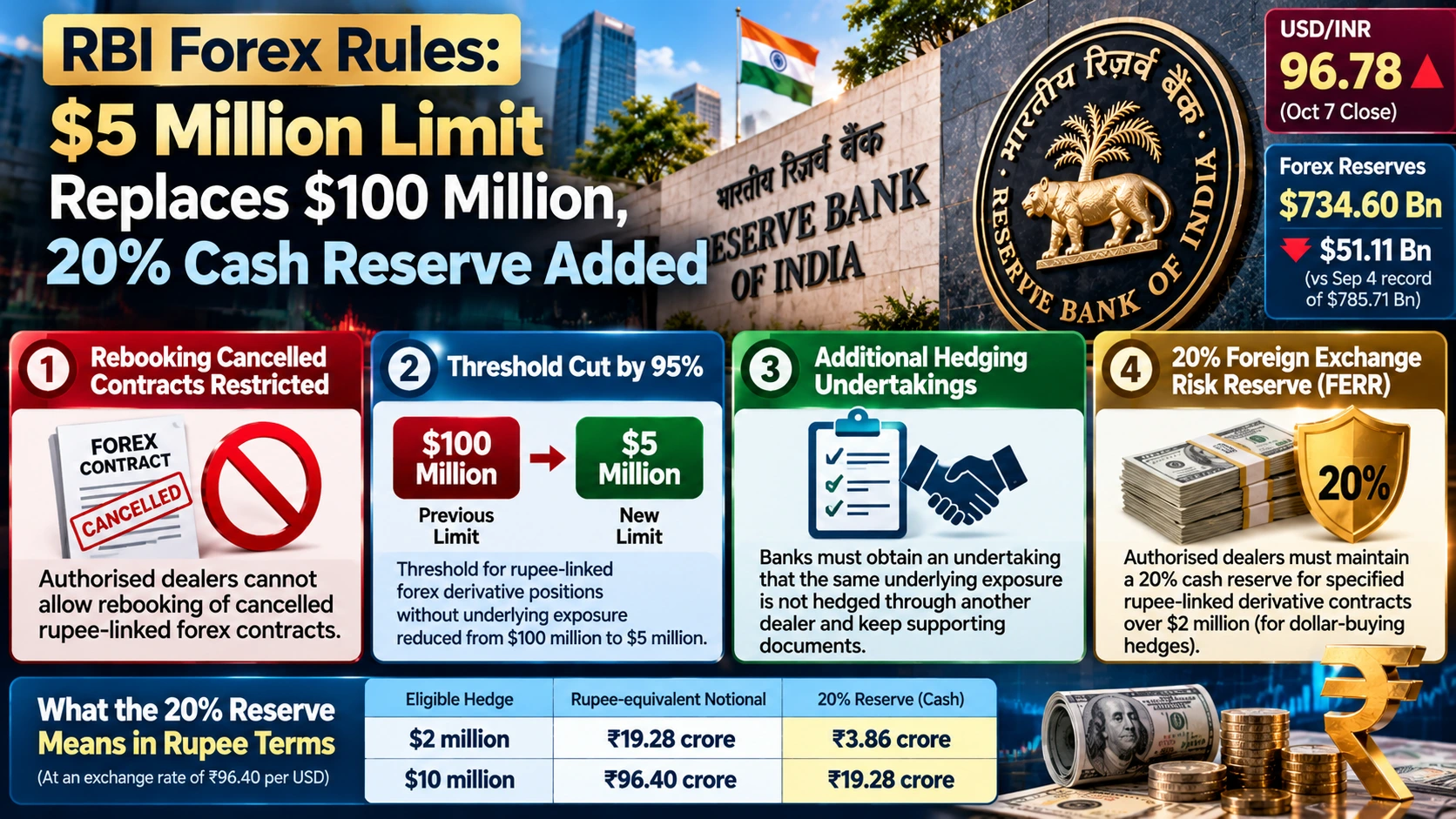
RBI Forex Rules: Four Changes to Know
The two circulars introduce changes covering position thresholds, contract cancellations, hedging documentation and reserve requirements.
1. Rebooking cancelled forex contracts is restricted
Authorised dealers cannot permit users to rebook covered rupee-linked foreign exchange derivative contracts, whether deliverable or non-deliverable, if the contracts were cancelled with an authorised dealer after the directions were issued.
This limits the flexibility to cancel a contract and subsequently replace it through the same or another authorised dealer. Rollovers at maturity remain permitted, subject to the applicable rules.
For businesses managing import payments or export receipts, this makes it more important to assess a hedge before cancelling it rather than assuming a replacement contract can be booked later.
2. The threshold without establishing underlying exposure falls 95%
The relevant threshold has been reduced from $100 million to $5 million equivalent.
The changes also cover positions in exchange-traded currency derivatives across rupee pairs and recognised stock exchanges under the applicable framework.
At an illustrative exchange rate of ₹96.40 per dollar, the two thresholds are equivalent to approximately ₹964 crore and ₹48.20 crore, respectively.
This is a reduction in the threshold for positions taken without establishing underlying exposure, not a blanket ₹48.20 crore cap on all legitimate forex hedging. Transactions supported by genuine underlying exposures must be assessed under the applicable regulatory requirements.
3. Banks must obtain additional hedging undertakings
Authorised dealers must obtain an undertaking from users confirming that the same underlying exposure has not been hedged through another authorised dealer. Where an exposure is hedged in parts, the relevant details must be disclosed in accordance with the applicable directions.
Dealers must also retain supporting documentation for the prescribed period. The two-year retention requirement should be checked against the precise wording of the relevant circular before publication.
The objective is to strengthen oversight of hedging transactions and prevent the same underlying exposure from supporting multiple undisclosed hedges.
4. A 20% Foreign Exchange Risk Reserve is introduced
The separate FERR circular requires authorised dealers to maintain a reserve for specified rupee-linked derivative contracts with a notional value exceeding $2 million equivalent.
The measure applies to contracts undertaken to hedge current-account transactions where the user purchases foreign currency against the rupee. It is not a universal reserve requirement for every forex derivative.
Also Read: FEMA Rules From Oct 1: RBI Keeps Export Deadline at 9 Months
How the RBI’s 20% Forex Cash Reserve Works
Under the FERR framework, the reserve equals 20% of the rupee equivalent of the notional amount of each eligible derivative contract. The reserve must be deposited and maintained in cash in India with the RBI on a daily basis until the contract terminates.
The obligation falls on authorised dealers. They must report the reserve details daily through the RBI’s Centralised Information Management System (CIMS).
The circular also explicitly treats attempts by users to circumvent the reserve requirement through multiple transactions with one or more authorised dealers as violations of the directions.
What does the reserve mean in rupee terms?
The following illustrations use an exchange rate of ₹96.40 per US dollar. They are calculations, not live transaction quotes.
| Eligible hedge | Rupee-equivalent notional | 20% reserve |
|---|---|---|
| $2 million | ₹19.28 crore | ₹3.86 crore |
| $10 million | ₹96.40 crore | ₹19.28 crore |
The FERR trigger is for contracts exceeding $2 million equivalent, so the first row illustrates the calculation at the threshold; a contract above that amount would produce a correspondingly higher reserve.
The reserve is maintained by the bank with the RBI. It should not automatically be described as a cash deposit that the customer must pay directly to the central bank.
However, maintaining the reserve may affect banks’ funding and transaction economics. Whether those costs are passed on to customers through hedge pricing and to what extent remains an open question.
Why Has the RBI Tightened Forex Derivative Rules Now?
The circular cites the need to ensure the orderly functioning of the foreign exchange market and refers to evolving market conditions. The broader market backdrop helps explain why the measures matter, although it should not be presented as the RBI’s explicitly stated rationale beyond what the circular says.
On October 7, the rupee closed at ₹96.78 per dollar, compared with the previous close of ₹96.43, after touching ₹96.83 during the session. The decline came even as the RBI raised its repo rate to 5.50% and shifted to a calibrated tightening stance.
The currency remains exposed to external pressures, including elevated crude oil prices, global dollar strength, higher US Treasury yields and foreign portfolio outflows.
India’s forex reserves also declined to $734.60 billion in the week ended October 2. That was approximately $51.11 billion below the record of $785.71 billion reached in the week ended September 4.
The reserve decline reflects more than one factor, including changes in foreign currency assets and gold reserves, as well as the effects of foreign exchange operations. It should not be interpreted as a direct measure of the RBI’s dollar sales alone.
The combination of a weaker rupee and falling reserves makes the latest regulatory changes important to watch. Still, tighter derivatives rules cannot, by themselves, remove the underlying demand for dollars.
Who Is Most Directly Affected?
Importers and dollar buyers: Businesses hedging eligible dollar payments under current-account transactions are the most directly exposed to the FERR requirement. The reserve is maintained by their authorised dealers, but the commercial implications may influence hedge pricing.
Exporters: Companies managing foreign currency receipts must review how the cancellation restrictions and revised position framework apply to their particular contracts and exposures.
Corporate treasury teams: The inability to freely rebook covered cancelled contracts makes advance planning and coordination across banking relationships more important.
Banks and authorised dealers: Banks must apply the revised rules, obtain the required undertakings, maintain the prescribed reserve for eligible contracts and meet the associated reporting requirements.
Currency derivatives participants: Participants using exchange-traded currency derivatives must reassess how the revised threshold applies to positions without establishing underlying exposure. The change should not be confused with a general prohibition on legitimate currency hedging.
What to Watch in the Currency Market Next
The first trading session after the October 10 announcement is Monday, October 12. It will provide an early opportunity to assess market reactions, but one session will not establish whether the measures have stabilised the rupee.
Three indicators deserve attention.
1. Dollar-hedging costs: Banks’ pricing of eligible hedges will help indicate whether the reserve requirement creates an additional cost for customers.
2. Currency-derivatives activity: Changes in exchange-traded and other covered derivative activity may indicate how participants are adjusting to the lower threshold and tighter cancellation rules.
3. The next forex-reserves release: The RBI’s weekly data will help track whether reserves continue to decline. However, movements in reserves can reflect several factors and should be interpreted alongside currency-market conditions.
The key uncertainty is whether tighter controls will meaningfully reduce destabilising activity without making genuine hedging more expensive or less flexible for businesses.
For now, the RBI has changed the rules governing how covered rupee-linked derivative positions can be maintained and managed. Whether that translates into a more stable rupee will depend on market demand for dollars, external conditions, and how banks and customers adapt to the new framework.
Read Next: ANAND RATHI WEALTH Q2 FY27 RESULTS: RECORD INFLOWS, BUT REPORTED PROFIT DIPS
Disclaimer: This article is for informational purposes only and is not investment, trading or hedging advice. The application of RBI directions depends on the transaction and the applicable regulatory conditions. Consult an authorised dealer for transaction-specific guidance.