EU Budget 2028-2034: Germany, France and Farmers Clash Over Who Gets Cut
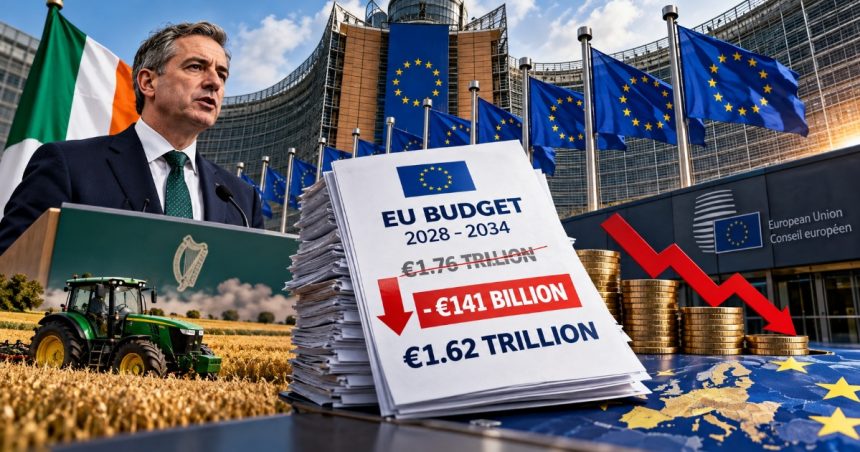
The European Union’s next seven-year budget is facing a major shake-up, with Ireland proposing a €141 billion reduction that could reshape funding for farmers, regional development, international aid and economic competitiveness.
The proposal would bring the EU budget for 2028–2034 down to approximately €1.62 trillion, compared with the European Commission’s original plan of €1.76 trillion at 2025 prices. The proposed reduction comes as member states remain divided over how much the bloc should spend and which priorities deserve protection.
For farmers, businesses and investors, the outcome could influence agricultural support, infrastructure investment, industrial competitiveness and Europe’s broader economic outlook.
Track Live : FII DII Data Today | NSE F&O Lot Size
EU budget cuts would affect international aid and competitiveness most
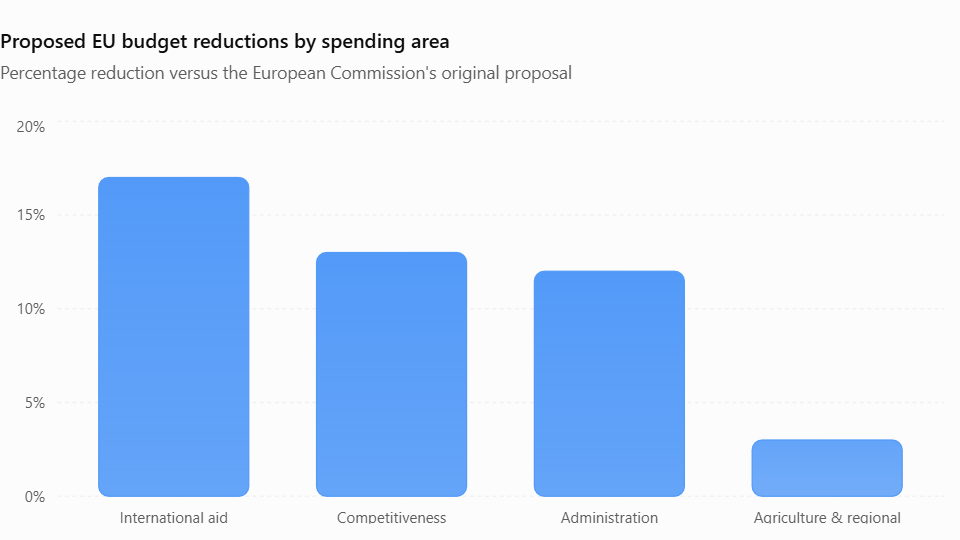
Ireland’s proposal distributes spending reductions unevenly across the EU’s main policy areas.
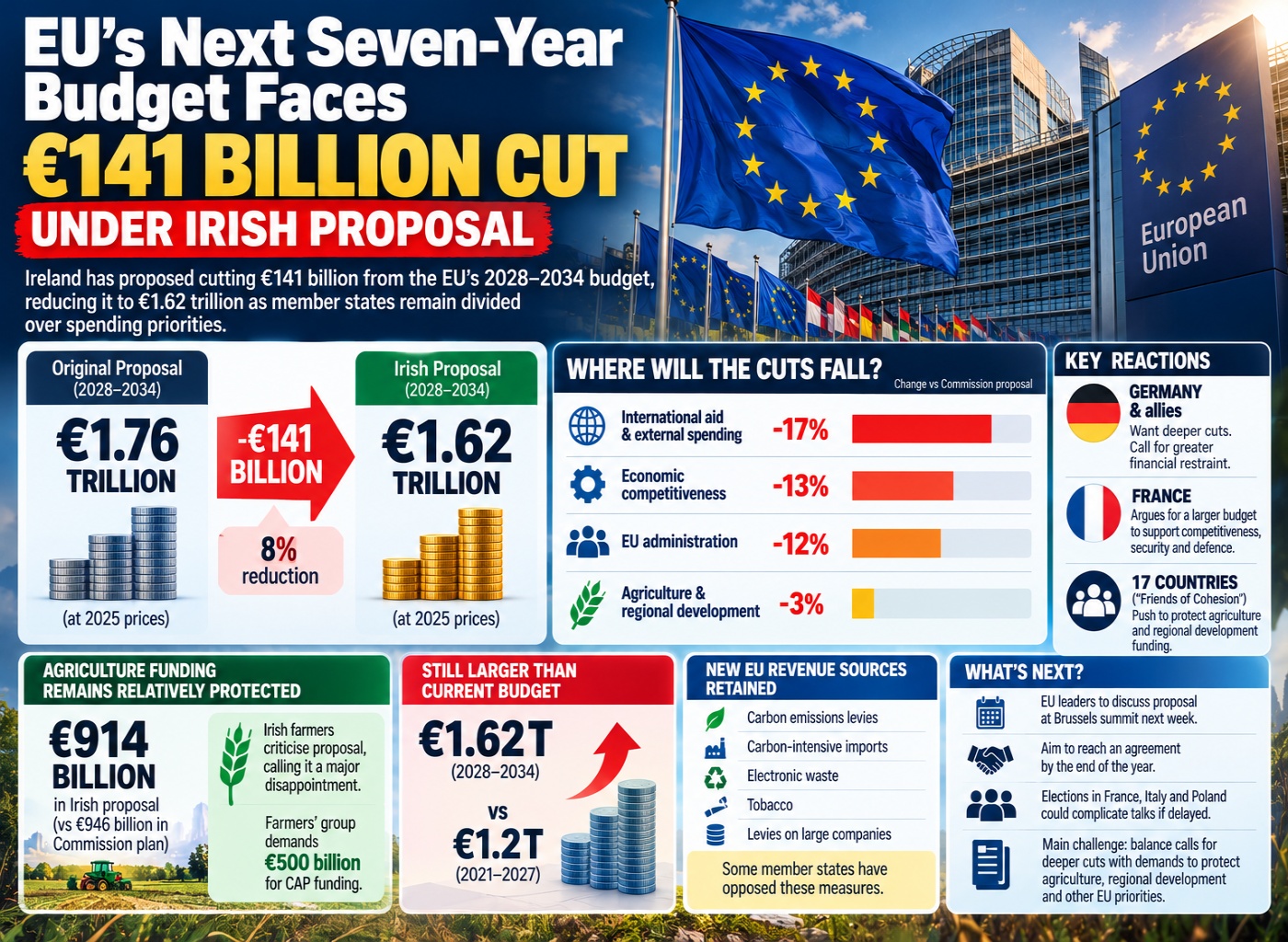
International aid and related external spending would face cuts of approximately 17%, while funding intended to strengthen economic competitiveness would fall by around 13%. EU administrative spending would be reduced by approximately 12%.
Agriculture and regional development would receive comparatively greater protection, with their combined funding reduced by around 3%.
The draft retains approximately €914 billion for agriculture and regional development, compared with €946 billion under the European Commission’s original proposal.
These allocations remain provisional and could change during negotiations.
EU Proposes €141 Billion Cut to Next Seven-Year Budget
-
Budget reduction: Ireland proposes cutting €141 billion from the EU’s 2028–2034 budget, bringing it to €1.62 trillion—an 8% reduction.
-
Biggest cuts: International cooperation and aid face a 17% reduction, while competitiveness, research and defence funding would be cut by around 13%.
-
Agriculture protected: Farm and regional development funding would be reduced by just 3%, to €914 billion, despite farmers’ concerns.
-
Political divisions: Germany and other fiscally conservative countries want deeper cuts, while France and other EU members seek stronger investment.
-
Next steps: EU leaders will discuss the proposal at the Brussels summit on October 15–16, 2026, with negotiations continuing toward a year-end agreement.
Germany demands deeper cuts while France pushes for investment
Germany is leading a group that includes Austria, Denmark, Finland, the Netherlands and Sweden in seeking reductions of several hundred billion euros from the Commission’s original proposal.
These governments argue that greater spending discipline is necessary as national budgets face competing demands.
France, by contrast, has called for an ambitious EU budget capable of supporting economic competitiveness, security and defence. French President Emmanuel Macron has argued for sufficient European resources to address these challenges.
Meanwhile, the Friends of Cohesion, a group of 17 southern, central and eastern European countries, wants agriculture and regional development funding protected.
An EU diplomat cited in a Politico report criticised the Irish proposal as insufficient, arguing that the spending level remained unaffordable and did not adequately prepare the bloc for future challenges.
Track Live : NSE Option Chain — Live | BSE Option Chain — Live Sensex & Bankex Options Data Today
Deepening Divisions Over the EU’s Next Budget
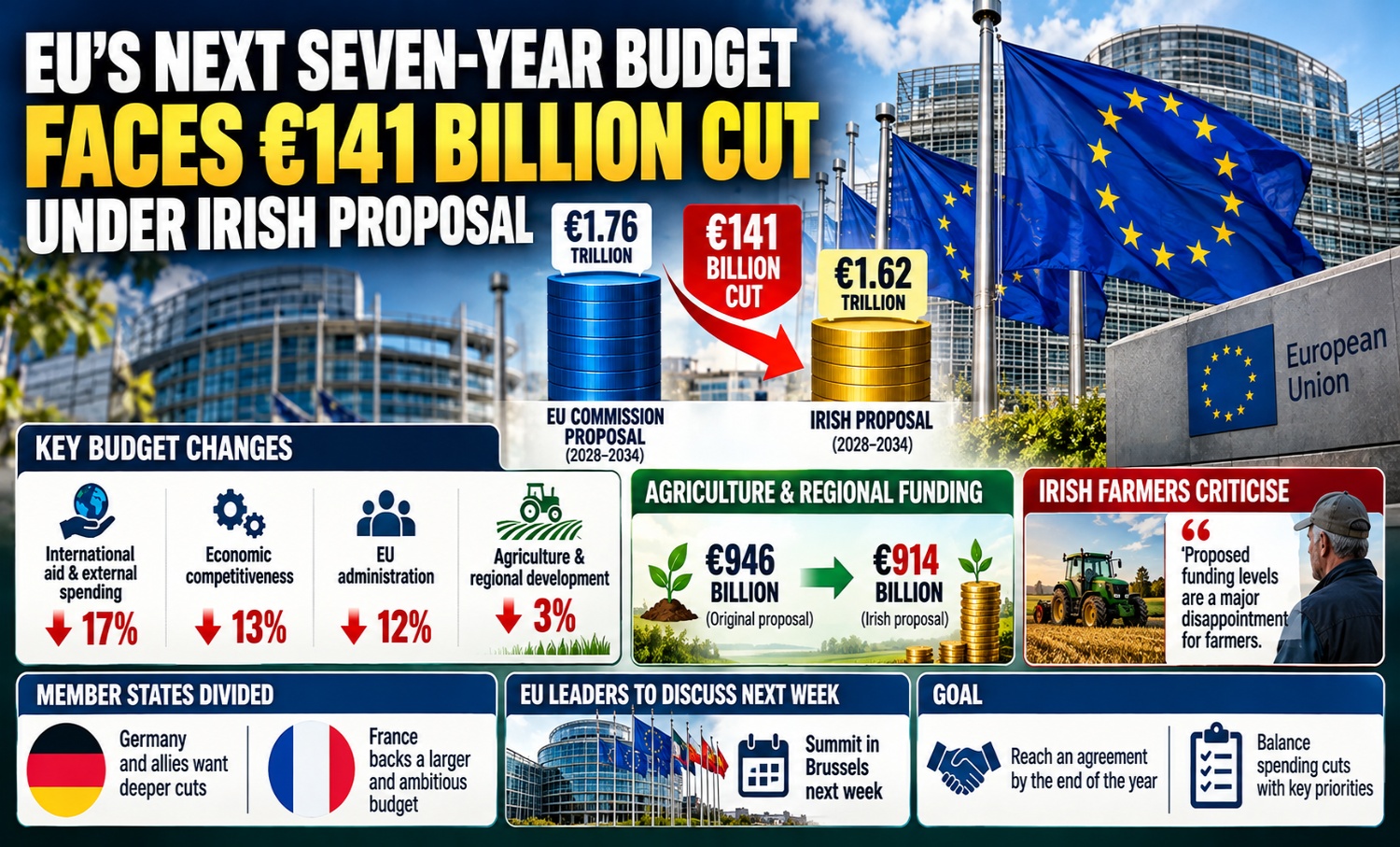
– Germany-led coalition: Germany, Austria, Denmark, Finland, the Netherlands and Sweden are demanding cuts of several hundred billion euros, arguing that the proposed budget remains too expensive.
– France’s investment push: President Emmanuel Macron supports a more ambitious EU budget to strengthen defence, security, technology and economic competitiveness.
– Friends of Cohesion: Seventeen southern, central and eastern European countries want agriculture and regional development funding protected from further reductions.
– Ireland’s compromise: The proposed €141 billion reduction aims to bridge these competing demands, but some governments and EU lawmakers argue that the revised budget still does not meet their expectations.
Irish farmers warn that agricultural funding remains inadequate
The Irish Farmers’ Association (IFA) has described the proposed budget as a major disappointment for the farming sector.
IFA President Francie Gorman said the draft had not improved on the European Commission’s earlier plans for the Common Agricultural Policy (CAP).
According to the IFA, the Commission’s original proposal would cut the CAP budget by 22%, potentially reducing payments to Irish farmers by 24%.
The association argues that €293 billion allocated to the CAP would be insufficient. Gorman has called for €500 billion to strengthen farm resilience, attract younger farmers, improve sustainability and protect food security.
The €500 billion figure represents the IFA’s funding demand, not an agreed EU allocation.
Backlash from the Agricultural Sector
– IFA criticism: The Irish Farmers’ Association (IFA) called Ireland’s proposed EU budget a “huge let-down” for farmers.
– CAP funding: The draft allocates €293 billion to the Common Agricultural Policy (CAP), leaving agriculture funding below the previous budget cycle’s level.
– Potential payment cuts: The IFA warns that the European Commission’s original proposal could reduce Ireland’s CAP allocation by 22% and farmers’ payments by up to 24%.
– €500 billion demand: IFA President Francie Gorman says farmers need a €500 billion CAP budget to strengthen farm resilience, food security, sustainability and opportunities for young farmers.
– What happens next: EU budget negotiations will determine the final allocation. The Irish proposal remains a draft and has not been adopted as the final budget.
New EU revenue proposals could influence businesses and investors
The negotiations also cover potential EU-wide revenue sources, including levies linked to carbon emissions, carbon-intensive imports, electronic waste, tobacco and large companies.
Ireland has retained these measures in its draft, although several proposals face opposition from member states.
For investors, the final budget could influence agricultural businesses, regional infrastructure projects, clean technology, industrial competitiveness and companies exposed to potential new levies. However, the actual effects will depend on the final allocations and whether the proposed revenue measures are approved.
Read More : Wall Street Near Record Highs, but Most Companies Are Quietly Losing Ground
Here’s what happened today and why EU leaders are debating budget cuts
Ireland, which holds the EU’s rotating presidency, has presented the revised budget proposal as an attempt to bridge differences between countries demanding lower spending and those seeking to preserve funding for traditional programmes.
The proposed €141 billion cut represents an approximately 8% reduction from the Commission’s original plan. However, the revised budget would still be considerably larger than the EU’s current 2021–2027 budget of around €1.2 trillion.
EU leaders are expected to discuss the proposal at a summit in Brussels next week, with governments aiming to reach an agreement by the end of the year.
The central question is whether the compromise can satisfy countries seeking fiscal restraint without weakening funding for agriculture, regional development and emerging strategic priorities.
EU leaders face a year-end deadline to reach a budget agreement
The Irish proposal is a negotiating framework, not a final settlement. EU leaders must reconcile demands for deeper spending cuts with calls for greater investment in economic resilience, security and regional development.
A delayed agreement could become more difficult as elections in France, Italy and Poland approach, potentially complicating negotiations.
The Brussels summit will therefore be an important step towards determining the EU’s financial priorities for 2028–2034. Until member states reach a compromise, uncertainty will remain over agricultural support, regional funding, international aid and Europe’s long-term investment plans.