Reliance Industries touched a 52-week low on Monday, but YES Securities says higher Venezuelan crude intake combined with fuller Jamnagar optimisation could add ₹8,400–12,600 crore to annualised oil-to-chemicals (O2C) EBITDA. It is a brokerage scenario, not company guidance.
Need to Know
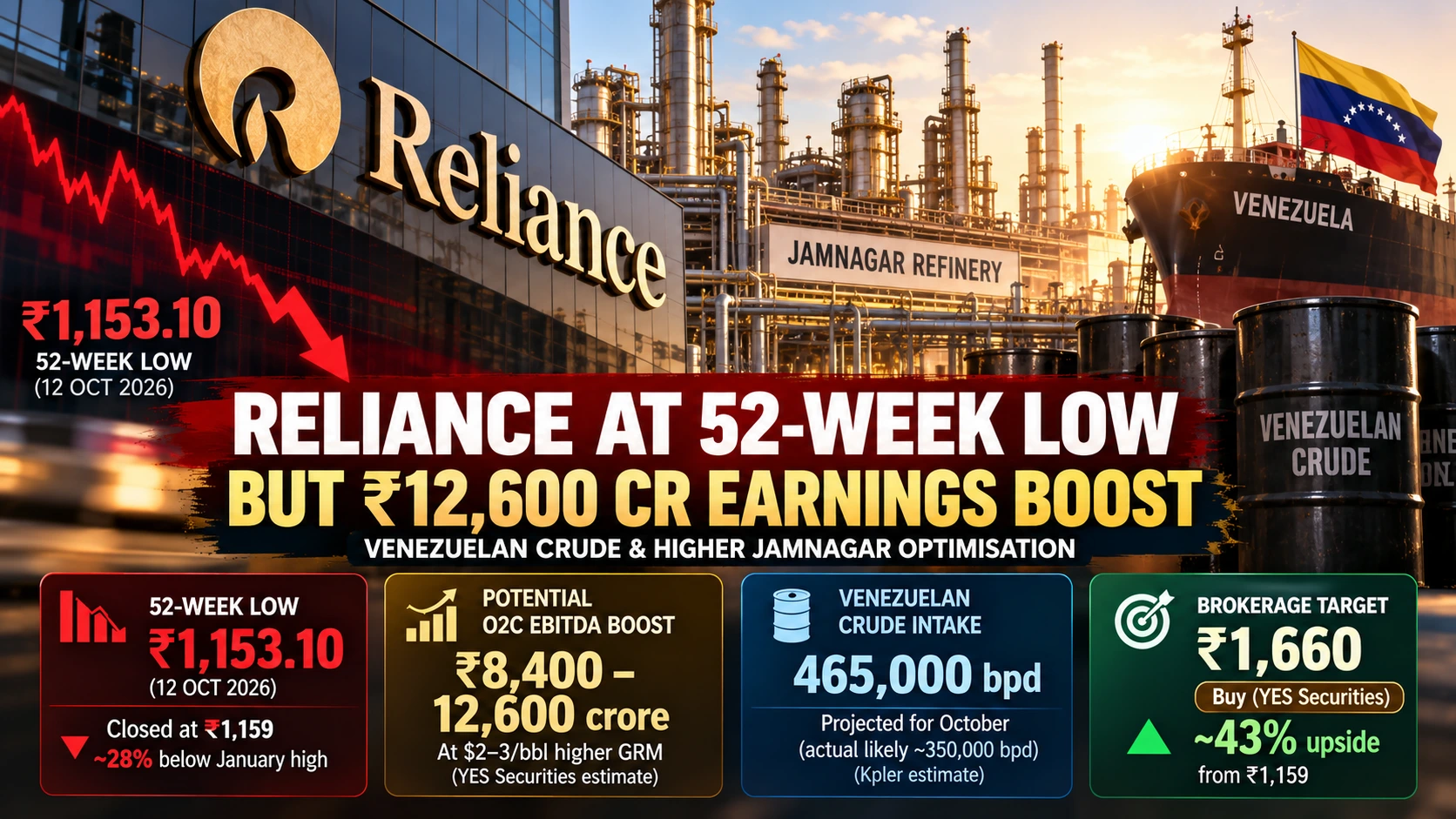
- Stock: Reliance touched an intraday 52-week low of ₹1,153.10 on October 12 and settled at ₹1,159, about 28% below its January high of ₹1,611.20.
- Upside estimate: YES Securities sees ₹4,200 crore of annual EBITDA per $1/bbl of blended GRM improvement, so ₹8,400–12,600 crore at $2–3/bbl.
- Supply: Kpler projected Venezuelan crude deliveries to India at about 465,000 bpd in October if scheduled cargoes arrive on time but expects the actual average to be nearer 350,000 bpd.
- Target: YES Securities has a Buy rating and a ₹1,660 target, about 43% above its ₹1,159 reference price. It is not a guaranteed return.
- Catch: the figure is annualised O2C EBITDA, not net profit.
Track Live: Reliance Option Chain Live – RIL Options Data
A Weak Stock Meets a Bullish Earnings Scenario
Reliance shares touched a 52-week low on Monday, about 28% below the January peak. Yet YES Securities argues that Venezuelan crude and fuller Jamnagar optimisation could add up to ₹12,600 crore a year to O2C EBITDA. The gap between a weak share price and a bullish earnings scenario is what makes the next few quarters worth watching.
How YES Securities Reaches ₹8,400–12,600 Crore
YES Securities builds on Reliance’s annual crude throughput of about 70 million tonnes. On that base, every $1/bbl rise in blended gross refining margin (GRM) is worth about ₹4,200 crore of annual EBITDA. The brokerage attributes the expected $2–3/bbl lift to higher Venezuelan intake combined with fuller optimisation of Jamnagar, not to the crude purchase alone.
- $1/bbl: ₹4,200 crore
- $2/bbl: ₹8,400 crore
- $3/bbl: ₹12,600 crore
These are annualised O2C estimates. EBITDA is earnings before interest, tax, depreciation and amortisation, so the figure does not translate one-for-one into consolidated profit. YES Securities also models a sustainable GRM premium of about $3/bbl over domestic PSU refiners as Venezuelan supply recovers and discounts on Russian Urals narrow.
Venezuelan Barrels Are Arriving Faster
Reliance stopped buying Venezuelan oil in early 2025 amid US sanctions. Reuters reported in March 2025 that the halt followed Washington’s 25% tariff on buyers of Venezuelan crude. On February 13, 2026, Reuters reported that Reliance had received a US general licence to buy Venezuelan oil directly. It had already bought 2 million barrels through trader Vitol earlier that month.
Volumes are rebounding. Kpler projected Venezuelan crude deliveries to India at about 465,000 bpd in October, up from 196,000 bpd in September. If all scheduled cargoes arrive on time, that would be the highest since December 2019. But Kpler senior manager Sumit Ritolia expects the actual October average to be nearer 350,000 bpd, as some vessels may not discharge before month-end.
The figures cover India overall, not Reliance alone. All Venezuelan cargoes then headed to India, listed as Sikka, which serves Jamnagar. These are shipment-tracking estimates, not company disclosures.
Why Jamnagar Can Use Heavy Crude Others Cannot
Venezuelan Merey is a heavy, sulphur-rich crude that can trade at a discount to benchmark oil. Jefferies noted in January that it historically sold at a $5–8/bbl discount to Brent. But the headline discount is not the final advantage. Freight, handling, processing needs and the price of alternative grades all matter. Jamnagar’s roughly 1.4 million bpd configuration lets Reliance process such feedstock, but the benefit depends on the delivered price and the value of the products recovered.
A Global Diesel Squeeze Adds a Second Tailwind
Reuters reported on October 6, citing Vortexa data, that Gulf crude and condensate exports had recovered to 91% of pre-war levels. Refined-fuel exports, including LPG, remained at 60%. That gap has deepened diesel and jet fuel shortages.
Jefferies, as reported by Business Standard, says about 4% of global refinery throughput has been lost to conflicts, leaving diesel and gasoline inventories at five-year lows. This is a sector-wide tailwind, not proof that Reliance will capture the full benefit. As product supply recovers, fuel margins could also narrow.
Why the Gap Between Target and Price Matters
YES Securities’ ₹1,660 target, set against a ₹1,159 reference price, implies about 43% upside. It is a dated brokerage view, not a guaranteed return. Reliance’s share-price weakness contrasts with that optimistic scenario.
The decline alone does not show whether investors have discounted the benefit or are focused on other concerns. The key test is whether improved feedstock economics lift reported GRM and O2C EBITDA.
What Could Shrink the Gain
- Licence risk: purchases depend on US authorisation staying in place.
- Narrower discounts: higher freight or a firmer Merey price can erode the advantage.
- Operational limits: lower utilisation or weaker product yields would cut the benefit.
- Margin squeeze: if crude costs rise faster than fuel prices, or the fuel supply recovers and margins narrow, GRM could disappoint.
Five Numbers to Watch Next
- Venezuelan crude volumes into Sikka
- Delivered discount after freight and handling
- Reported GRM in upcoming quarterly results
- O2C EBITDA growth
- Jamnagar utilisation and product yields
If these indicators move together, the scenario becomes more credible. Reported quarterly results will decide how much of the estimated benefit is realised.
Read Next: Banks Ask RBI to Replace 20% Forex Hedge Deposit as Rupee Jumps 1%
FAQs
How much extra EBITDA could Venezuelan crude add for Reliance?
YES Securities estimates ₹8,400–12,600 crore of additional annualised O2C EBITDA if blended GRM improves by $2–3/bbl. It is conditional, not guaranteed.
Why is Jamnagar suited to Venezuelan crude?
Its complex configuration can process heavy, sulphur-rich crude and convert it into higher-value products.
Does Reliance have US permission to buy Venezuelan oil?
Reuters reported on February 13, 2026, that Reliance received a US general licence for direct purchases.
Will net profit rise by ₹12,600 crore?
No. The estimate covers O2C EBITDA only, before interest, tax and depreciation.
What is the biggest risk?
Licence changes, narrower crude discounts, weaker refinery performance or compressed fuel margins could each reduce the gain.
Disclaimer: This article is for information only and is not investment advice. Brokerage targets are opinions and may not materialise. Consult a SEBI-registered adviser before investing.