
BSE Share Price Up as SEBI panel backs existing expiry pricing method
BSE shares climbed nearly 3% on October 15 after reports suggested that a key Securities and Exchange Board of India (SEBI) advisory panel favoured retaining the existing derivatives settlement methodology.
The development has drawn traders’ attention as market participants continue to debate sharp index movements on futures and options (F&O) expiry days.
At 2:08 pm, BSE shares were trading 2.8% higher at Rs 3,430 apiece. NSE shares gained 0.6% to Rs 1,773.
The gains followed a Moneycontrol report stating that SEBI’s Secondary Market Advisory Committee (SMAC) favoured retaining the volume-weighted average price (VWAP) method instead of immediately introducing a blended formula incorporating closing auction session (CAS) prices.
Track Live : Nifty Levels Today | Sensex Levels Today
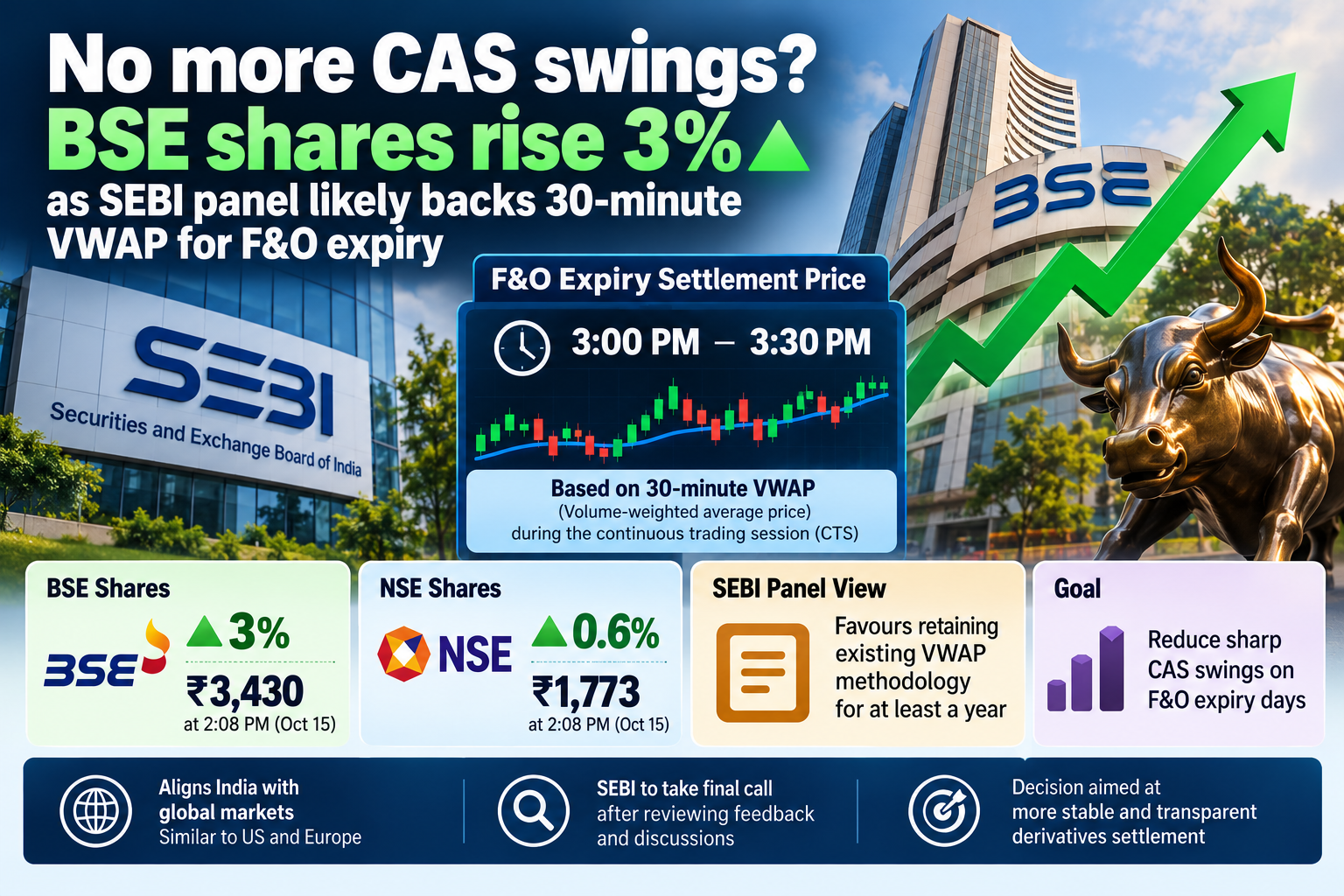
BSE Share Price Up : SEBI panel reportedly favours the 30-minute VWAP method
Under Option 2 of SEBI’s September 12 consultation paper, derivatives settlement prices would be calculated using the VWAP of trades executed between 3 pm and 3:30 pm during the continuous trading session.
Sources cited in the report said the panel favoured retaining this arrangement for at least one year before considering a change.
The recommendation comes amid concerns about sharp index swings on F&O expiry days. Market participants have argued that reviewing the CAS mechanism could help address these fluctuations.
However, the recommendation is not yet a final regulatory decision. SEBI is expected to take a final call after considering feedback and discussions at Thursday’s meeting.
Factors supporting a BSE rally
-
SEBI panel backs 30-minute VWAP: The panel reportedly favours retaining the existing method for at least one year, delaying a shift to a formula incorporating closing auction session (CAS) prices.
-
BSE shares jump: BSE gained nearly 3% on October 15, trading at ₹3,430 at 2:08 pm, following the report.
-
Reduced expiry-day volatility: Retaining VWAP could help address sharp derivatives price swings associated with the closing auction mechanism.
-
Final decision pending: SEBI is expected to consider the committee’s recommendations before finalising the framework.
Why the VWAP method matters for F&O expiry trading
VWAP measures the average traded price over a specified period, weighted by trading volume. Under the existing approach described in the report, the final 30-minute trading window determines the derivatives settlement price.
The alternative proposal would incorporate closing auction session prices into a blended formula. Traders have debated whether this change could affect expiry-day price movements and settlement calculations.
Retaining VWAP for an interim period could provide continuity while the regulator assesses whether another methodology is necessary.
Track Live : NSE Option Chain — Live | BSE Option Chain — Live Sensex & Bankex Options Data Today
What the reported recommendation means for BSE and NSE investors
The market reaction suggests investors welcomed the possibility of continuity in derivatives settlement rules. BSE shares outperformed NSE shares during the cited afternoon trading session.
However, one day’s gains do not establish a lasting trend. The impact on exchange stocks will depend on SEBI’s final decision, trading activity, regulatory developments and broader market conditions.
Investors should not assume that retaining VWAP alone will guarantee higher profits or sustained share-price gains.
What has the SEBI panel recommended?
-
Retain the existing settlement method: Use the volume-weighted average price of trades executed between 3 pm and 3:30 pm.
-
Defer the blended formula: Consider incorporating closing auction session (CAS) prices after at least a year.
-
Continue CAS for eligible stocks: The proposal concerns derivatives settlement methodology, not necessarily scrapping the closing auction itself.
Read More : Jio IPO Has Reliance Shares Rising 3%: Will the Rally Last Till the October 28 Listing?

Proposed changes to market timings
According to Moneycontrol, the panel has also favoured the following schedule changes.
| Market activity | Proposed timing |
|---|---|
| Continuous trading in CAS stocks | Until 3:30 pm |
| Closing auction session | 3:31–3:40 pm |
| F&O trading | Until 3:45 pm |
The proposed schedule would allow derivatives trading to continue for five minutes after the closing auction ends.
Why is SEBI reviewing CAS?
CAS was introduced on August 3, 2026, to improve closing-price discovery. However, market participants subsequently raised concerns about sharp price swings, lower liquidity and uncertainty around derivatives settlement on expiry days. SEBI received more than 20,000 comments on its consultation paper.
Which stocks could benefit?
Reported market moves on October 15, 2026
| Stock | Reported price | Gain |
|---|---|---|
| BSE | ₹3,445 | Over 3% |
| Groww | ₹200 | Over 3% |
| Angel One | ₹315 | Over 3% |
| Motilal Oswal Financial Services | ₹1,065.65 | 2.5% |
| NSE | ₹1,768 | 0.3% |
These figures were reported around 2:30 pm and are not live prices.
Here’s what happened today and why traders reacted
The immediate trigger for the rise in BSE shares was the report suggesting that SEBI may retain the existing 30-minute VWAP mechanism.
The possibility of avoiding an immediate change in settlement rules appears to have supported sentiment towards exchange stocks.
Expiry-day pricing matters because it can influence hedging decisions, trading strategies and intraday volatility. A change in the calculation method could also require traders to adjust their positions and risk-management approaches.
For BSE investors, the reported recommendation provided a potential short-term sentiment boost. However, its long-term impact on the exchange’s earnings remains uncertain.
What investors should watch after SEBI’s meeting
SEBI’s final decision will be the next important development. Traders should watch whether the regulator confirms the existing 30-minute VWAP approach, specifies an interim period or proposes further changes.
For now, the reported recommendation has lifted sentiment around BSE shares. Whether the rally continues will depend on the final regulatory outcome and its implications for F&O expiry trading and market volatility.