
Jio’s Profit Engine: How It Grew EBITDA 17.8% in 3 Years, Per Akash Ambani
Jio Platforms has reported an EBITDA of Rs 76,000 crore, with growth of 17.8% over three years, as the company prepares for its proposed initial public offering (IPO). Managing Director Akash Ambani outlined the company’s plans to expand affordable digital services and strengthen its role in India’s digital economy on Thursday.
Speaking at a press conference ahead of the IPO, Ambani said Jio aims to connect every Indian household, citizen and enterprise through affordable digital services.
“The mission of Jio is simple: to connect every Indian home, every Indian citizen, and every Indian enterprise with the highest quantity and most affordable digital services,” he said.
The financial performance and expansion strategy are likely to draw investor attention as Jio Platforms prepares to enter the public markets.
Track Live : Nifty Levels Today | Sensex Levels Today
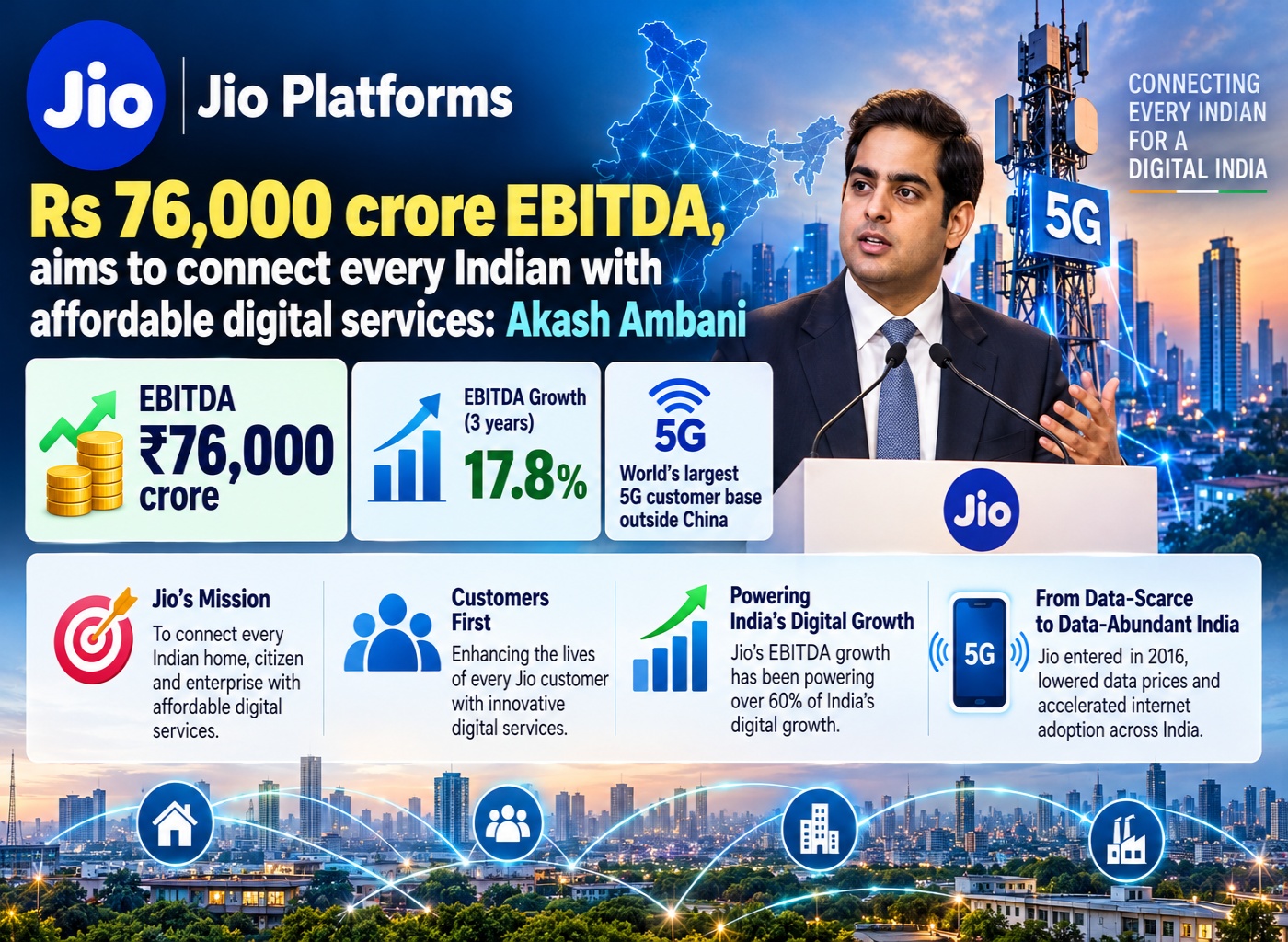
Jio’s Profit Engine: Akash Ambani highlights Jio’s role in India’s digital transformation
Ambani said Jio Platforms’ vision aligns with the government’s Digital India and Make in India initiatives, alongside the broader ambition of building a Viksit Bharat by 2047.
He described the company as a potential partner in India’s transition towards a digitally empowered society.
“To do that, we see a goal of enabling India as a premier digital society. And us, as Jio Platforms Limited, as an able partner to enable them,” he said.
The company also plans to expand its portfolio beyond connectivity, using its existing digital infrastructure to offer products and services that address customers’ changing needs.
Key Operational & Structural Highlights
- World-Class 5G Infrastructure: Having launched its rollout exactly three years ago, Jio has officially established the largest 5G customer base in the world outside of China, achieving the global telecom industry’s fastest massive migration from 4G to 5G.
- From Scarcity to Abundance: Ambani contrasted the current landscape with 2016, when Jio entered as India’s 14th operator. At that time, India was “data-scarce” with mobile internet priced at an astronomical ₹228 per GB for sluggish 2.5 Mbps speeds. Today, Jio’s infrastructure has repositioned India as the world’s most data-abundant nation.
- Beyond Simple Connectivity: The next leg of growth relies heavily on layering a comprehensive digital product suite (cloud enterprise solutions, media partnerships, AI integrations, and localized software) directly over its existing telecom network to drive higher monetization per user.
Jio Platforms reports ₹76,000 crore EBITDA as Akash Ambani outlines growth plans
Jio Platforms reported EBITDA of more than ₹76,000 crore, with 17.8% growth over three years, as managing director Akash Ambani outlined the company’s ambition to expand affordable digital services across India ahead of its IPO.
Key highlights
-
Financial strength: EBITDA exceeds ₹76,000 crore, with a reported 17.8% growth rate over three years.
-
5G leadership: Jio says it has built the world’s largest 5G customer base outside China.
-
Affordable connectivity: The company aims to connect every Indian household, citizen and enterprise with affordable digital services.
-
Beyond telecom: Jio plans to expand broadband, enterprise solutions and technology-based services.
-
IPO spotlight: Investors will focus on Jio’s ability to monetise its large customer base and sustain earnings growth.
Jio builds the world’s largest 5G customer base outside China
Ambani said Jio began rolling out its 5G network three years ago and has since built the world’s largest 5G customer base outside China. He also highlighted the company’s rapid migration of customers from 4G to 5G.
The expanded network provides a foundation for Jio to develop additional digital services and improve customer engagement.
However, investors will also watch how effectively the company converts its expanding 5G customer base into higher revenue and profitability.
Track Live : NSE Option Chain — Live | BSE Option Chain — Live Sensex & Bankex Options Data Today
What this Means for the Upcoming IPO
- Premium Valuation Grounding: The reported ₹76,000 crore EBITDA provides a concrete foundation for the company’s target IPO valuation of ₹10.3 lakh crore ($108 Billion) at the upper price band of ₹1,119 per share.
- Clear Use of Capital: Because the ₹30,213 crore public issue consists entirely of fresh shares, the cash inflow will actively deleverage the balance sheet by allocating ₹27,500 crore to completely clear telecom borrowings, instantly dropping interest outlays and boosting net cash flow to fund this next phase of the digital ecosystem expansion.
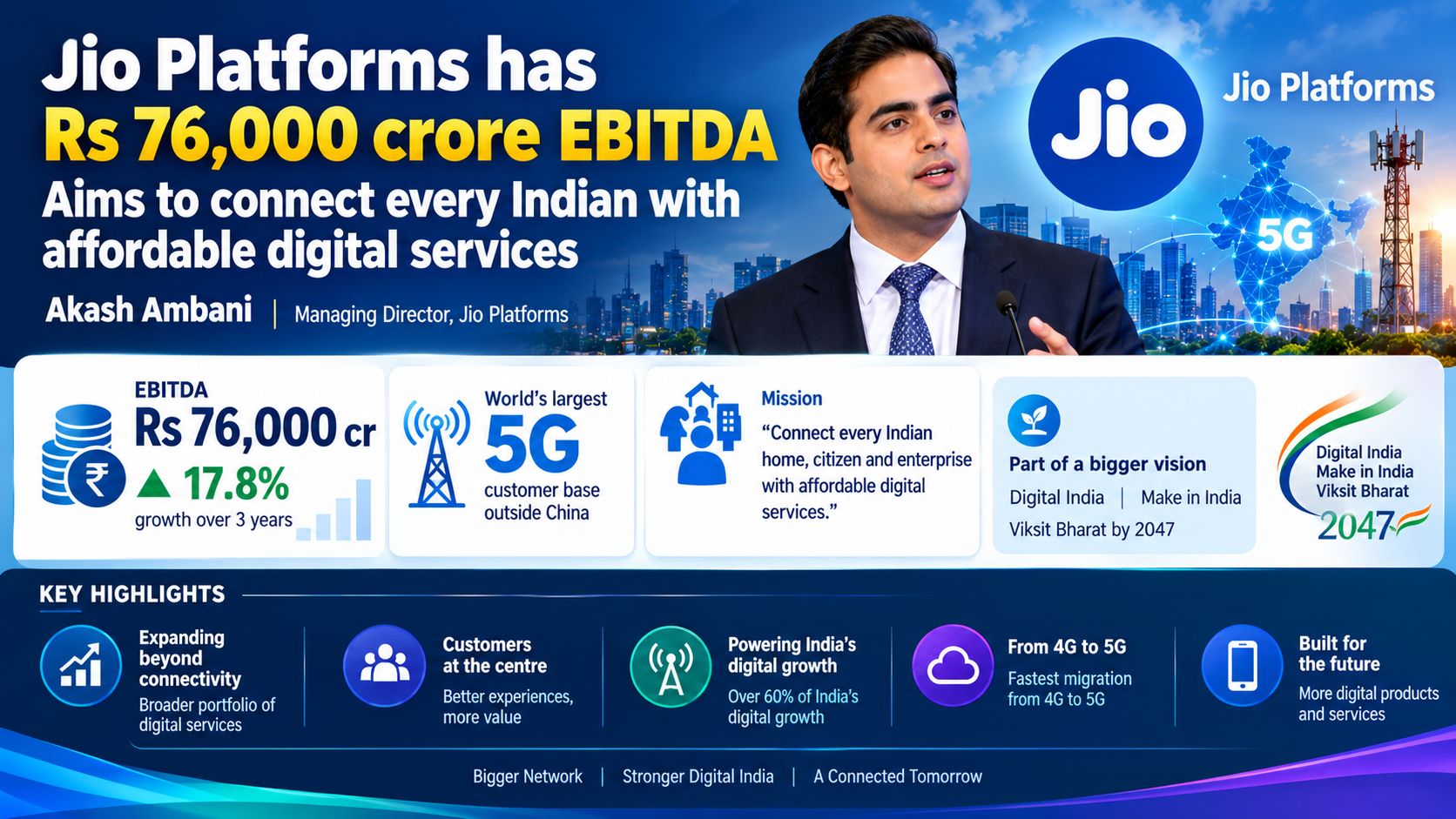
How Jio transformed India’s mobile data market
Jio entered the telecom market in 2016 as the industry’s 14th operator. At the time, mobile data cost around Rs 228 per GB, while download speeds stood at approximately 2.5 Mbps, according to Ambani.
The company saw an opportunity to make internet access more affordable and widely available.
“We saw that as our biggest opportunity, to change India from a data-scarce nation to a data-abundant nation,” he said.
Jio’s entry triggered major changes in telecom pricing and accelerated mobile internet adoption across India, intensifying competition among operators.
Read More : BSE Share Price Up 2.8% Today: What the SEBI Panel’s View on CAS Means for Expiry Day Traders
Here’s what happened today and why traders reacted
Jio Platforms’ Rs 76,000 crore EBITDA and 17.8% growth over three years highlight the scale of its business ahead of its proposed IPO.
For investors, the key question is whether Jio can sustain this growth while generating more revenue from its large customer base. Its financial performance, 5G expansion and digital services strategy could influence how the market values the company.
The proposed listing also brings greater attention to Reliance Industries, Jio’s parent group, as investors assess the potential value of its digital business.
What Jio Platforms’ financial growth means for investors
Jio’s reported EBITDA, 5G infrastructure and expanding digital ecosystem provide important indicators for investors evaluating its IPO prospects.
The company’s future performance will depend on its ability to sustain earnings growth, monetise its customer base and expand services beyond traditional telecom connectivity.
For Reliance Industries investors, Jio’s proposed listing could provide a clearer view of the digital business’s standalone valuation. However, the eventual market assessment will depend on the IPO pricing, investor demand and the company’s ability to deliver continued growth.
As Jio Platforms moves towards the public markets, its financial strength and digital expansion plans will remain central to investor expectations.