Margin Trading Is Booming, but NSE’s Audit Shows Where Brokers Slipped
NSE Flags Broker Violations as Margin Trading Facilities Risks and Compliance Gaps Come Under Scrutiny
Could the rapid growth of margin trading expose investors to greater risks if brokers fail to follow essential safeguards? The National Stock Exchange (NSE) has flagged several compliance deficiencies among trading members and authorised persons, putting the spotlight on margin collection, client-fund protection and cybersecurity in India’s stock market.
The official NSE inspection circular, Ref. No. NSE/INSP/77149 dated October 28, 2026, covers the October 2025–March 2026 inspection period. The exchange asks trading members to strengthen their compliance systems and procedures. The following details would make your article more complete.
For investors, the findings raise an important question: are brokerage risk-management systems keeping pace with the growing use of leveraged trading?
Track Live : NSE Option Chain — Live | BSE Option Chain — Live Sensex & Bankex Options Data Today
Rising Margin Trading Facilities activity makes margin collection a key concern
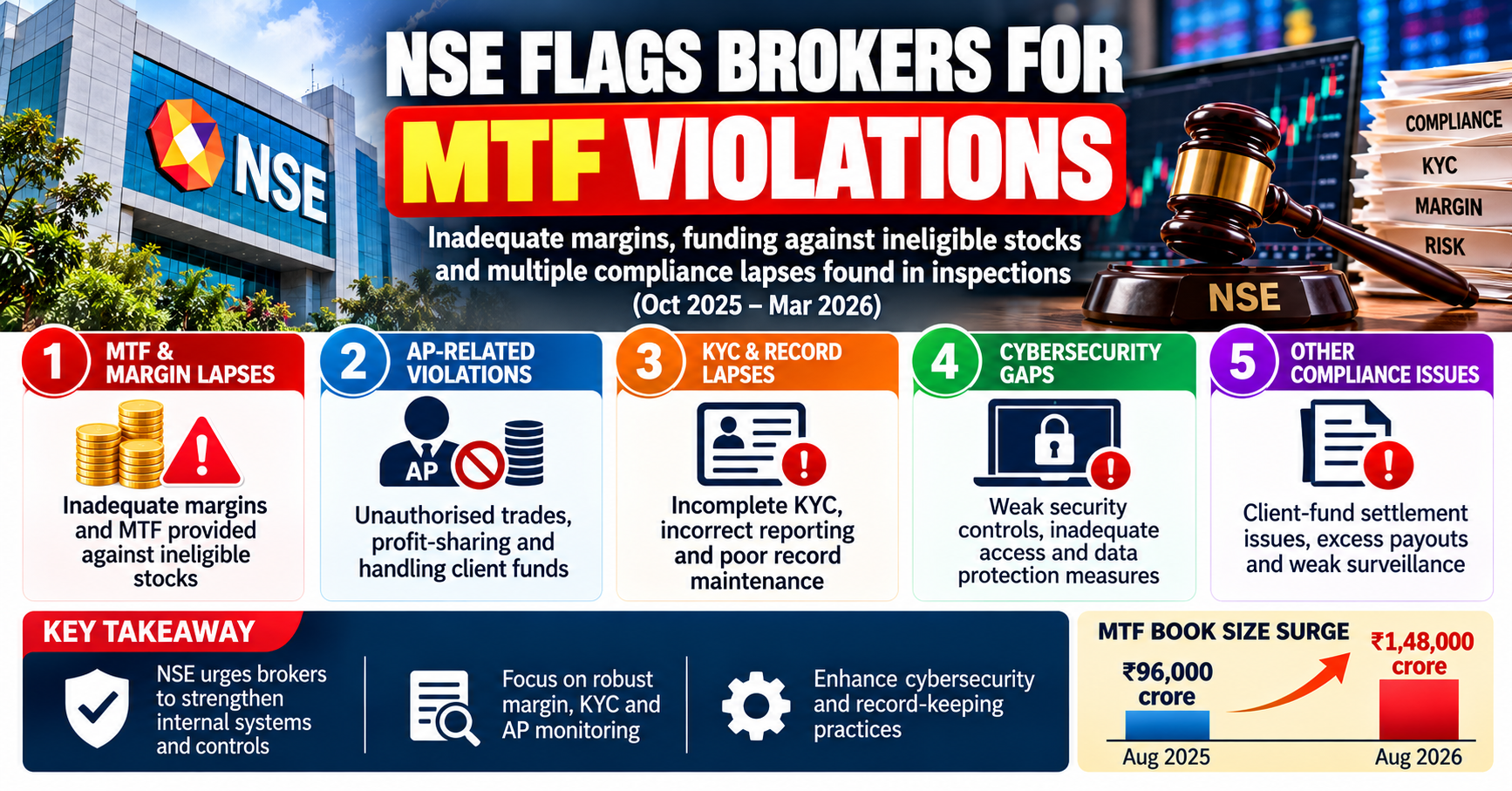
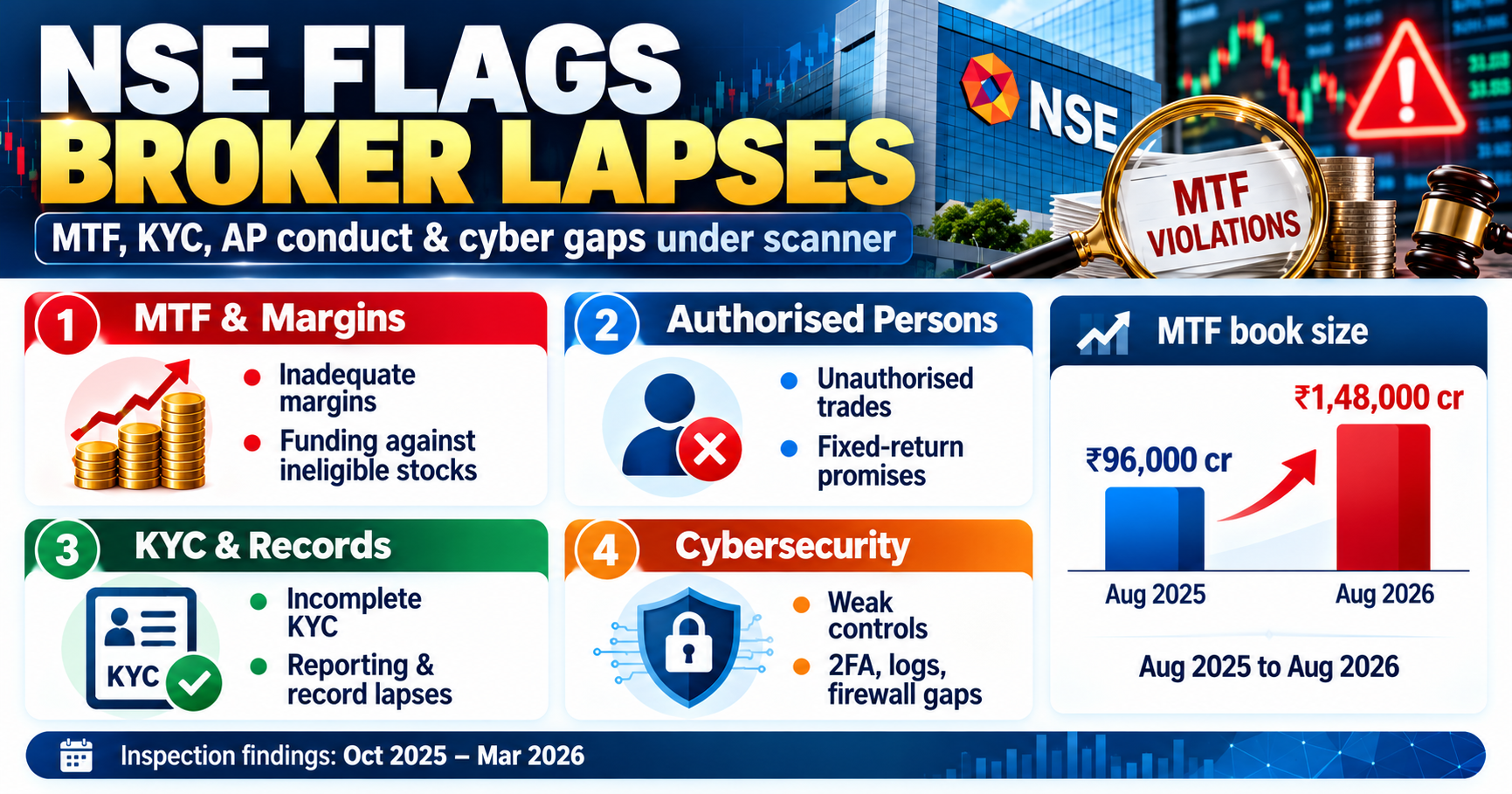
One of the major issues identified by the NSE was brokers providing MTF funding against ineligible securities, including stocks outside the Group I category. The exchange also found instances of inadequate margin collection.
Under applicable MTF requirements, brokers must collect sufficient eligible collateral, including cash, cash equivalents or eligible Group I equity shares, after applying appropriate haircuts.
The concern becomes more significant as margin trading expands. According to figures attributed to BSE and NSE data compiled by CareEdge Ratings, the MTF book increased from ₹96,000 crore in August 2025 to ₹1.48 lakh crore in August 2026.
That represents an increase of approximately 54%. The figures should be verified against the original source before publication.
With leveraged positions magnifying both gains and losses, inadequate margins can increase the risks associated with sharp share-price movements.
MTF violations
Your article explains inadequate margins and funding against ineligible securities. Consider adding these points:
-
MTF exposure limits: Explain that compliance also requires brokers to adhere to the applicable exposure limits when providing margin trading facilities, where relevant under the governing rules.
-
Separate client-wise records: Brokers must maintain separate ledgers for client funds, cash collateral, mark-to-market collections and funded stock positions, along with records of funds used for MTF and their sources.
-
MTF reporting deadlines: NSE’s MTF FAQs state that members must report their MTF exposure by 6 p.m. on the following trading day. Failure to submit the required daily file can constitute non-compliance.
-
Broker eligibility: Only eligible corporate members meeting the prescribed net-worth requirement and obtaining exchange approval can offer MTF. NSE’s published FAQ specifies a minimum net worth of ₹3 crore.
Client funds and margin reporting also face scrutiny
The NSE identified other deficiencies, including delayed or inaccurate daily margin statements, incorrect reporting of margin and mark-to-market loss collection, and discrepancies in client-fund retention statements.
Some brokers were also found to have paid out more than clients’ available credit balances or passed penalties for short collection of upfront margins to clients.
Other lapses included missing SMS and email notifications about fund transfers during running-account settlements.
These findings highlight why investors should regularly check their trading statements, fund balances and margin obligations rather than relying entirely on their broker’s internal processes.
Bank-account transfers and protection of client money
-
Improper transfers between designated accounts: NSE flagged impermissible transfers between Up Streaming Client Nodal Bank Accounts (USCNBA), Down Streaming Client Nodal Bank Accounts (DSCNBA) and other bank accounts of trading members.
-
Delayed bank-account reporting: Brokers were flagged for failing to report the opening or closure of bank accounts within prescribed timelines.
-
Missing bank-account undertakings: Members were found to have failed to submit the required undertaking addendum within seven working days of opening a new bank account, empowering the exchange to freeze the account for debits in the event of a potential default.
-
Incorrect annual returns: Incorrect information in annual returns was another reporting deficiency.
Track Live : Nifty Levels Today | Sensex Levels Today
Authorised person violations raise questions about investor protection
The exchange also flagged concerns involving authorised persons (APs), who facilitate trading services for clients.
The inspection findings included handling client funds, using clients’ login credentials to execute unauthorised trades, seeking permission to trade on clients’ behalf and offering fixed or assured returns.
Other deficiencies involved profit-sharing arrangements, unauthorised portfolio management, unapproved advertisements and missing evidence of client orders.
The NSE further found cases where AP terminals were located at addresses different from those reported to the exchange or were operated by unauthorised individuals.
For retail investors, these findings reinforce the importance of keeping trading credentials private and checking that all orders and transactions have been authorised.
KYC, reporting and cybersecurity gaps add to compliance concerns
The NSE flagged incomplete client registration documents, missing KYC information and failures to provide completed registration documents within the prescribed seven-day period after uploading the Unique Client Code (UCC).
Other issues included incorrect client contact details, failure to mark accounts inactive after 24 months without trading and inaccurate regulatory reporting.
Cybersecurity deficiencies included weak password policies, inadequate two-factor authentication, poor privileged-access management, insufficient log monitoring and incomplete encryption of stored data. The exchange also identified gaps involving data-loss prevention and web application firewalls.
Additional findings covered securities pledging, client collateral segregation, delayed contract notes, discrepancies in net-worth calculations and inadequate surveillance of client trading.
KYC, account access and client registration
-
Incorrect contractual clauses: Client registration documents contained clauses that did not comply with applicable requirements.
-
Online account-freezing policy: The inspection circular identifies failures to communicate the policy on voluntarily freezing or blocking online trading-account access to new clients.
-
Contact details and family relationships: Shared email addresses or mobile numbers across multiple clients require compliance with applicable rules; common contact details cannot simply be treated as acceptable without the prescribed relationship requirements.
-
Contract notes sent to shared email addresses: The exchange flagged cases where contract notes were sent to multiple clients using the same email address without establishing acceptable relationships.
Read Here : Reliance Q2 FY27 Results on Oct 30: Rs 20,900 Crore Profit Seen, Retail the Weak Link
Cybersecurity: Vulnerabilities missing from your article
-
Unapproved system tools: PowerShell, command prompt and Windows Script Host (wscript) were enabled on endpoints without a business requirement or approval.
-
Unnecessary open ports: Port whitelisting and open-port configurations did not always match business requirements.
-
Weak privileged-access controls: Some brokers lacked appropriate privileged-access management controls, while generic user IDs had privileged access without proper ownership.
-
Unapproved or inadequately protected systems: Critical assets were not properly classified, and some assets were not integrated with firewalls and security operations centres.
-
Missing cybersecurity policy approval: The exchange’s inspection checklist also identifies cases where the Cyber Security and Cyber Resiliency Policy had not been approved.
Here’s what happened today and why traders reacted
The NSE’s inspection findings bring attention to the operational and regulatory risks that can emerge when brokers fail to maintain adequate safeguards. However, the findings alone do not establish that every broker has committed every listed violation, nor do they automatically signal an immediate market-wide sell-off.
The direct impact on the Nifty 50, Sensex or individual brokerage stocks will depend on subsequent enforcement actions, corrective measures and any additional compliance costs.
What NSE’s findings mean for traders and investors
Investors should monitor official exchange announcements, review their broker’s margin statements and understand the risks before using MTF to buy shares.
Brokerages may need to improve internal controls, authorised-person supervision and cybersecurity systems. While these measures can raise compliance costs in the short term, stronger safeguards could support investor confidence over time.