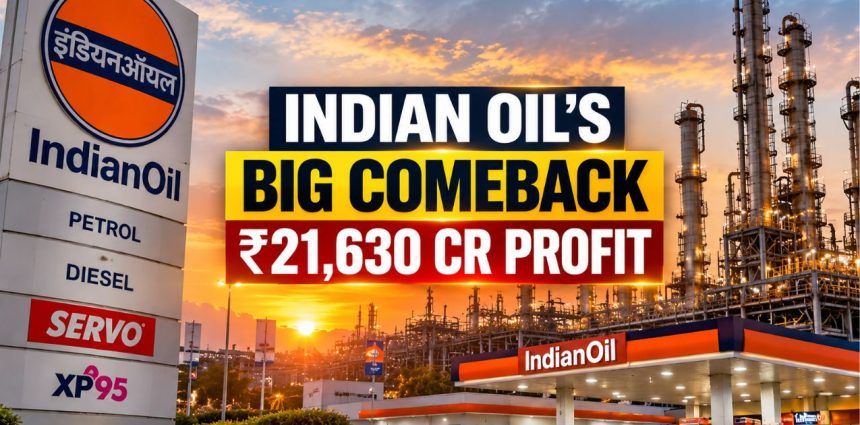
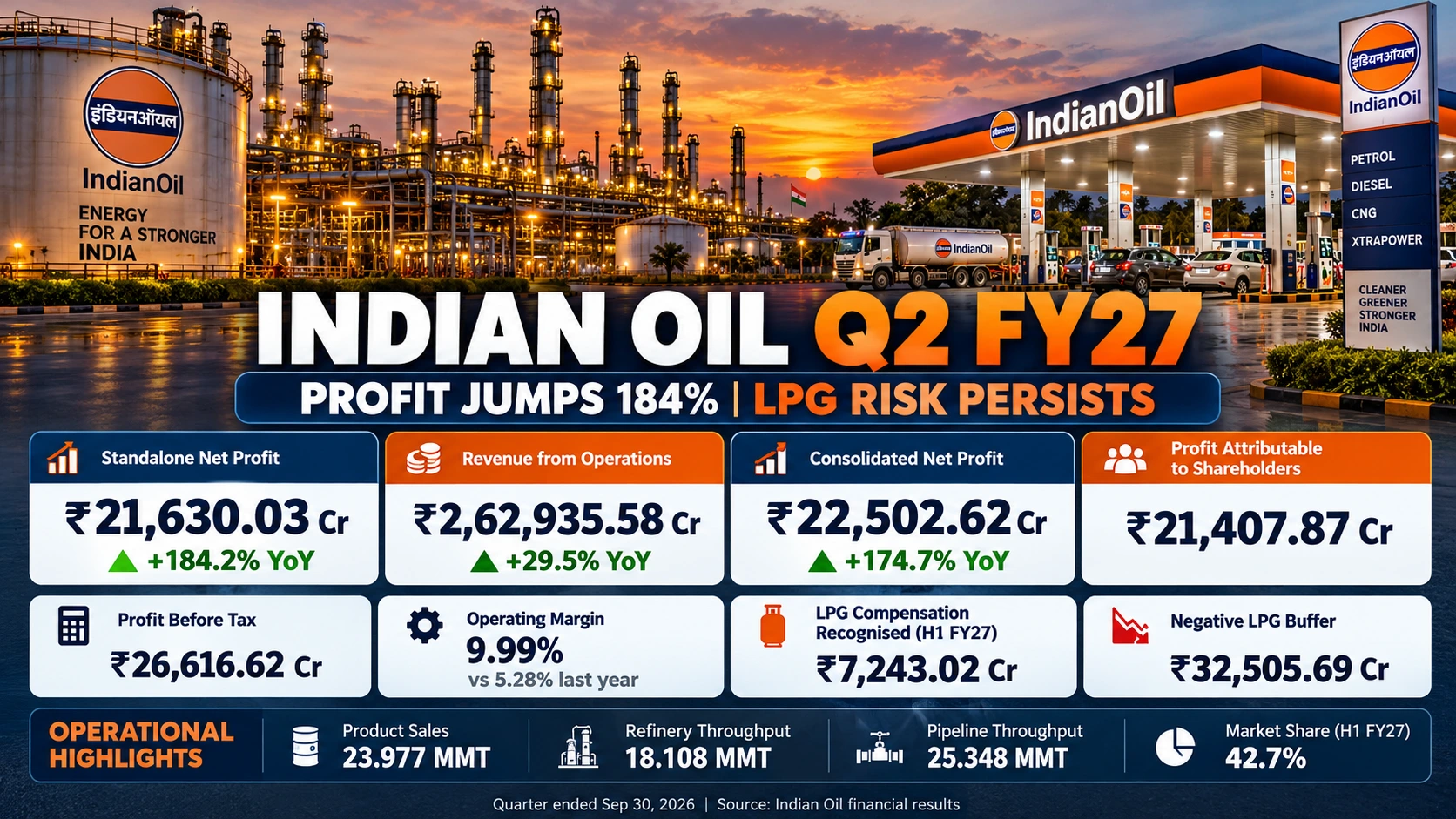
Indian Oil Q2 FY27 Results: Indian Oil Corporation (IOC) reported a 184.2% year-on-year (YoY) surge in standalone net profit to ₹21,630.03 crore for the quarter ended September 30, 2026, compared with ₹7,610.45 crore a year earlier. The sharp earnings recovery was supported by improved petroleum-products profitability, favourable crude oil price movements during part of the quarter, stronger petrochemical and gas margins, and government compensation for domestic LPG under-recoveries.
Revenue from operations climbed 29.5% to ₹2,62,935.58 crore from ₹2,02,992.34 crore in Q2 FY26.
The results, announced on October 30, also marked a substantial turnaround from the ₹2,661.37 crore standalone loss recorded in the June quarter.
However, Indian Oil’s cumulative negative LPG buffer of ₹32,505.69 crore and the possibility of inventory losses from future crude price movements remain important risks to earnings sustainability.
Track Live: INDIAN OIL CORPORATION Options Chart | Nifty Trader
Indian Oil Q2 FY27 Results: Key Financial Highlights
| Particulars (Standalone) | Q2 FY27 | Q2 FY26 | YoY Change |
|---|---|---|---|
| Revenue from operations | ₹2,62,935.58 Cr | ₹2,02,992.34 Cr | +29.5% |
| Net profit | ₹21,630.03 Cr | ₹7,610.45 Cr | +184.2% |
| Profit before tax | ₹26,616.62 Cr | ₹10,065.57 Cr | +164.4% |
| Operating margin | 9.99% | 5.28% | +471 bps |
| Basic EPS | ₹15.71 | ₹5.53 | +184.1% |
Source: Indian Oil’s unaudited standalone financial results for Q2 FY27.
Indian Oil Consolidated Profit Rises 175% to ₹22,503 Crore
On a consolidated basis, Indian Oil reported total net profit of ₹22,502.62 crore, up 174.7% from ₹8,190.86 crore in the corresponding quarter last year.
Of this, ₹21,407.87 crore was attributable to equity holders of the parent company, compared with ₹7,817.55 crore in Q2 FY26.
The difference reflects profit attributable to non-controlling interests in the consolidated financial statements.
Consolidated revenue from operations increased 29.8% to ₹2,68,039.38 crore from ₹2,06,447.11 crore a year earlier.
The consolidated results also represented a turnaround from the ₹1,141.09 crore net loss reported in Q1 FY27.
Why Did Indian Oil’s Profit Surge in Q2 FY27?
Indian Oil’s profitability improved following a temporary decline in crude oil prices between mid-June and mid-August, alongside stronger margins in its petrochemical and gas businesses.
The company highlighted these factors in its October 30 performance statement.
The petroleum-products segment also recorded a substantial earnings recovery, reflecting improved profitability across its refining and marketing operations.
Additionally, government compensation recognised against domestic LPG under-recoveries provided important support to reported revenue and earnings.
Crude Price Movements and Fuel Marketing Margins
Indian Oil faced considerable cost pressures earlier in FY27 as geopolitical tensions pushed up global crude oil prices.
According to Moneycontrol, retail fuel prices were increased cumulatively by ₹7 per litre in May 2026, helping support fuel marketing margins.
Although crude oil prices moderated temporarily between mid-June and mid-August, the company’s profitability remained sensitive to international energy prices and the relationship between fuel selling prices and procurement costs.
Consequently, the September-quarter recovery should not be interpreted as evidence that all crude-related margin pressures have disappeared.
Indian Oil Q2 Segment Results: Petroleum Business Profit More Than Doubles
Indian Oil reported a sharp improvement in its petroleum-products segment, alongside stronger results from gas and petrochemicals.
| Business Segment | Q2 FY27 Result | Q2 FY26 Result |
|---|---|---|
| Petroleum products | ₹24,935.01 Cr | ₹11,268.80 Cr |
| Petrochemicals | ₹528.40 Cr | ₹168.42 Cr |
| Gas | ₹1,237.67 Cr | ₹243.49 Cr |
The petroleum-products segment result more than doubled, rising approximately 121% year-on-year.
Gas segment profit increased substantially, while petrochemical earnings also recorded significant growth.
These improvements helped the company recover from the weakness experienced in the previous quarter.
Important: The figures represent standalone segment results before specified adjustments for finance costs, interest income, dividends and exceptional items. Petroleum-products segment profit includes refining and marketing activities and should not be interpreted as gross refining margin (GRM) or refining-only profit.
LPG Compensation Supports Profit, but ₹32,506 Crore Negative Buffer Remains
Government compensation for domestic LPG under-recoveries was another important component of Indian Oil’s reported financial performance.
According to the company’s October 30 filing, Indian Oil recognised ₹7,243.02 crore as revenue from operations during April–September 2026 (H1 FY27) under the government’s approved LPG compensation arrangement.
This amount relates to six monthly instalments and should not be confused with compensation attributable exclusively to Q2 FY27.
The government had approved total compensation of ₹14,486 crore for Indian Oil in connection with domestic LPG under-recoveries to be disbursed through monthly instalments.
However, the company’s cumulative net negative LPG buffer remained at ₹32,505.69 crore as of September 30, 2026, after accounting for the recognised compensation.
The sizeable negative balance highlights the financial pressure created when the effective cost of supplying domestic LPG exceeds the regulated selling price.
For investors, the pace of future compensation recognition and developments in LPG supply costs will remain important factors to monitor.
Indian Oil Fuel Sales and Refinery Throughput Increase
Indian Oil recorded higher domestic petroleum product sales and refinery throughput during the September quarter.
| Operational Metric | Q2 FY27 | Q2 FY26 |
|---|---|---|
| Domestic product sales | 23.977 MMT | 22.851 MMT |
| Refinery throughput | 18.108 MMT | 17.608 MMT |
| Pipeline throughput | 25.348 MMT | 24.087 MMT |
Domestic petroleum product sales increased approximately 4.9% year-on-year, while refinery throughput rose around 2.8%.
For the first half of FY27, the company reported its highest-ever H1 refinery throughput of 37.273 million metric tonnes, with capacity utilisation reaching 105.8%.
Cross-country pipeline throughput also reached an H1 high of 53.896 MMT.
Indian Oil’s domestic petroleum market share increased to 42.7% in H1 FY27 from 41.5% in the corresponding period last year.
The improvement in operational volumes provided an additional positive development alongside the recovery in profitability.
Indian Oil H1 FY27 Results: Profit Rises Nearly 43%
For the six months ended September 30, 2026, Indian Oil reported standalone net profit of ₹18,968.66 crore, compared with ₹13,295.05 crore in H1 FY26.
This represents year-on-year profit growth of approximately 42.7%.
Standalone revenue from operations increased 27.8% to ₹5,38,907.35 crore from ₹4,21,600.04 crore.
The strong second-quarter earnings more than offset the company’s standalone loss in Q1 FY27.
Indian Oil Share Price: IOC Stock in Focus After Results
Indian Oil shares closed at ₹130.00 on the BSE on Friday, October 30, 2026, declining 0.12% during the session.
On the NSE, the stock settled at ₹130.15, down 0.20%.
The company’s quarterly results were released after market hours, putting IOC shares in focus when trading resumes on Monday, November 2.
The substantial recovery in profit, improvement in petroleum-products earnings and stronger gas segment performance are important developments for investors.
However, the large LPG under-recovery buffer and uncertainties surrounding global crude oil prices remain significant factors in assessing the company’s earnings outlook.
Also Track: INDIAN OIL CORPORATION Option Chain (NSE) — Live OI, PCR & Greeks
Indian Oil Outlook: Can the Earnings Recovery Continue?
Despite the strong September-quarter performance, Indian Oil has cautioned that profitability could come under pressure in the coming quarters.
In its official statement, the company flagged potential inventory losses if crude oil prices decline following a normalisation of geopolitical tensions in the Middle East.
Inventory losses may arise when the market value of crude oil or petroleum products held by the company falls as international prices decline.
Investors should monitor three major developments:
- Crude oil price movements: Higher procurement costs could pressure marketing profitability, while falling prices could result in inventory losses.
- Petroleum-products profitability: The sustainability of the sharp improvement in segment earnings will remain critical.
- LPG under-recoveries: The negative LPG buffer and future government compensation will continue to influence reported financial performance.
The company’s operational growth provides support to its business outlook, but future profitability will depend heavily on energy price movements and domestic pricing conditions.
Bottom Line
Indian Oil delivered a substantial earnings recovery in Q2 FY27, supported by improved business profitability and government LPG compensation.
However, the ₹32,506 crore negative LPG buffer, exposure to crude oil volatility and potential inventory losses remain important challenges.
The key question for investors is whether the company can sustain its improved profitability as global energy market conditions evolve.
Read Next: FIIs Buy ₹3,599 Crore on Friday, but October Selling Tops ₹45,000 Crore; Nifty Eyes 23,200
Indian Oil Q2 Results 2026: Frequently Asked Questions
What was Indian Oil’s net profit in Q2 FY27?
Indian Oil reported standalone net profit of ₹21,630.03 crore, representing growth of 184.2% year-on-year. Total consolidated net profit stood at ₹22,502.62 crore, of which ₹21,407.87 crore was attributable to the parent company’s shareholders.
Why did Indian Oil’s profit increase sharply?
The earnings recovery was supported by improved petroleum-products profitability, a temporary decline in crude oil prices, stronger petrochemical and gas margins, and the recognition of government compensation for domestic LPG under-recoveries.
How much LPG compensation did Indian Oil recognise?
Indian Oil recognised ₹7,243.02 crore in government LPG compensation as revenue from operations during April–September 2026. This represents the first six months of FY27, not Q2 alone.
What was Indian Oil’s revenue in Q2 FY27?
Standalone revenue from operations increased 29.5% to ₹2,62,935.58 crore.
What is the outlook for Indian Oil shares?
Investors will monitor crude oil prices, petroleum-products profitability, LPG under-recoveries and the sustainability of the company’s earnings recovery. The financial results alone do not establish a future share-price direction.
Disclaimer: This article is intended for informational and educational purposes only. It does not constitute investment advice.