A few rupees saved on every trade can look insignificant until you see them add up across dozens or hundreds of orders. For an investor building a portfolio or a trader placing frequent positions, brokerage charges can quietly become a meaningful part of the overall trading cost. That is why comparing platforms on more than a headline offer of zero brokerage makes sense.
Today, traders and investors have several brokers offering competitive pricing, including zero brokerage on selected segments or for limited periods. But the real comparison begins when you look at delivery, intraday, and futures & options (F&O) charges together. Here is how some popular platforms compare based on their current official pricing.
1. Kotak Neo
Kotak Neo’s official pricing gives it a particularly strong starting position in this comparison. Its Trade Free Plan offers ₹0 brokerage for the first 30 days across equity intraday, stock delivery and F&O. After that, equity intraday costs ₹10 or 0.05% per executed order, whichever is lower. Equity delivery is 0.20%, and F&O is ₹10 per executed order. The plan has a ₹0 account opening fee.
For a trader, the ₹10 F&O rate is one of the lower ongoing brokerage rates among the platforms compared here, as Zerodha, Upstox, 5paisa and Angel One charge ₹20 per executed order under their standard pricing. Kotak Neo also states that Trade API orders carry zero brokerage and zero API charges, though this applies to the primary order. If a Bracket Order is placed via the API, the automatic square-off leg is charged standard brokerage, so it isn’t entirely brokerage-free end to end. Its Trade Free Youth plan also offers zero brokerage for the first 30 days across equity intraday and F&O. However, the Youth plan continues to offer ₹0 brokerage on stock delivery beyond the initial 30-day period, subject to a nominal 0.01-paisa-per-order charge.
The platform combines these brokerage charges with features such as trade from charts, payoff analyser, margin trading facility (MTF), StockCase stock baskets, Siplt, and research calls from Kotak’s team. These give the pricing structure some useful context instead of making the comparison purely about the lowest number in brokerage charges.
2. Zerodha
Zerodha’s official charges page shows ₹0 brokerage on equity delivery. Intraday and equity futures are charged at ₹20 or 0.03% per executed order, whichever is lower, while equity options are ₹20 per executed order. Individual account opening is free.
Its Kite platform brings several trading tools together. These include advanced charts, 20 market-depth data, good till triggered (GTT) orders, baskets, and market alerts. Zerodha has also introduced Kite Terminal Mode, which allows traders to build customised workspaces around different trading styles. Users can arrange charts, option chains, orders, positions, baskets, alerts and other widgets within the same workspace.
All this makes Zerodha a considerable choice for investors. Its pricing is particularly relevant to investors who mainly buy and hold shares. Its platform also has a clearly defined cost structure for active traders, although its F&O brokerage is higher than Kotak Neo’s ₹10 per executed order under the plans compared here.
3. Upstox
Upstox’s official brokerage schedule lists ₹20 per executed order for equity delivery. For intraday trades, the charge is ₹20 or 0.1%, for futures it is ₹20 or 0.05%, and for options it is ₹20 per executed order, whichever applicable structure is lower.
Upstox also offers free account opening and no account maintenance charge (AMC) during the first year. Afterwards, for a basic services demat account (BSDA), the AMC is ₹0 for holdings up to ₹4 lakh and ₹100 per annum for holdings between ₹4 lakh and ₹10 lakh, in line with SEBI’s current BSDA framework, under which the eligibility ceiling was raised to ₹10 lakh. For holdings above ₹10 lakh or non-BSDA accounts, the AMC is ₹300 per annum, excluding Goods and Services Tax (GST).
On the features side, Upstox offers Pro Web and Pro Mobile for trading across web and mobile. Its charting ecosystem includes TradingView integration, 100+ indicators and 80+ drawing tools. For active traders, Chart 360 brings chart-based execution together with multi-chart viewing, option-chain strategies, target and stop-loss levels, and open-interest analysis.
For investors comparing zero brokerage offers, the important distinction is that Upstox’s standard equity delivery pricing is ₹20 per executed order rather than permanently free delivery brokerage.
4. 5paisa
5paisa’s official account and pricing information currently offer ₹0 brokerage for the first 30 days, up to ₹500. After that, its published structure moves to a flat ₹20 per trade across segments. Account opening and AMC for the first year are ₹0.
The platform also provides advanced charts, an options chain, FnO 360, smart order types and a high-speed Scalper terminal. Investors get access to initial public offerings (IPOs), mutual funds, exchange-traded funds (ETFs) and MTF from the same platform.
That makes 5paisa worth considering for users who prefer a predictable flat-fee structure after an introductory zero-brokerage period.
5. Angel One
Angel One’s official pricing page currently offers ₹0 brokerage up to ₹500 for the first 30 days. Thereafter, equity delivery and intraday are charged at ₹20 or 0.1% per executed order, whichever is lower, with a ₹5 minimum, while F&O is ₹20 per executed order.
Account opening is free, and the first year’s AMC is also ₹0. From the second year, BSDA clients with holdings of up to ₹4 lakh pay no AMC, while holdings between ₹4 lakh and ₹10 lakh attract ₹100 plus GST per year. For non-BSDA clients, the charge is ₹60 plus GST per quarter, billed after the first trade in each quarter.
The platform provides basket orders, GTT orders, SmartAPI, advanced charts, mutual funds, IPOs and MTF.
Its zero brokerage offer can therefore reduce initial trading costs, while the standard ₹20 structure becomes the more relevant figure for longer-term users.
Brokerage Charges At A Glance
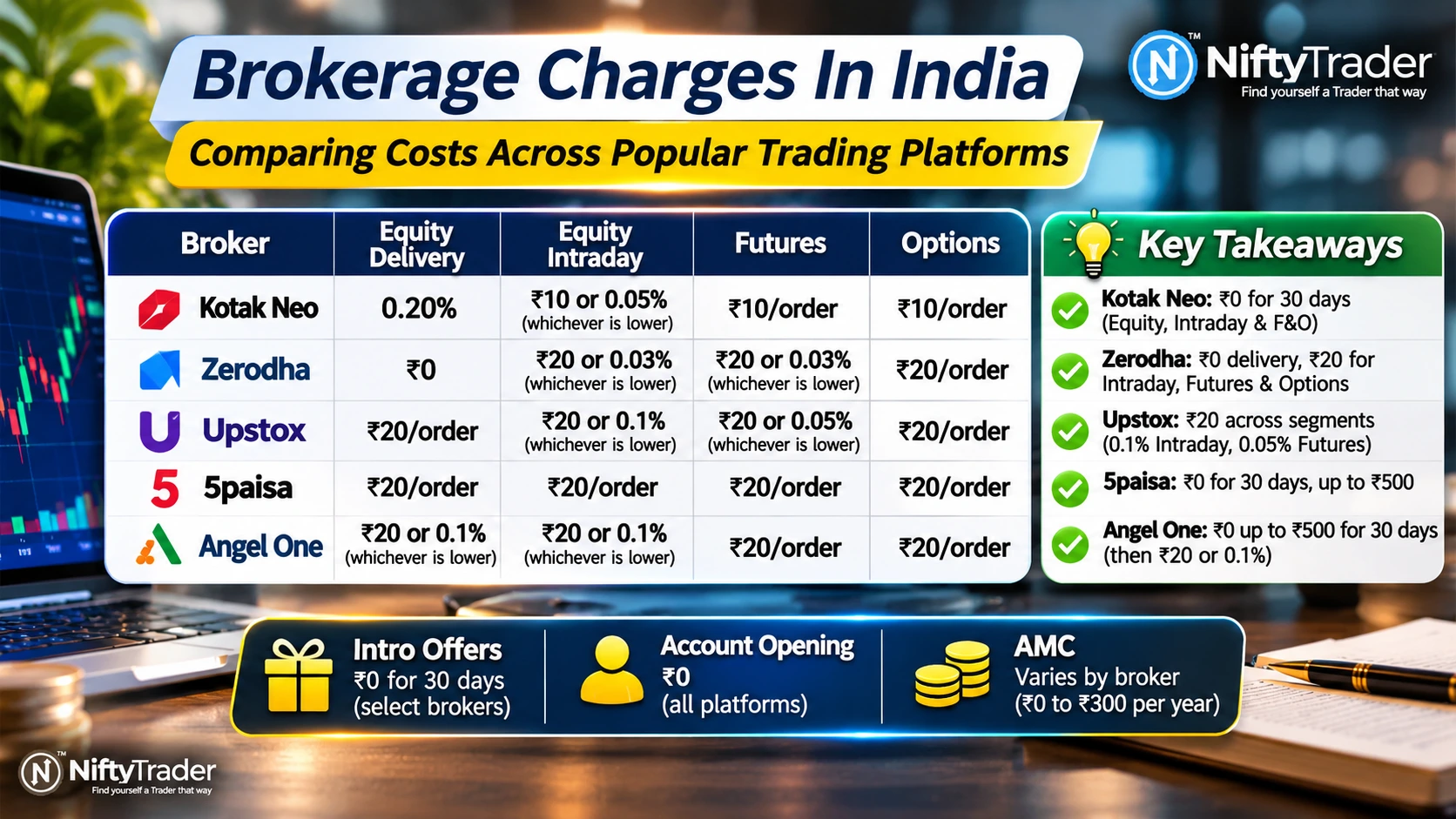
| Broker | Delivery | Intraday | Futures | Options | Introductory Offer |
|---|---|---|---|---|---|
| Kotak Neo | 0.20% | ₹10 or 0.05%, whichever is lower | ₹10/order | ₹10/order | ₹0 brokerage for the first 30 days across equity delivery, intraday and F&O |
| Zerodha | ₹0 | ₹20 or 0.03%, whichever is lower | ₹20 or 0.03%, whichever is lower | ₹20/order | No introductory brokerage offer |
| Upstox | ₹20/order | ₹20 or 0.1%, whichever is lower | ₹20 or 0.05%, whichever is lower | ₹20/order | ₹0 AMC for the first year |
| 5paisa | ₹20/order | ₹20/order | ₹20/order | ₹20/order | ₹0 brokerage for first 30 days, up to ₹500 |
| Angel One | ₹20 or 0.1%, whichever is lower | ₹20 or 0.1%, whichever is lower | ₹20/order | ₹20/order | ₹0 brokerage up to ₹500 for the first 30 days |
Introductory offers are subject to the respective broker’s terms and conditions.
What Should You Check Before Choosing A Broker?
The lowest brokerage charges are not necessarily the lowest overall trading costs. Securities transaction tax (STT), GST, exchange transaction charges, stamp duty and depository participant (DP) charges can still affect the final amount shown in your contract note.
If you mainly invest in delivery stocks, ₹0 delivery brokerage can make a meaningful difference. If you trade F&O regularly, the per-order rate deserves greater attention. And if you are attracted by zero brokerage, check whether it is permanent, segment-specific or limited to an introductory period.
Conclusion
There is no single broker that is cheapest for every investor and every segment. The sensible approach is simple: compare the brokerage charges against the trades you actually make. A headline zero brokerage offer is attractive, but the better deal is the one that keeps your total trading cost aligned with your investing style.
Read Next: F&O Build-Up November 5: 88 Stocks See Short Covering, 80 Add Fresh Longs