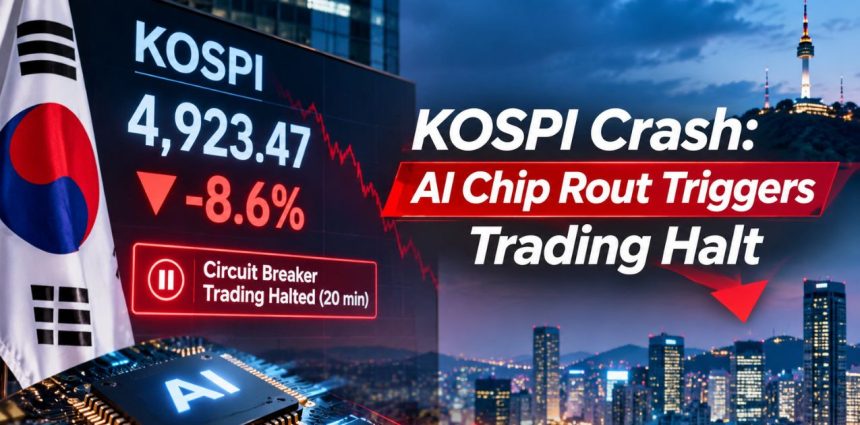
South Korea’s benchmark KOSPI index plunged more than 8.5% in early trading on Friday, November 6, falling below the psychologically important 5,000 mark and triggering a 20-minute trading suspension. A sharp sell-off in semiconductor and technology stocks, led by Samsung Electronics and SK Hynix, dragged the index to its lowest intraday level in nine months as concerns over US artificial intelligence (AI) infrastructure spending rattled global equity markets.
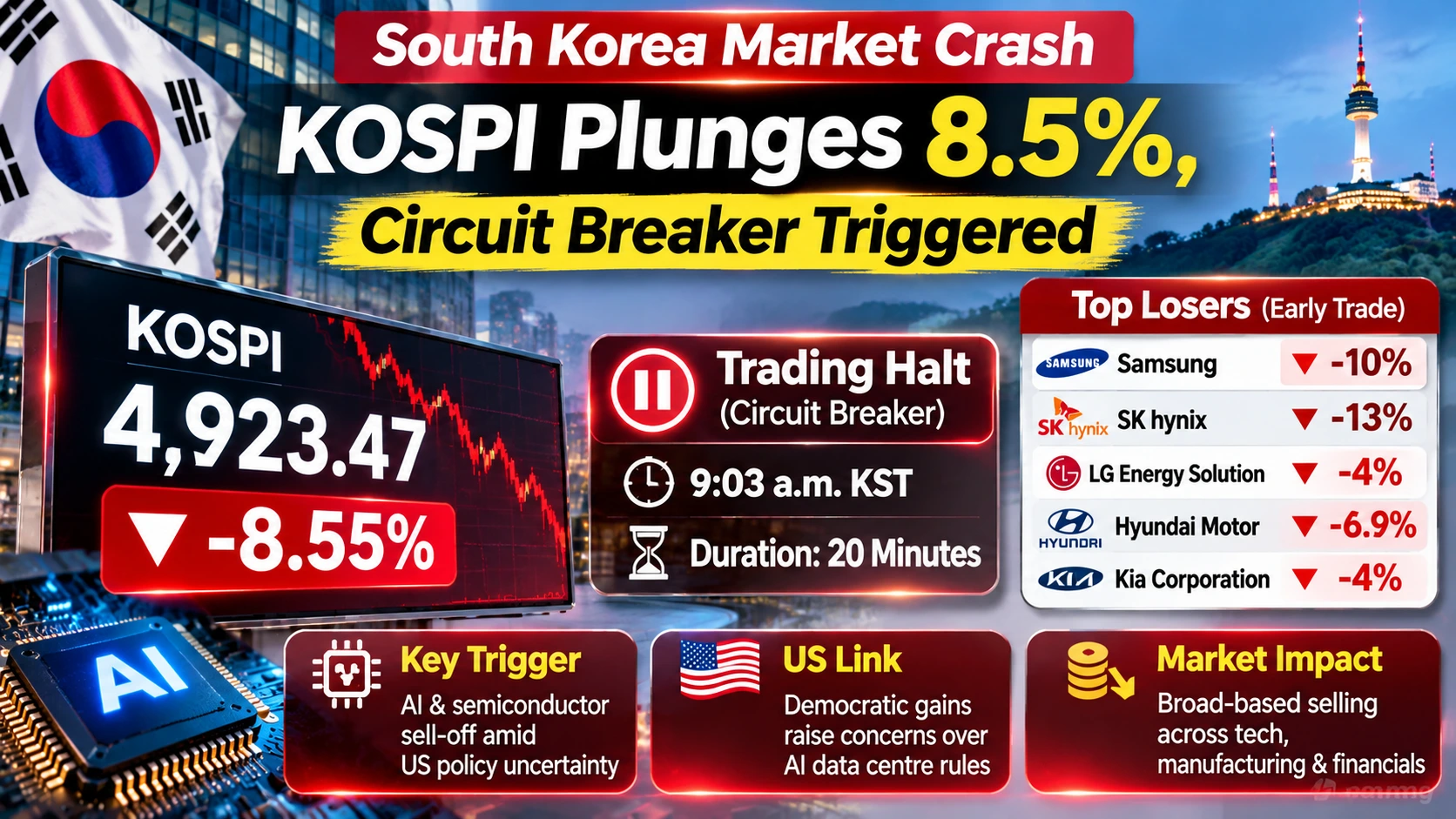
The Korea Exchange (KRX) activated a Level 1 circuit breaker at 9:03 a.m. South Korea time after the KOSPI fell more than 8% from its previous close. Reuters subsequently reported the index at 4,923.47, down 8.6%, as of 9:26 a.m. KST (00:26 GMT). The benchmark had closed Thursday at 5,383.80.
The decline followed Thursday’s 5.28% fall and marked the first time in nine months that the KOSPI had fallen below 5,000 during intraday trading.
The index subsequently recovered above 5,000 after trading resumed. At 11:03 a.m. KST, it stood at 5,094.96, down 5.36% from the previous session, after touching an intraday low of 4,911.28.
An Associated Press market update separately reported the KOSPI at 4,985.99, down 7.4%, while Samsung Electronics shares were lower by 7.9% in morning trading.
The sharp reversal in the benchmark highlighted the scale of intraday volatility, although the recovery did not remove concerns over further selling in semiconductor and technology stocks.
Track Live: GIFT Nifty Live – Today Price, Chart, Timings and Nifty Opening Signal
Need to Know: Why Did South Korea’s KOSPI Crash?
The sell-off was driven by three interconnected developments: a sharp overnight decline in US technology stocks, uncertainty surrounding AI data centre investment following the US midterm elections, and continued pressure on semiconductor companies.
The immediate trigger was growing concern that the stronger political position of the Democratic Party in the United States could lead to greater scrutiny of AI data centre construction.
Investors are assessing the possibility of tighter regulations involving electricity consumption, power-grid capacity, construction approvals and the costs associated with large-scale data centre projects.
This is important for South Korea because its equity market has substantial exposure to semiconductor manufacturers supplying the global AI industry.
Samsung Electronics and SK Hynix are among the world’s major memory-chip manufacturers. Their businesses are closely connected to demand for advanced memory products used in AI servers and data centre infrastructure.
Any delay in planned infrastructure projects could affect the timing of semiconductor orders and future earnings expectations.
However, the election outcome does not automatically mean that AI data centre projects will be cancelled. The current sell-off reflects uncertainty over potential policy changes rather than confirmation of a nationwide construction ban.
KOSPI Circuit Breaker: Why Did the Korea Exchange Halt Trading?
The Korea Exchange activated a Level 1 circuit breaker at approximately 9:03 a.m. KST after the benchmark remained at least 8% below its previous closing level for the required period.
Under the KRX mechanism, a decline of 8% or more sustained for one minute triggers the first-stage circuit breaker.
The mechanism temporarily suspends stock trading and related equity-linked futures and options trading for 20 minutes.
The purpose is to interrupt panic-driven selling and provide investors with time to assess rapidly changing market conditions.
The KOSDAQ market also faced a separate disruption. A sell-side sidecar was activated during the morning session, temporarily restricting qualifying program-trading sell orders for five minutes.
A circuit breaker and a sidecar are different mechanisms. The circuit breaker suspends broader market trading, while a sidecar temporarily limits the effectiveness of program-trading orders.
Samsung Electronics and SK Hynix Lead South Korea’s Semiconductor Sell-Off
Semiconductor stocks suffered some of the steepest losses as investors reassessed the outlook for AI-related hardware demand.
Reuters reported that Samsung Electronics shares fell approximately 10%, while SK Hynix declined around 13% during the early sell-off.
Other major index constituents also faced significant selling pressure.
| Company | Decline reported by Reuters |
|---|---|
| Samsung Electronics | 10% |
| SK Hynix | 13% |
| LG Energy Solution | 4% |
| Hyundai Motor | 6.9% |
| Kia Corporation | 4% |
The weakness extended beyond the largest semiconductor companies.
At the 9:24 a.m. market snapshot, MoneyToday reported that all 20 of the KOSPI’s largest companies by market capitalisation were trading lower.
The electrical and electronics sector was down around 10%, manufacturing declined approximately 9%, while medical and precision instruments fell around 8%. Machinery, securities and financial stocks also recorded losses of more than 7%.
This broad-based weakness suggests that investors were reducing exposure across multiple sectors rather than simply booking profits in individual semiconductor companies.
Foreign Investor Selling Adds to Market Pressure
Foreign investor activity added another layer of pressure to South Korean equities.
At the 9:24 a.m. market snapshot, foreign investors were net sellers of KRW 36.8 billion worth of KOSPI shares. Retail investors were also net sellers of KRW 134.9 billion, while institutions were net buyers of KRW 142.2 billion.
South Korean broadcaster SBS separately reported that foreign investors had sold approximately KRW 130 billion within the first three minutes of trading.
The divergence between foreign selling and institutional buying is important because continued overseas outflows could make it difficult for the market to establish a sustained recovery.
Domestic institutional demand may provide some support, but the sustainability of that buying remains uncertain if global investors continue reducing exposure to semiconductor-heavy markets.
Explore FII-DII data and institutional positioning.
Wall Street’s Technology Sell-Off Spreads to Asian Markets
South Korea’s market weakness followed a severe technology-led correction on Wall Street on Thursday, November 5.
US investors reduced exposure to semiconductor, AI infrastructure and high-valuation technology stocks amid concerns over the profitability and pace of investment in data centre projects.
The major US indices closed sharply lower.
| US Index | November 5 Closing Performance |
|---|---|
| S&P 500 | -4.36% |
| Nasdaq Composite | -5.52% |
| Dow Jones Industrial Average | -3.44% |
| Philadelphia Semiconductor Index | More than -12% |
The S&P 500 recorded its worst daily performance since April 2025, while the Nasdaq fell 11.9% below its October record, entering correction territory.
Semiconductor companies were among the biggest casualties.
Nvidia declined approximately 9.3%, while Advanced Micro Devices (AMD) plunged 17.3%. Other AI-linked companies also faced substantial selling pressure.
The weakness then carried into Asian markets.
Japan’s Nikkei 225 fell 5.7% by midday, while Australia’s S&P/ASX 200 declined 1%. Hong Kong’s Hang Seng lost 0.7%, and the Shanghai Composite fell 1.3%, according to the Associated Press market update.
The simultaneous weakness across major Asian markets reflected a broader reassessment of technology and AI-related valuations rather than an isolated South Korean market event.
US Midterm Election Results Raise Questions About AI Infrastructure Spending
The political backdrop has become an important part of investors’ reassessment of technology stocks.
The Democratic Party’s sweeping gains in the US midterm elections raised expectations of greater scrutiny of AI data centre development.
Concerns include electricity demand, pressure on local power grids, rising utility bills and the impact of large infrastructure projects on surrounding communities.
This matters because AI data centres require substantial investment in advanced processors, high-bandwidth memory, networking equipment, cooling systems and electricity infrastructure.
A slowdown in construction could affect demand across this supply chain, including semiconductor manufacturers, server suppliers and power-equipment companies.
However, there is an important distinction between tighter regulatory oversight and an outright halt to AI infrastructure investment.
Analysts quoted by MoneyToday argued that the focus of potential restrictions could be on reducing the burden of data centre-related electricity costs on local residents rather than preventing construction altogether.
Park Yeon-ju of Mirae Asset Securities indicated that the investment impact could remain limited, although some projects scheduled for 2028 could face delays.
This suggests that the immediate market reaction may be more severe than the potential long-term impact. Nevertheless, investors will need clearer policy signals before the uncertainty can be fully removed.
Is the KOSPI Crash an Overreaction or the Start of a Deeper Correction?
The sharp decline has raised questions about whether investors are reacting too aggressively to political uncertainty or beginning to price in a more meaningful slowdown in AI infrastructure spending.
Jun Kwang-woo, chairman of the Institute for Global Economics and former chairman of South Korea’s National Pension Service, described the decline as a correction and suggested that the market could be overreacting to the US election outcome.
Other market experts have also cautioned against treating potential regulatory scrutiny as proof that technology companies will abandon their infrastructure investment plans.
However, the near-term risk remains significant.
Even if long-term AI demand stays intact, delays in data centre construction could affect order visibility, capital expenditure expectations and semiconductor earnings projections.
The next phase of trading will therefore depend on whether global technology shares stabilise and whether investors receive clearer signals about US AI policy.
What Should Investors Watch Next?
Three developments could determine whether the KOSPI stabilises or faces another round of selling.
1. US AI and data centre policy: Investors will watch for concrete proposals affecting construction approvals, electricity costs and power-grid expansion. Any significant restrictions or project delays could influence semiconductor demand expectations.
2. Semiconductor earnings and investment guidance: Commentary from major technology companies on AI capital expenditure, memory-chip demand and expected investment returns will be important in determining whether the latest sell-off is temporary or reflects a broader change in growth expectations.
3. Foreign investor flows: Continued overseas selling could keep pressure on the KOSPI, especially if domestic institutional buying loses momentum.
For investors, the recovery above 5,000 is an important intraday development, but it should not yet be treated as confirmation of a sustained market reversal.
What Does the KOSPI Sell-Off Mean for Indian Stock Market Investors?
The South Korean market correction is also relevant for Indian investors because it reflects a deterioration in global risk appetite towards technology and AI-linked equities.
Weakness in US semiconductor stocks and Asian technology markets could influence sentiment across emerging markets, particularly companies exposed to global technology spending.
However, a decline in the KOSPI does not automatically indicate that the Nifty 50 will follow the same direction.
Indian market participants should also monitor GIFT Nifty, movements in US technology stocks, foreign institutional investor flows, the rupee and crude oil prices to assess the potential spillover into domestic equities.
The key risk is that persistent weakness in global technology shares could encourage investors to reduce exposure to riskier assets across multiple markets.
Track Live: NIFTY 50 | SENSEX | GIFT NIFTY
Bottom Line
South Korea’s KOSPI plunged more than 8.5% in early trading on November 6, falling below 5,000 and triggering a 20-minute circuit breaker as semiconductor stocks led a broad market sell-off. Samsung Electronics and SK Hynix were among the biggest casualties following Wall Street’s sharp technology-led correction.
Although the index recovered above 5,000 and reached 5,094.96 by 11:03 a.m. KST, the session’s intraday low of 4,911.28 highlighted the extent of selling pressure.
The bigger concern is whether uncertainty surrounding US AI infrastructure policies will translate into actual delays in data centre investment. Until there is greater clarity on regulation, semiconductor demand and foreign investor flows, volatility in South Korean equities and global technology stocks could remain elevated.
Market data note: This article uses time-stamped intraday observations from November 6, 2026. The figures are not final closing prices.
Read Next: F&O Build-Up November 5: 88 Stocks See Short Covering, 80 Add Fresh Longs
Disclaimer: This article is for informational and educational purposes only and does not constitute investment advice or a recommendation to buy or sell any securities. Market conditions can change rapidly, and investors should consult a SEBI-registered financial adviser before making investment decisions.