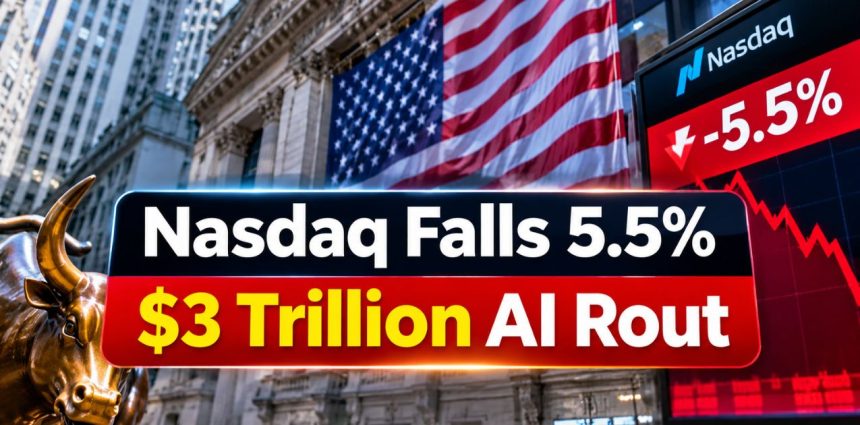
Wall Street’s artificial intelligence (AI) investment boom faced a major reality check on Thursday as semiconductor stocks collapsed, the Nasdaq Composite entered correction territory and investors questioned whether the enormous investments in AI infrastructure could generate the returns expected by the market. The selloff erased approximately $2.9 trillion in market value from S&P 500 companies, with political opposition to data-centre construction adding another risk to an already weakening technology rally.
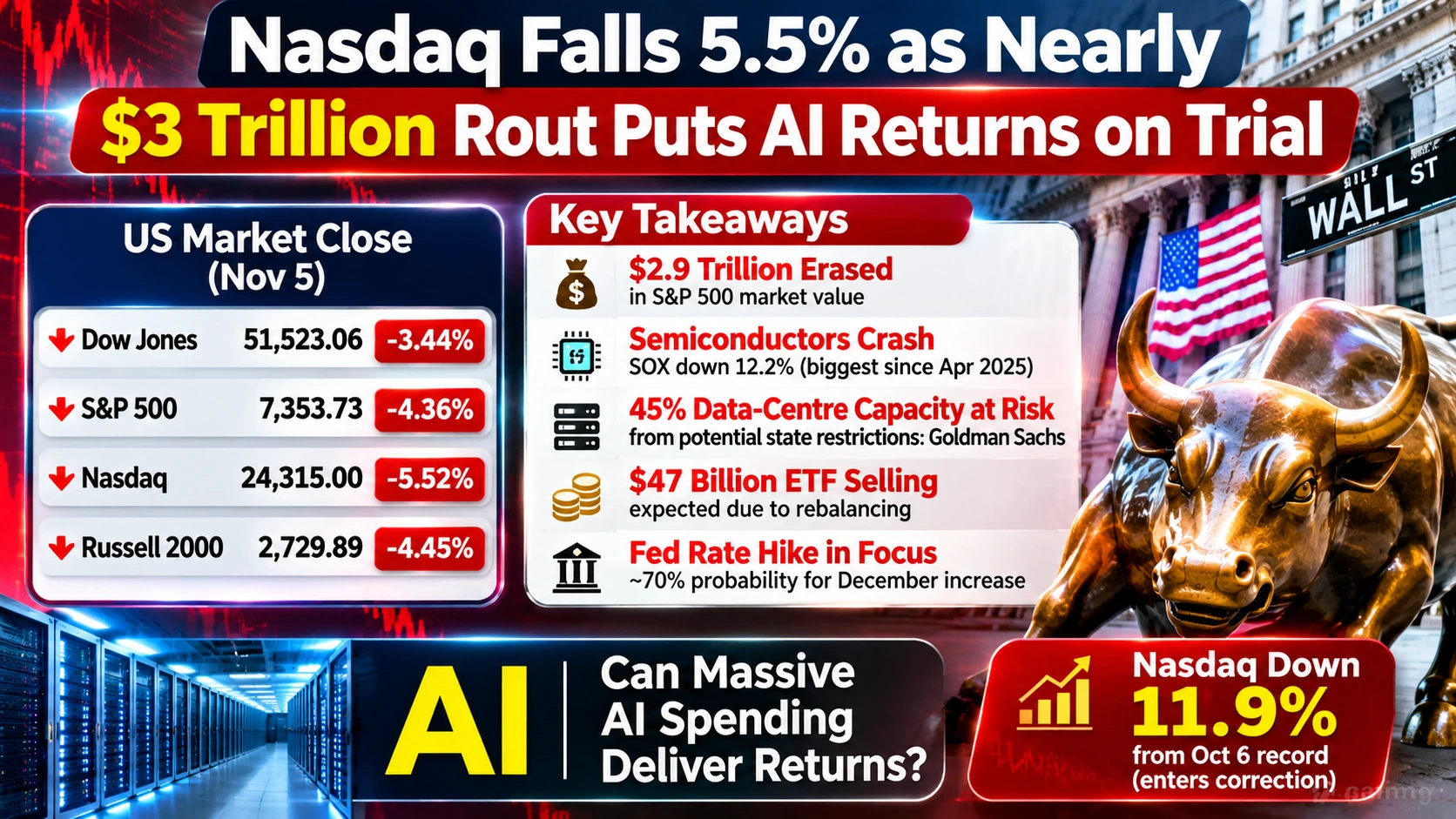
The Nasdaq Composite plunged 1,421.52 points, or 5.52%, to close at 24,315.00, its biggest one-day percentage decline in 19 months. The index ended approximately 11.9% below its October 6 record closing high, confirming a technical correction. The S&P 500 dropped 334.89 points, or 4.36%, to 7,353.73, while the Dow Jones Industrial Average tumbled 1,833.06 points, or 3.44%, to 51,523.06.
The damage extended beyond the headline indices. The Nasdaq-100 fell 6.4%, wiping out approximately $2.5 trillion in market value, while the Magnificent Seven technology companies collectively lost an estimated $1.04 trillion.
These market-cap losses cover overlapping groups of companies and should not be added together. They represent declines in market valuation rather than equivalent amounts of cash withdrawn from the market.
However, Thursday’s rout was not simply a reaction to the November 3 US midterm election results. Concerns about returns on AI capital expenditure, weaker semiconductor earnings signals, tighter financing conditions and aggressive institutional selling had already been building. The election results intensified those pressures by introducing uncertainty over how quickly new data centres could receive approval and become operational.
Track Live: NiftyTrader: Live Options Analytics & F&O Trading Tools
Key Highlights
- $2.9 trillion erased: S&P 500 companies suffered an estimated $2.9 trillion decline in market value.
- Nasdaq correction: The index fell 5.52% and ended approximately 11.9% below its October 6 record.
- Semiconductors under pressure: The Philadelphia Semiconductor Index plunged 12.2%, its biggest one-day decline since April 2025 on a closing basis.
- Data-centre restrictions: Goldman Sachs estimates that states potentially exposed to tighter restrictions account for around 45% of planned US data-centre capacity.
- ETF selling pressure: Leveraged ETFs were expected to sell approximately $47 billion in stocks as part of their rebalancing.
- Fed uncertainty: Markets continued to price in a December rate increase, although its probability declined to approximately 70% from more than 80% a day earlier.
US Stock Market Closing: Dow Loses 1,833 Points as Nasdaq Falls 5.52%
All three major US equity benchmarks recorded substantial declines on Thursday, with technology stocks leading the retreat. The S&P 500 suffered its steepest daily percentage decline since April 2025, when President Donald Trump’s tariff announcement triggered a major global market selloff.
| US index | November 5 close | Points lost | Change |
|---|---|---|---|
| Dow Jones | 51,523.06 | 1,833.06 | -3.44% |
| S&P 500 | 7,353.73 | 334.89 | -4.36% |
| Nasdaq Composite | 24,315.00 | 1,421.52 | -5.52% |
| Russell 2000 | 2,729.89 | 127.06 | -4.44% |
The Philadelphia Semiconductor Index (SOX) suffered an even deeper decline, falling approximately 12.2% on a closing basis. This marked its biggest one-day percentage decline since April 2025, according to Reuters’ later full-session report.
The reversal was particularly striking because the S&P 500 had recorded its strongest one-day percentage gain in three months on Wednesday. Thursday’s losses erased that advance, showing how quickly investors reassessed the outlook for AI-related companies following the election results.
Nvidia, AMD, Micron and SanDisk Lead the Semiconductor Selloff
Semiconductor companies bore the brunt of the selling as investors reconsidered the earnings and growth assumptions supporting the AI investment cycle.
SanDisk plunged approximately 22%, while Micron Technology and Advanced Micro Devices (AMD) each lost around 17%. Marvell Technology also recorded a double-digit decline. Nvidia shares fell approximately 9.3%, adding pressure to the technology-heavy benchmarks.
The weakness spread beyond chipmakers to data-centre developers, neocloud companies and infrastructure suppliers. CoreWeave, IREN, Applied Digital and Nebius Group came under heavy selling pressure, while electricity and equipment-related companies, including GE Vernova and Constellation Energy, also declined.
Qualcomm’s smartphone business adds to chip-sector concerns
The semiconductor selloff was not driven exclusively by political developments.
Qualcomm shares fell approximately 9.5% after its smartphone chip sales missed Wall Street expectations. The company’s handset division revenue declined 26% year-over-year to $5.14 billion, while chip-segment sales dropped 8% to $9.02 billion.
The figures highlighted a separate concern for semiconductor investors: expanding AI demand does not automatically offset weakness in traditional chip markets.
Qualcomm is attempting to diversify beyond smartphones through automotive, Internet of Things and data-centre opportunities. However, investors are looking for clearer evidence that these businesses can compensate for weakness in its established handset operations.
The combination of disappointing demand signals in traditional chip markets and uncertainty around future AI infrastructure spending left semiconductor stocks particularly vulnerable.
US Midterm Elections Put Data-Centre Expansion Under Regulatory Pressure
The November 3 midterm elections introduced a new political dimension to the AI investment outlook.
Democrats secured control of Congress and made significant gains in state-level elections, including gubernatorial victories in Texas and Georgia. Candidates who campaigned on tighter oversight or restrictions on data-centre construction gained political influence in regions important to the technology industry.
The growing opposition reflects concerns about electricity and water consumption, pressure on local power grids, rising utility bills and the environmental impact of rapid infrastructure expansion.
This matters because AI growth depends on more than semiconductor manufacturing. It also requires large investments in data centres, electricity generation, cooling systems, networking equipment and supporting infrastructure.
According to Goldman Sachs, states where tighter restrictions could emerge account for approximately 45% of planned US data-centre capacity expansion. Texas alone represents around 25% of planned capacity.
A separate UBS estimate suggests approximately 30% of expected US data-centre capacity additions in 2028 could be at risk from potential construction pauses.
These estimates measure potential exposure to delays and restrictions, not confirmed cancellations. Goldman Sachs expects some interruptions to be temporary, while other analysts believe companies could move projects to states or countries with fewer regulatory obstacles.
The immediate risk is therefore not necessarily the disappearance of AI demand, but uncertainty over where and when the infrastructure required to meet that demand can be built.
AI Investment Returns and Financing Concerns Deepen the Selloff
Political uncertainty arrived when investors were already questioning whether AI infrastructure spending was growing faster than the profits it could eventually generate.
Major technology companies have committed enormous amounts of capital to AI data centres, advanced processors, networking equipment and electricity infrastructure. While these investments have supported semiconductor demand and boosted revenue expectations, investors increasingly want evidence of sustainable returns.
The financing environment is also becoming more important.
As stock and bond markets weaken, companies involved in data-centre construction may find it harder to raise capital on favourable terms. This is particularly relevant for smaller infrastructure providers and neocloud businesses that depend on external financing to fund expansion.
CoreWeave became one example of this concern. Its shares fell approximately 10%, while its five-year credit-default-swap (CDS) spread widened to a record 1,267.9 basis points, according to S&P Global Market Intelligence data cited by Reuters.
Credit-default swaps are contracts that provide protection against a company’s potential debt default. A rising CDS spread generally indicates that investors are demanding more compensation to bear the company’s credit risk. It does not mean that a default has occurred or is certain.
Investors are also examining the impact of heavy AI expenditure on free cash flow. Companies that increase capital spending while depending on additional debt or equity financing may face greater pressure on valuations if revenue growth does not keep pace.
The central question is no longer simply whether demand for AI computing will increase. It is whether the spending required to capture that demand will generate adequate returns for shareholders.
VIX Jumps to 28.36 as $47 Billion in Potential ETF Selling Adds Pressure
Market positioning and automated trading strategies may have amplified Thursday’s decline.
The Cboe Volatility Index (VIX), Wall Street’s main measure of expected stock market volatility, jumped 11.75 points to an eight-month intraday high of 28.36. It subsequently closed at 28.18, compared with the previous session’s close of 16.61.
Demand for downside protection increased sharply, with put-option premiums running at approximately twice their usual levels across major index products. Put options are contracts that can help investors protect their portfolios against falling share prices.
Institutional investors and hedge funds were also reducing their exposure to technology and AI-linked positions. Reuters reported that retail investors were on track for their largest single-stock selling day since the COVID-related market crash, based on an intraday estimate from Vanda Research.
One particularly significant estimate came from Nomura.
Leveraged ETFs were expected to sell approximately $47 billion in stocks into Thursday’s close as part of their rebalancing activity. Leveraged and inverse ETFs are funds designed to magnify market movements, and they periodically adjust their holdings as prices and volatility change.
According to Nomura, the projected selling would represent the second-largest amount in its data going back to July 2006, with most of the expected pressure coming from technology and AI-focused funds.
This was an estimate of expected selling, not confirmation that the entire $47 billion was actually sold.
The combination of potential ETF rebalancing, hedge-fund deleveraging and retail selling helps explain why the decline became so aggressive. Deleveraging means reducing investment exposure financed with borrowed money.
The market was therefore facing two pressures simultaneously: investors reconsidering the long-term AI growth narrative and trading strategies potentially amplifying immediate selling pressure.
Federal Reserve Rate Outlook: December Hike Still in Focus
The Wall Street correction also unfolded alongside renewed discussion about US monetary policy.
Cleveland Federal Reserve President Beth Hammack and Richmond Fed President Thomas Barkin both supported a gradual path of interest rate increases to bring inflation towards the central bank’s 2% target.
Hammack said monetary policy would need to move into restrictive territory to bring inflation under control. She favoured more frequent but smaller adjustments, arguing that a gradual approach could reduce disruption for households, businesses and financial markets.
Barkin echoed the approach, saying inflation remained too high and that a gradual pace of future rate increases made sense.
The Federal Reserve kept its benchmark interest rate in the 3.75%-4.00% range at its previous meeting after raising rates in September. Hammack, along with Fed Governor Lisa Cook, had supported another increase at that meeting.
Interest-rate futures continued to indicate that another increase at the December 8-9 policy meeting remained likely. However, the probability had declined to approximately 70% on Thursday from more than 80% on Wednesday.
There is also a developing connection between the AI investment outlook and the inflation outlook.
Heavy technology-sector investment has contributed to economic demand and pressure on equipment and other infrastructure-related costs. If political restrictions slow data-centre development, demand for certain equipment and related inputs could moderate, potentially easing some inflationary pressure over the next year or two.
Evercore ISI suggested that slower AI capital expenditure could help balance overall demand and supply, potentially reducing the need for additional rate increases. TD Securities, however, maintained a more hawkish outlook, forecasting cumulative rate increases of half a percentage point by early next year.
This leaves investors balancing two competing developments: the Fed’s determination to control persistent inflation and the possibility that slower AI infrastructure investment could eventually reduce the need for further tightening.
US October Jobs Report Becomes the Next Market Trigger
Investors are also awaiting the October US nonfarm payrolls report for additional clues about the economy and the Federal Reserve’s policy direction.
The US Bureau of Labor Statistics has scheduled the report for Friday, November 6, at 8:30 a.m. Eastern Time, equivalent to 7:00 p.m. Indian Standard Time.
Economists surveyed by Reuters expect the US economy to have added approximately 65,000 jobs in October, compared with the relatively weak increase of 29,000 in September. The unemployment rate is expected to remain at 4.2%.
These are market expectations, not reported October employment figures. The actual report is scheduled for later on November 6 and should be added to this section after its release.
A stronger-than-expected employment reading could reinforce expectations that the Federal Reserve has room to maintain restrictive monetary policy. A weaker report could revive questions about economic growth, although a stable unemployment rate may limit its impact on rate expectations.
For equity investors, the immediate focus remains on whether the AI trade can stabilise after the sharp repricing and whether concerns about data-centre permits translate into actual project delays.
Indian Stock Market Impact: Nifty IT Holds Up Despite Wall Street’s AI Rout
The US technology selloff created a negative opening signal for Indian equities on Friday, but domestic stocks showed relative resilience in early trade. GIFT Nifty had indicated a weaker start, trading around 24,415 at approximately 8:10 a.m. IST, down nearly 185 points. However, by 9:21 a.m., the Nifty 50 was down just 0.09% at 24,515.30, while the Sensex gained 0.19% to 79,467.15. The Nifty IT index was also up 1.41% at 33,301.60 by 9:37 a.m. IST.
Foreign investors provided another source of support, purchasing approximately ₹15,000 crore of Indian equities on November 5, their biggest single-day net buying in nearly six years, Reuters reported.
India’s limited direct exposure to US chipmakers and AI infrastructure developers could provide some insulation, but a sustained reduction in US technology spending could still affect Indian IT companies through weaker client budgets and demand for technology services. The early-session resilience does not eliminate that longer-term risk.
Track Live: NIFTY 50 | NIFTY IT | SENSEX | GIFT NIFTY |
Bottom Line: Has Wall Street’s AI Growth Story Reached an Inflection Point?
Thursday’s selloff exposed the risks of a technology rally that had become increasingly dependent on uninterrupted AI infrastructure spending.
The combination of election-driven regulatory uncertainty, weaker smartphone-chip sales, expensive infrastructure investment and aggressive institutional selling created a powerful decline across technology stocks.
However, the correction does not establish that AI demand has peaked or that the data-centre expansion cycle is over. Most of the political risks currently being discussed involve tighter approval requirements, possible temporary moratoriums and project delays rather than a nationwide ban.
The more important question for investors is whether AI companies can convert their enormous infrastructure investments into sustainable earnings and cash flow without relying on an endlessly accelerating expansion cycle.
Until there is greater clarity on project approvals, financing conditions, returns on AI spending and the Federal Reserve’s interest rate path, semiconductor and AI infrastructure stocks could remain vulnerable to further volatility.
Read Next: KOSPI Falls Below 5,000 as AI Chip Rout Triggers Circuit Breaker
Disclaimer: This article is for informational purposes only and is not investment advice. Market figures, analyst estimates and policy expectations reflect information available at the time of publication and may change.