
Indian Stocks Rally Inc Q2 Earnings Beat Expectations, but Falling Margins Raise Fresh Concerns
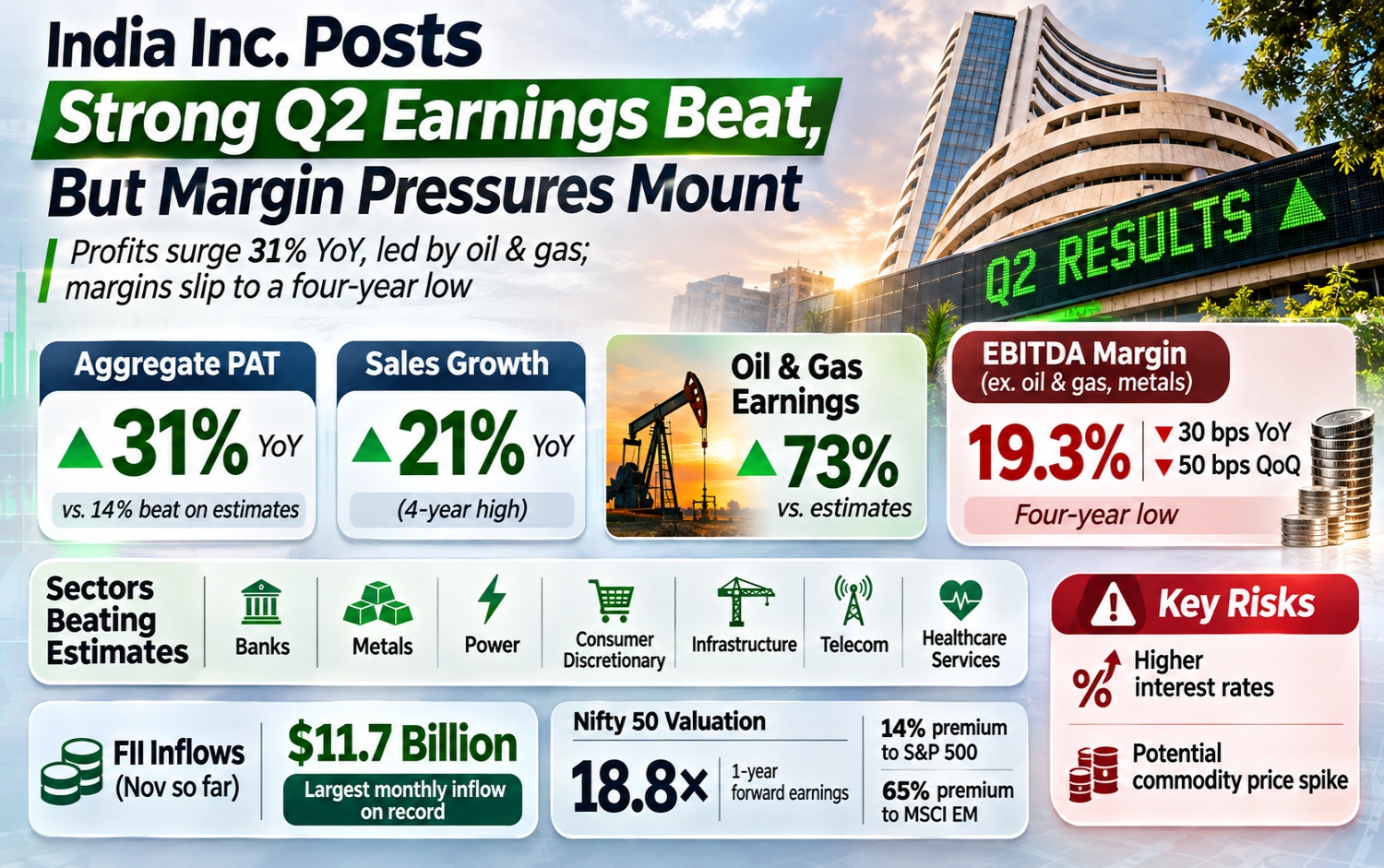
India Inc has delivered a strong earnings surprise in the second quarter of FY27, but beneath the impressive profit growth, a warning signal is emerging for stock market investors.
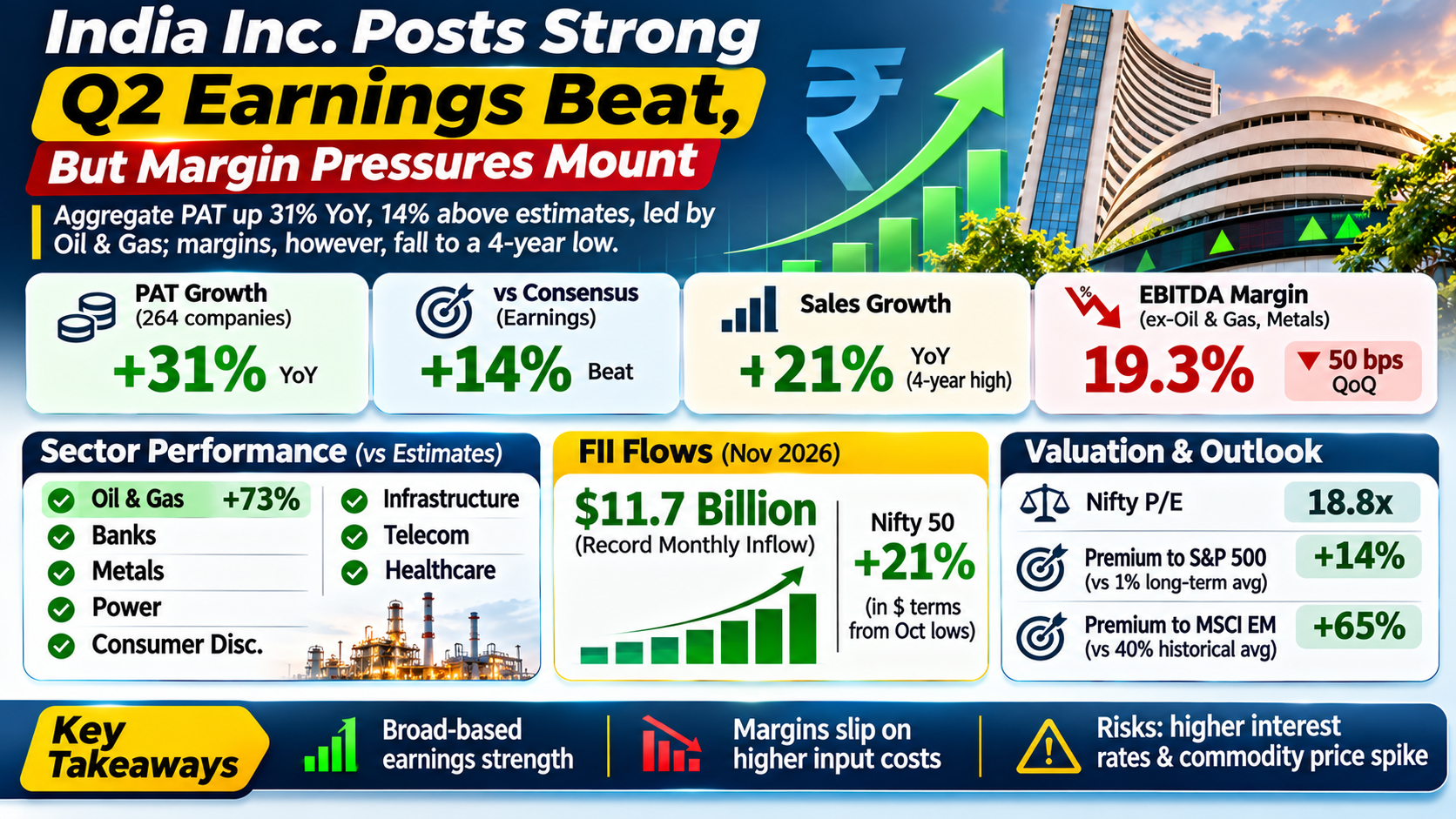
Corporate profit after tax (PAT) surged 31% year-on-year across 264 companies analysed by Nomura, exceeding Bloomberg consensus estimates by 14%.
The performance suggests that Indian businesses are benefiting from stronger demand, improving sales and sector-specific earnings recovery.
However, declining operating margins and increasingly expensive stock market valuations could create challenges for investors in the coming quarters.
Track Live : NSE Option Chain — Live | BSE Option Chain — Live Sensex & Bankex Options Data Today
Indian Stocks Rally: Oil and Gas Companies Lead Q2 FY27 Earnings Growth
The oil and gas sector emerged as the biggest contributor to India’s Q2 FY27 earnings outperformance, beating analysts’ estimates by 73%.
Higher refinery margins, lower marketing losses and inventory gains supported profitability across the sector.
Companies in banking, metals, power, consumer discretionary, infrastructure, telecom and healthcare services also reported earnings above expectations.
Importantly, excluding oil and gas and metals, corporate earnings still increased 23% year-on-year and exceeded consensus estimates by 5%.
This indicates that the earnings recovery extended beyond a few commodity-linked industries.
Track Live : Nifty Levels Today | Sensex Levels Today | Bank Nifty Levels Today
Sales growth reaches a four-year high in Q2 FY27
Revenue growth was another major positive development during the September quarter.
According to the Nomura analysis in your supplied content, aggregate sales increased 21% year-on-year.
Excluding oil and gas and metals, sales growth reached 23.7%.
The report describes this as the strongest sales performance in 16 quarters.
Approximately 75% of the companies covered reportedly recorded double-digit revenue growth.
This is important because higher sales indicate improving demand, business activity and customer spending.
The broader market evidence is also encouraging.
According to Business Standard’s analysis of 2,979 listed companies:
-
Combined net sales increased 22.3% year-on-year.
-
Total sales reached approximately ₹49.42 trillion.
-
This was the strongest revenue growth in 16 quarters.
Jefferies separately reported 21% revenue growth for its coverage universe, excluding oil and gas and metals, marking a 15-quarter high.
Track Live : GIFT Nifty Live – Today Price, Chart, Timings and Nifty Opening Signa
India Inc’s Q2 FY27 earnings beat expectations by 14%
According to the Nomura analysis cited in the report, 264 companies recorded aggregate PAT growth of 31% in Q2 FY27 compared with the corresponding quarter last year.
The performance exceeded Bloomberg consensus estimates by 14%.
This indicates that corporate earnings were stronger than analysts had anticipated before the results season.
The main factors supporting the earnings recovery included:
-
Higher refining margins in the oil and gas sector.
-
Lower marketing losses for oil marketing companies.
-
Inventory gains from commodity-price movements.
-
Stronger sales growth across multiple industries.
-
Improved banking and financial-sector profitability.
-
Higher earnings from metals and power companies.
An important additional comparison comes from Motilal Oswal Financial Services (MOFSL).
Its larger universe of 398 companies reported:
| Financial metric | Actual growth | Earlier estimate |
|---|---|---|
| Sales | 25% | 19% |
| EBITDA | 23% | 17% |
| PAT | 32% | 21% |
Track Live : NSE F&O Lot Size | FII DII Data Today
Corporate Sales Growth Hits Four-Year High as Demand Improves
Revenue growth was another major highlight of the Q2 FY27 earnings season.
Overall sales growth +21% Year-on-year
Excluding oil, gas and metals +23.7% Strongest in 16 quarters
Approximately 75% of companies covered by Nomura reported double-digit revenue growth.
The acceleration, which began in Q3 FY26, coincided with GST rate reductions and monetary easing during 2025.
These developments helped support consumption and business activity, contributing to stronger corporate sales.
Earnings growth remained strong even after excluding oil and gas and metals
One of the strongest arguments supporting the recovery is that earnings growth remained healthy even after removing oil and gas and metals companies.
According to the Nomura figures in your supplied report:
-
Aggregate PAT increased 23% year-on-year.
-
Earnings were 5% above consensus estimates.
This suggests that the earnings recovery was not entirely dependent on commodity producers.
Several sectors reportedly exceeded analyst expectations, including:
| Sector | Q2 FY27 performance |
|---|---|
| Banks | Better-than-expected earnings |
| Metals | Strong profitability |
| Power | Earnings above estimates |
| Consumer discretionary | Positive earnings surprise |
| Infrastructure | Better operating performance |
| Telecom | Earnings above expectations |
| Healthcare services | Better-than-expected results |
Motilal Oswal’s independent review also found that 28 of the 24? No: its report covered 24 sectors, with all 24 reporting positive PAT growth, and 28 of its 398 companies’ tracked sector categories meeting or exceeding estimates.
Which sectors are benefiting most from the earnings recovery?
The Q2 FY27 results show significant differences in performance across industries.
The following additional sector information comes from Motilal Oswal’s broader market analysis.
| Sector | Q2 FY27 PAT growth |
|---|---|
| Metals | 76% |
| Oil and gas | 61% |
| Financials | 20% |
| Automobiles | 34% |
| Utilities | 46% |
| Capital goods | 27% |
| Cement | 43% |
| Healthcare | 13% |
| Technology | 10% |
| Consumer companies | 2% |
Metals, oil and gas and financials were among the largest contributors to corporate earnings growth.
However, consumer companies reported much weaker profitability growth.
Which companies contributed significantly to Q2 FY27 earnings growth?
Business Standard identified several companies that played an important role in the September-quarter earnings recovery.
| Company | Important development |
|---|---|
| Indian Oil Corporation | Adjusted net profit increased 174% |
| Reliance Industries | Adjusted net profit increased 40.6% |
| ONGC | Adjusted net profit increased 56% |
| Adani Power | Adjusted net profit increased 134.3% |
| Tata Motors Passenger Vehicles | Turned profitable from a loss in the year-ago quarter |
These five companies accounted for nearly 31% of the overall increase in corporate earnings in the analysis.
Indian Oil Corporation was the single largest contributor, accounting for approximately 12% of the overall increase.
On the other hand, companies including Ambuja Cements, BPCL, Glenmark Pharmaceuticals, REC, Suzlon Energy, Maruti Suzuki, Cipla and Dr Reddy’s were among the reported earnings laggards.
Foreign investors return to Indian equities with record November inflows
Foreign portfolio investors have made a significant return to Indian equities during November 2026.
According to Reuters’ November 20 report, foreign investors poured approximately $12 billion into Indian shares during November, marking a record monthly inflow.
The Indian Express separately reported inflows of approximately $11.3 billion as of November 19.
The difference reflects different reporting cut-off dates.
The inflows followed a prolonged period of foreign investor selling.
Important developments include:
-
Foreign investors returned after more than two consecutive months of selling.
-
November inflows exceeded previous monthly records.
-
The Nifty 50 and Sensex recovered approximately 11–12% over three weeks, according to the Indian Express.
-
The inflows were supported by improving earnings, stabilising currency conditions and more attractive relative valuations.
The shift is particularly important because foreign investment flows can influence Indian equity market liquidity, currency demand and investor sentiment.
What is Nomura’s outlook for earnings growth in H2 FY27?
One important risk is that the strong Q2 earnings performance may not continue at the same pace during the second half of FY27.
Nomura’s earlier November 2 strategy report highlighted the possibility of a sharp moderation in earnings growth.
Its projections included:
| Sector | H1 FY27 PAT growth | H2 FY27 estimated PAT growth |
|---|---|---|
| Banks | 23% | 11% |
| NBFCs | 43% | 32% |
| IT services | 11% | 12% |
| Oil and gas | -17% | -48% |
These forecasts came from an earlier reporting stage and a different company universe from the later 264-company earnings analysis.
Read More : Oil Falls Toward Its Lowest Since August at $89 as Libya Restarts Supply, but Hormuz Risks Remain
EBITDA Margins Fall to Four-Year Low Despite Strong Earnings
While corporate profits improved, operating margins showed signs of weakness.
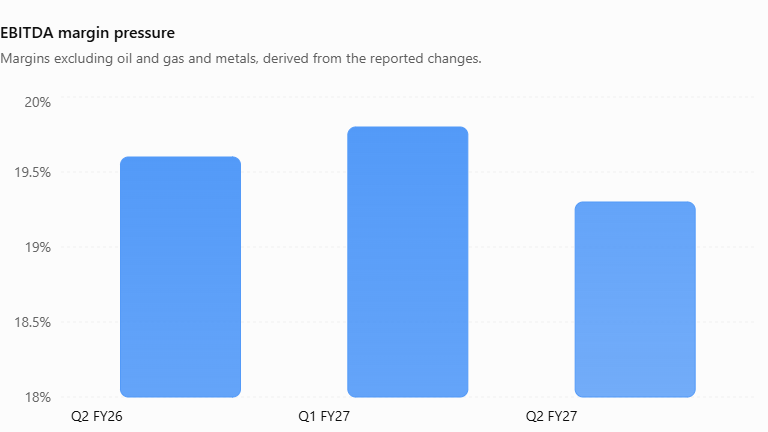
EBITDA margins excluding oil and gas and metals declined to 19.3%, falling 30 basis points year-on-year and 50 basis points sequentially.
Margins excluding oil and gas and metals, derived from the reported changes.
Nomura warned that companies have only partially passed higher input costs to customers, compressing margins across several industries.
The widening gap between wholesale and consumer inflation could create additional profitability challenges.
Nifty 50 Valuations Raise Questions for Investors
The Nifty 50 currently trades at 18.8 times one-year forward earnings, according to Nomura.
Its valuation premium over the S&P 500 stands at 14%, compared with a long-term average of 1%.
Against the MSCI Emerging Markets index, the premium has reached 65%, significantly above its historical average of 40%.
These elevated valuations suggest investors may have already priced in considerable earnings growth.
What Should Investors Watch After Q2 Results?
Investors should closely monitor corporate margins, commodity prices, interest rates and foreign institutional investment flows.
Banking, oil and gas, infrastructure and consumer discretionary stocks could remain in focus following their earnings outperformance.
However, higher borrowing costs and a potential commodity price spike could weaken future earnings growth.