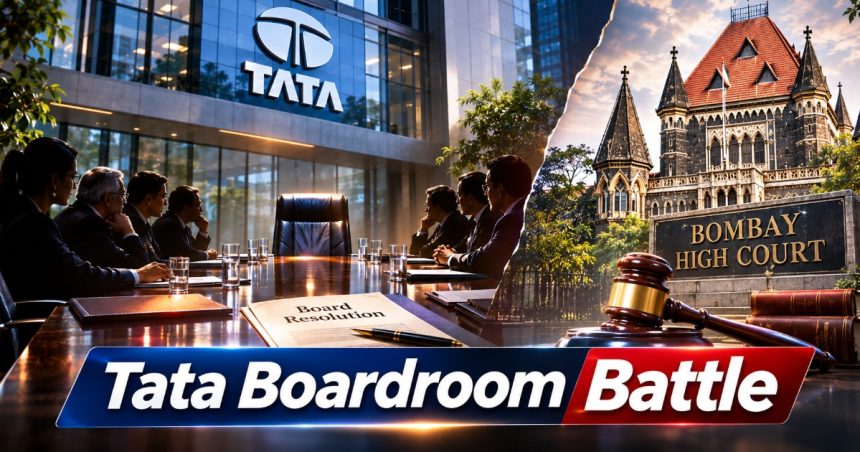
Tata Sons Board Is Set to Meet Nov 30 on a Possible Listing, but a 3 pm Court Hearing on Nov 27 Comes First
A major corporate governance dispute within the Tata Group has reached the Bombay High Court, with Tata Trusts challenging the reappointment of Tata Sons Chairman N Chandrasekaran. The legal move could have wider implications for how important board decisions are approved at one of India’s largest business groups.
Led by Noel Tata, Sir Dorabji Tata Trust and R.D. Tata Trust have approached the court seeking to prevent Tata Sons from using the chairman’s casting vote to approve resolutions when the two Trust-nominated directors disagree.
The timing is significant, as the Tata Sons board is expected to meet on November 30, with discussions likely to include the company’s possible listing and meetings required to ratify Chandrasekaran’s directorship.
Track Live : NSE Option Chain — Live | BSE Option Chain — Live Sensex & Bankex Options Data Today
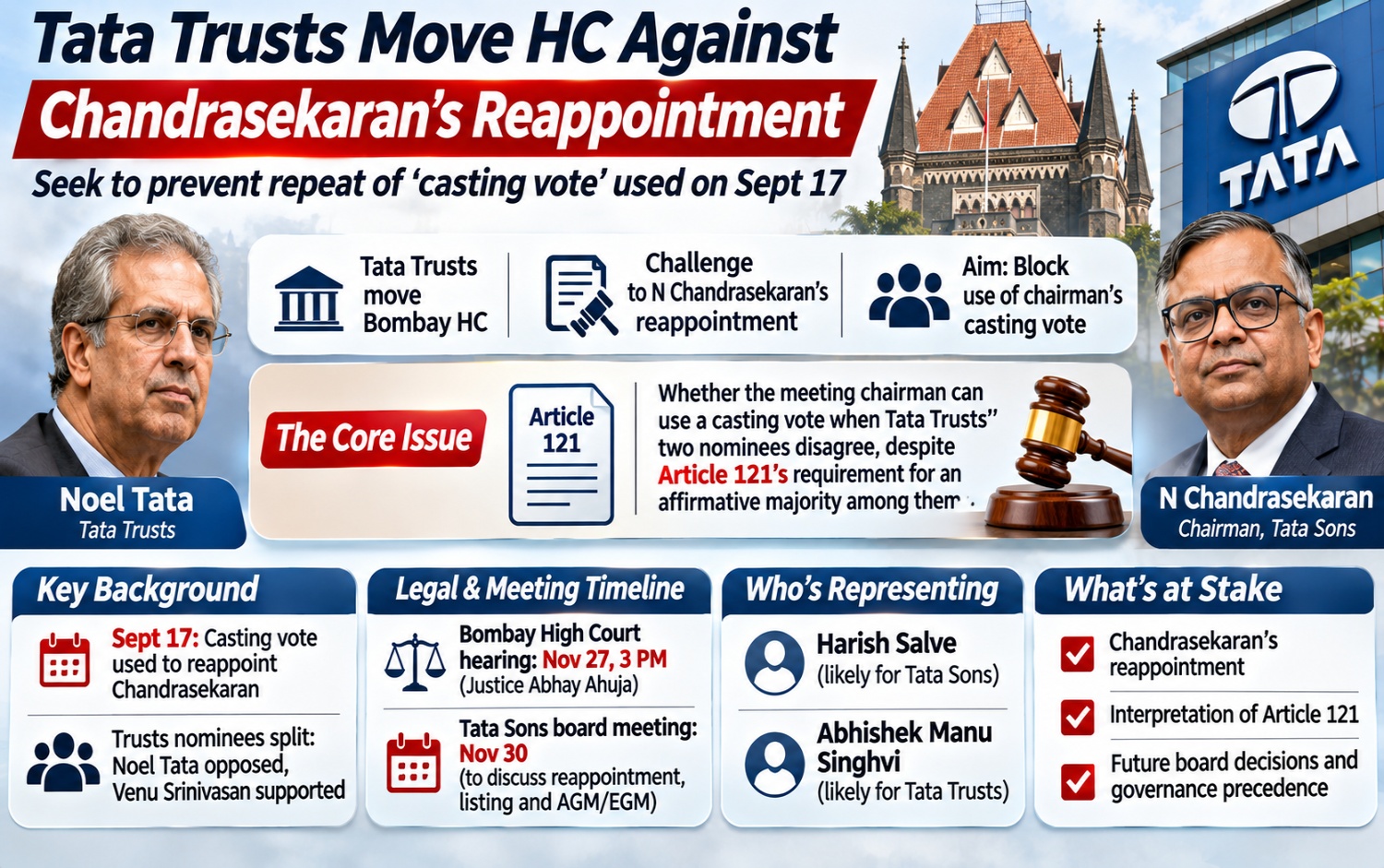
Article 121 becomes the centre of the Tata Sons Board legal dispute
The central legal question concerns Article 121 of Tata Sons’ Articles of Association.
The provision requires an affirmative vote from a majority of directors appointed under Article 104B, which governs the appointment of Tata Trusts’ nominee directors.
Article 121 also provides the chairman with a casting vote in case of an equality of votes.
It states: “In the case of an equality of votes the Chairman shall have a casting vote.”
Tata Trusts’ argument is that when both nominee directors are present, support from only one representative cannot satisfy the requirement for an affirmative majority.
The Trusts contend that the chairman’s casting vote cannot override this specific requirement.
The outcome could establish an important interpretation of Tata Sons’ internal governance rules, particularly when its two Trust-nominated directors disagree on major resolutions.
Understanding the two important parts of Article 121
| Provision | Meaning |
|---|---|
| Affirmative voting requirement | A majority of Tata Trusts-appointed directors present must support the relevant resolution |
| Casting-vote provision | The chairman gets an additional vote when there is an equality of votes |
The dispute arises because these two requirements could potentially operate differently in a situation where Tata Trusts’ two nominated directors disagree.
Tata Trusts’ interpretation: The affirmative-vote requirement is a separate condition. A casting vote cannot replace the required support from the nominated directors.
The opposing interpretation: The casting-vote provision may be available to resolve an equality of votes at the board meeting.
The court will have to examine the relevant Articles and their interaction. The Trusts’ interpretation is an allegation and legal position, not a judicial finding.
Track Live : NSE F&O Lot Size | FII DII Data Today
What exactly are Tata Trusts challenging?
Tata Trusts, chaired by Noel Tata, has challenged the September 17, 2026, Tata Sons board resolution that approved another five-year term for N Chandrasekaran as executive chairman.
The resolution was passed by a reported 4:1 majority, but the two Tata Trusts nominee directors took opposing positions.
-
Noel Tata voted against Chandrasekaran’s reappointment.
-
Venu Srinivasan supported the proposal.
-
Independent director Harish Manwani, who chaired the meeting, exercised the casting vote.
-
Chandrasekaran abstained from voting.
The Trusts argue that the resolution was invalid because it did not receive the affirmative support required from a majority of their nominated directors.
Track Live : NSE Commodity Option Chain — Live MCX Options Data for Crude Oil, Gold, Silver & More
Key details of the legal dispute
| Particulars | Details |
|---|---|
| Company | Tata Sons |
| Chairman whose reappointment is challenged | N Chandrasekaran |
| Trusts initiating legal proceedings | Sir Dorabji Tata Trust and R.D. Tata Trust |
| Tata Trusts chairman | Noel Tata |
| Other Trusts nominee | Venu Srinivasan |
| Board resolution date | September 17, 2026 |
| Voting outcome | 4:1 in favour |
| Main disputed provision | Article 121 |
| Additional relevant provision | Article 104B |
| Court | Bombay High Court |
| Hearing date | November 27, 2026 |
| Judge | Justice Abhay Ahuja |
| Damages sought | ₹65 crore collectively |
| Next Tata Sons board meeting | November 30, 2026 |
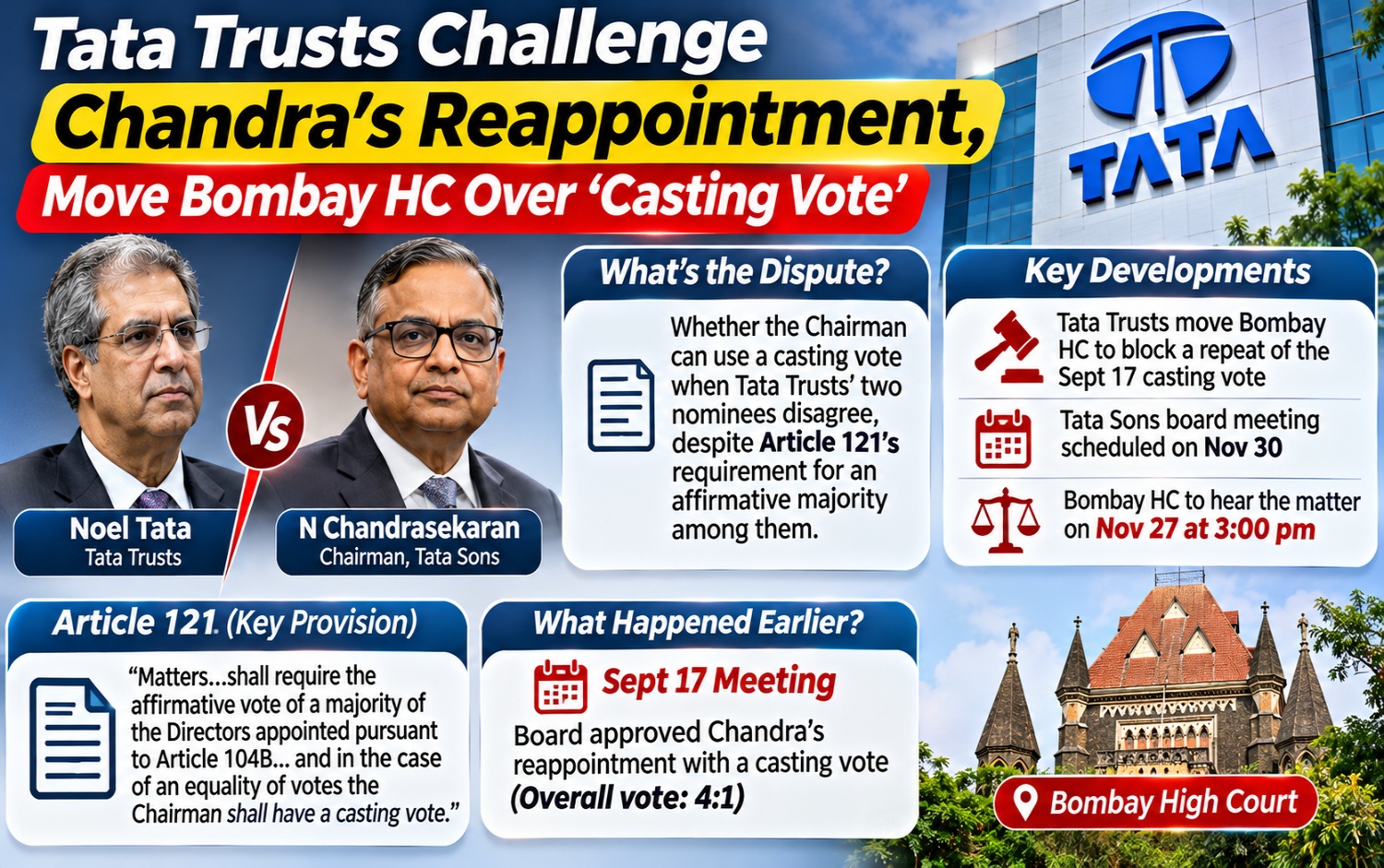
Bombay High Court hearing scheduled for November 27
The legal dispute has now reached the Bombay High Court, with the matter scheduled for an urgent hearing on Friday, November 27.
The petitions were initially mentioned before Justice Arif Doctor. He recused himself without stating a reason.
The matters were subsequently placed before Justice Abhay Ahuja, who agreed to hear them on November 27.
The Trusts sought urgent consideration because Tata Sons’ next board meeting is scheduled for November 30.
Court proceedings
| Particulars | Details |
|---|---|
| Court | Bombay High Court |
| Original bench | Justice Arif Doctor |
| Subsequent bench | Justice Abhay Ahuja |
| Next hearing | November 27, 2026 |
| Main petitioners | Sir Dorabji Tata Trust and R.D. Tata Trust |
| Respondents | Tata Sons and six directors |
| Urgent relief requested | Restriction on casting-vote powers |
| Reason for urgency | November 30 Tata Sons board meeting |
November 30 Tata Sons board meeting adds urgency to the dispute
The legal challenge comes just days before the scheduled November 30 board meeting.
The possible listing of Tata Sons and the convening of annual and extraordinary general meetings to ratify Chandrasekaran’s directorship are among the matters expected to be discussed.
Moneycontrol had earlier reported that Noel Tata wrote to Tata Sons company secretary Suprakash Mukhopadhyay on November 25, reiterating that the issues he had raised should be considered before other agenda items.
The Trusts are seeking restrictions on implementing the reappointment resolution and treating future resolutions as approved without the affirmative votes required under the company’s Articles of Association.
Why did the September 17 board meeting become controversial?
The September 17 meeting became the focal point of the dispute because Chandrasekaran’s reappointment was approved despite opposition from Noel Tata.
The two Tata Trusts nominees were divided, with one supporting the reappointment and the other opposing it.
The meeting chairman, Harish Manwani, then exercised the casting vote in favour of the resolution.
How the voting unfolded
| Board participant | Position |
|---|---|
| Noel Tata | Opposed reappointment |
| Venu Srinivasan | Supported reappointment |
| Harish Manwani | Exercised casting vote in favour |
| Anita M George | Supported reappointment |
| Saurabh Agrawal | Supported reappointment |
| N Chandrasekaran | Abstained |
The reported overall result was 4:1 in favour of the resolution, with Chandrasekaran abstaining.
Tata Trusts seek ₹65 crore in damages from Tata Sons and six directors
One of the most significant details emerging from the latest court proceedings is the monetary compensation sought by the two trusts.
According to the petitions reported on November 26, the Sir Dorabji Tata Trust and R.D. Tata Trust have collectively sought ₹65 crore in damages from Tata Sons and six directors.
The claims are divided between the two trusts.
| Petitioner | Damages sought |
|---|---|
| Sir Dorabji Tata Trust | ₹50 crore |
| R.D. Tata Trust | ₹15 crore |
| Total | ₹65 crore |
Track Live : Nifty Levels Today | Sensex Levels Today | Bank Nifty Levels Today
Why is Article 104B also important in this dispute?
Article 104B is another important provision of Tata Sons’ Articles of Association.
It governs the appointment of Tata Trusts’ nominated directors to the Tata Sons board.
The two nominees at the centre of the current dispute are Noel Tata and Venu Srinivasan.
Article 121 refers specifically to directors appointed under Article 104B. This is why the interpretation of Article 104B and Article 121 together is central to the legal challenge.
| Article | Role in the dispute |
|---|---|
| Article 104B | Provides the basis for Tata Trusts’ nominee director appointments |
| Article 121 | Establishes affirmative voting requirements and the casting-vote provision |
| Article 121A | Contains additional protections relating to Tata Trusts’ rights and shareholding |
| Article 121B | Relevant to the priority given to matters raised by directors |
Read More : HDFC Bank Rebound From Its October Low Has Added Nearly 30%. Can It Reach Rs 1,017 Again?
Noel Tata’s alternative restructuring proposal: Can Tata Sons avoid an IPO?
Another important dimension of the dispute is Noel Tata’s proposal to reorganise the Tata Group’s holding structure.
According to reports, his proposal involves merging two Tata Group companies with Tata Sons as an alternative to a stock-market listing.
The proposal is significant because Tata Sons is facing regulatory pressure to comply with the RBI’s upper-layer NBFC requirements.
Two competing approaches
| Issue | Noel Tata’s reported position | Other board members’ reported position |
|---|---|---|
| Tata Sons listing | Prefers restructuring alternatives | Favours regulatory compliance and listing |
| Chandrasekaran’s reappointment | Opposed the September resolution | Supported continuation |
| Holding-company structure | Proposes a merger-based restructuring | Supports the existing structure with listing |
| Governance | Seeks to preserve the traditional model | Supports proceeding with the proposed regulatory route |
What should investors watch after the Tata Trusts legal challenge?
The Bombay High Court is scheduled to hear the matter before Justice Abhay Ahuja at 3 pm on November 27, according to media reports.
For investors and market participants, the dispute is important because Tata Sons sits at the centre of the wider Tata Group structure.
The immediate developments to watch include the court’s observations, the interpretation of Article 121 and whether the November 30 board meeting proceeds with the proposed agenda.
Although the dispute does not automatically indicate any change in the operating performance of Tata Group companies, prolonged uncertainty around Tata Sons’ governance could influence investor sentiment towards the group’s broader corporate structure.